Enterprise teams deploying AI agents face a fundamental infrastructure decision: which LLM router should power their production workloads? Requesty and OpenRouter represent two distinct approaches to model routing, each with strengths that align with different organizational priorities. OpenRouter remains primarily focused on model access and routing, while Requesty now also offers an MCP Gateway with server management, authentication controls, service accounts, tool-call analytics, and user-attributed audit logs. MintMCP extends this governance model through its MCP Gateway and Agent Gateway. The MCP Gateway provides SCIM-driven Virtual MCP Bundles and governed tool access, while the Agent Gateway adds per-agent identities with M2M authentication, scoped permissions, memory, and monitoring beyond gateway traffic.
This article breaks down the core differences between Requesty and OpenRouter across performance, pricing, security, and enterprise readiness, then explains why the complete AI stack requires a dedicated governance layer regardless of which router you choose.
Key Takeaways
- Published gateway-overhead benchmarks from vendors should be treated as directional and validated through workload-specific testing rather than treated as independent measurements
- Both platforms currently advertise access to 400+ models, with provider catalogs changing frequently based on upstream availability
- LLM routers optimize model selection, failover, and observability; MCP gateways add server management, authentication, and tool-level controls; Agent Gateways extend governance with per-agent identities, scoped permissions, memory, and monitoring
- OpenRouter remains primarily focused on model routing and application-level tool calling, while Requesty provides MCP server management alongside its routing capabilities
- Enterprise teams evaluating agentic AI deployments should assess both model-routing infrastructure and agent-governance architecture, as these operate in parallel rather than as sequential layers
- The choice between routers depends on specific model availability, regional requirements, governance depth, and measured performance for the organization's actual traffic patterns
Understanding LLM Routers: The Gateway to Enterprise AI Efficiency
LLM routers solve a specific infrastructure problem: they provide a unified API layer that abstracts away the complexity of working with multiple model providers. Instead of integrating separately with OpenAI, Anthropic, Google, and others, teams connect to one endpoint and let the router handle model selection, failover, and load balancing.
The Value Proposition
LLM routers deliver several key capabilities:
- Reduced integration complexity: One API endpoint regardless of which models you use
- Cost optimization: Route requests to cheaper models when appropriate
- Reliability: Automatic failover when providers experience outages
- Observability: Centralized logging and analytics across all model calls
Both Requesty and OpenRouter deliver these capabilities, but they differ significantly in how aggressively they optimize for production use versus developer flexibility.
The Governance Layer
What LLM routers focus on is the model layer. When AI agents start accessing enterprise systems, additional governance architecture becomes necessary. An LLM router can tell you which model processed a request, but agent-level governance requires tracking which agent made the request, what tools that agent accessed, and whether it had permission to access sensitive data. This governance layer requires infrastructure built around agent identities and tool-level access control.
Requesty vs OpenRouter: Core Features and Architectural Paradigms
The two platforms take fundamentally different approaches to the routing problem.
Requesty's Production-First Architecture
Requesty positions itself as a production-grade router with optimization built in. Its prompt-aware smart routing analyzes request content to determine whether a task requires expensive reasoning models or can be handled by faster, cheaper alternatives.
Key capabilities include:
- Weighted load-balancing policies and latency-based routing using current performance data
- Configurable fallback policies that can immediately move to another model for some non-retryable errors and use exponential backoff for retryable provider failures
- Automatic provider-level prompt caching that inserts cache breakpoints into repeated prompt prefixes on supported Anthropic and Gemini models
- RBAC, enterprise SSO, groups, access lists, approved-model policies, and audit logging
- MCP server management, authentication configuration, per-user MCP credentials, service accounts, and tool-call analytics
OpenRouter's Marketplace Approach
OpenRouter takes a different philosophy, emphasizing breadth and developer control. The platform includes community features like app leaderboards and a credit-based system that appeals to individual developers and small teams.
Key capabilities include:
- Provider-preference routing that respects explicit model selections
- Configurable provider selection with price-, latency-, or throughput-based routing
- BYOK fee waiver for first 1 million requests monthly
- Community rankings and marketplace visibility
- Generous free tier with 25+ models available
- Response caching and automatic fallbacks
API Compatibility
Both platforms support OpenAI-compatible APIs, so the base URL and API key are the primary changes. Teams must also review model identifiers, routing parameters, provider preferences, caching configuration, headers, guardrails, and observability integrations.
Evaluating LLM API Pricing: Cost-Effectiveness for Enterprise Deployments
Pricing structures differ in ways that significantly impact total cost of ownership at scale.
Platform Fees
- Requesty charges a 5% markup on pay-as-you-go model costs and separately supports BYOK. Teams should confirm the current fee treatment for their specific BYOK configuration before comparing total costs.
- OpenRouter waives its BYOK fee for the first 1 million BYOK requests each month, then charges 5% of what the same model and provider would normally cost through OpenRouter.
Cost Optimization Features
Requesty's prompt caching and smart routing create potential savings for workloads with repetitive patterns. Requesty's prompt caching can reduce input-token costs when supported models repeatedly receive the same prompt prefixes, but actual savings depend on model pricing, prefix size, and cache-hit rate.
OpenRouter supports provider prompt caching and model-agnostic response caching for identical requests. Its routing and caching approach differs from Requesty's, so savings should be compared using measured cache-hit rates and model-selection behavior.
Enterprise Pricing Comparison
For $10,000 in underlying model usage, Requesty's published 5% pay-as-you-go markup would add approximately $500. Purchasing $10,000 in OpenRouter credits would add approximately $550 under its published 5.5% credit-purchase fee.
Routing and caching may reduce underlying model usage on either platform, but the result depends on model mix, prompt repetition, cache-hit rate, routing policy, response quality requirements, and BYOK usage. A defensible comparison requires replaying representative production traffic through both platforms rather than applying fixed savings percentages.
Security and Compliance: A Critical Lens for Enterprise AI Platforms
Enterprise deployments require security capabilities beyond basic API access and should align governance controls with a recognized framework such as the NIST AI RMF.
Compliance Certifications
The SOC reporting framework distinguishes between reports that evaluate control design at a point in time and reports that evaluate the operating effectiveness of controls over a review period.
- Requesty publishes GDPR and EU data-residency controls, but its public security page currently contains conflicting statements about whether its SOC 2 Type II audit is complete or still in progress. Verify the current report in Requesty's Trust Center before making procurement decisions.
- OpenRouter's Trust Center lists SOC 2 Type II. Its EU in-region routing and Zero Data Retention controls should be described with the applicable plan and routing configuration.
Data Protection Features
Both platforms now document PII controls and prompt-injection guardrails. Requesty includes configurable PII scrubbing and security policies, while OpenRouter supports sensitive-information guardrails, regex-based prompt-injection detection, model and provider restrictions, and assignments to members or API keys.
Both platforms offer:
- Zero data retention options
- EU data residency
- Encrypted data in transit and at rest
The Governance Gap
LLM routers operate at the model layer. They see tokens in and tokens out. OpenRouter remains primarily focused on model routing and application-level tool calling. Requesty now provides MCP server management, service accounts, per-user MCP credentials, tool-call analytics, and audit attribution, while MintMCP adds more specialized Agent Gateway controls such as SCIM-driven Virtual MCP Bundles, independently managed agent identities, scoped tools, M2M authentication, and off-gateway Agent Monitor coverage.
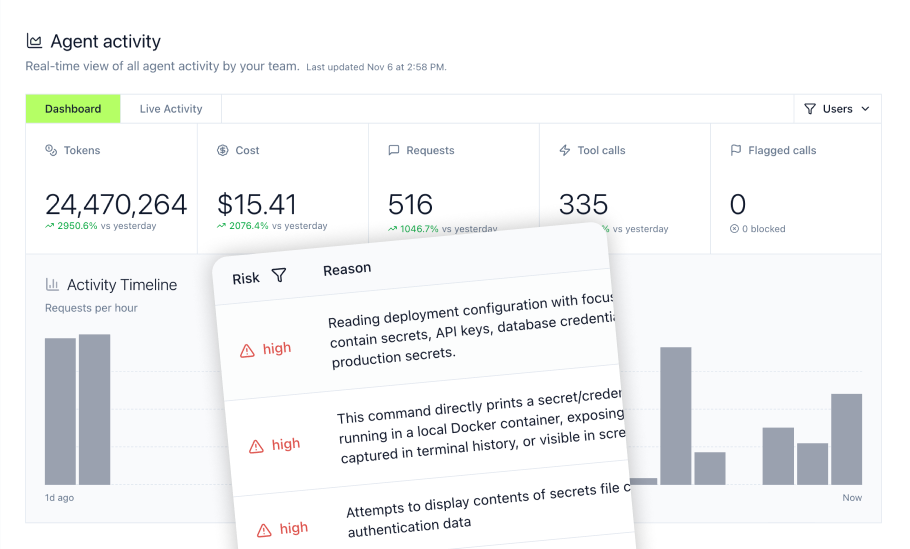
This is where MintMCP's Agent Monitor provides broader visibility. Agent Monitor tracks agent activity in real-time, including MCP calls made outside the gateway through hooks in tools like Claude Code and Cursor. It detects PII exposure, credential leakage, risky commands, and prompt injection attempts using configurable guardrail policies.
Governance and Observability: Centralizing Control for AI Agents
The difference between AI gateways becomes critical when agents start interacting with internal systems.
What LLM Routers Provide
- Token-level logging of model requests and responses
- Per-key spend tracking and rate limiting
- Basic to advanced RBAC depending on platform tier
- Aggregate usage analytics
What MCP and Agent Gateways Add
MintMCP's Bundle architecture addresses gaps in agent-level governance. Virtual MCP Bundles package tool access, policy enforcement, and audit logging into single governance units tied to SCIM group membership. Each team or role gets a curated set of MCP servers with explicit permissions, and every tool call is logged with full attribution.
Agent Bundles extend this model to non-human principals. Each deployed agent receives its own credentials that can be rotated independently, with scoped permissions that do not depend on the creator's access level. This separation is essential for audit attribution and credential hygiene at scale.
Integration Ecosystem: Connecting LLMs to Internal Systems and Data
LLM routers excel at connecting to model providers. Connecting to enterprise data sources requires different infrastructure.
LLM Router Integrations
Both Requesty and OpenRouter currently advertise access to 400+ models. Provider and model catalogs change frequently, so teams should compare the specific models, regions, and providers required by their workloads rather than relying on a fixed provider count.
Enterprise System Integrations
OpenRouter standardizes model tool-calling interfaces but generally leaves tool execution and enterprise integrations to the application. Requesty now provides MCP server management, authentication configuration, per-user credentials, and MCP analytics. MintMCP differentiates through 50+ managed connectors, hosted custom MCP servers, SCIM-driven Virtual MCP Bundles, tool-level policies, per-agent identities, and Agent Monitor coverage.
This architecture means agents can access internal systems through governed channels rather than through ad-hoc API keys scattered across developer machines.
Strategic Enterprise Adoption: Selecting the Right LLM Router for Scale
The choice between Requesty and OpenRouter depends on organizational priorities.
Choose Requesty When
- Production reliability with published SLA backing is required
- Workloads have repetitive patterns that benefit from prompt caching
- Enterprise governance including RBAC, groups, and approved-model policies is required
- Requesty publishes an 8ms P50 gateway-overhead figure and a 40-55ms P50 estimate for OpenRouter in its own comparison, which may matter for latency-sensitive workloads
- MCP server management, authentication controls, and tool-call analytics are valuable alongside model routing
Choose OpenRouter When
- The availability of particular models, providers, regions, and routing options is the priority
- BYOK structure with fee waiver for first 1 million monthly requests is valuable
- Teams want configurable provider selection, price-, latency-, or throughput-based routing, model fallbacks, and optional automatic model routing
- Rapid prototyping requires generous free tier access
- Community marketplace features add value
The Complete Enterprise Stack
Regardless of which router you choose, enterprise-grade AI deployment requires thinking about model routing and agent governance as parallel rather than sequential concerns. The architecture looks like this:
AI Client or Agent
│
├── Model requests
│ ↓
│ LLM Router
│ (Requesty or OpenRouter)
│ ↓
│ Model Providers
│
└── Tool and data requests
↓
MCP Gateway
↓
Agent Gateway
(identity, permissions,
memory, and monitoring)
↓
Enterprise Systems
Why MintMCP Completes Your AI Infrastructure
While LLM routers optimize how your applications talk to models, and MCP capabilities govern how tools connect to systems, production agentic AI requires a third layer: comprehensive agent governance that works whether your agents route through a gateway or call tools directly from their environment.
MintMCP provides this missing layer through an integrated governance platform purpose-built for agentic AI:
Virtual MCP Bundles tie tool access directly to your identity provider through SCIM integration. When an employee joins the sales team, they inherit access to the Salesforce, HubSpot, and analytics MCP servers assigned to that group after the relevant SCIM sync. When they leave or are deactivated in the identity provider, MintMCP updates their access automatically at the next SCIM sync. This eliminates the credential sprawl that emerges when each developer provisions their own API keys.
Agent Bundles extend the same governance model to non-human principals. Each deployed agent receives its own M2M credentials with independently scoped permissions. An agent built for customer support cannot accidentally access financial systems, even if its creator has that access. M2M access tokens are short-lived, while agent credentials can be rotated or revoked independently. Every tool call is attributed to the specific agent identity in the audit trail.
Agent Monitor closes the visibility gap that all gateway-only solutions leave open. It tracks supported prompts, shell commands, file operations, and MCP tool calls through hooks in Claude Code, Cursor, and Codex, including activity outside the MCP Gateway path. Configurable guardrails detect PII exposure, credential leakage, risky commands, and prompt injection attempts before they reach production systems.
50+ managed connectors eliminate the operational burden of hosting and maintaining MCP servers for common enterprise systems. MintMCP handles OAuth flows, credential refresh, error handling, and version updates for Salesforce, GitHub, Slack, Notion, Linear, Gmail, Stripe, Snowflake, Elasticsearch, and dozens of other platforms your agents need to access.
This architecture works alongside either Requesty or OpenRouter. Your LLM router handles model selection, cost optimization, and failover. MintMCP handles agent identity, tool permissions, policy enforcement, and audit attribution. Together, they provide the complete governance stack that production agentic AI requires.
Frequently Asked Questions
Can I use both Requesty and OpenRouter simultaneously?
Yes. Some teams route different workload types through different routers. Since both support OpenAI-compatible APIs, you can configure routing at the application level. However, this adds operational complexity and splits your usage analytics. Most organizations standardize on one router and add a governance layer for tool and data access control.
How do LLM routers handle provider outages?
Both platforms include automatic failover capabilities. Requesty specifies configurable fallback policies that can immediately move to another model for some non-retryable errors and use exponential backoff for retryable provider failures. OpenRouter handles failover automatically through its provider routing and fallback mechanisms. Teams should test failover behavior with their specific model and provider configurations.
What happens to my data when using an LLM router?
Requesty does not retain prompt and response bodies by default unless content logging is enabled. OpenRouter keeps input/output logging off by default but retains operational metadata, while its Zero Data Retention setting restricts routing to upstream endpoints that do not retain request content. Data flows through the router to the model provider, so you also inherit the data handling policies of whichever models you use. Requesty states that it does not train on customer prompts. OpenRouter's use of prompt and completion content is off by default and requires an explicit opt-in; upstream provider training and retention policies must still be evaluated separately.
Do LLM routers support streaming responses?
Yes. Both Requesty and OpenRouter support streaming through their OpenAI-compatible APIs. Streaming works the same way it would with direct provider connections.
How do I migrate from one router to another?
Both platforms support OpenAI-compatible APIs, so the base URL and API key are the primary changes. Teams must also review model identifiers, routing parameters, provider preferences, caching configuration, headers, guardrails, and observability integrations. Historical data and analytics do not transfer, so plan for a transition period if you need continuous metrics.
What compliance certifications should I look for in an LLM router?
The SOC reporting framework distinguishes between reports that evaluate control design at a point in time and reports that evaluate the operating effectiveness of controls over a review period. OpenRouter's Trust Center lists SOC 2 Type II. Requesty's public materials currently conflict on whether its Type II audit is complete, so its current status should be verified directly through its Trust Center before making procurement decisions. For regulated industries, also verify data residency options, encryption standards, and whether the platform signs BAAs for workloads subject to HIPAA standards.