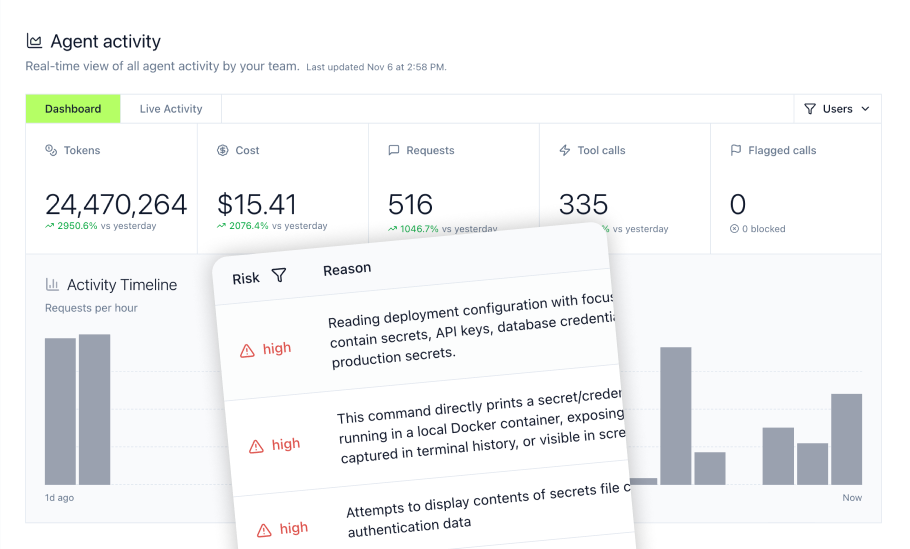
Enterprise data revealing how OAuth and SSO implementations reduce security incidents, cut operational costs, and enable secure AI tool access at scale
OAuth and SSO authentication have become non-negotiable for enterprises deploying AI tools across distributed teams. Without centralized authentication, organizations face scattered credentials, audit blind spots, and compliance gaps that compound as AI adoption accelerates. MintMCP's MCP Gateway provides OAuth 2.0 and SSO enforcement for all MCP servers—transforming local AI tools into production-grade infrastructure with complete audit trails. The statistics below quantify the security risks of fragmented authentication, the measurable benefits of SSO implementation, and the market forces driving enterprise adoption of centralized identity management for AI workflows.
Key takeaways
- SSO market growth validates enterprise priority – The global SSO market is estimated at $3.34 billion in 2025 and is projected to reach $6.29 billion by 2030, growing at 18.39% CAGR
- Identity vulnerabilities drive breaches – 87% of breaches are attributed to identity vulnerabilities, making authentication the critical control point
- Implementation gaps create risk – Only 35% of corporate apps are fully onboarded to SSO, leaving substantial attack surface
- Password costs add up – Each password reset is estimated at around $70, with 40% of help desk calls related to password issues
- Passwordless momentum accelerates – Passkey adoption surged 550% in 2024, signaling the future of enterprise authentication
- Zero Trust delivers results – Organizations implementing Zero Trust with SSO report significant decreases in security incidents
SSO market growth statistics
1. The global SSO market is estimated at $3.34 billion in 2025 and is projected to reach $6.29 billion by 2030
Market research confirms SSO has moved from departmental tool to enterprise infrastructure priority. This more than doubling reflects mainstream adoption as organizations recognize the operational and security benefits of centralized authentication. The growth encompasses software platforms, implementation services, and ongoing optimization across industries—driven by AI tool proliferation and the need for governed access to sensitive data systems.
2. The SSO market is projected to grow at about a 13.5% CAGR through 2030
Industry analysts project sustained growth that substantially exceeds most enterprise software categories. This acceleration stems from proven ROI case studies, executive-level buy-in for authentication initiatives, and competitive pressure as early adopters gain advantages in security posture and operational efficiency. Organizations delaying SSO implementation risk falling behind competitors who deliver faster, more consistent access experiences at lower costs.
3. Cloud deployments account for 67.7% of SSO market share, expanding at 14.7% CAGR
Cloud-based SSO solutions dominate enterprise adoption, reflecting the shift toward SaaS applications and distributed workforces. Cloud deployment enables rapid implementation without infrastructure overhead—a critical factor for organizations deploying AI tools at scale. The accelerated growth rate indicates cloud SSO will capture even larger market share as legacy on-premises deployments modernize.
4. Large enterprises account for 71.1% of 2024 SSO revenues
Revenue distribution data confirms enterprise organizations drive SSO market growth. Large enterprises face the most complex authentication challenges: hundreds of applications, thousands of users, and strict compliance requirements. This concentration validates enterprise-grade platforms that provide comprehensive governance, audit capabilities, and integration depth rather than basic SSO functionality.
Security impact statistics
5. Organizations implementing zero trust with SSO report significantly reduced security incidents
Cybersecurity trend research shows the compounding effect of combining SSO with Zero Trust architecture. The dramatic reduction validates layered security approaches where authentication serves as the foundation. AI tool deployments benefit particularly from this combination—continuous verification ensures every tool call originates from authorized users with appropriate permissions.
6. 87% of breaches are attributed to identity vulnerabilities
Expert analysis identifies identity as the primary attack vector for enterprise breaches. This statistic underscores why authentication infrastructure deserves strategic investment priority. Organizations deploying AI tools without centralized authentication create new identity attack surfaces—each MCP server with scattered credentials represents potential breach exposure.
7. 22% of security incidents had credential abuse as the initial attack vector
Verizon's Data Breach Investigations Report confirms credentials remain a primary entry point for attackers. Stolen or compromised credentials enable lateral movement through connected systems. SSO with OAuth enforcement reduces credential exposure by centralizing authentication rather than distributing passwords across applications and AI tools.
8. 80% of web application attacks involve stolen credentials
API security research reveals credential theft's role in application-layer attacks. As AI tools increasingly access web APIs and enterprise data, securing the authentication layer becomes critical. OAuth-based access control limits credential exposure by using tokens rather than passwords, with automatic expiration and revocation capabilities.
9. Breaches from stolen credentials take an average of 328 days to identify and contain
IBM's Cost of a Data Breach Report quantifies the extended timeline for credential-based breaches. The lengthy detection period reflects attackers' ability to blend with legitimate users when using valid credentials. Centralized SSO with real-time monitoring enables anomaly detection that shortens this timeline through behavioral analysis and audit trail correlation.
10. Global average cost of a data breach reached $4.88 million
Breach cost analysis establishes the financial stakes for authentication failures. This average encompasses direct costs like investigation and remediation plus indirect impacts including customer churn and regulatory penalties. For enterprises deploying AI tools with data access, breach exposure multiplies—making OAuth/SSO enforcement a cost-avoidance investment rather than discretionary security spending.
11. Breaches affecting 50M–60M records averaged roughly $387 million in total cost
Large-scale breach data demonstrates the catastrophic financial impact of major credential compromises. AI tools with broad data access create potential for exactly these large-scale incidents. Proper authentication governance limits the blast radius by enforcing least-privilege access and enabling rapid revocation when credentials are compromised.
12. Third-party involvement in breaches doubled from 15% to 30%
Verizon's DBIR highlights growing supply chain and integration risks. AI tools often require third-party connections to function—OAuth provides standardized authorization that limits third-party credential exposure. MintMCP's authentication models support both shared service accounts and per-user OAuth flows to match third-party integration requirements.
User behavior and password statistics
13. 68% of employees switch between ten apps every hour
Productivity research quantifies the authentication burden facing modern workers. Without SSO, each application switch potentially requires separate login, creating friction that degrades productivity and encourages password reuse. AI tools add to this application sprawl—centralized authentication through MCP gateways eliminates this friction while maintaining security.
14. 59% of employees use the same or similar passwords across multiple accounts
Password behavior data confirms the security risk created by authentication friction. Password reuse means a single credential compromise can cascade across systems. SSO eliminates the need for multiple passwords, removing the reuse incentive while improving both security and user experience.
15. 89% of consumers have complaints about keeping track of their passwords
Consumer survey data from Ping Identity reveals widespread password fatigue. This frustration extends to enterprise users accessing internal AI tools. SSO addresses the root cause by reducing credential count while maintaining—or improving—security posture through centralized policy enforcement.
16. 54% of consumers have stopped using an account or service because login was too frustrating
User abandonment research demonstrates the productivity cost of poor authentication experiences. In enterprise contexts, frustrating AI tool access leads to workarounds and shadow IT. SSO removes friction while maintaining governance—employees adopt sanctioned tools when access is seamless.
17. 62% of americans reuse passwords across accounts
Password reuse research confirms this behavior remains endemic despite security awareness efforts. This behavior pattern makes SSO implementation a security necessity rather than convenience enhancement. OAuth-based authentication eliminates passwords from the equation entirely for connected applications and AI tools.
18. A significant portion of consumers have had accounts compromised due to weak or stolen passwords
Survey data quantifies the real-world impact of password-based authentication failures. This compromise rate underscores why enterprises are moving toward passwordless approaches. OAuth/SSO provides the foundation for passwordless migration while delivering immediate security improvements.
Adoption driver statistics
19. 66% of organizations adopt SSO to improve access management
Gartner Peer Community data identifies access management as the top driver for SSO adoption. Centralized access control enables consistent policy enforcement across applications—including AI tools. MintMCP's role-based access control extends this governance to MCP servers with granular tool-level permissions.
20. 56% adopt SSO to solve poor end-user password practices
Enterprise adoption research shows password hygiene concerns drive over half of SSO implementations. Rather than relying on training and policy to improve password behavior, SSO removes the problem by eliminating distributed passwords. This approach proves more effective than attempting to modify entrenched user habits.
21. 55% adopt SSO to reduce IT support ticket requests
Support cost data reveals operational efficiency drives SSO adoption alongside security concerns. Password resets consume significant IT resources—SSO reduces this burden while improving user productivity. For organizations deploying AI tools, reduced support overhead enables IT teams to focus on strategic initiatives.
22. 40% of all help desk calls are due to password issues
Industry research quantifies the operational burden of password-based authentication. This volume represents both direct support costs and productivity loss for waiting users. SSO implementation directly addresses this cost center while improving security posture—a rare combination of operational and security benefits.
23. Each password reset is estimated at around $70
Analysis establishes the per-incident cost of password support. At enterprise scale with thousands of users, these costs compound significantly. SSO delivers measurable ROI through support cost reduction alone, before accounting for security and productivity benefits.
Implementation gap statistics
24. Only 35% of corporate apps are fully onboarded to SSO
Gartner 2024 data reveals substantial gaps in SSO implementation despite widespread adoption. The two-thirds of applications outside SSO governance represent uncontrolled attack surface. As organizations deploy AI tools, ensuring these new applications connect through SSO from day one prevents expanding these gaps.
25. 15-20% of SaaS apps allow local accounts to remain active, involved in 40% of identity breaches
Security configuration research highlights the risk of incomplete SSO enforcement. Local accounts bypass centralized controls—enabling both unauthorized access and audit gaps. MintMCP's OAuth enforcement eliminates local account risks by wrapping authentication automatically.
26. 30-40% of SaaS apps operate outside security oversight as shadow IT bypassing SSO
Shadow IT prevalence data quantifies the governance gap created by unmanaged application adoption. AI tools represent the newest shadow IT category—employees adopt tools that bypass security controls. MintMCP enables organizations to transform shadow AI into sanctioned AI with proper authentication governance.
27. 90% of security incidents involving SaaS apps are due to misconfigurations including SSO/MFA not enforced
CSA SaaS Security Survey identifies configuration errors as the dominant SaaS security issue. Enforcement gaps—rather than fundamental technology failures—cause most incidents. This finding validates platforms that enforce SSO/MFA by default rather than relying on manual configuration for each deployment.
28. 99% of companies wish to redesign their access approach; only 1% fully satisfied with current SSO setup
Enterprise satisfaction research reveals near-universal dissatisfaction with authentication status quo. This gap between current state and desired state creates opportunity for platforms that simplify SSO implementation. MintMCP's one-click deployment addresses this need specifically for AI tool authentication.
29. 63% of IT leaders cite lack of visibility into app configurations as top barrier to fully enforcing SSO
Okta State of IAM Report identifies visibility as the primary implementation barrier. Organizations cannot enforce SSO on applications they cannot see. Centralized MCP gateways solve this visibility problem by routing all AI tool access through a governed control point with complete audit logging.
Future trend statistics
30. Passkey adoption surged 550% in 2024 with over 15 billion online accounts now supporting passkeys
Passwordless adoption data signals the future direction of enterprise authentication. Passkeys eliminate passwords entirely while maintaining strong security. Organizations building SSO infrastructure today should ensure OAuth 2.0 compatibility that enables passwordless migration as passkey support expands across enterprise applications and AI tools.
Strategic implementation insights
OAuth and SSO deliver maximum value when implemented as foundational infrastructure rather than application-by-application additions. The data reveals critical success factors:
- Start with centralized enforcement – Deploy SSO through a gateway architecture that automatically wraps authentication for all connected applications and AI tools
- Eliminate local accounts – Research shows local accounts are involved in a significant portion of identity breaches, demonstrating the risk of partial implementation
- Enable visibility first – Address the 63% of IT leaders who cite visibility gaps by implementing comprehensive audit logging
- Plan for passwordless – The 550% passkey growth rate indicates passwordless will become standard; build OAuth infrastructure that supports this evolution
MintMCP's architecture addresses these requirements by providing OAuth + SSO enforcement at the gateway level. Rather than configuring authentication for each MCP server individually, organizations deploy centralized governance that applies consistently across all AI tools. This approach eliminates the configuration errors responsible for 90% of SaaS security incidents while enabling the visibility that 63% of IT leaders identify as their primary barrier.
For enterprises deploying AI tools at scale, authentication infrastructure determines both security posture and user adoption. The statistics demonstrate clear ROI: significant security incident reduction, 55% support ticket reduction through streamlined access, and elimination of password reset burdens. Combined with compliance audit trails for SOC2, HIPAA, and GDPR requirements, OAuth/SSO enforcement transforms AI tool access from security liability to governed capability.
Frequently asked questions
What is the difference between OAuth and SSO in enterprise AI deployments?
OAuth is an authorization protocol that enables applications to access resources without sharing passwords, using tokens instead of credentials. SSO is an authentication approach that allows users to access multiple applications with a single login. In enterprise AI deployments, OAuth provides the authorization framework while SSO delivers the user experience—MintMCP combines both through its MCP Gateway, enabling single sign-on access to AI tools with OAuth-based authorization for data access.
How does MintMCP ensure compliance with SOC2 HIPAA and GDPR requirements?
MintMCP is SOC 2 Type II compliant and provides HIPAA compliance options with complete audit trails. The platform logs every MCP interaction, access request, and configuration change—creating the documentation required for compliance audits. Data residency controls enable organizations to meet GDPR requirements by controlling where AI tool data is processed and stored.
Can OAuth and SSO be applied to existing locally hosted MCP servers?
Yes. MintMCP's hosted connectors transform STDIO-based MCP servers into OAuth-protected services without code changes. The gateway wraps existing servers with enterprise authentication automatically, enabling organizations to convert local AI tools into production-grade infrastructure with one-click deployment rather than manual configuration.
What are the main security benefits of implementing SSO for AI clients like ChatGPT or Claude?
SSO implementation for AI clients delivers centralized access control, complete audit logging, and rapid access revocation. With 87% of breaches attributed to identity vulnerabilities, centralized authentication closes the primary attack vector. MintMCP supports Claude, ChatGPT, Microsoft Copilot, Cursor, and other AI clients with consistent SSO enforcement across all connected tools.
How does MintMCP provide centralized visibility and control over AI tool authentication?
MintMCP's gateway architecture routes all AI tool access through a central control point with real-time dashboards for server health, usage patterns, and security alerts. This addresses the 63% of IT leaders who cite lack of visibility as their top barrier to SSO enforcement. Complete audit trails track every tool call, enabling security teams to monitor AI tool usage across the organization.