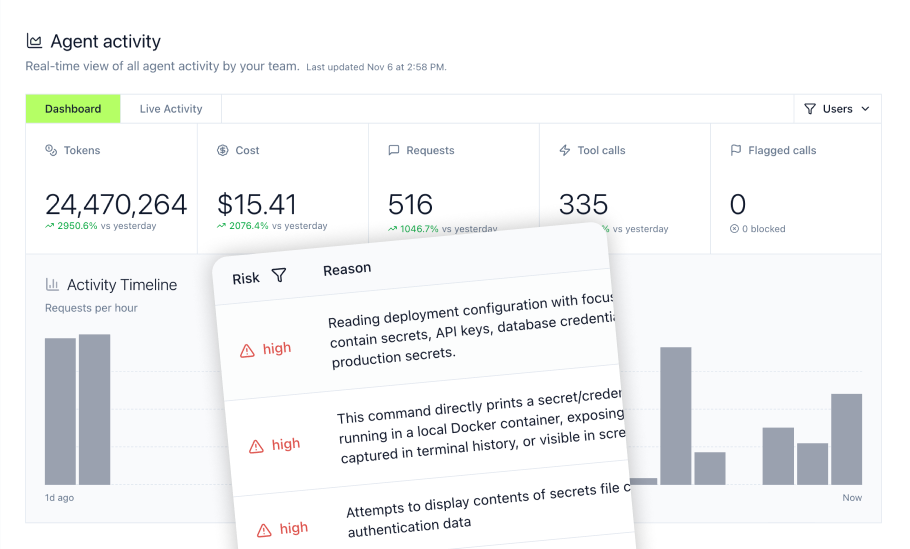
Data-driven insights revealing how enterprises deploy AI safety controls, governance frameworks, and real-time monitoring to transform shadow AI into production-ready infrastructure
The AI Guardrails market is projected to grow from $0.7 billion in 2024 to $109.9 billion by 2034—yet 87% of enterprises still lack comprehensive security frameworks. This gap between AI adoption and safe deployment creates significant risk. MintMCP's MCP Gateway addresses this challenge with centralized governance, real-time monitoring, and complete audit trails that transform local MCP servers into production-grade infrastructure. Some reports and case examples suggest guardrails can reduce incidents and lower breach costs, but results vary by environment and maturity.
Key takeaways
- Market explosion validates urgency – The AI Guardrails market is growing at 65.8% CAGR through 2034, one of the fastest-growing governance/security subcategories
- Security gaps persist – 87% of enterprises lack comprehensive AI security frameworks despite widespread adoption
- ROI is proven – Organizations with mature guardrails achieve $2.1 million savings per prevented data breach
- Compliance efficiency compounds – AI-powered governance platforms reduce manual review workload by 94%
- Implementation timelines accelerate – Modern platforms deploy in 4-8 weeks, not months
The proliferation of AI: Why Real-Time guardrails are Non-Negotiable
1. 88% of organizations use AI in at least one business function
McKinsey Global AI Survey data confirms AI has moved from experimental technology to mainstream business infrastructure. Customer support, development workflows, and data analysis represent the highest-adoption functions due to clear ROI metrics. This widespread deployment increases the attack surface and governance complexity that guardrails must address.
2. 88% of organizations struggle to scale AI responsibly
Research on scaling suggests many AI pilots struggle to reach production—highlighting the need for production-grade monitoring and controls. The struggle stems from inadequate monitoring, fragmented access controls, and missing audit capabilities. MintMCP's LLM Proxy solves this by providing complete visibility into coding agent operations without disrupting developer workflows.
3. 92% of generative AI users have leaked company data despite having AI guidelines
World Economic Forum research exposes a critical gap between policy and enforcement. Written guidelines alone cannot prevent data exposure—organizations require real-time blocking capabilities and automated policy enforcement. This statistic validates the need for guardrails that actively prevent harmful actions rather than merely logging them.
4. 75% of enterprises have implemented internal measures to regulate AI
Acrolinx Survey data shows three-quarters of organizations recognize the need for AI governance. However, the gap between "implemented measures" and "effective guardrails" explains why data leaks persist despite policy documentation. Production-grade infrastructure requires centralized enforcement, not distributed policy documents.
Real-Time monitoring and observability: The foundation of modern AI safety
5. Organizations with mature AI guardrails report 67% reduction in security incidents
Obsidian Security research quantifies the protective value of comprehensive guardrail implementations. The reduction stems from proactive threat detection, real-time blocking of risky operations, and continuous monitoring of AI agent behavior. MintMCP delivers this through live dashboards for server health, usage patterns, and security alerts.
6. Global average cost of a data breach is around $4.4 million
IBM Cost of a Data Breach Report data quantifies the financial stakes of inadequate AI governance. The cost includes direct remediation, regulatory fines, customer notification, and long-term reputation damage. This figure makes the ROI calculation for guardrail investments straightforward—prevention costs a fraction of recovery.
Market growth and investment trends
7. The global AI guardrails market is projected to reach $109.9 billion by 2034
Market.us analysis projects explosive growth from the current $0.7 billion market. This expansion reflects mainstream enterprise adoption as organizations recognize the strategic necessity of AI governance infrastructure. The market encompasses software platforms, implementation services, and ongoing optimization across industries.
8. The AI guardrails market is growing at 65.8% CAGR through 2034
Industry growth projections confirm AI guardrails as one of the fastest-growing enterprise software categories. This rate substantially exceeds most technology investments, validating guardrails as urgent infrastructure rather than optional enhancement. Brands delaying implementation risk falling behind competitors who deploy AI safely at scale.
9. The u.S. AI guardrails market is anticipated to reach $23.4 billion by 2034
U.S. market sizing reveals North America's dominant position in AI governance adoption. The projection reflects regulatory pressure, enterprise concentration, and mature technology infrastructure supporting advanced implementations. U.S. organizations face particularly stringent compliance requirements driving guardrail investment.
10. The u.S. Market is expanding at 60.2% CAGR through 2034
Regional growth data shows American enterprises are investing aggressively in AI safety infrastructure. The acceleration stems from proven ROI case studies, executive buy-in for automation initiatives, and competitive pressure as early adopters gain advantages in security and efficiency.
11. North america held 33.4% of global AI guardrails market share in 2024
Market share analysis confirms the region's leadership in AI governance adoption. North America generated $0.23 billion in guardrails revenue in 2024, reflecting concentrated enterprise spending on compliance and security infrastructure. This share will expand as U.S. growth outpaces global averages.
12. Asia pacific is projected to register 27.4% CAGR through 2033
Regional projections identify Asia Pacific as the fastest-growing geography for AI guardrails adoption. The acceleration reflects expanding AI deployments, emerging regulatory frameworks, and multinational enterprises requiring consistent governance across regions.
Shifting from reactive to proactive: Real-Time AI guardrails in action
13. Organizations with ai-specific security controls save $2.1 million per breach
Breach Report findings compare breach costs between organizations with and without AI-focused security. The savings difference validates investment in specialized tools like MintMCP's security features rather than adapting traditional security infrastructure for AI workloads.
14. 87% of enterprises lack comprehensive AI security frameworks
Research reveals the vast majority of organizations operate AI without adequate protection. This gap creates massive exposure as AI agents access sensitive data, execute commands, and interact with production systems. The statistic validates the urgent need for purpose-built governance platforms.
15. BFSI segment accounted for 30.2% of AI guardrails market share in 2024
Industry segment analysis shows banking, financial services, and insurance organizations lead guardrails adoption. Regulatory requirements, data sensitivity, and substantial AI investment drive financial sector leadership. Other industries should follow BFSI's governance example as AI deployments expand.
16. Large enterprises dominated the market with 75.5% share in 2024
Enterprise size data confirms that organizations with substantial AI deployments invest most heavily in governance infrastructure. Large enterprises face greater complexity, higher compliance stakes, and larger attack surfaces requiring comprehensive guardrail solutions.
17. On-premises deployment led the market with 65.5% share in 2024
Deployment model analysis reveals enterprise preference for infrastructure control. However, cloud-based solutions are gaining traction due to scalability and cost-effectiveness. MintMCP offers both managed cloud service and self-hosted options to address varying enterprise requirements.
18. Rule-based guardrails held 28.9% market share in 2024
Technology segment data shows configurable policy frameworks remain the foundation of AI governance. Rule-based approaches enable granular control over tool access, command execution, and data access—capabilities central to MintMCP's Virtual MCP architecture.
Compliance in Real-Time: Meeting regulatory standards with AI guardrails
19. Compliance teams using AI platforms saw 94% reduction in manual document review
Research quantifies automation's impact on governance workload. The dramatic reduction enables compliance professionals to focus on strategic risk management rather than administrative documentation tasks.
20. AI guardrails saved 87 workdays every 6 months for compliance teams
Productivity research translates efficiency gains into concrete time savings. Over a year, this represents substantial capacity expansion—equivalent to adding team members without recruitment or training costs. MintMCP's complete audit trails automate evidence generation for SOC2, HIPAA, and GDPR compliance.
21. Financial services report double-digit percentage increases in compliance guardrail budgets
Budget allocation trends confirm regulatory pressure driving investment. Banks and insurers allocate substantial resources to data privacy and AI compliance infrastructure as regulatory scrutiny intensifies.
The enterprise transformation: From developer utility to Production-Grade
22. Average AI guardrails implementation takes 6 weeks for production deployment
Implementation timeline data reveals modern platforms deploy faster than traditional enterprise software. MintMCP's one-click deployment accelerates this further—transforming local MCP servers into production services in minutes rather than weeks.
23. Ai's added value in banking could reach $1 trillion by 2030
McKinsey projections quantify the economic potential that guardrails unlock. Without proper governance, organizations cannot capture this value—making guardrails an investment enabler rather than cost center.
Future trends and projections
24. Alternative market projections value the AI guardrails market at $1.8 billion in 2024
Market Intelo analysis provides alternative sizing that reflects different methodology. Regardless of specific valuation, all analyses confirm explosive growth trajectory validating guardrails as strategic infrastructure.
25. Alternative forecasts project $12.4 billion market by 2033 at 23.9% CAGR
Conservative growth projections still represent substantial market expansion. Even lower-bound estimates confirm AI guardrails as a high-growth category warranting immediate enterprise attention.
26. North america accounts for 38% of global market share in alternative estimates
Regional share analysis consistently identifies North America as the dominant geography for AI governance adoption. Enterprise concentration, regulatory maturity, and technology leadership drive regional prominence.
27. Healthcare requires rigorous guardrails for algorithmic bias and patient safety
Industry requirement analysis highlights vertical-specific governance needs. AI in diagnostics and patient care demands specialized controls that prevent harm while enabling innovation.
28. Guardrails AI secured $7.5 million in seed funding in february 2024
Investment activity confirms venture capital interest in AI governance platforms. The funding targets finance, healthcare, and technology verticals where compliance requirements drive adoption.
29. AWS made guardrails for Amazon bedrock generally available
Product launch data demonstrates major cloud providers investing in native guardrail capabilities. AWS made Guardrails for Amazon Bedrock announced in preview in November 2023 and generally available in April 2024, with configurable safeguards, safety filters, and privacy controls that reflect market demand for integrated governance tools.
Strategic implementation recommendations
Real-time guardrails work best when built for complete governance, not just monitoring. The organizations achieving 67% incident reduction and $2.1 million breach savings implement centralized platforms that enforce policies automatically with deep system integration. MintMCP's architecture delivers this through unified authentication, granular tool access control, and complete audit trails across all MCP connections.
Here's how to maximize results:
- Start with visibility – Deploy LLM Proxy to track every tool call, bash command, and file access from coding agents before implementing blocking rules
- Centralize authentication – Configure OAuth and SSO integration through MCP Gateway to eliminate credential sprawl and enable role-based access
- Automate compliance evidence – Use built-in audit logs to generate SOC2, HIPAA, and GDPR documentation without manual collection
- Curate tool access – Configure Virtual MCPs that expose only required capabilities rather than entire servers
- Monitor continuously – Use real-time dashboards to detect anomalies and maintain SLA compliance across AI deployments
Organizations following this approach transform shadow AI into sanctioned AI—gaining productivity benefits while maintaining security and compliance standards that enterprise deployments require.
Frequently asked questions
What are real-time guardrails in the context of AI?
Real-time guardrails are automated controls that monitor, govern, and enforce policies on AI systems during operation. Unlike static guidelines, they actively block dangerous commands, restrict unauthorized data access, and maintain complete audit trails. MintMCP provides real-time guardrails through its MCP Gateway and LLM Proxy products, enabling enterprises to deploy AI tools with production-grade security.
How do real-time guardrails help organizations achieve AI compliance?
Real-time guardrails automate compliance evidence generation through complete audit trails of every AI interaction, access request, and configuration change. Organizations using AI-powered governance platforms report 94% reduction in manual review workload and improved audit readiness and fewer compliance gaps.
What is the difference between real-time monitoring and real-time guardrails?
Real-time monitoring provides visibility into AI operations—tracking tool calls, data access, and system interactions. Real-time guardrails add active enforcement—blocking dangerous commands, restricting file access, and preventing policy violations before they occur. Organizations with guardrails achieve 67% fewer security incidents compared to monitoring-only approaches.
How can real-time guardrails turn shadow AI into sanctioned AI?
Shadow AI grows when employees use AI tools without IT visibility or governance. Real-time guardrails provide centralized monitoring and policy enforcement that brings unsanctioned usage under control without disrupting workflows. MintMCP's LLM Proxy tracks every tool invocation from coding agents while enabling approved use cases, converting risky shadow deployments into governed, production-ready infrastructure.
What ROI can organizations expect from AI guardrails implementation?
Organizations with mature AI guardrails report $2.1 million savings per prevented breach, 40% faster incident response times, and 60% reduction in false positive alerts. Implementation timelines of 4-8 weeks enable rapid value realization compared to traditional enterprise security deployments requiring 12-18 months.