Selecting the right MCP gateway for enterprise AI deployment requires evaluating deployment speed, security posture, governance capabilities, and integration ecosystems. The MCP Gateway category is maturing rapidly alongside the broader AI infrastructure market, with the AI inference gateway market projected to grow from $2.71 billion in 2025 to $9.83 billion by 2030 at a 29.4% CAGR. MintMCP, TrueFoundry, and Airia MCP Gateway represent three distinct approaches to enterprise MCP infrastructure: MintMCP delivers a data-permissions-first gateway for authentication, tool-level access control, credential management, logging, rule-based policy, and agent governance; TrueFoundry offers a unified AI platform spanning LLM routing and model serving; and Airia focuses on integration breadth with over 1,000 pre-configured connectors. This comparison examines each platform's strengths to help engineering teams identify the right fit for their AI governance requirements.
Key Takeaways
- MintMCP provides managed SaaS-first deployment with zero Kubernetes expertise required, plus VPC/self-hosted options on request, while TrueFoundry offers managed SaaS and self-hosted deployment paths that vary in infrastructure complexity
- TrueFoundry performance references commonly cite approximately 3-4ms gateway latency at 250 RPS
- Airia MCP Gateway offers a broad integration catalog with 1,000+ pre-configured integrations
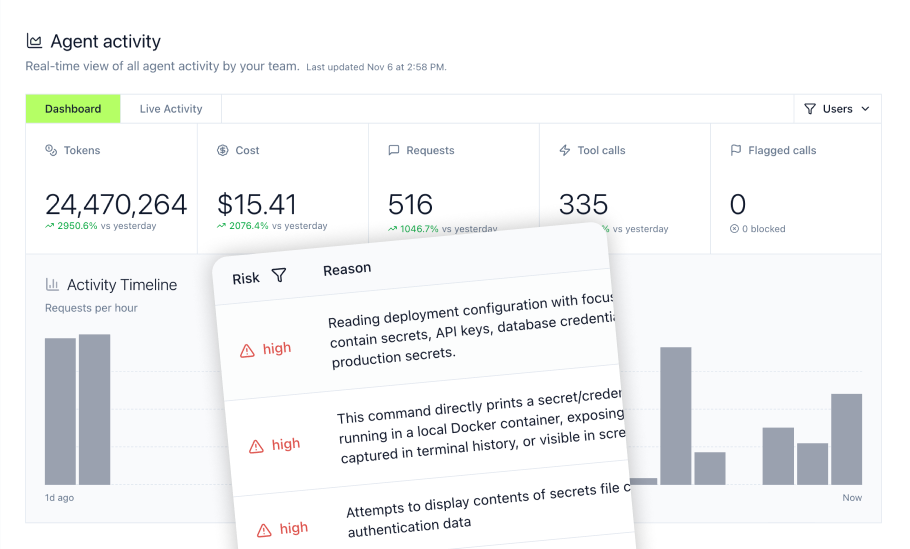
- MintMCP's Gateway + Agent Monitor model governs MCP traffic and monitors local coding-agent activity, including bash commands, file operations, and prompt submissions
- Gartner's 2025 Software Engineering Survey predicts 75% of API gateway vendors will include MCP features by 2026
- MintMCP is an official Cursor Hooks partner for secure AI coding agent workflows
- MintMCP supports Virtual MCP Bundles for per-use-case endpoints with SCIM-driven membership, plus Agent Bundles for per-agent identity with M2M auth and “act as agent” flows
Understanding the Enterprise MCP Gateway Landscape: MintMCP, TrueFoundry, and Airia
The Model Context Protocol (MCP) has emerged as the industry standard for connecting AI clients to enterprise data and tools. Supported by Anthropic, OpenAI, Google, and Microsoft, MCP enables AI assistants like Claude and ChatGPT to interact securely with internal systems. However, deploying MCP servers at enterprise scale introduces challenges around security, governance, and operational complexity.
MCP gateways address three core problems: tool organization, protocol translation, and security control. Understanding how each platform approaches these challenges helps clarify which solution aligns with specific enterprise requirements.
What is an MCP Gateway?
An MCP gateway serves as the central infrastructure layer between AI clients and MCP servers. It handles:
- Authentication and authorization for all AI tool access
- Audit logging of every interaction for compliance requirements
- Credential management for API keys, tokens, and connector access
- Rate limiting and access control to prevent misuse
- Protocol translation between different MCP server types
- Centralized management of credentials and configurations
Without a gateway, organizations face scattered credentials, no request history, and uncontrolled access to sensitive systems.
Key Challenges in Enterprise AI Adoption
Enterprise AI deployments face specific hurdles that MCP gateways must address:
- Shadow AI proliferation: Teams deploy AI tools without IT oversight, creating security blind spots
- Compliance requirements: Regulated industries need complete audit trails and consistent access control
- Operational complexity: STDIO-based MCP servers require infrastructure expertise to deploy and manage
- Governance gaps: No visibility into which AI tools access what data
MintMCP's approach centers on solving these challenges with minimal friction. The platform starts from data permissions, including SSO, SCIM-driven RBAC, IdP groups, Virtual MCP Bundles, tool-level policy, and audit, then enables agents on top.
The Role of Gateways in AI Governance
Organizations report improvements in productivity and retention when deploying AI agents strategically. Realizing these gains requires governance infrastructure that enables safe AI tool access without slowing teams down.
MintMCP's MCP Gateway provides the deployment and monitoring infrastructure MCPs need. The platform bridges the gap between AI assistants and internal data while handling authentication, permissions, credential management, and audit trails.
Deployment and Scalability: From Local to Enterprise-Grade MCP
Deployment speed and operational complexity separate platforms designed for enterprise scale from those requiring significant engineering investment.
Simplifying MCP Server Deployment
Most MCP servers are STDIO-based, requiring local installation and manual configuration. This creates challenges for enterprise teams:
- Engineers must maintain local server instances
- No centralized visibility into server health or usage
- Security configurations must be applied individually
- Scaling requires duplicating infrastructure
MintMCP addresses these challenges with managed SaaS-first deployment, hosted MCP connectors run by MintMCP, and OAuth brokering for stdio and hosted MCP servers. Customers do not need to operate Kubernetes pods, connector runtimes, or scaling infrastructure for the connector layer.
TrueFoundry follows a broader AI platform model, with managed SaaS and self-hosted control plane options that can involve Kubernetes and cloud infrastructure setup. This approach suits organizations that want flexible AI infrastructure deployment models, though self-hosted configurations add complexity for teams without platform engineering expertise.
Airia MCP Gateway emphasizes integration breadth over deployment documentation. Airia offers SaaS, private cloud, on-premises, and hybrid deployment options, though specific setup timelines vary by deployment model and are not consistently published.
Ensuring High Availability and Reliability
Production AI deployments require enterprise-grade reliability:
MintMCP:
- Managed SaaS-first deployment in US and EU regions, with VPC/self-hosted options on request
- Hosted MCP connectors run by MintMCP
- Auto-scaling and isolated execution for connector instances
- Centralized observability and audit logs for AI tool and agent activity
- No Kubernetes infrastructure management required from customers
TrueFoundry:
- Published benchmarks: 350+ requests per second on 1 vCPU
- Gateway latency: approximately 3-4ms at 250 RPS
- Self-hosted control plane options that may involve customer-managed Kubernetes or cloud infrastructure
Airia MCP Gateway:
- Enterprise deployment positioning
- Specific performance metrics not publicly documented
Flexible Deployment Options: Cloud vs. Self-Hosted
Deployment preferences vary by organization size and regulatory environment. MintMCP offers managed SaaS-first deployment in US and EU regions, with VPC/self-hosted options available on request. TrueFoundry provides managed SaaS and self-hosted deployment paths that can involve Kubernetes infrastructure depending on requirements. Airia supports SaaS, private cloud, on-premises, and hybrid deployment options, though specific deployment requirements and timelines vary by model.
MintMCP's managed SaaS-first approach reduces DevOps overhead while still offering VPC/self-hosted options for organizations requiring more infrastructure control.
Governance and Control: Managing AI Tool Access and Usage
Centralized governance transforms shadow AI into sanctioned AI. Without proper controls, AI tools operate as black boxes with significant security risks.
Preventing Shadow AI with Centralized Control
Shadow AI grows rapidly as teams adopt AI tools without IT oversight. MintMCP's centralized governance model provides:
- Unified authentication: SSO enforcement across MCP endpoints
- SCIM-driven RBAC: Provision access from IdP groups and team membership
- Tool curation: Virtual MCP Bundles expose only the minimum required tools, not entire MCP servers
- Policy enforcement: Rule-based policies and tool-level allowlisting for governed access
- Credential management: Centralized API key and token management
This approach turns scattered, unmonitored AI tool usage into governed, observable infrastructure.
Real-time Monitoring and Usage Tracking
Visibility into AI tool usage enables informed governance decisions. MintMCP's monitoring capabilities include:
- Centralized observability for MCP traffic
- Audit logs for compliance review and security investigations
- Security alerts for anomalous behavior
- Gateway + Agent Monitor coverage across MCP traffic and local coding-agent activity
- Visibility into Claude, Cursor, ChatGPT, Gemini, and Copilot governance workflows
These observability features support security review and compliance reporting while providing the audit trails required for regulated enterprise environments.
Defining Access Policies for Teams and Individuals
Granular access control ensures teams access only the tools they need:
- Role-based access control: Define permissions by role and IdP group
- SCIM-driven provisioning: Centralized user management with team-level controls
- Virtual MCP Bundles: Create per-use-case endpoints with curated tool sets and SCIM-driven membership
- Agent Bundles: Give agents per-agent identity with M2M auth and “act as agent” flows
- Tool-update policy: Auto-enable new upstream tools or require admin approval before tool expansion
MintMCP's approach balances security requirements with developer productivity, enabling fast, controlled access to AI tools.
Gateway and Agent Monitor Capabilities: Monitoring and Securing Coding Agents
Coding agents operate with extensive system access, reading files, executing commands, and accessing production systems through MCP tools. MintMCP's Gateway + Agent Monitor model provides visibility and control over both MCP traffic and local non-MCP agent activity.
Tracking Agent Interactions for Observability
MintMCP's Agent Monitor covers local coding-agent activity through Claude Code and Cursor hooks, while the Gateway governs MCP traffic. This architecture provides:
- Tool call tracking: Monitor MCP tool invocation across coding agents
- Command history: Audit bash commands executed by coding agents
- File operation logging: See which files agents access and modify
- Prompt submission visibility: Monitor prompt activity where supported by agent hooks
- MCP inventory: Visibility into MCPs and usage patterns
When evaluating TrueFoundry or Airia for coding-agent governance, teams should confirm whether they provide comparable coverage across MCP traffic, local shell activity, file reads/writes, and prompt submissions.
Protecting Sensitive Data from AI Access
Coding agents can inadvertently access sensitive configuration files, credentials, and environment variables. MintMCP's security guardrails include:
- Sensitive file protection: Prevent access to .env files, SSH keys, and credentials
- PII detection: Identify and block exposure of personally identifiable information
- Environment variable protection: Block tool calls attempting to read secrets
These protections help teams enforce policies before sensitive data is exposed.
Blocking Dangerous Commands and Actions
MintMCP enforces security policies across MCP traffic and local coding-agent activity:
- Block risky tool calls like reading environment secrets
- Prevent execution of dangerous commands
- Restrict file access based on configurable policies
- Alert security teams to policy violations
This proactive approach helps prevent security incidents rather than detecting them only after the fact.
Integration Ecosystem: Connecting AI to Your Enterprise Data and Tools
Integration breadth and depth determine how effectively AI agents can access enterprise systems. Each platform takes a different approach to building its connector ecosystem.
MintMCP's Enterprise-Focused Connectors
MintMCP provides hundreds of prebuilt connectors and hosted MCP connectors run by MintMCP, focused on critical enterprise data sources:
Data Warehouses and Databases:
- Snowflake with Cortex Agent/Analyst for natural language to SQL
- Elasticsearch for enterprise search and log analysis
- PostgreSQL, MySQL, MongoDB, and additional database connectors
Communication and Productivity:
Development Tools:
- Linear for project management
- GitHub integration for repository access
Airia's Breadth-First Approach
Airia MCP Gateway emphasizes integration quantity with over 1,000 pre-configured integrations, including:
- Salesforce, HubSpot, Stripe, Twilio
- Snowflake, GitHub, Slack, MongoDB
- Microsoft Teams and additional SaaS applications
Airia also offers MCP Apps support, enabling interactive dashboards and forms within AI conversations.
TrueFoundry's DevOps Focus
TrueFoundry's integration ecosystem centers on development and operations tools:
- Slack, Confluence, Sentry
- Datadog, GitHub
- 25+ agent framework integrations including LangChain, CrewAI, and AutoGen
Custom Integration Development
For tools not covered by pre-built connectors, each platform offers custom integration options:
MintMCP:
- STDIO server hosting with OAuth brokering for stdio and hosted MCP servers
- Custom MCP connector development support
- Hosted MCP connectors operated by MintMCP
- JavaScript Gateway Middleware in a JS sandbox for inline policy, transformation, and external DLP or guardrails integrations
TrueFoundry:
- Custom integration via Kubernetes or cloud infrastructure deployment
- Requires platform engineering expertise for self-hosted configurations
Airia:
- Custom integrations via MCP protocol
- Focus on point-and-click configuration
Cost Efficiency and Performance: Optimizing AI Operations
Total cost of ownership extends beyond subscription pricing to include infrastructure costs, engineering time, and operational overhead.
Understanding Total Cost of Ownership
MintMCP's managed SaaS-first approach reduces total cost through:
- Reduced infrastructure management: MintMCP operates hosted MCP connectors and connector scaling
- Faster deployment: Reduced opportunity cost compared to self-hosted setup
- Built-in governance: SSO, SCIM-driven RBAC, audit logs, and rule-based policy reduce custom implementation work
TrueFoundry's model may require:
- Kubernetes expertise and platform engineering resources for self-hosted deployments
- Ongoing cluster management and maintenance for certain configurations
Tracking Usage Across Teams and Projects
MintMCP's platform includes audit and observability capabilities that help teams track:
- AI tool usage across teams and departments
- MCP activity for specific projects and workflows
- Tool access and policy events across integrations
This visibility enables informed governance decisions and helps identify optimization opportunities.
Performance Considerations
TrueFoundry provides the most transparent performance documentation, publishing benchmarks of approximately 3-4ms gateway latency at 250 RPS and throughput of 350+ requests per second on a single vCPU.
MintMCP's performance metrics are not publicly disclosed, with the platform emphasizing governance depth, managed connector operations, and centralized observability over raw throughput claims.
Airia does not publish specific performance benchmarks.
Client Compatibility and User Experience: A Developer-Friendly Approach
AI client compatibility determines which tools your teams can use with the gateway infrastructure.
Supporting a Diverse AI Client Ecosystem
MintMCP supports a broad range of AI clients:
- Claude (Desktop and Web)
- ChatGPT (via Custom GPTs and Actions)
- Microsoft Copilot
- Cursor
- Gemini
- Goose
- LibreChat
- Open WebUI
- Windsurf
- Custom MCP-compatible agents
This compatibility ensures teams can use their preferred AI tools while maintaining centralized governance.
TrueFoundry supports multiple LLM providers and agent frameworks, with particular strength in framework integrations for LangChain, CrewAI, and AutoGen.
Airia mentions support for Claude, Cursor, and ChatGPT.
Ensuring a Seamless Developer Experience
MintMCP's design philosophy prioritizes developer experience:
- No workflow changes: Works with existing AI tool deployments
- Self-service access: Developers request and receive access through governed workflows
- Rapid deployment: Deploy MCP access with pre-configured policies
This approach enables AI tool adoption without slowing development teams.
MintMCP's Unique Value Proposition: Bridging Accessibility and Control
MintMCP occupies a distinct position in the MCP gateway market: purpose-built infrastructure for enterprises that need compliance and governance without the operational complexity of unified AI platforms.
Making AI Accessible to Everyone
MintMCP's mission centers on accessibility: the platform is designed so AI tools can be accessible to everyone in an organization, not just engineers. This philosophy drives design decisions throughout the platform:
- Managed SaaS-first deployment reduces infrastructure barriers
- Pre-configured security policies reduce implementation complexity
- Self-service access enables business users to request AI tool access
Turning Shadow AI into Sanctioned AI
Teams already use AI tools. The question is whether that usage is governed or invisible. MintMCP provides visibility and control without disrupting existing workflows:
- See which MCP tools teams are using
- Track usage patterns and data access
- Enforce policies automatically
The MintMCP Philosophy: Software Adapts to People
MintMCP operates on the belief that software should adapt to people, not the other way around. This philosophy manifests in:
- Zero Kubernetes requirement: Deploy enterprise infrastructure without platform engineering expertise
- OAuth brokering: Simplify auth for stdio and hosted MCP servers
- Procurement-ready security posture: SOC 2 Type II audited, compliant with HIPAA standards, penetration tested, and supported by audit trails
Conclusion: Why MintMCP Delivers Enterprise MCP Infrastructure
For organizations seeking production-ready MCP governance, MintMCP provides a fast path from local development to enterprise deployment. Managed SaaS-first deployment, combined with SOC 2 Type II audited security posture, compliance with HIPAA standards, and comprehensive agent monitoring through Gateway + Agent Monitor, enables regulated industries to adopt AI tools confidently.
The platform's purpose-built approach means organizations invest in MCP expertise specifically designed for governance and compliance. Reduced infrastructure management eliminates DevOps overhead, while complete audit trails support security review and regulatory requirements.
MintMCP transforms shadow AI into sanctioned AI, providing the visibility and control enterprises need without disrupting developer workflows. OAuth brokering, monitoring dashboards, and enterprise-ready governance features deliver production-grade infrastructure that teams can deploy quickly. Unlike platforms requiring Kubernetes expertise or weeks of setup for certain deployment models, MintMCP enables security and compliance teams to govern AI tool usage from day one.
For engineering leaders balancing innovation velocity with risk management, MintMCP delivers the governance infrastructure that makes enterprise AI deployment practical and secure. The platform handles the complexity of authentication, audit logging, credential management, and policy enforcement so teams can focus on building AI-powered workflows that drive business value.
For teams ready to deploy MCP infrastructure at scale, schedule a demo to see the platform in action.
Frequently Asked Questions
What is the primary purpose of an MCP Gateway for enterprises?
An MCP gateway serves as centralized infrastructure connecting AI clients to enterprise data and tools. It handles authentication, audit logging, credential management, rate limiting, and access control for all AI tool interactions. Without a gateway, organizations face scattered credentials, no visibility into AI tool usage, and uncontrolled access to sensitive systems. MintMCP's MCP Gateway transforms this challenge into governed, observable infrastructure with SSO, SCIM-driven RBAC, Virtual MCP Bundles, rule-based policy, and complete audit trails.
What kind of integrations do these MCP Gateways offer with existing enterprise systems?
MintMCP provides hundreds of prebuilt connectors focused on data warehouses (Snowflake, Elasticsearch), databases (PostgreSQL, MySQL, MongoDB), and productivity tools (Gmail, Outlook, Notion). Airia offers a broad catalog with over 1,000 pre-configured integrations across SaaS applications. TrueFoundry focuses on DevOps integrations (Slack, Datadog, GitHub) and agent frameworks (LangChain, CrewAI, AutoGen).
Can these platforms help manage and monitor coding agents' interactions with internal systems?
MintMCP's Gateway + Agent Monitor model provides monitoring for MCP traffic and local coding-agent activity, including tool calls, bash commands, file operations, and prompt submissions where supported by agent hooks. It can enforce policy-based controls for risky commands and sensitive file access. When evaluating TrueFoundry or Airia, teams should confirm whether comparable coverage exists across MCP traffic and local coding-agent behavior.
What are the typical deployment options available for enterprise MCP gateway solutions?
MintMCP offers managed SaaS-first deployment in US and EU regions, with VPC/self-hosted options on request. TrueFoundry provides managed SaaS and self-hosted deployment paths that can involve Kubernetes infrastructure depending on requirements. Airia supports SaaS, private cloud, on-premises, and hybrid deployment options, though specific deployment requirements and timelines vary by model.
How does MintMCP differentiate itself in terms of ease-of-use and accessibility for non-engineers?
MintMCP's design philosophy positions AI tool access as something accessible to everyone in an organization, not just engineers. Managed SaaS-first deployment reduces infrastructure complexity, OAuth brokering simplifies auth for stdio and hosted MCP servers, and self-service access enables business users to request AI tool access through governed workflows. This approach contrasts with platforms requiring Kubernetes expertise or extensive engineering investment for certain deployment models.