Choosing the right MCP gateway determines how effectively your organization can deploy AI agents at scale while maintaining security and compliance. The MCP Gateway market has evolved rapidly, with three platforms emerging as options for enterprise teams: MintMCP, RunLayer, and Portkey. Each takes a distinct approach to connecting AI assistants with internal data and tools. MintMCP focuses on rapid deployment with enterprise governance, RunLayer emphasizes security-first governance and observability, and Portkey offers a unified LLM and MCP management platform. This comparison examines each solution's strengths across deployment speed, security, compliance, and total cost of ownership to help engineering leaders make informed decisions.
Key Takeaways
- MintMCP deploys STDIO-based and hosted MCP servers to production in minutes with OAuth brokering, compared to longer onboarding cycles for some hybrid or self-hosted alternatives
- RunLayer focuses on MCP security, governance, observability, and access controls for internal employee and agent governance use cases
- Portkey combines MCP gateway capabilities with broader LLM routing, observability, and self-hosted or hybrid enterprise deployment options
- MintMCP's Virtual MCP Bundles enable per-use-case endpoints with SCIM-driven membership, curated tool access, and rule-based policy
- MintMCP adds Agent Bundles with per-agent identity, M2M authentication, and “act as agent” flows for governed internal agents
Understanding MCP Gateways and Enterprise AI Infrastructure
MCP gateways solve three interconnected challenges that enterprises face when deploying AI agents: tool organization, protocol translation, and security control. As 71% of organizations now regularly use generative AI, the need for governed AI-to-data connections has become critical infrastructure.
What Are MCP Gateways and Why Do They Matter?
An MCP gateway sits between AI clients (Claude, ChatGPT, Cursor, Copilot) and the MCP servers that provide tool capabilities. The gateway handles authentication, enforces access policies, logs all interactions, and routes requests to appropriate backend servers. Without a gateway, organizations face several challenges:
- Zero telemetry: No visibility into what AI tools access or how they behave
- No request history: Unable to audit AI agent actions for compliance
- Uncontrolled access: AI assistants can potentially access any connected system without governance
For enterprise teams, understanding MCP gateways represents the foundation of production AI deployment.
Key Challenges in Enterprise AI Infrastructure
Shadow AI can grow as employees adopt AI tools without IT oversight. Organizations need solutions that transform unsanctioned AI usage into governed, auditable workflows. The challenge intensifies because many MCP servers are STDIO-based and difficult to deploy, requiring containerization, authentication setup, and ongoing maintenance.
MintMCP: Enterprise MCP Deployment in Minutes
MintMCP approaches MCP infrastructure with a singular focus: getting enterprises from local development to production deployment as quickly as possible while maintaining security and compliance standards.
Core Capabilities
MintMCP's gateway transforms local STDIO-based and hosted MCP servers into production-ready services through:
- One-click deployment: Host STDIO servers on MintMCP instead of managing local installations
- OAuth brokering: Add enterprise authentication to STDIO and hosted MCP servers without modifying server code
- Hosted MCP connectors: Run connectors on MintMCP with auto-scaling and isolated execution per connector
- Virtual MCP Bundles: Create per-use-case endpoints with SCIM-driven membership, curated tool sets, and rule-based policy
- Agent Bundles: Give internal agents scoped tools, per-agent identity, M2M authentication, and “act as agent” flows
This approach eliminates the DevOps overhead that typically delays AI agent deployments. Teams can move from evaluation to production in minutes rather than weeks.
Security and Compliance
MintMCP provides comprehensive enterprise security features:
- SOC 2 Type II audited with compliance documentation available through the Trust Center
- Compliant with HIPAA standards, with HIPAA documentation available for customers handling protected health information
- Enterprise SSO and SCIM-driven RBAC for identity-based access management
- Complete audit trails capturing every MCP interaction and configuration change
- Tool-level allowlisting and rule-based policy for granular access control
- Credential management for secure connector and agent access
- Enterprise security controls with penetration testing, encryption in transit and at rest, data residency options, and uptime SLA
The platform supports hosted MCP connectors, custom connector deployment, and centralized governance across enterprise AI clients.
LLM Proxy for Coding Agent Governance
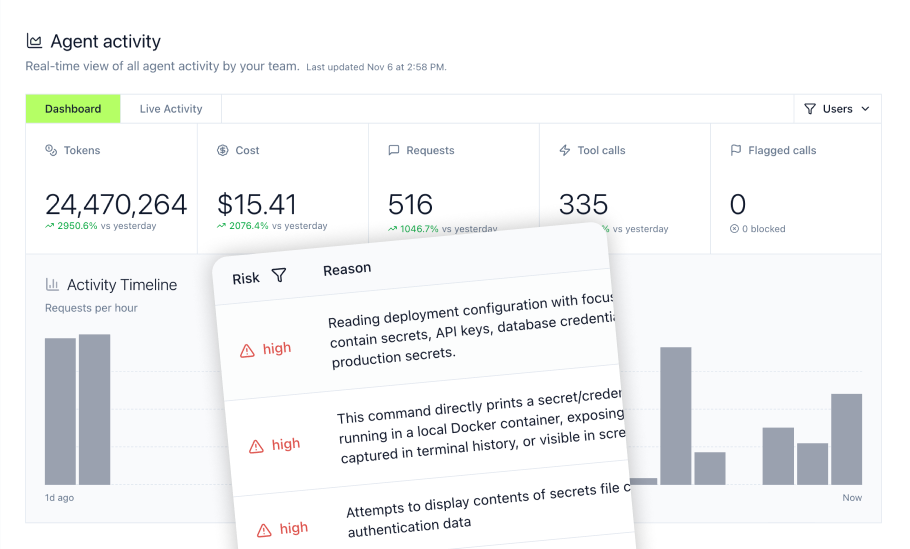
Beyond MCP gateway capabilities, MintMCP offers an LLM Proxy and Agent Monitor layer specifically designed for monitoring AI coding assistants like Cursor and Claude Code:
- Track every tool call, bash command, and file operation
- Block dangerous commands in real-time before execution
- Protect sensitive files (.env, SSH keys, credentials) from agent access
- Maintain complete command history for security review
This capability addresses a growing concern: coding agents operate with extensive system access, and without monitoring, organizations cannot see what they access or control their actions. MintMCP's two-layer governance model covers MCP traffic through the gateway and local non-MCP agent activity through Agent Monitor.
Enterprise Readiness
MintMCP is built for mid-market and enterprise teams, including regulated industries that need governed MCP access for employees and internal agents. The platform supports centralized governance across Claude, Cursor, ChatGPT, Gemini, and Copilot, and is listed in the Cursor Hooks Partners Program for enterprise coding workflows.
RunLayer
RunLayer positions itself as a security-focused MCP platform for internal employee and agent governance use cases, with a hybrid deployment model that supports managed SaaS plus self-hosted deployment on customer infrastructure.
Security and Control Approach
RunLayer emphasizes MCP governance, observability, and access controls for organizations that need to monitor and secure AI tool usage. Its security-first positioning makes it relevant for teams evaluating threat detection, access control, and AI agent activity visibility.
Server Catalog and Client Support
RunLayer supports enterprise MCP adoption across internal employee and agent workflows, including AI/DevEx, IT, security, and platform engineering use cases.
Customer Base
RunLayer is positioned for enterprise teams adopting MCP across internal knowledge worker and agent workflows. Teams evaluating RunLayer should validate connector coverage, deployment model, audit requirements, and identity governance capabilities during procurement.
Deployment Considerations
RunLayer's hybrid model may fit teams that want managed SaaS plus self-hosted deployment on customer infrastructure. Teams should also evaluate whether their use case requires MintMCP-specific primitives such as Virtual MCP Bundles with SCIM-driven membership, Agent Bundles with M2M authentication, hosted MCP connectors run by the vendor, and OAuth brokering for STDIO and hosted MCP servers.
Portkey
Portkey takes a different approach, offering MCP gateway capabilities as part of a broader LLM management platform built for production AI traffic.
Unified Observability Capabilities
Portkey's core strength lies in managing both LLM API calls and MCP tool invocations through a single control plane:
- LLM routing: Route requests across multiple model providers
- Automatic fallbacks: Maintain reliability when primary providers experience issues
- Semantic caching: Reduce costs and latency through intelligent response caching
- Unified traces: Correlate LLM behavior with MCP tool usage for debugging
Open-Source Foundation
Portkey maintains an open-source AI Gateway and supports self-hosted or hybrid enterprise deployments for teams requiring more infrastructure control.
Recognition and Reviews
Portkey is relevant for developer and platform engineering teams that want LLM routing, observability, and MCP management in one platform. Teams primarily focused on internal MCP governance should evaluate how Portkey's broader LLM infrastructure model maps to requirements such as SCIM-driven RBAC, per-use-case tool bundles, agent identity, and centralized audit.
Pricing Structure
Portkey offers tiered pricing, with enterprise features such as SOC 2 Type II audited status, SSO, SCIM, and dedicated support available through enterprise plans.
Feature Comparison: Security and Compliance
Understanding how each platform approaches enterprise requirements helps align solutions with organizational needs.
Compliance and Attestation
MintMCP:
- SOC 2 Type II audited: Yes
- Compliant with HIPAA standards: Yes
- Audit Log Export: Available
- Security Controls: Penetration tested, encryption in transit and at rest, data residency options, uptime SLA
RunLayer:
- SOC 2 Type II audited: Validate during procurement
- GDPR Support: Validate during procurement
- Audit Log Export: Validate during procurement
- Security Controls: Available
Portkey:
- SOC 2 Type II audited: Enterprise tier
- GDPR Support: Yes
- Audit Log Export: Enterprise tier
- Security Controls: Enterprise tier
MintMCP's compliance documentation is available through their Trust Center, providing security posture and compliance documentation for enterprise review.
Authentication and Access Control
All three platforms support enterprise identity and access control use cases:
- MintMCP: SSO, SCIM-driven RBAC, IdP groups, OAuth brokering for STDIO and hosted MCP servers, Virtual MCP Bundles, and Agent Bundles
- RunLayer: Enterprise access controls for internal employee and agent governance use cases
- Portkey: Enterprise identity features including SSO and SCIM on enterprise plans
MintMCP's Virtual MCP Bundles distinguish it from alternatives by combining per-use-case endpoints, SCIM-driven membership, curated tool sets, and rule-based policy into the same governance primitive used for both human teams and agent identities.
Real-Time Monitoring Capabilities
Observability approaches vary by platform focus:
- MintMCP: Dedicated dashboards for MCP tool calls, bash commands, file operations, server health, and local agent activity through Gateway plus Agent Monitor coverage
- RunLayer: Security-focused monitoring and governance for MCP usage
- Portkey: Unified LLM and MCP traces with cost attribution
For teams primarily focused on MCP governance, MintMCP's dedicated monitoring provides visibility into tool-specific behavior, agent activity, and policy enforcement.
Deployment and Integration Flexibility
How quickly teams can move from evaluation to production significantly impacts time-to-value.
Deployment Speed Comparison
MintMCP:
- Deployment time: Minutes (one-click STDIO and hosted MCP deployment)
- Model: Managed SaaS-first, with US and EU deployment and VPC/self-hosted on request
RunLayer:
- Deployment time: Depends on managed SaaS or self-hosted implementation scope
- Model: Hybrid managed SaaS plus self-hosted deployment on customer infrastructure
Portkey:
- Deployment time: Depends on SDK, gateway, and enterprise deployment scope
- Model: Managed SaaS, open-source AI Gateway, and self-hosted or hybrid enterprise options
MintMCP's one-click deployment transforms local STDIO servers into hosted, authenticated services without infrastructure setup. This approach eliminates the DevOps burden that delays many AI agent initiatives.
Pre-Built Enterprise Connectors
MintMCP provides ready-to-use connectors for common enterprise systems:
- Data warehouses: Snowflake, BigQuery, PostgreSQL
- Search platforms: Elasticsearch
- Productivity tools: Gmail, Google Calendar, Notion
- Development tools: GitHub, Linear
RunLayer focuses on MCP security and governance, while Portkey focuses on LLM routing and observability alongside MCP capabilities.
AI Client Compatibility
All three platforms support major AI client workflows, though MintMCP is listed in the Cursor Hooks Partners Program for enterprise coding workflows:
MintMCP supports: Claude (Desktop and Web), ChatGPT, Microsoft Copilot, Cursor, Gemini, Goose, LibreChat, Open WebUI, Windsurf
Making the Right Choice: Key Considerations
Selecting the right MCP gateway depends on organizational priorities, existing infrastructure, and specific use cases.
Choose MintMCP When You Need
- Rapid deployment: Production-ready MCP infrastructure in minutes without DevOps overhead
- Compliance-first approach: SOC 2 Type II audited status, HIPAA standards alignment, and streamlined audit documentation
- Data-permissions-first governance: SSO, SCIM-driven RBAC, IdP groups, tool-level allowlisting, and audit before agents are enabled
- Role-based governance: Virtual MCP Bundles for team-specific and use-case-specific tool access
- Agent identity governance: Agent Bundles with M2M authentication and “act as agent” flows
- Coding agent monitoring: LLM Proxy and Agent Monitor coverage for Cursor and Claude Code governance
MintMCP serves teams that prioritize speed-to-production and enterprise governance without sacrificing developer experience.
Enterprise Use Case Alignment
Different industries and functions align with different platform strengths:
Regulated industries (finance, government, healthcare, and other regulated environments): MintMCP's audited security posture, HIPAA standards alignment, and audit documentation support strict regulatory review. Teams can connect AI agents to database systems while maintaining full audit trails.
Development teams: MintMCP's Cursor Hooks Partners Program listing, LLM Proxy, and Agent Monitor provide governance for AI coding assistants without disrupting developer workflows.
Data and analytics teams: MintMCP's pre-built connectors for Snowflake and other data platforms enable natural language queries against enterprise data with proper access controls.
Conclusion
For organizations seeking to deploy MCP infrastructure at enterprise scale, MintMCP delivers the combination of speed, security, and governance that production environments demand. The platform's one-click deployment transforms STDIO-based and hosted MCP servers into authenticated, monitored services in minutes rather than weeks. OAuth brokering helps reduce the engineering effort typically required to add enterprise authentication. Virtual MCP Bundles enable precise control over which tools each team can access, while Agent Bundles extend governed access to internal agents with per-agent identity and M2M authentication.
MintMCP's compliance posture, Trust Center documentation, and audit trails support the requirements of regulated industries. The dedicated LLM Proxy and Agent Monitor layer extend governance to AI coding assistants, addressing a critical gap as development teams increasingly rely on AI pair programming.
Engineering leaders evaluating MCP gateway solutions should consider how quickly they need production deployment, what compliance requirements they must meet, and whether their teams need specialized coding agent monitoring. For organizations prioritizing rapid deployment, enterprise governance, and developer productivity, MintMCP provides the infrastructure to turn shadow AI into sanctioned AI without slowing development velocity.
Book a demo to see how MintMCP can accelerate your enterprise MCP deployment.
Frequently Asked Questions
What is the primary difference between an MCP Gateway and a traditional API Gateway?
An MCP gateway specifically handles the Model Context Protocol, which connects AI assistants to external tools and data sources. Unlike traditional API gateways that manage HTTP request routing, MCP gateways understand AI-specific workflows, including tool invocations, context management, and multi-turn conversations. MintMCP's MCP Gateway adds enterprise capabilities like OAuth brokering for STDIO and hosted MCP servers, Virtual MCP Bundles for role-based access, Agent Bundles for per-agent identity, and complete audit trails of AI agent interactions.
How do MCP Gateways help organizations achieve compliance like SOC 2?
MCP gateways provide the audit infrastructure that compliance frameworks require. They log every tool call, track data access patterns, and maintain records of AI agent behavior. MintMCP specifically supports compliance workflows through audit exports, complete interaction histories, and security documentation available through their Trust Center. This infrastructure helps organizations demonstrate control over AI systems during audits.
Can MintMCP integrate with existing LLM clients?
Yes. MintMCP supports major AI clients including Claude (Desktop and Web), ChatGPT via Custom GPTs, Microsoft Copilot, Cursor, Gemini, Goose, LibreChat, Open WebUI, and Windsurf. The platform's MCP registry provides one-click configuration for connecting these clients to enterprise data sources. For Cursor workflows, MintMCP is listed in the Cursor Hooks Partners Program.
How do MCP Gateway solutions help with cost control?
MCP gateways provide visibility into AI tool usage that enables cost optimization. MintMCP tracks spending per team, project, and tool through cost analytics dashboards. The platform also measures response times, error rates, and usage patterns to identify inefficiencies. By centralizing AI tool access through a gateway, organizations gain the data needed to allocate costs accurately and optimize resource utilization across teams.