When evaluating RunLayer alternatives, the decision typically comes down to three constraints that matter most in enterprise rollouts: compliance readiness, deployment velocity, and the level of engineering effort required to operate the platform day-to-day. RunLayer is a credible option for teams evaluating MCP security and management, but many enterprises prioritize faster paths to production, clearer governance controls, and audit-ready documentation that reduces procurement friction.
This guide examines the top RunLayer alternatives through an enterprise lens, where security review cycles, identity integration, and operational overhead often matter as much as feature depth. The sections below also highlight why MintMCP’s Gateway is positioned as a strong choice for compliance-first deployments that need to move quickly from pilot to production without building a large internal platform team.
Key Takeaways
- Deployment models differ significantly: MintMCP is managed SaaS-first with VPC/self-hosted available on request, while open-source options may require more infrastructure ownership
- Open-source options exist but come with trade-offs. IBM ContextForge is free under Apache 2.0, but production teams should evaluate the operational lift required to run and govern it
- Enterprise MCP governance is moving beyond basic gateway access, with teams increasingly evaluating SSO, SCIM-driven RBAC, tool-level allowlisting, audit logs, credential management, and agent identity controls
Understanding RunLayer
RunLayer positions itself as an enterprise MCP security and management platform, but enterprises evaluating alternatives typically weigh time-to-production, governance clarity, and audit-ready documentation just as heavily as feature depth.
Key RunLayer Characteristics
- Internal employee and agent governance use case
- Hybrid deployment model with managed SaaS plus self-hosted deployment on customer infrastructure
- Governance, observability, and access control capabilities for MCP environments
- Designed for IT-Sec-AIOps and Platform Engineering teams
- Positioned for enterprise MCP security and management
RunLayer Considerations
- Pricing transparency may require direct vendor engagement
- Confirm current SOC 2 Type II attestation status, BAA availability, and report scope during procurement
- Hybrid and self-hosted deployment options can require more planning than managed SaaS-first approaches
- Teams should evaluate whether RunLayer supports MCP-specific primitives such as Virtual MCP Bundles with SCIM-driven membership, Agent Bundles with M2M auth, tool-update policy, and OAuth brokering for stdio and hosted MCP servers
1. MintMCP: Strong Fit for Compliance-First Enterprise Deployment
MintMCP is an enterprise gateway for Model Context Protocol focused on authentication, tool-level access control, credential management, logging, rule-based policy, and agent governance. The platform addresses the core enterprise challenges of security, governance, and deployment speed without requiring teams to operate the connector layer themselves.
Key MintMCP Advantages
Security and Compliance:
- **SOC 2 Type II audited **security controls and compliance with HIPAA standards, with BAA availability for enterprise security reviews
- Data-permissions-first architecture built around SSO, SCIM, IdP groups, Virtual MCP Bundles, tool-level policy, and audit
- Complete audit trails for security review and governance workflows
- SSO and SCIM-driven RBAC with tool-level allowlisting and rule-based policy
Deployment and Performance:
- Managed SaaS-first deployment with US and EU availability, plus VPC/self-hosted options on request
- Virtual MCP Bundles provide per-use-case endpoints with SCIM-driven membership, curated tools, and access policy
- Hosted MCP connectors run by MintMCP, reducing the need to manage connector runtimes, scaling, and Kubernetes infrastructure
- OAuth brokering for stdio and hosted MCP servers to simplify authentication across varied MCP server types
Platform Capabilities:
- MCP Gateway for centralized enablement and access control
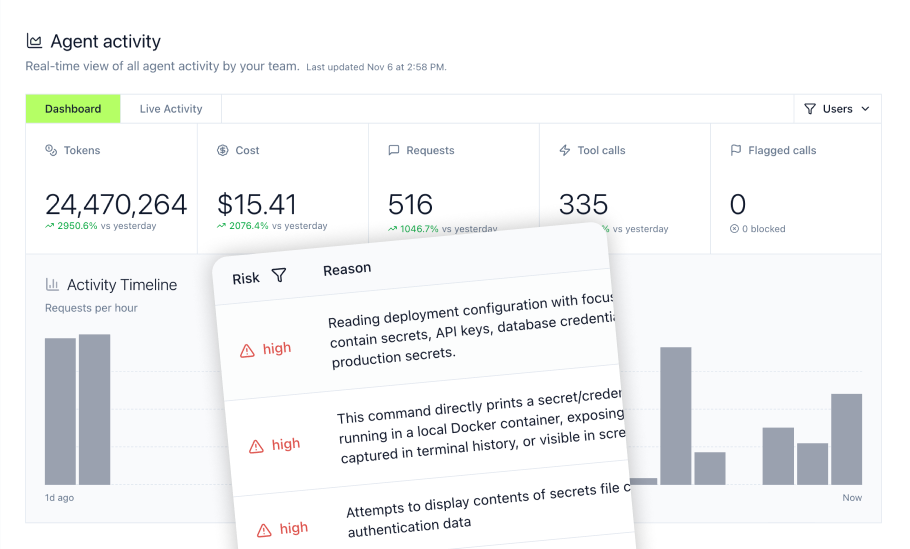
- Agent Monitor for governance across Claude, Cursor, ChatGPT, Gemini, and Copilot
- Pre-built connectors for Snowflake, Gmail, Elasticsearch, and more
- Role-based access control with granular tool permissions
- Agent Bundles with M2M auth and “act as agent” flow
- JavaScript Gateway Middleware in a JS sandbox for inline policy, DLP, and guardrails integrations
- Real-time monitoring dashboards
Deployment and Security Architecture
MintMCP's approach to enterprise deployment centers on removing friction while maintaining governance. The platform brokers OAuth protection across stdio and hosted MCP servers, reducing the manual configuration required by self-managed alternatives.
The security architecture includes:
- SSO and SCIM-driven RBAC
- Tool-level allowlisting and rule-based policy
- Credential management
- Audit logs and centralized observability
- External DLP and guardrails integrations
- Tool-update policy for controlling newly introduced upstream tools
AI Client Compatibility
MintMCP supports governance across Claude, Cursor, ChatGPT, Gemini, and Copilot, with Gateway and Agent Monitor coverage for MCP traffic and local non-MCP agent activity.
Pricing Structure
MintMCP offers per-user licensing with managed SaaS-first deployment and VPC/self-hosted options on request. Contact the team for custom enterprise quotes based on team size and requirements.
Where MintMCP Fits Best
Organizations in regulated industries, including healthcare, finance, and government-adjacent environments, benefit most from MintMCP's compliance posture and data-permissions-first architecture. SOC 2 Type II audited security controls, compliance with HIPAA standards, BAA availability, SCIM-driven RBAC, tool-level policy, and audit logs help reduce the internal lift required to approve and operationalize MCP at scale.
2. Peta.io
Peta.io focuses on secure credential management and zero-trust patterns for AI agent operations.
Primary Focus
- Credential management for agent workflows
- Server-side credential handling patterns
- Human-in-the-loop approvals for policy enforcement
- RBAC/ABAC access controls for granular permissions
- Deployment options for sensitive environments
Tradeoffs to consider
Credential security is important, but enterprises should also evaluate whether Peta.io provides the broader MCP governance layer required for SSO, SCIM-driven RBAC, per-use-case tool bundles, audit logs, centralized observability, hosted MCP connectors, and agent identity governance. MintMCP addresses those requirements through a managed SaaS-first gateway and data-permissions-first architecture.
3. IBM ContextForge
IBM ContextForge provides an open-source MCP gateway. The platform offers customization without vendor lock-in, but comes with operational requirements.
Primary Characteristics
- Free and open-source under Apache 2.0 license
- Federation capabilities for distributed MCP management
- OpenTelemetry integration for observability
- REST/gRPC virtualization for backend integration
- Customizable open-source gateway architecture
For a detailed comparison, see MintMCP vs ContextForge.
Operational Requirements
ContextForge requires infrastructure investment. Running ContextForge in production may require teams to operate databases, cache layers, and container orchestration infrastructure depending on deployment design. Teams should validate commercial support, SLA coverage, and compliance documentation directly during procurement.
Tradeoffs to consider
A self-hosted open-source gateway can provide flexibility, but it can also require the customer to manage connector runtimes, scaling, upgrades, and production infrastructure. MintMCP addresses this with managed SaaS-first deployment, hosted MCP connectors, SSO and SCIM-driven RBAC, audit logs, tool-update policy, and Virtual MCP Bundles.
4. Obot
Obot provides an open-source framework for building and deploying AI agents with MCP support.
Primary Focus
- Open-source agent orchestration framework
- MCP protocol support for tool integration
- Community-driven development
- Self-hosted deployment model
Tradeoffs to consider
An OSS-first, self-hosted agent framework may fit teams that want infrastructure control, but it can make managed governance, centralized audit, hosted connectors, SCIM-driven RBAC, and cross-client agent monitoring harder to operationalize. MintMCP is designed for IT, Security, and AI Operations teams that need governed MCP access for internal employees and internal agents without operating the full connector and gateway layer themselves.
5. Lasso Security
Lasso Security focuses on AI security with MCP-related capabilities.
Primary Focus
- Security-first approach to AI tool governance
- Focus on threat detection and prevention
- Enterprise security integrations
Tradeoffs to consider
Security-focused MCP tooling can be useful for detection and prevention, but enterprises should also evaluate identity, access, and operating-model requirements. MintMCP pairs gateway security with SSO and SCIM-driven RBAC, tool-level allowlisting, audit logs, credential management, Virtual MCP Bundles, Agent Bundles, hosted MCP connectors, and external DLP and guardrails integrations.
Why MintMCP Fits Enterprise MCP Deployment
MintMCP’s strength in enterprise MCP deployment stems from several advantages that address real enterprise challenges.
Compliance and Governance Readiness
SOC 2 Type II audited security controls, compliance with HIPAA standards, and BAA availability help regulated teams streamline vendor review. Healthcare organizations, financial services firms, and government-adjacent teams still need to complete their own procurement and security review, but MintMCP provides the compliance posture and governance controls that those reviews commonly require.
Virtual MCP Bundles
MintMCP's Virtual MCP Bundles provide per-use-case endpoints with SCIM-driven membership, curated tool lists, and per-bundle access policy. This gives teams a consistent way to govern which users, groups, and agents can access specific tools, rather than relying on shared service-account keys or broad gateway access.
Agent Identity Governance
MintMCP’s Agent Bundles provide per-agent identity with M2M auth and an “act as agent” flow for connectors that require per-agent OAuth. This helps enterprises govern autonomous agents as first-class identities with scoped tools, independent rotation and revocation, and auditable access.
Deployment Speed
While hybrid or self-hosted platforms can require more planning, MintMCP’s managed SaaS-first model and hosted MCP connectors reduce the infrastructure work needed to move from pilot to production. This difference compounds across organizations with dozens or hundreds of MCP servers and connectors to manage.
Technical Capabilities Comparison
MintMCP provides SSO and SCIM-driven RBAC, tool-level allowlisting, credential management, OAuth brokering for stdio and hosted MCP servers, audit logs, centralized observability, Virtual MCP Bundles, Agent Bundles, hosted MCP connectors, JavaScript Gateway Middleware, and external DLP and guardrails integrations. RunLayer provides governance, observability, and access controls for MCP environments with hybrid deployment. Peta.io focuses on secure credential handling and zero-trust access patterns, while ContextForge enables open-source federation and backend integration.
For authentication, MintMCP provides SSO, SCIM-driven RBAC, OAuth brokering, and tool-level policy. RunLayer supports enterprise access control workflows. Peta.io supports credential and policy enforcement patterns. ContextForge can be configured by teams that want to manage authentication and infrastructure directly.
For additional context on MCP gateways, MintMCP provides comprehensive documentation.
Migration Considerations
MintMCP simplifies migration with a managed gateway model, hosted MCP connectors, and governance primitives that can be introduced incrementally. The platform's managed SaaS-first deployment reduces the infrastructure overhead of self-managed solutions. From open-source solutions like ContextForge, migration planning should account for connector runtime ownership, policy mapping, audit requirements, and authentication flows. From manual STDIO setup, teams can prioritize stdio and hosted MCP servers that benefit most from OAuth brokering, centralized audit, and tool-level policy. From RunLayer, migration should be handled in phases, starting with a subset of MCP servers to validate authentication, logging, and runtime behavior under real workloads. Organizations with no existing MCP can start with MintMCP’s managed gateway and expand governance as usage grows.
Making the Right Choice
Selecting the ideal RunLayer alternative depends on your compliance requirements, deployment timeline, and technical resources. MintMCP is a strong choice for enterprise deployments where regulatory review, deployment speed, and governed production access are priorities.
For organizations in regulated industries requiring audit-ready documentation, MintMCP's SOC 2 Type II audited security controls, compliance with HIPAA standards, and BAA availability provide an immediate procurement advantage. The platform's managed SaaS-first deployment, hosted MCP connectors, Virtual MCP Bundles, Agent Bundles, SSO and SCIM-driven RBAC, and audit logs address enterprise challenges that self-managed or narrower solutions may leave unresolved.
The future of enterprise AI depends on secure, governed access to organizational tools and data. MintMCP provides the infrastructure layer that helps transform AI agents from experimental projects to production-grade enterprise assets, with centralized governance, auditable access, and scoped permissions from the start.
Frequently Asked Questions
What makes MintMCP a strong RunLayer alternative for regulated industries?
MintMCP is designed for teams that need to clear security and procurement reviews quickly. With SOC 2 Type II audited security controls, compliance with HIPAA standards, and BAA availability, organizations in healthcare, financial services, and government-adjacent environments can often streamline vendor assessment steps that otherwise delay production deployments. Combined with SSO, SCIM-driven RBAC, tool-level allowlisting, credential management, and complete audit trails, MintMCP supports the core governance expectations that regulated teams typically require before enabling AI agents against sensitive systems, helping reduce the internal lift needed to justify and operationalize MCP at scale.
Can I migrate from RunLayer to MintMCP?
Yes. MintMCP maintains compatibility with standard MCP workflows and supports structured migration through configuration and incremental cutover approaches. Many teams start by deploying MintMCP alongside existing RunLayer setups, moving a subset of MCP servers first to validate authentication, logging, and runtime behavior under real workloads. From there, migration can proceed in phases, prioritizing the highest-value or most compliance-sensitive servers, so risk is reduced and big-bang changes to agent workflows are avoided.
How does MintMCP's pricing compare to RunLayer?
MintMCP offers per-user licensing and managed SaaS-first deployment with VPC/self-hosted options on request, which can make procurement simpler when a predictable model tied to team size is preferred. RunLayer pricing may require direct vendor engagement, so enterprises typically evaluate scope, scale, required features, and deployment model. In practice, the difference is often not just the sticker price, but the total cost of ownership, including time-to-production, onboarding effort, connector runtime ownership, and the amount of internal engineering required to operate the platform reliably.
What are Virtual MCP Bundles?
Virtual MCP Bundles provide per-use-case endpoints with SCIM-driven membership, curated tool lists, and per-bundle access policy. Instead of giving broad gateway access or relying on shared credentials, teams can define which users, groups, and agents can access specific tools for a specific workflow. The result is a more uniform governance model across heterogeneous infrastructure, which is especially useful in enterprises where critical workflows span older systems, hosted connectors, internal APIs, and autonomous agents.
How long does deployment take?
MintMCP is designed to reduce the gap between local experimentation and production rollout. For stdio and hosted MCP servers, OAuth brokering, hosted connectors, monitoring hooks, and audit logging help move implementations into a managed, governed environment more quickly than self-managed infrastructure. This contrasts with platforms that require heavier onboarding or infrastructure setup before the first production-grade deployment is possible. The practical outcome is faster iteration: value can be validated early, then governance can scale as server count and usage grow.