Selecting the right MCP gateway for enterprise AI deployments requires evaluating deployment speed, security posture, governance capabilities, and integration ecosystems. As organizations accelerate AI agent adoption, the infrastructure supporting these deployments becomes critical to both productivity and compliance.
MintMCP Gateway is designed to help teams turn local MCP servers into governed, production-ready infrastructure with authentication, monitoring, and audit controls. Runlayer focuses on MCP security governance and shadow AI discovery, while Obot provides an open-source option for teams that want to manage infrastructure themselves.
This comparison examines all three platforms to help engineering leaders determine which approach aligns with their enterprise requirements.
Key Takeaways
- MCP gateways help organizations centralize authentication, monitoring, audit logging, and policy enforcement for AI-to-tool connections.
- MintMCP is designed for teams that want managed MCP deployment, OAuth brokering for stdio and hosted MCP servers, and tool-level access control without building infrastructure from scratch.
- MintMCP's Virtual MCP Bundles help teams create dedicated per-use-case endpoints with SCIM-driven membership that expose only the tools each role, team, or agent needs.
- Deployment timelines vary by platform and implementation scope. Managed SaaS-first platforms can reduce infrastructure work, while self-hosted deployments require more internal setup.
Understanding the Need for Enterprise MCP Gateways
The Model Context Protocol (MCP) has become a widely adopted standard for connecting AI assistants to enterprise data and tools, supported by Anthropic, OpenAI, Google, and Microsoft. However, rapid adoption creates governance challenges that unmanaged deployments cannot address.
According to NIST's AI Risk Management Framework, organizations need systematic controls for AI system transparency, accountability, and security.
The Rise of Shadow AI
Shadow AI refers to unauthorized AI tools and integrations deployed by employees outside IT governance. Without centralized control, organizations can face:
- Zero telemetry into what data AI agents access
- No request history for compliance audits
- Uncontrolled access to sensitive systems and credentials
- Scattered tool installations across teams
- Limited ability to revoke access quickly
Unmanaged AI tool usage can spread quickly when teams adopt MCP servers, coding agents, or plugins outside central security visibility. Runlayer's Gusto case study describes multiple teams using MCPs outside central security visibility, illustrating how quickly unmanaged AI tool usage can spread in enterprise environments.
Challenges with Unmanaged MCP Deployments
Most MCP servers are STDIO-based, meaning they run locally and present deployment challenges such as:
- No built-in authentication or authorization
- Credentials scattered across developer machines
- Limited monitoring and audit visibility
- No centralized policy enforcement
- Difficult access revocation
- Inconsistent configuration across teams
These limitations make raw MCP servers difficult to manage in production enterprise environments where compliance, access control, and security oversight are required.
Benefits of a Unified Gateway
An MCP gateway addresses these challenges by providing a centralized control plane for AI-to-data integrations.
Key benefits include:
- Centralized governance: Unified authentication, permissions, and access policies
- Real-time monitoring: Visibility into tool calls, usage patterns, and data access
- Policy enforcement: Rules that determine which users, agents, or teams can access specific tools
- Audit readiness: Logs that support security reviews and incident investigations
- Operational consistency: A standard way to deploy, manage, and monitor MCP servers
Understanding MCP gateways helps organizations transform unmanaged AI usage into governed AI adoption while preserving developer agility.
MintMCP Gateway: Minutes to Production with Role-Based Control
MintMCP was built with a focus on transforming local MCP servers into production-ready enterprise infrastructure. Its core capabilities center on deployment, authentication, tool-level access control, credential management, rule-based policy, and observability.
Deployment and Scalability
MintMCP's deployment model is designed to reduce the infrastructure overhead that slows enterprise AI adoption.
Key capabilities include:
- One-click STDIO transformation: Convert local MCP servers into hosted, production-ready services
- Managed SaaS-first infrastructure: Reduce the need for teams to operate Kubernetes or custom hosting layers
- Hosted MCP connectors: Make containerized servers accessible to approved clients without local installations
- US and EU deployment support: Validate data residency options, VPC, and self-hosted requirements directly with MintMCP during security review
- Faster rollout: Help teams move from local experimentation to governed production usage
This approach is useful for organizations that want MCP governance without building and maintaining the gateway layer internally.
Security and Governance Features
MintMCP provides security capabilities designed for enterprise environments.
Core controls include:
- OAuth 2.0, SAML, SSO, and SCIM-driven RBAC: Enterprise authentication and provisioning for MCP endpoints
- Complete audit trails: Logs for MCP interactions, access requests, and configuration changes
- Tool-level access control: Define which users, teams, or agents can access specific tools and data
- Real-time monitoring: Dashboards for server health, usage patterns, and security alerts
- Centralized policy enforcement: A consistent layer for governing MCP access across teams
- Credential management: Centralized handling of credentials for governed tool access
The platform is SOC 2 Type II audited, compliant with HIPAA standards, penetration tested, and includes audit logs for agent activity. Customers handling protected health information can request HIPAA documentation, and MintMCP signs BAAs. Security teams can review MintMCP's security posture in the Trust Center.
Virtual MCP Architecture
MintMCP's Virtual MCP concept is designed to help enterprises expose only the tools each team, role, or agent needs.
Examples include:
- Sales teams accessing CRM tools only
- DevOps teams accessing infrastructure tools only
- Finance teams accessing financial reporting tools only
- Support teams accessing ticketing and knowledge base tools only
This granular tool access model helps prevent over-privileged access while maintaining productivity. Virtual MCP Bundles create dedicated per-use-case endpoints with SCIM-driven membership, curated tools, and access policy, simplifying governance at scale.
MintMCP's Approach to AI Integration
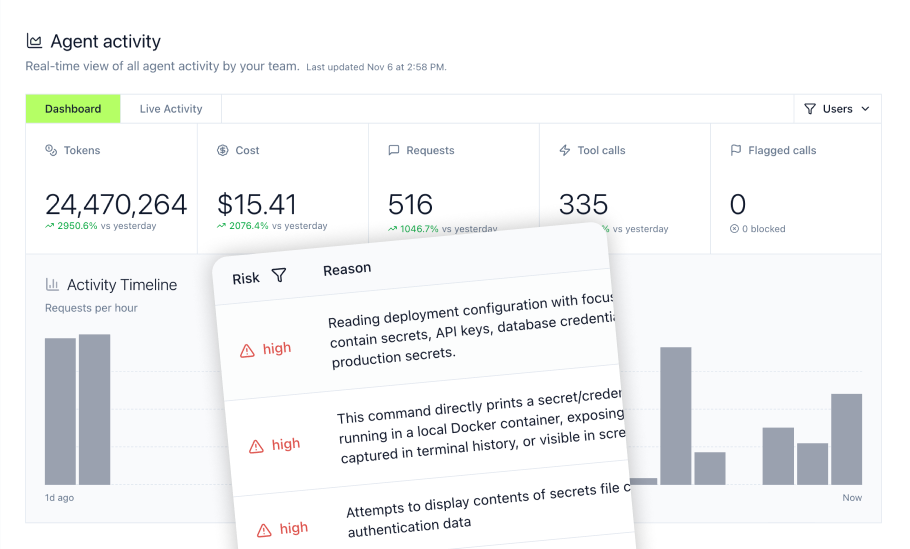
MintMCP's Gateway and Agent Monitor extend governance beyond MCP traffic to monitor AI coding agents and local agent activity.
This two-layer governance helps teams:
- Track MCP tool invocations
- Monitor bash commands and file operations
- See which MCPs are installed across the organization
- Block dangerous commands in real time
- Protect sensitive files such as environment configurations and SSH keys
This visibility is important because coding agents can operate with extensive system access, including reading files, executing commands, and accessing production systems through MCP tools.
Runlayer MCP Gateway
Runlayer focuses on MCP security governance, shadow MCP discovery, and enterprise policy controls. Its positioning is most relevant for organizations prioritizing AI security monitoring and visibility across employee devices.
Runlayer's Security-First Approach
Runlayer's platform emphasizes security evaluation and control.
General capabilities include:
- Threat detection for MCP, skills, plugins, and agents
- Fine-grained permissions for users, teams, and actions
- Policy evaluation before requests reach downstream tools
- Observability and audit logging for MCP activity
- Governance workflows for MCP access and usage
Key Features
Runlayer addresses enterprise security concerns through features such as:
- Shadow MCP detection: Device management integrations to identify unauthorized AI tool usage
- Enterprise identity workflows: Identity integrations and provisioning support
- Policy-based access: Controls for approved users, teams, tools, and actions
- MCP ecosystem access: A large catalog of available MCP servers
- Centralized visibility: Monitoring for MCP usage across teams
These capabilities may be relevant for organizations that need to discover and control unmanaged MCP usage across employee environments.
Deployment Considerations
Full enterprise integration can involve a multi-week rollout depending on implementation scope, identity configuration, and internal security requirements. Organizations evaluating Runlayer should factor deployment planning, governance workflows, and device integration needs into the review process.
Tradeoffs to consider
Runlayer is a security-focused MCP governance platform, so teams should evaluate whether its implementation supports the data-permissions-first primitives they need, including SCIM-driven RBAC, per-use-case tool bundles, credential management, audit logs, and per-agent identity governance. MintMCP addresses these needs through Virtual MCP Bundles, Agent Bundles with M2M authentication, OAuth brokering for stdio and hosted MCP servers, and Gateway plus Agent Monitor governance.
Obot MCP Gateway
Obot takes a different approach as an open-source, self-hosted MCP gateway. It is most relevant for organizations that want direct infrastructure control and have the internal resources to operate self-hosted systems.
Open-Source Value Proposition
Obot appeals to organizations prioritizing:
- Source code access: Teams can inspect and modify the platform
- Infrastructure control: Deploy on customer-managed environments
- No vendor lock-in: Customize and operate the gateway internally
- Data sovereignty: Keep data within customer-controlled infrastructure
- Flexible implementation: Adapt the deployment to internal architecture requirements
The open-source model can reduce software licensing restrictions, though infrastructure, maintenance, and support costs remain the customer's responsibility.
Architectural Philosophy
Obot supports self-hosted deployment, with Docker available for local or small deployments and Kubernetes documented for production-grade reliability, scalability, and high availability.
Its model includes:
- Built-in MCP catalog support
- Self-hosted deployment on customer infrastructure
- Community-driven development
- Customer-managed updates, scaling, and configuration
Common Deployment Scenarios
Obot may fit organizations that need:
- Complete infrastructure control
- Data sovereignty
- Strong internal DevOps ownership
- Custom integration requirements
- Open-source flexibility
- Self-managed deployment and operations
Tradeoffs to consider
The open-source model introduces responsibilities that managed SaaS-first platforms typically handle for the customer.
Organizations should plan for:
- Compliance controls, evidence, and audit readiness
- Docker or Kubernetes planning for production deployments
- Ongoing maintenance and updates
- Internal monitoring and observability setup
- Customer-managed authentication configuration
- Internal support ownership
For teams that want self-hosted control, these tradeoffs may be acceptable. For teams that want governed MCP deployment without operating connector runtimes, scaling, Kubernetes infrastructure, or audit systems themselves, MintMCP addresses these gaps with managed SaaS-first deployment, hosted MCP connectors, centralized observability, and Virtual MCP Bundles.
Key Comparison Points: Security, Compliance, and Governance
Enterprise MCP gateway selection often depends on security and compliance capabilities. Each platform approaches these requirements differently.
Achieving Regulatory Compliance
For compliance and audit readiness, teams should evaluate:
- SOC 2 Type II audited status: MintMCP is SOC 2 Type II audited. Runlayer's compliance status should be validated during vendor review. Obot deployments make compliance implementation the customer's responsibility.
- HIPAA documentation and BAAs: MintMCP is compliant with HIPAA standards, customers handling protected health information can request HIPAA documentation, and MintMCP signs BAAs.
- Audit trail completeness: MintMCP and Runlayer provide logging out of the box, while Obot requires customer-managed implementation.
- Data residency options: Organizations should validate data residency and regional requirements directly with each vendor during security review. Obot allows customer-managed infrastructure placement.
- Enterprise SLAs: MintMCP offers uptime SLA coverage through commercial agreements. Runlayer SLA terms should be validated during vendor review. Obot deployments require self-managed service levels unless support is added.
Authentication and Authorization
All three platforms support enterprise identity providers, but implementation approaches differ.
MintMCP:
- OAuth 2.0, SAML, SSO, and SCIM-driven RBAC
- OAuth brokering for stdio and hosted MCP servers
- Shared, per-user, and per-agent authentication models
- Centralized access control without code changes
Runlayer:
- Enterprise identity integrations
- Provisioning support
- SSO-managed catalog access
- Approval workflows for tool access
Obot:
- Customer-managed identity setup
- Support for common authentication providers depending on configuration
- Full customization for teams with specific requirements
- Internal ownership of setup and operations
MintMCP's OAuth brokering is a major operational advantage for teams that want to turn local servers into authenticated services without manual configuration work.
Integration Capabilities and AI Client Compatibility
The value of an MCP gateway depends partly on the integrations available and the AI clients supported.
Connecting to Enterprise Data
MintMCP provides pre-built enterprise connectors for critical systems, including:
- Elasticsearch integration: Query knowledge bases, search support tickets, and analyze application logs
- Snowflake integration: Support natural language to SQL workflows, Cortex Agent services, and semantic views
- Gmail integration: Search, draft, and send emails with security oversight
- Additional connectors: Notion, Linear, Outlook, and Google Calendar
Other platforms also support MCP connectivity, but integration setup, approval workflows, and infrastructure ownership vary by platform.
Seamless Workflow Integration
MintMCP's approach to integration emphasizes operational simplicity.
Key workflow advantages include:
- One-click STDIO deployment: Use MCP servers without rebuilding infrastructure
- Automatic authentication: Add OAuth brokering while preserving existing functionality
- Gradual rollout: Deploy Virtual MCP Bundles team by team
- Centralized governance: Apply consistent controls across tools and clients
Deployment Flexibility: Cloud vs. Self-Hosted Solutions
Deployment model preferences vary across organizations based on data sensitivity, compliance requirements, and operational capabilities.
Evaluating Deployment Models
Cloud-managed platforms can provide:
- Immediate availability
- Vendor-managed infrastructure
- Automatic updates and maintenance
- SLA-backed reliability
- Reduced internal DevOps burden
Self-hosted platforms can provide:
- Complete infrastructure control
- Customer-managed data environments
- Custom deployment architecture
- Internal ownership of updates and scaling
- Higher operational responsibility
MintMCP's Current and Future Offerings
MintMCP operates as a managed SaaS-first service with US and EU deployment support, uptime SLA coverage, and VPC or self-hosted deployment available on request.
Current deployment benefits include:
- High availability with automatic failover
- Enterprise SLAs with defined uptime guarantees
- Rapid deployment measured in minutes
- Managed infrastructure that reduces DevOps overhead
Data residency, VPC, and self-hosted requirements should be validated directly with MintMCP during security review.
Operational Considerations
Deployment speed varies significantly by platform and implementation scope.
General deployment considerations include:
- MintMCP: Managed SaaS-first model designed for minutes-to-production deployment
- Runlayer: Enterprise rollout timing depends on security, identity, and device integration scope
- Obot: Self-hosted deployment scope depends on Docker, Kubernetes, internal DevOps capacity, and production requirements
Organizations prioritizing time-to-value should weigh deployment timelines against control, customization, and internal ownership requirements.
Why MintMCP Delivers Governance Without Complexity
For organizations evaluating MCP gateway solutions, MintMCP offers a combination of deployment speed, governance capabilities, and enterprise security that directly addresses the challenges enterprises face when scaling AI adoption.
MintMCP helps teams:
- Transform local MCP servers into production-ready services in minutes
- Reduce the infrastructure overhead that delays AI initiatives
- Centralize authentication, access control, credential management, and monitoring
- Create role-specific and agent-specific endpoints through Virtual MCP Bundles
- Maintain audit trails for security reviews and compliance workflows
- Govern AI coding assistants through Gateway and Agent Monitor visibility
MintMCP's Virtual MCP Bundles provide role-based and agent-based tool exposure through dedicated endpoints, ensuring teams and agents access only the tools they need while maintaining comprehensive audit trails. This granular control helps prevent over-privileged access without sacrificing developer productivity.
The platform's pre-built integrations with Elasticsearch, Snowflake, and other enterprise systems accelerate time-to-value while maintaining security oversight. Combined with SOC 2 Type II audited status, HIPAA standards alignment, and AI coding assistant governance capabilities, MintMCP provides a production-ready foundation for enterprise AI deployment.
Engineering leaders seeking to deploy MCP infrastructure without months of implementation work should explore how MintMCP can improve their AI governance posture in days rather than quarters.
Frequently Asked Questions
What is the primary difference between MintMCP Gateway and other MCP gateway solutions?
MintMCP differentiates through deployment speed and Virtual MCP Bundles. While some platforms require weeks for enterprise onboarding or complex Kubernetes configurations, MintMCP deploys MCP servers to production in minutes with one-click STDIO transformation. Virtual MCP Bundles create role-specific and agent-specific endpoints that expose only minimum required tools per team or use case. This architecture enables granular access control where sales teams access CRM tools only and DevOps accesses infrastructure only, preventing over-privileged access while maintaining productivity.
How does MintMCP Gateway ensure enterprise-grade security and compliance for AI tools?
MintMCP provides security through OAuth brokering for stdio and hosted MCP servers, complete audit trails of every interaction, SCIM-driven RBAC, and tool-level access control. The platform is SOC 2 Type II audited, compliant with HIPAA standards, penetration tested, and provides security documentation through its Trust Center. Customers handling protected health information can request HIPAA documentation, and MintMCP signs BAAs. Real-time monitoring dashboards track server health, usage patterns, and security alerts, while Gateway and Agent Monitor governance extend visibility to AI coding agents by tracking tool calls, bash commands, and file operations.
Can MintMCP Gateway integrate with my existing data warehouses and communication platforms?
Yes. MintMCP provides pre-built enterprise connectors for critical systems including Snowflake for data warehouse queries with natural language to SQL conversion, Elasticsearch for knowledge base and log analysis, and Gmail for email search and drafting with security oversight. Additional connectors support Notion, Linear, Outlook, and Google Calendar. MintMCP also supports hosted MCP connectors run by MintMCP, allowing teams to use MCP servers while maintaining centralized governance.
What kind of deployment options does MintMCP offer for its MCP Gateway?
MintMCP operates as a managed SaaS-first service with US and EU deployment support, enterprise SLAs, and high availability. The cloud deployment model provides immediate availability with automatic updates. Data residency, VPC, and self-hosted requirements should be validated directly with MintMCP during security review. The managed approach reduces DevOps overhead and delivers production-ready MCP servers in minutes rather than the weeks often required for self-hosted alternatives.
How does MintMCP help in monitoring and controlling the costs associated with AI tool usage?
MintMCP provides centralized observability that helps teams understand MCP usage patterns across teams, tools, and clients. Real-time usage tracking monitors AI tool interactions across Claude, Cursor, ChatGPT, Gemini, Copilot, and other supported clients. Audit logs and performance metrics help organizations review adoption patterns, investigate incidents, and maintain governance as AI tool usage grows.