Selecting the right MCP gateway for enterprise AI deployment requires evaluating security posture, deployment complexity, compliance readiness, and governance capabilities. Both MintMCP and Portkey have established positions in the AI infrastructure space, but they serve different needs through distinct approaches. MintMCP's MCP Gateway sspecializes in enterprise MCP governance with managed deployment, OAuth brokering, tool-level access control, audit logging, and SOC 2 Type II audited security controls, while Portkey operates as a broader AI gateway platform offering LLM routing alongside MCP capabilities. This comparison examines both platforms to help determine which approach aligns with your organization's AI infrastructure priorities.
Key Takeaways
- MintMCP provides managed STDIO server deployment and hosted MCP connectors, while Portkey offers a hybrid model that includes managed SaaS, OSS AI Gateway, and self-hosted or hybrid enterprise deployment
- MintMCP provides OAuth brokering for stdio and hosted MCP servers, reducing manual authentication work for enterprise MCP deployments
- MintMCP provides audit logs and centralized observability for MCP interactions; Portkey's Pro tier includes 100K recorded logs per month with 30-day log retention
- MintMCP focuses on MCP governance, credential management, tool-level policy, and internal-agent governance; Portkey serves as a unified platform for LLM routing alongside MCP tools
- MintMCP offers data-permissions-first MCP architecture with SSO, SCIM-driven RBAC, Virtual MCP Bundles, Agent Bundles, and rule-based policy; Portkey extends its broader AI gateway model to include MCP functionality
- Portkey provides an open source gateway and a free tier; MintMCP focuses on managed enterprise services for mid-market and enterprise teams
Understanding MCP Gateways: Bridging AI Tools and Enterprise Needs
The Model Context Protocol (MCP) is a protocol for connecting AI clients, supported by companies like Anthropic, OpenAI, Google, and Microsoft. However, deploying MCP servers at enterprise scale introduces challenges around authentication, permissions, audit trails, and governance that individual MCP servers cannot address alone.
MCP gateways solve three specific problems:
- Tool Organization: Centralizing access to multiple MCP servers through a unified interface
- Protocol Translation: Handling the stateful sessions, JSON-RPC communication, and bidirectional connections that MCP requires
- Security Control: Enforcing authentication, authorization, and audit logging across all AI tool interactions
Organizations deploying AI agents need infrastructure that provides visibility and control without disrupting developer workflows. Without proper governance, AI tools operate as black boxes with significant security risks: zero telemetry, no request history, and uncontrolled access.
Why MCP Gateways Differ from Traditional API Gateways
MCP gateways differ fundamentally from API gateways. Traditional API gateways handle stateless HTTP requests with simple request-response patterns. MCP requires:
- Stateful session management for persistent tool contexts
- Native JSON-RPC support for the MCP communication protocol
- Streamable HTTP and STDIO handling for real-time agent interactions
This architectural difference explains why purpose-built MCP gateways deliver better results than retrofitted API gateway solutions.
MintMCP Gateway: Secure and Scalable Deployment for Enterprise AI
MintMCP provides the deployment and monitoring infrastructure that MCP servers need to run in production environments. The platform transforms local MCP servers into production-ready services with enterprise security, policy, and compliance controls.
Key Features for Deployment and Enablement
MintMCP's deployment capabilities address the primary friction point in enterprise MCP adoption, the complexity of moving from local development to production:
- Managed STDIO Deployment: Deploy STDIO-based MCP servers with hosted infrastructure, reducing the need for teams to operate custom runtime infrastructure
- Hosted MCP Connectors: Use MintMCP-operated connectors with isolated execution, scaling, and centralized governance
- Virtual MCP Bundles: Create per-use-case endpoints with SCIM-driven membership, curated tools, and access policy
- Easy Connection: Connect to MCP servers with centralized authentication, policy, and audit controls
The deployment timeline comparison is significant: MintMCP deploys in minutes versus weeks or months for custom infrastructure builds.
Robust Security and Governance Capabilities
Security forms the foundation of MintMCP's architecture:
- OAuth/SSO Integration: MCP endpoints can be protected with OAuth, SAML, SSO, and IdP-backed access controls
- SCIM-Driven RBAC: Use identity provider groups to manage access to Virtual MCP Bundles and tools
- Complete Audit Trails: Every MCP interaction, access request, and configuration change is logged
- Real-Time Monitoring: Live dashboards track server health, usage patterns, and security alerts
- Granular Tool Access Control: Configure tool access by role, enabling read-only operations while excluding write tools
- Rule-Based Policy and Middleware: Apply rule-based policies and JavaScript Gateway Middleware in a JS sandbox for inline enforcement and external DLP or guardrails integrations
- Agent Bundles: Scope agent identities with M2M auth and an “act as agent” flow for connectors that require per-agent OAuth
MintMCP's approach reduces reliance on insecure static credentials by combining centralized credential management, OAuth brokering, and enterprise authentication for MCP deployments.
Infrastructure for Global Scale
For organizations operating across regions, MintMCP provides:
- Managed SaaS-First Deployment: US and EU managed SaaS deployment, with VPC or self-hosted options available on request
- Containerized Server Hosting: Host STDIO servers on MintMCP infrastructure instead of running locally
Portkey MCP Gateway: An Alternative Approach in the MCP Ecosystem
Portkey approaches MCP from a different angle, as an extension of its broader LLM gateway platform. It is positioned for developer and platform engineering teams that want LLM routing, observability, and MCP tool management in a unified gateway model.
Portkey's Platform Overview
Portkey provides a unified control plane for both LLM routing and MCP tool management:
- Universal LLM API: Single API for models across providers
- MCP Gateway Extension: MCP capabilities added to the existing LLM gateway infrastructure
- Open Source Foundation: Open source gateway with self-hosting options
- Observability Platform: Monitoring and tracing for both LLM and MCP interactions
Portkey's platform serves teams that need unified management of LLM routing, model selection, and MCP tools in a single solution.
Tradeoffs to consider
Portkey can be a fit for teams that want a broader LLM gateway with MCP capabilities. Teams evaluating it for enterprise MCP governance should also assess whether they need MintMCP-specific primitives such as Virtual MCP Bundles with SCIM-driven membership, Agent Bundles with M2M auth and “act as agent” flow, hosted MCP connectors run by the vendor, tool-update policy, Admin MCP, and Gateway plus Agent Monitor two-layer governance.
Portkey Pricing Structure
Portkey offers tiered pricing with a free entry point:
- Free Tier: $0/month with 10K logs and 3-day retention
- Pro Tier: $49/month with 100K logs and 30-day retention; overage at $9 per additional 100K requests
- Enterprise Tier: Custom pricing with advanced governance and VPC hosting
The free tier enables immediate experimentation, though log retention limits may constrain visibility as usage scales.
Security and Compliance: Ensuring Trust in Your AI Infrastructure
For regulated industries such as healthcare, financial services, and government, security and compliance requirements drive platform selection decisions.
MintMCP's Compliance Posture
MintMCP is SOC 2 Type II audited and compliant with HIPAA standards, with BAA availability. This provides auditor-ready documentation for compliance reviews while giving regulated teams a clearer path to deploying governed MCP infrastructure.
Additional compliance features include:
- Healthcare Security Reviews: Healthcare organizations can validate HIPAA requirements and BAA needs directly during security review and contracting
- GDPR-Aligned Controls: Audit logging, access control, and data handling controls for European operations
Organizations in regulated industries report that pre-attested infrastructure reduces audit preparation costs by eliminating the need to build and validate custom compliance infrastructure.
Authentication and Access Control
MintMCP's authentication model provides multiple layers of protection:
- OAuth 2.0 and SAML Integration: Connect to existing identity providers
- SSO Enforcement: Enterprise authentication wrapping for MCP endpoints
- SCIM-Driven RBAC: Use IdP groups to manage access to bundles, tools, and policies
- Shared and Per-User Auth: Flexibility to configure service accounts or individual OAuth flows
- Role-Based Access Control: Define who can use which AI tools and access what data
Portkey also provides authentication capabilities, including OAuth 2.1, Okta, Entra, and JWT validation on its Enterprise tier.
AI Agent Monitoring and Control: Beyond the Gateway with MintMCP Agent Monitor
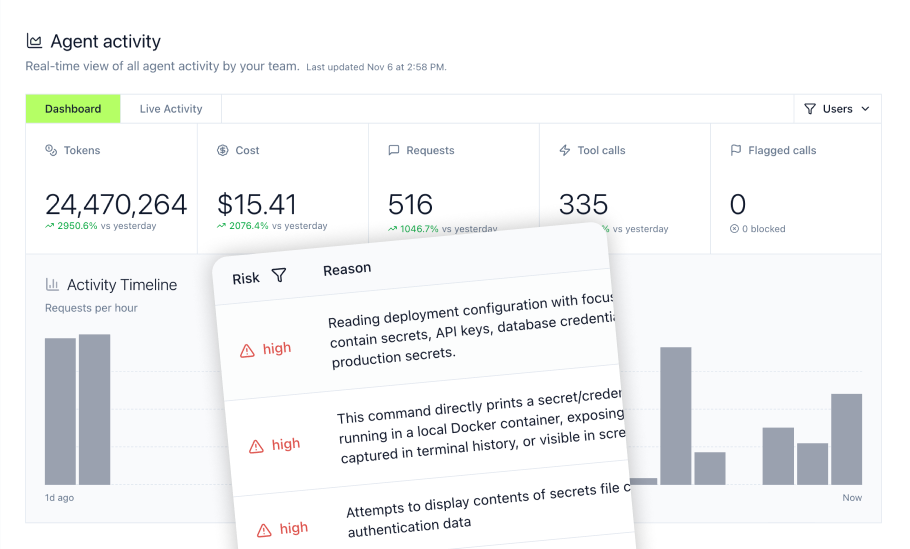
Coding agents operate with extensive system access, reading files, executing commands, and accessing production systems through MCP tools. MintMCP's Agent Monitor addresses this challenge by providing visibility and control over agent behavior across tools such as Claude Code and Cursor.
Gaining Visibility into AI Agent Actions
The Agent Monitor covers local non-MCP agent activity alongside gateway-level MCP traffic:
- Tool Call Tracking: Monitor MCP tool invocation, bash commands, and file operations from coding agents
- MCP Inventory: Visibility into installed MCPs, their permissions, and usage patterns across teams
- Command History: Audit trail of bash commands, file access, and tool calls for security review
Proactive Security for Coding Agents
Beyond monitoring, the Agent Monitor provides active protection:
- Security Guardrails: Block dangerous commands, restrict file access, and control MCP permissions in real time
- Sensitive File Protection: Prevent access to .env files, SSH keys, credentials, and other sensitive configuration
- Real-Time Blocking: Stop risky tool calls like reading environment secrets or executing dangerous commands before they complete
This capability addresses a critical gap: without monitoring, organizations cannot see what agents access or control their actions.
Integrating AI with Enterprise Data: MintMCP Connectors and Use Cases
MintMCP provides pre-built connectors for enterprise systems, enabling AI agents to access organizational data with proper governance.
Unlocking Data with Elasticsearch Integration
The Elasticsearch MCP Server enables AI-powered search and analysis:
- Search: Perform Elasticsearch searches using query DSL for flexible document retrieval
- ES|QL Queries: Execute advanced data analysis with Elasticsearch query language
- Index Management: List indices, retrieve mappings, and monitor shard health
Use cases by team:
- HR teams build AI-accessible knowledge bases from company documentation and policies
- Product teams enable AI-powered documentation search and contextual help systems
- Support teams search historical tickets and resolution patterns for faster issue resolution
Leveraging Snowflake for Data-Driven AI
The Snowflake MCP Server connects AI agents to data warehouse analytics:
- Cortex Agent: Combine structured and unstructured data querying with custom tools
- Natural Language SQL: Convert natural language to SQL using Cortex Analyst with semantic models
- Semantic Search: Search against configured Cortex Search services with filtering
Use cases by team:
- Product management teams enable AI-driven analytics and user behavior analysis with natural language queries
- Finance teams automate financial reporting, variance analysis, and forecasting
- Executive teams generate real-time business intelligence without SQL expertise
Streamlining Communications with Gmail Integration
The Gmail MCP Server enables controlled email automation:
- Search and Retrieval: Search Gmail messages using advanced query syntax with labels and filters
- Draft Creation: Create Markdown-formatted email drafts
- Controlled Sending: Dispatch prepared drafts through approved workflows
Use cases: AI-driven customer response automation, product feedback aggregation, and executive communication analysis.
Platform Features: Centralized Control, Cost Analytics, and Rapid Deployment
MintMCP's platform provides the infrastructure layer that enterprise AI deployments require.
Comprehensive Observability and Cost Management
- Real-Time Usage Tracking: Monitor AI tool interactions across Claude, Cursor, ChatGPT, Gemini, Copilot, and other clients
- Cost Analytics: Track spending per team, project, and tool with detailed breakdowns
- Performance Metrics: Measure response times, error rates, and usage patterns
- Data Access Logs: See what data each AI tool accesses and when
Streamlined Access and Policy Enforcement
- Role-Based Access Control: Define who can use which AI tools and access what data
- Policy Enforcement: Enforce data access and usage policies through rule-based controls
- Enterprise SSO: SAML and OIDC integration with your identity provider
- Centralized Credentials: Manage AI tool API keys and tokens in one place
- Tool-Update Policy: Decide whether new upstream tools are auto-enabled or require admin approval
Accelerating AI Deployment and Management
- Rapid Deployment: Deploy MCP servers with pre-configured policies
- Self-Service Access: Developers request and receive AI tool access through governed workflows
- Cross-Tool Integration: Connect AI tools to your databases, APIs, and services
- User Management: Centralized user provisioning with team-based access controls
- Admin MCP: Manage rules, deploy custom connectors, pull logs, and administer the platform from MCP-compatible clients
Addressing Enterprise Challenges: From Shadow AI to Sanctioned AI
Organizations face a growing challenge: shadow AI grows year-over-year as employees adopt AI tools without IT oversight. MintMCP provides the governance layer that transforms ungoverned AI usage into sanctioned, controlled deployments.
The Shadow AI Challenge
Teams are already using AI tools. The question is whether organizations have visibility into:
- Which AI tools are being used
- What data those tools access
- Whether usage complies with security policies
- How to enforce consistent governance
MintMCP's Governance Solution
MintMCP addresses these challenges through:
- Visibility: See which MCP tools teams are using, track usage patterns, understand data access
- Compliance: Get audit trails and compliance reports for SOC 2 Type II audited security controls, compliance with HIPAA standards, BAA availability, and GDPR-aligned requirements
- Safe Enablement: Deploy MCP tools with pre-configured policies without slowing developers
The result: organizations gain MCP observability while meeting compliance requirements and enabling AI tools safely.
Client Compatibility and Flexible Deployment Options
MintMCP supports the AI clients that enterprise teams use daily.
Broad Support for Major AI Clients
MintMCP's gateway works with:
- Claude: Desktop and Web
- ChatGPT: Via Custom GPTs and Actions
- Microsoft Copilot
- Cursor
- Gemini
- Goose
- LibreChat
- Open WebUI
- Windsurf
- Custom MCP-compatible agents
This broad compatibility ensures that teams can use their preferred AI tools while maintaining centralized governance.
Deployment Options
MintMCP offers managed SaaS-first deployment in the US and EU, with VPC or self-hosted deployment options available on request for organizations requiring greater infrastructure control.
Pricing and Value: Understanding Total Cost of Ownership
Pricing structures differ significantly between the platforms.
MintMCP Pricing Model
MintMCP provides custom pricing based on:
- Active AI agent users
- Team size and usage patterns
- Deployment requirements
MintMCP's managed offering includes enterprise security controls and SOC 2 Type II audited security controls, reducing the need to build separate compliance infrastructure.
Total Cost Considerations
For organizations in regulated industries, the total cost analysis extends beyond subscription fees:
- Avoided compliance infrastructure costs: Building custom SOC 2-compliant infrastructure typically requires $150K-$300K in development
- Reduced audit preparation: Pre-attested infrastructure reduces custom audit preparation
- Faster time to value: Deploy in 2-4 weeks versus 3-6 months for custom implementation
Organizations building equivalent infrastructure in-house face Year 1 costs of $392K-$982K for mid-size enterprises.
Why MintMCP Delivers Enterprise MCP Infrastructure
For organizations deploying MCP at enterprise scale, MintMCP provides the purpose-built infrastructure that production environments demand. The platform's managed deployment transforms local MCP servers into production-ready services quickly, reducing the infrastructure work that alternative approaches can require.
MintMCP's SOC 2 Type II audited security controls, compliance with HIPAA standards, and BAA availability provide auditor-ready compliance documentation, which is critical for healthcare, financial services, and government organizations. OAuth brokering and SSO-backed access controls help ensure MCP servers receive enterprise authentication without manual configuration, reducing the insecure static credentials that create security gaps.
With audit logs, centralized observability, rule-based policy, and granular tool access control, MintMCP delivers the visibility and governance that enterprise AI deployments require. The MCP Gateway handles the complexity of stateful sessions, JSON-RPC communication, and bidirectional connections natively, while the Agent Monitor provides essential monitoring and security for coding agents.
Organizations benefit from rapid deployment timelines, hosted MCP connectors for enterprise data sources like Snowflake and Elasticsearch, and comprehensive policy enforcement that transforms shadow AI into sanctioned, controlled deployments. The platform's support for major AI clients, including Claude, ChatGPT, Cursor, Gemini, Microsoft Copilot, and others, ensures teams can maintain their preferred workflows while benefiting from centralized governance.
From local MCP to enterprise deployment, fast. That's what MintMCP delivers.
Frequently Asked Questions
What is the primary difference between MintMCP's MCP Gateway and its Agent Monitor?
The MCP Gateway centralizes MCP server deployment, authentication, and governance, transforming local STDIO servers into production-ready managed services with OAuth brokering, SSO-backed access controls, audit logging, and rule-based policy. The Agent Monitor covers local non-MCP agent activity from tools like Cursor or Claude Code, monitoring tool calls, bash commands, and file access while blocking risky operations in real time. Together, they provide two-layer visibility and control over AI tool usage.
How does MintMCP ensure data privacy and compliance like SOC 2, HIPAA, and GDPR?
MintMCP is SOC 2 Type II audited and compliant with HIPAA standards, with BAA availability. The platform provides GDPR-aligned data handling with audit logs, access controls, and policy enforcement. Organizations with healthcare or jurisdiction-specific requirements should validate those needs directly during security review and contracting. Every MCP interaction is logged for compliance reporting.
What AI clients are compatible with MintMCP's gateway solution?
MintMCP supports Claude (Desktop and Web), ChatGPT via Custom GPTs and Actions, Microsoft Copilot, Cursor, Gemini, Goose, LibreChat, Open WebUI, Windsurf, and custom MCP-compatible agents. This broad compatibility ensures teams can maintain their preferred AI workflows while benefiting from centralized governance.
Can MintMCP integrate with existing enterprise data sources like Snowflake or Elasticsearch?
Yes. MintMCP provides pre-built connectors for Snowflake, Elasticsearch, Gmail, and other enterprise systems. These connectors enable AI agents to query data warehouses, search knowledge bases, and interact with business tools, all with proper authentication, audit logging, and access control.
How does MintMCP help organizations address shadow AI?
MintMCP transforms shadow AI into sanctioned AI by providing visibility into which MCP tools teams use, what data those tools access, and whether usage complies with security policies. The platform enables organizations to deploy MCP tools with pre-configured policies without slowing developers, turning ungoverned AI usage into controlled, compliant deployments.