Selecting the right MCP gateway for enterprise AI deployments requires evaluating security features, deployment speed, compliance capabilities, and governance controls. Both MintMCP and Lasso.Security have established themselves as notable MCP gateway solutions, but they serve different organizational needs through distinct approaches. MintMCP's MCP Gateway delivers enterprise gateway infrastructure focused on authentication, tool-level access control, credential management, logging, rule-based policy, and agent governance. Lasso.Security takes a security-first, open-source approach with threat detection and customization capabilities. This comparison examines both platforms to help determine which approach aligns with enterprise AI governance priorities.
Key Takeaways
- MintMCP's one-click deployment transforms local STDIO MCP servers into production-ready services in minutes without code changes
- MintMCP is designed for production deployments with enterprise monitoring, logging, centralized governance, and a data-permissions-first architecture
- MintMCP includes hosted MCP connectors run by MintMCP for Snowflake, Elasticsearch, Gmail, and other data sources, reducing integration development time
- MintMCP's Virtual MCP Bundles enable per-use-case endpoints with SCIM-driven membership and granular tool-level policy
- MintMCP's Agent Bundles provide per-agent identity with M2M auth and an “act as agent” flow for scoped internal-agent governance
- Lasso.Security offers an open-source option with threat detection and a plugin architecture for customization
- MintMCP is part of Cursor's hooks partner ecosystem, reinforcing its role in MCP governance and visibility for AI coding agents
Understanding the Core: What is an MCP Gateway?
An MCP gateway sits between LLM clients, Claude, ChatGPT, Cursor, and similar AI tools, and MCP servers, providing security, governance, and observability layers that transform developer utilities into production-grade infrastructure.
MCP (Model Context Protocol) has become a standard protocol for connecting AI clients to enterprise tools and data. Supported by Anthropic, OpenAI, Google, and Microsoft, MCP enables AI agents to access databases, APIs, and internal systems. However, raw MCP deployments introduce challenges:
- Zero telemetry on what AI agents access
- No request history for audit and compliance
- Uncontrolled access to sensitive systems and data
- Scattered credentials across developer environments
- Manual deployment requiring infrastructure expertise
MCP gateways solve these problems by providing centralized authentication, comprehensive audit logging, and rate control for all MCP connections. For organizations where 71% regularly use generative AI according to McKinsey research, governed AI tool access has become essential infrastructure.
MintMCP Gateway addresses these challenges through a managed, data-permissions-first platform approach with SSO, SCIM-driven RBAC, IdP groups, Virtual MCP Bundles, tool-level policy, audit, automatic OAuth brokering, and enterprise monitoring without infrastructure overhead. This transforms shadow AI into sanctioned AI while maintaining developer velocity.
Enterprise-Grade Security: MintMCP's Robust Approach to API Security
Security architecture determines whether an MCP gateway can meet enterprise requirements. MintMCP's approach centers on enterprise authentication, comprehensive audit trails, rule-based policy, credential management, and real-time monitoring designed for regulated industries.
Audit Trails and Observability for Compliance
MintMCP provides complete audit trails of every MCP interaction, access request, and configuration change. This observability infrastructure supports:
- **SOC 2 Type II audited **security controls
- Compliant with HIPAA standards, with BAA availability for healthcare and regulated workflows
- Compliance-ready audit logging for regulated environments
- Complete request logging for security review and incident response
Organizations with formal AI governance strategies are better positioned to manage access, auditability, and risk as AI usage expands across teams. MintMCP's audit capabilities provide the foundation for that governance structure.
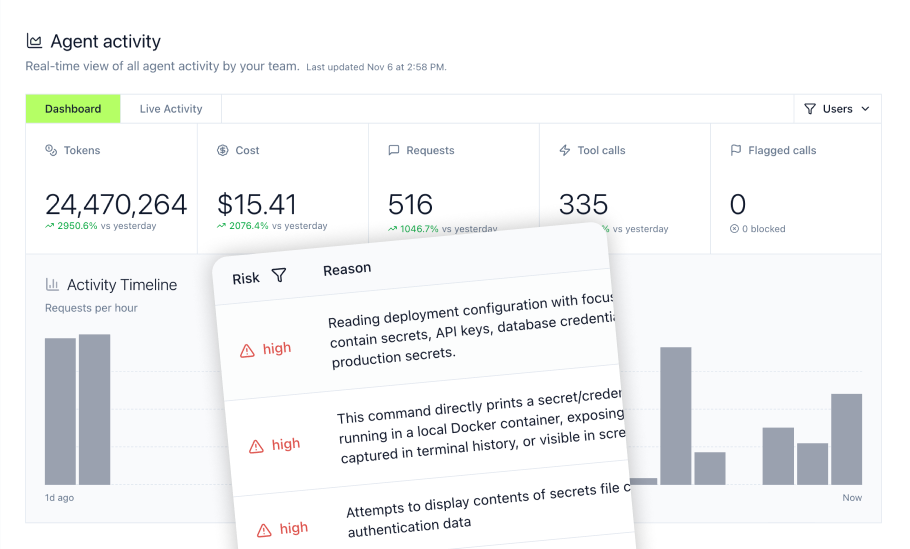
MintMCP's Agent Monitor layer extends this observability to coding agents, monitoring MCP tool invocation, bash commands, file operations, and prompt submissions from AI assistants like Cursor and Claude Code.
Protecting Sensitive Data and Commands
MintMCP enforces security guardrails at multiple levels:
- SSO and SCIM-driven RBAC with enterprise identity providers and IdP groups
- SSO enforcement across MCP endpoints
- Role-based access control defining who can use which AI tools
- Granular tool permissions configuring access by role, for example read-only operations
- Tool-level allowlisting and rule-based policy to enforce least-privilege access
- Credential management to reduce scattered secrets across developer environments
- JavaScript Gateway Middleware running in a JS sandbox for inline policy, masking, and transformation workflows
- External DLP and guardrails integrations for teams with existing security investments
- Gateway + Agent Monitor two-layer governance for MCP traffic and local non-MCP agent activity
These controls address the reality that coding agents operate with extensive system access. Without proper governance, AI tools function as black boxes with significant security risks.
Lasso.Security MCP Gateway: A Competitive Overview
Lasso.Security entered the MCP gateway market with a security-first, open-source approach. The platform emphasizes AI security and threat detection as core parts of its positioning.
Key characteristics of Lasso.Security's approach:
- Open-source availability providing code visibility for teams that want to inspect or customize the gateway
- Threat detection for prompt injection and data exfiltration risks
- PII masking capabilities through Presidio integration
- Plugin architecture enabling custom security guardrails
- MCP server reputation scoring based on GitHub metrics
Lasso.Security offers open-source deployment and enterprise engagement options, with commercial details handled through its sales process.
Primary Focus and Key Differentiators
Lasso.Security is designed to add security scanning and guardrails in front of MCP interactions, making it suitable for organizations prioritizing inspection and policy enforcement.
Lasso.Security's plugin-based architecture enables teams with DevOps expertise to extend security capabilities beyond standard configurations. The open-source model provides code visibility for organizations requiring auditable security implementations.
Tradeoffs to consider
A security-focused MCP gateway can help teams inspect MCP traffic and enforce guardrails, but buyers should also evaluate whether it supports the governance primitives needed for internal employee and internal-agent access at scale: SCIM-driven RBAC, per-use-case tool bundles, audit logs, credential management, and agent identity governance. MintMCP addresses these needs through Virtual MCP Bundles, Agent Bundles with M2M auth, managed SaaS-first deployment, hosted MCP connectors, and centralized observability.
Deploying Your MCP Servers: MintMCP's One-Click Advantage
Deployment speed directly impacts time-to-value for AI infrastructure investments. MintMCP's architecture eliminates the infrastructure overhead that typically delays MCP deployments.
From Local to Production in Minutes
Most MCP servers are STDIO-based, designed for local development environments rather than production deployment. Transforming these servers into enterprise-ready services traditionally requires:
- Container orchestration setup
- Authentication layer implementation
- Monitoring infrastructure deployment
- Security policy configuration
- High availability architecture
MintMCP eliminates this complexity through one-click deployment that automatically:
- Hosts STDIO servers on MintMCP infrastructure instead of local machines
- Brokers OAuth for stdio and hosted MCP servers without code changes
- Enables enterprise monitoring with live dashboards
- Runs hosted MCP connectors with managed scaling and isolated execution
This approach reduces deployment time from weeks to minutes. Organizations can transform existing local MCP servers into production services immediately, accelerating AI tool adoption without waiting for infrastructure teams.
MintMCP's MCP registry provides a central catalog of available MCP servers with one-click installation and configuration. Combined with Virtual MCP Bundles for role-based access, teams can deploy governed AI tool access without custom development.
Unified Access and Control: Centralized Governance with MintMCP
Enterprise AI governance requires more than security, it demands unified control over who accesses what, when, and how. MintMCP's centralized governance model addresses this through comprehensive access management.
Managing Who Can Access What: Granular Permissions
MintMCP's Virtual MCP Bundles enable administrators to create custom MCP endpoints exposing only the minimum required tools for each team, role, or use case. This capability supports:
- Least-privilege enforcement through tool-level allowlisting and rule-based policy
- Team-specific tool sets such as read-only database access for analysts
- SCIM-driven membership using IdP groups for role and team assignment
- Credential isolation preventing cross-team access to sensitive systems
- Self-service access requests with policy-based approval workflows
Organizations implementing enterprise-wide AI governance can standardize access controls, auditability, and policy enforcement across AI clients and internal tools. MintMCP's governance architecture provides the foundation for consistent, enforceable AI policies.
The platform supports both shared and per-user authentication models, with flexibility to configure service accounts at the admin level or enable individual OAuth flows based on organizational requirements. For internal agents, Agent Bundles add per-agent identity, M2M auth, scoped tools, and an “act as agent” flow for connectors that require per-agent OAuth.
Real-time Monitoring and Observability: Gain MCP Insights
Visibility into AI tool usage drives informed governance decisions. MintMCP's monitoring infrastructure tracks every interaction across MCP deployments.
Real-time dashboards provide:
- Server health status across all MCP endpoints
- Usage patterns by team, project, and tool
- Security alerts for policy violations
- Performance metrics including response times and error rates
- Centralized observability for MCP traffic and governed agent activity
Data access logging captures:
- Which data sources each AI tool accesses
- Query patterns and data volumes
- User-level activity tracking
- Temporal access patterns for anomaly detection
This observability enables organizations to understand AI tool adoption, identify optimization opportunities, and demonstrate compliance during audits. MintMCP's Agent Monitor layer extends monitoring to coding agents specifically, tracking bash commands, file operations, prompt submissions, and tool invocations from AI assistants in development environments.
Building AI-Powered Workflows: MintMCP's Integrations and Use Cases
Pre-built integrations accelerate AI deployment by eliminating custom connector development. MintMCP's connector library includes enterprise-ready integrations for common data sources and business systems.
Connecting AI to Your Enterprise Data
Snowflake MCP Server enables:
- Natural language to SQL conversion via Cortex Analyst
- Semantic search against configured Cortex Search services
- Direct query execution with DML and DDL support
- Semantic view querying with dimensions, metrics, and facts
Elasticsearch MCP Server provides:
- Flexible document retrieval using query DSL
- ES|QL queries for advanced data analysis
- Index listing and mapping retrieval
- Shard health monitoring
Gmail MCP Server supports:
- Advanced email search with labels and filters
- Email drafting with Markdown formatting
- Thread-aware reply generation
- Controlled draft dispatch workflows
Practical Applications Across Departments
These integrations enable concrete use cases:
- HR teams build AI-accessible knowledge bases from company documentation and policies
- Product teams enable AI-powered documentation search and contextual help systems
- Support teams search historical tickets and resolution patterns for faster issue resolution
- Finance teams automate reporting and variance analysis from data warehouses
- Executive teams generate business intelligence dashboards without SQL expertise
For teams adopting AI workflows across departments, governed connectors help reduce custom integration work while keeping access, credentials, and audit trails centralized.
Navigating Compliance: SOC 2 and Enterprise Standards with MintMCP
Compliance requirements often determine MCP gateway selection for regulated industries. MintMCP's compliance architecture addresses enterprise security and audit requirements.
SOC 2 Type II audited security controls and compliance with HIPAA standards, with BAA availability provide:
- Documented security controls verified by independent auditors
- Evidence of operational effectiveness over time
- Faster enterprise procurement cycles
- Reduced vendor security review burden
Compliance-ready infrastructure enables:
- Complete audit trails for data access
- Enterprise authentication and access controls
- Security logging for internal review processes
MintMCP's compliance posture accelerates enterprise AI adoption by providing the documentation and controls that procurement and security teams require during vendor evaluation. For the latest compliance information, visit the MintMCP Trust Center.
Comparing Deployment Models: Cloud vs. Self-Hosted Options
Deployment model preferences vary based on organizational requirements for data control, infrastructure management, and operational complexity.
MintMCP's deployment options:
- Managed SaaS-first deployment: Available in US and EU regions, with managed updates and reduced infrastructure management
- VPC/self-hosted on request: Available for organizations with infrastructure control requirements, subject to deployment scope and procurement discussion
The managed SaaS-first approach provides:
- Reduced infrastructure management for IT and security teams
- Managed connector runtime and hosted MCP connectors run by MintMCP
- Enterprise deployment options aligned to organizational data handling requirements
- No customer-operated Kubernetes pods or connector runtimes for the managed connector layer
Lasso.Security's deployment options:
- Open-source self-hosted: Full infrastructure control for teams that want to operate the gateway themselves
- Enterprise engagement: Hosted and managed options may be evaluated through its sales process
Organizations with existing DevOps capabilities and requirements for self-hosted deployment may evaluate Lasso.Security's open-source option. However, this approach can require ongoing maintenance, security patching, and infrastructure management that increase total cost of ownership.
For teams prioritizing speed to production and minimal operational overhead, MintMCP's managed SaaS-first deployment reduces infrastructure complexity while providing enterprise governance, hosted MCP connectors, and centralized observability.
The Value Proposition: Why Choose MintMCP for Enterprise AI Governance?
MintMCP addresses the core enterprise challenges in AI tool deployment: visibility, compliance, and controlled enablement without sacrificing developer velocity. The platform transforms MCP gateway infrastructure from a technical implementation challenge into a strategic enabler for AI adoption.
Comprehensive observability provides visibility into which MCP tools teams use, tracking usage patterns, and understanding data access across organizations. This transforms shadow AI into governed AI infrastructure with complete audit trails and real-time monitoring.
Enterprise compliance readiness through SOC 2 Type II audited security controls, compliance with HIPAA standards, BAA availability, and compliance-ready logging enables AI deployment in regulated industries where audited security controls are non-negotiable. Complete audit trails, enterprise authentication, and documented security controls accelerate procurement cycles and reduce vendor review burden.
Rapid deployment without code changes through one-click deployment, OAuth brokering for stdio and hosted MCP servers, and hosted MCP connectors run by MintMCP. Local MCP servers transform into production-ready services without infrastructure overhead, reducing time-to-value from weeks to minutes.
Granular access control via Virtual MCP Bundles enables per-use-case endpoints, SCIM-driven membership, tool-level allowlisting, credential management, and least-privilege enforcement. Security teams maintain control while developers receive access to AI tools through policy-based approval workflows.
Internal-agent governance through Agent Bundles gives each agent its own scoped identity with M2M auth and an “act as agent” flow. This keeps agent access tied to explicit policy instead of shared service-account keys.
MintMCP works with existing AI tool deployments, Claude, ChatGPT, Gemini, Cursor, Copilot, and other MCP-compatible clients, without requiring changes to developer workflows. This compatibility ensures adoption without disruption while providing the governance layer that enterprise security and compliance teams require.
For organizations seeking enterprise MCP infrastructure that balances security, compliance, and developer experience, MintMCP provides a fast path from local development to production deployment. Book a demo to see how MintMCP can transform AI governance approaches.
Frequently Asked Questions
What is the primary difference between MintMCP and Lasso.Security MCP Gateway?
MintMCP provides a managed enterprise platform with SOC 2 Type II audited security controls, compliance with HIPAA standards, BAA availability, one-click deployment, Virtual MCP Bundles, Agent Bundles, and hosted MCP connectors designed for rapid production deployment in regulated industries. Lasso.Security offers an open-source gateway with a security-first approach featuring threat detection and a plugin architecture. MintMCP prioritizes data-permissions-first governance, deployment speed, and compliance readiness, while Lasso.Security focuses on security customization for teams with DevOps expertise.
How does MintMCP ensure compliance with enterprise security standards?
MintMCP is SOC 2 Type II audited and compliant with HIPAA standards, with BAA availability, providing documented security controls for enterprise procurement. The platform offers complete audit trails, enterprise authentication, and compliance-ready logging that can support regulated environments and internal review processes. Every MCP interaction, access request, and configuration change is logged for security review and incident response.
Can MintMCP support existing AI client deployments?
Yes. MintMCP supports Claude, Cursor, ChatGPT, Gemini, Microsoft Copilot, and other MCP-compatible agents. The platform works with existing AI tool deployments without requiring changes to developer workflows, so teams can connect current AI clients to MintMCP-governed MCP servers immediately.
What deployment options are available for MintMCP?
MintMCP is managed SaaS-first, with US and EU availability, and VPC/self-hosted deployment available on request. Organizations with VPC, on-premise, or self-hosted requirements can discuss deployment scope and availability with MintMCP during procurement. The managed approach reduces infrastructure overhead while providing centralized governance and operational support.
How does MintMCP help control costs and improve observability?
MintMCP provides real-time dashboards tracking usage patterns, centralized observability by team and project, and performance metrics including response times and error rates. The platform logs which data sources each AI tool accesses, enabling organizations to optimize AI tool investments, identify adoption patterns, and demonstrate governance during audits.
What enterprise integrations does MintMCP offer?
MintMCP includes hosted MCP connectors for Snowflake (natural language to SQL, semantic search), Elasticsearch (query DSL, ES|QL analytics), Gmail (email search and drafting), plus integrations for Notion, Linear, Google Calendar, Outlook, and databases including PostgreSQL, MySQL, MongoDB, and others. These production-ready integrations reduce development time from weeks to minutes.