Selecting the right MCP gateway for enterprise AI deployment requires evaluating security posture, deployment speed, compliance readiness, and integration capabilities. As organizations scale AI agent usage, the Model Context Protocol has quickly emerged as an important open standard for connecting AI clients to internal tools and data. MintMCP's MCP Gateway delivers enterprise infrastructure with one-click deployment and centralized governance. Lasso.Security offers a security-focused gateway with customizable plugins. Composio provides a developer-first platform with extensive integration options. This comparison examines how each platform addresses enterprise AI governance needs to help engineering leaders make informed decisions.
Key Takeaways
- MintMCP provides one-click deployment with production-ready infrastructure in minutes, compared to more self-managed alternatives
- MintMCP is an official Cursor partner, validating enterprise-grade quality for AI coding workflows
- Lasso.Security emphasizes security scanning and plugin-based customization for teams that want more control over the gateway layer
- Composio offers a broad app integration catalog for developer teams building multi-tool AI workflows
- Formal AI governance requires structured controls for authentication, policy enforcement, credential management, and auditability
- MintMCP's data-permissions-first architecture enables security teams to govern access with SSO, SCIM-driven RBAC, Virtual MCP Bundles, tool-level policy, and audit logs before broad engineering deployment
Understanding the Need for MCP Gateways in Enterprise AI
The Model Context Protocol market emerged following Anthropic's November 2024 release of the open-source MCP standard. Adoption has accelerated across the AI tooling ecosystem, making MCP an increasingly important protocol for AI-to-tool connections.
Enterprise teams face specific challenges when deploying MCP at scale:
- Shadow AI proliferation: Teams adopt AI tools without centralized oversight or security review
- Scattered credentials: API keys and tokens spread across individual developer machines
- Zero telemetry: No visibility into what data AI agents access or what actions they execute
- Compliance gaps: Audit trails required for SOC 2, HIPAA, and GDPR remain incomplete
MCP gateways solve these problems by providing a centralized control plane between AI clients and backend tools. The gateway handles authentication, monitors tool invocations, enforces access policies, and generates compliance-ready audit logs.
Why Gateway Selection Matters
The choice of MCP gateway impacts deployment speed, operational overhead, and long-term governance capabilities. MCP deployments can introduce risks such as command injection, SSRF, and unreviewed tool exposure when servers are connected without centralized governance. A well-architected gateway addresses these risks at the infrastructure level rather than requiring per-server remediation.
MintMCP's gateway architecture transforms local STDIO-based MCP servers into production services with OAuth protection, real-time monitoring, and enterprise hardening. This approach reduces the infrastructure overhead that slows AI adoption while maintaining the security controls enterprises require.
MintMCP's MCP Gateway: Enterprise-Grade Infrastructure
MintMCP's MCP Gateway addresses three core enterprise requirements: rapid deployment, centralized governance, and compliance-ready security.
Deployment and Infrastructure
MintMCP enables one-click deployment of STDIO-based MCP servers with automatic hosting and lifecycle management. Key infrastructure capabilities include:
- STDIO server support: Deploy and manage STDIO-based MCP servers without local installations
- MCP registry: Central catalog of available MCP servers with one-click installation
- Virtual MCP Bundles: Create per-use-case endpoints with SCIM-driven membership, curated tools, and role-based access policy
- Agent Bundles: Give internal agents scoped identities with M2M auth and an “act as agent” flow where connectors require per-agent OAuth
- OAuth brokering: Add SSO and OAuth to stdio and hosted MCP servers
- Tool-update policy: Require admin approval before newly exposed upstream tools become available, or auto-enable them where appropriate
- Easy connection: Simple connection to any MCP server with automatic discovery and configuration
The platform transforms local development servers into production-ready services with monitoring, logging, and compliance alignment. Engineering teams deploy in minutes rather than spending weeks on infrastructure setup.
Enterprise Cloud Infrastructure
For organizations with enterprise deployment requirements, MintMCP provides:
- Managed SaaS-first deployment: US and EU hosted deployment options for enterprise rollouts
- High availability: Enterprise-oriented infrastructure and support for production deployments
- VPC and self-hosted options: Available on request for organizations with stricter infrastructure requirements
- Data residency options: Deployment options for organizations evaluating regional governance needs
These capabilities address deployment and governance requirements common in healthcare, financial services, and government sectors.
Real-Time Observability and Control
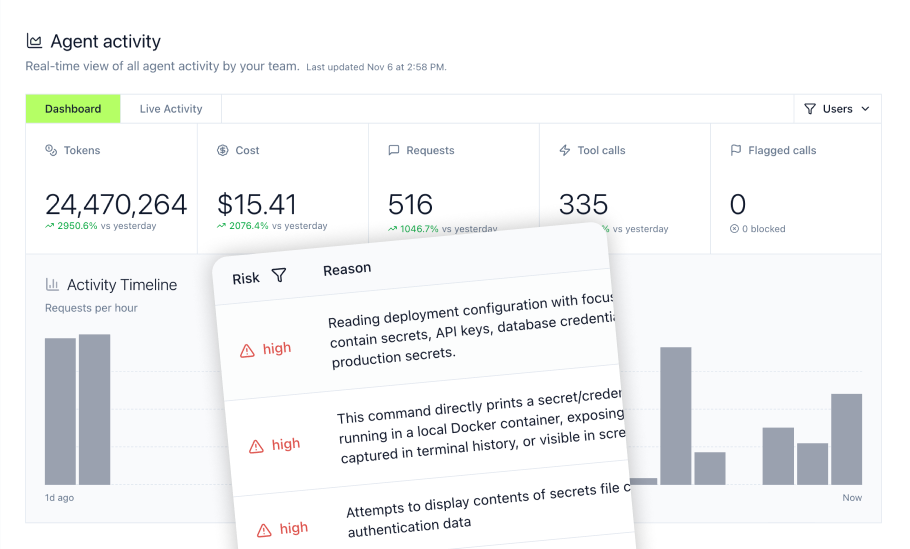
MintMCP's observability features provide complete visibility into AI agent behavior:
- Live dashboards: Monitor server health, usage patterns, and security alerts in real time
- Tool call tracking: Record every MCP tool invocation with full context
- Security alerting: Surface unusual access patterns and operational issues for review
- Performance metrics: Measure response times, error rates, and usage trends
This telemetry enables security teams to understand exactly what AI tools access and when, converting black-box AI operations into auditable workflows.
Lasso.Security MCP Gateway
Lasso.Security provides a security-focused MCP gateway, emphasizing threat detection, policy customization, and code-level control.
Core Security Features
Lasso.Security focuses on threat detection and prevention:
- Prompt injection defense: Detection of malicious prompt patterns
- PII masking: Personal data redaction workflows
- Tool reputation scoring: Evaluate risk levels of connected MCP servers
- Plugin architecture: Extensible framework for custom security rules
The platform is relevant for teams that want to customize gateway behavior and security scanning workflows.
Performance Characteristics
Lasso.Security's architecture balances security scanning with performance requirements. Teams should evaluate latency using their own deployment model, traffic profile, and security scanning configuration rather than relying on generic performance claims.
Deployment Model
Lasso.Security follows a security-focused gateway model:
- Self-managed deployment: Suitable for teams that want direct control over gateway configuration and operations
- Customizable security controls: Plugin-oriented customization for security workflows
- Infrastructure requirements: Requires internal ownership of deployment, maintenance, and policy operations
Tradeoffs to consider
A security-focused gateway can help teams inspect MCP traffic and customize controls, but security teams should also evaluate whether it provides the identity and governance primitives needed for internal employee and internal-agent governance. MintMCP addresses this with managed SaaS-first deployment, SSO and SCIM-driven RBAC, Virtual MCP Bundles, Agent Bundles with M2M auth, tool-level allowlisting, credential management, and audit logs.
Composio
Composio positions itself as a developer-first platform for AI agent integrations, offering a broad connector library in the MCP ecosystem.
Integration Library
Composio provides app integrations spanning:
- Productivity tools: Slack, Notion, Gmail, Google Calendar
- Developer platforms: GitHub, Linear, Jira, Sentry
- Databases and APIs: Various data sources with unified access
- Custom integrations: Framework support for LangChain, CrewAI, Autogen
Integration Capabilities
Composio's integration breadth serves teams building multi-tool AI workflows. The platform offers:
- Managed OAuth: Authentication with token lifecycle management
- Bidirectional triggers: Event-driven workflows beyond simple actions
- Sandboxed execution: Remote sandboxes for secure tool composition
- SDK support: Python, TypeScript, and CLI interfaces
Considerations
Composio is primarily oriented toward developer and AI engineering teams building agentic apps and external customer-facing AI products. Teams focused on internal employee and internal-agent governance should evaluate whether they need MintMCP-specific controls such as SCIM-driven RBAC, Virtual MCP Bundles, Agent Bundles, tool-update policy, hosted MCP connectors run by MintMCP, and centralized audit logs across Claude, Cursor, ChatGPT, Gemini, and Copilot.
Security and Compliance: MintMCP's Enterprise-Grade Standards
MintMCP's security architecture addresses enterprise compliance requirements from the foundation.
SOC 2 Type II Audited
MintMCP is SOC 2 Type II audited, providing independent validation of security controls. MintMCP is also compliant with HIPAA standards, penetration tested, and built with complete audit trails. Customers handling protected health information can request HIPAA documentation, and MintMCP signs BAAs.
These controls:
- Streamline security review processes for enterprise procurement
- Demonstrate continuous monitoring and control effectiveness
- Support vendor security requirements for regulated industries
MintMCP also provides GDPR-aligned data handling with complete audit trails.
Regulatory Compliance Support
MintMCP generates compliance-ready audit logs for SOC 2, HIPAA, and GDPR review workflows:
- Complete audit trail: Every MCP interaction, access request, and configuration change recorded
- Data access logs: See exactly what data each AI tool accesses and when
- Policy enforcement: Automatically enforce data access and usage policies
- Retention controls: Configurable log retention for enterprise review requirements
These capabilities reduce the compliance burden on security and legal teams while enabling AI adoption.
Security Controls for AI Coding Agents
MintMCP's LLM Proxy and Agent Monitor extend security controls to coding agents:
- Command blocking: Block dangerous bash commands in real time
- Sensitive file protection: Prevent access to .env files, SSH keys, and credentials
- MCP inventory: Complete visibility into installed MCPs across the organization
- Command history: Full audit trail of every bash command and file access
This protection layer addresses the security risks inherent in AI coding assistants that operate with extensive system access.
Integration Capabilities: Connecting AI Tools to Your Ecosystem
MintMCP provides pre-built enterprise connectors for common business systems, enabling rapid deployment without custom development.
Enterprise Data Connectors
MintMCP offers production-ready connectors for:
- Elasticsearch: Search knowledge bases, support tickets, and application logs with AI-powered queries
- Snowflake: Execute natural language queries against data warehouses for analytics and reporting
- Gmail: Enable AI assistants to search, draft, and send communications with full security oversight
Data Analysis with Snowflake
MintMCP's Snowflake MCP Server includes tools for:
- Cortex Agent: Combine structured and unstructured data querying with custom tools
- Cortex Analyst: Natural language to SQL conversion using semantic models
- Cortex Search: Semantic search against configured search services
- Query execution: Run SQL queries with support for DML and DDL operations
These capabilities enable product, finance, and executive teams to access data insights through AI agents without SQL expertise.
Communication Automation with Gmail
MintMCP's Gmail MCP Server supports:
- Email search: Search Gmail messages using advanced query syntax
- Content retrieval: Retrieve complete email content including metadata
- Draft creation: Create Markdown-formatted email drafts
- Thread management: Generate replies within existing threads
- Controlled sending: Dispatch prepared drafts through approved workflows
Customer support teams use these capabilities for AI-driven response automation with full security oversight.
Comparing Licensing and Support Models
For organizations evaluating open-source alternatives, IBM ContextForge represents another option in the MCP gateway space.
Enterprise Support Considerations
IBM ContextForge operates under the Apache 2.0 license. Teams evaluating it for production deployments should verify the support model, operational ownership, and enterprise maintenance path that apply to their environment. This model provides:
- Open-source core: Apache 2.0 licensing for the base platform
- Customer-managed operations: Internal teams remain responsible for deployment and maintenance unless a separate support path is arranged
- Enterprise evaluation path: Teams can assess support, security, and operational requirements before production use
Support Model Comparison
Support considerations for MCP gateways vary by platform:
MintMCP provides support as part of the managed service model, including infrastructure management, monitoring, and compliance maintenance within enterprise plans. Lasso.Security is a stronger fit for teams that want more direct ownership of gateway configuration and operations. IBM ContextForge support and maintenance paths should be verified during procurement. Composio includes support options for teams building integration-heavy AI workflows.
MintMCP's managed service model reduces the need to build internal DevOps expertise for MCP infrastructure.
Platform Features for Observability, Cost, and Governance
Enterprise MCP deployments require visibility into usage, costs, and access patterns across teams and projects.
MintMCP's Governance Capabilities
MintMCP provides comprehensive platform features:
- Real-time usage tracking: Monitor every AI tool interaction across Claude, Cursor, ChatGPT, Gemini, Copilot, and more
- Cost analytics: Track spending per team, project, and tool with detailed breakdowns
- Performance metrics: Measure response times, error rates, and usage patterns
- Data access logs: See exactly what data each AI tool accesses and when
Cost Management Features
MintMCP's cost management features include:
- Team-based allocation: Attribute costs to specific teams and projects
- Usage quotas: Set limits on tool calls and data access by role
- Trend analysis: Identify usage patterns and optimize resource allocation
- Budget alerts: Receive notifications when spending approaches limits
Centralized Policy Enforcement
MintMCP's governance features enable:
- Role-based access control: Define who can use which AI tools and access what data
- Enterprise SSO: SAML and OIDC integration with your identity provider
- SCIM-driven user management: Centralized provisioning with team-based access controls
- Tool-level allowlisting: Curate which tools are available to each team, role, and agent
- Centralized credentials: Manage all AI tool API keys and tokens in one place
- Policy enforcement: Automatically enforce data access and usage policies
These capabilities transform scattered AI tool usage into governed, auditable workflows.
Addressing Enterprise AI Adoption Challenges
Enterprise AI adoption faces specific obstacles that MCP gateways must address.
Converting Shadow AI into Sanctioned AI
Shadow AI grows rapidly as teams adopt tools without central oversight. MintMCP addresses this challenge by:
- Providing visibility into existing AI tool usage across the organization
- Enabling rapid deployment of approved MCP servers with pre-configured policies
- Maintaining developer velocity while adding security and governance controls
- Creating audit trails that satisfy compliance requirements
The approach transforms ungoverned AI usage into controlled, observable workflows without disrupting team productivity.
Accelerating Production Deployment
Traditional enterprise software deployments require extensive planning, infrastructure provisioning, and security reviews. MintMCP accelerates this timeline:
- One-click deployment: Deploy STDIO-based MCPs instantly with built-in hosting
- Automatic OAuth: Add enterprise authentication without code changes
- Pre-configured policies: Start with security controls enabled by default
- Self-service access: Developers request and receive AI tool access through governed workflows
Structured deployment and governance help organizations make AI agents useful in production while maintaining security oversight.
Why MintMCP for Enterprise MCP Deployment
MintMCP delivers the combination of deployment speed, compliance readiness, and governance capabilities that enterprise AI deployments require. Engineering leaders evaluating MCP gateways face the challenge of balancing developer velocity with security, compliance, and operational control. MintMCP addresses this challenge through production-ready infrastructure that deploys in minutes rather than months.
The platform's SOC 2 Type II audited controls, HIPAA standards alignment, and BAA availability support enterprise security reviews that can delay AI adoption. GDPR-aligned controls and comprehensive audit logging support regulatory review workflows across healthcare, financial services, and government sectors. Unlike self-managed alternatives that require DevOps expertise and ongoing maintenance, MintMCP's managed service model includes infrastructure, monitoring, and compliance management.
MintMCP's data-permissions-first architecture enables security teams to govern approved tools before broad engineering deployment, transforming shadow AI into sanctioned workflows. The platform provides complete observability into AI agent behavior, tracking every tool call, file access, and command execution across Claude, Cursor, ChatGPT, Gemini, Copilot, and other clients. Pre-built enterprise connectors for Snowflake, Elasticsearch, and Gmail accelerate integration with existing data systems.
For organizations deploying AI at scale, MintMCP's centralized governance features provide role-based access control, enterprise SSO integration, SCIM-driven provisioning, and policy enforcement across teams. The LLM Proxy and Agent Monitor add security controls specifically designed for AI coding assistants, blocking dangerous commands and protecting sensitive credentials. These capabilities enable organizations to maintain developer productivity while ensuring AI operations remain secure, compliant, and auditable.
Book a demo to see how MintMCP transforms MCP deployment for your organization.
Frequently Asked Questions
What is the primary function of an MCP Gateway in an enterprise setting?
An MCP gateway serves as a centralized control plane between AI clients (like Claude, ChatGPT, or Cursor) and backend tools and data sources. The gateway handles authentication, monitors tool invocations, enforces access policies, and generates audit logs. This architecture enables organizations to deploy AI tools at scale while maintaining security, compliance, and visibility. MintMCP's MCP Gateway adds one-click deployment, OAuth protection, and real-time monitoring to transform local MCP servers into production-ready infrastructure.
How does MintMCP ensure compliance with regulations like SOC 2 and GDPR?
MintMCP is SOC 2 Type II audited and provides GDPR-aligned data handling. The platform generates complete audit trails of every MCP interaction, access request, and configuration change in formats ready for compliance review. MintMCP is also compliant with HIPAA standards, and customers handling protected health information can request HIPAA documentation and BAAs. MintMCP's security documentation details the specific controls and attestations available for enterprise deployments.
What are the key differences between MintMCP, Lasso.Security, and Composio?
MintMCP focuses on enterprise governance with managed infrastructure, delivering one-click deployment, data-permissions-first access control, and compliance-ready security. Lasso.Security emphasizes security scanning and plugin-based customization for teams that want more gateway-layer control. Composio prioritizes integration breadth for developer teams building multi-tool workflows. MintMCP serves organizations that need production-ready MCP infrastructure with SSO, SCIM-driven RBAC, Virtual MCP Bundles, Agent Bundles, credential management, and centralized audit logs.
Can MintMCP integrate with existing enterprise data warehouses like Snowflake?
Yes. MintMCP provides pre-built connectors for enterprise data systems including Snowflake, Elasticsearch, and Gmail. The Snowflake MCP Server includes Cortex Agent, Cortex Analyst, and Cortex Search capabilities for natural language queries against data warehouses. These integrations enable product, finance, and executive teams to access data insights through AI agents with full security governance.
What kind of support is available for IBM ContextForge compared to MintMCP?
IBM ContextForge operates under the Apache 2.0 license. Teams evaluating it should verify the support and maintenance path that applies to their deployment model. MintMCP provides support as part of the managed service model, including infrastructure management, monitoring, and compliance maintenance. MintMCP's approach reduces the need for internal DevOps expertise while providing enterprise-grade support and SLAs.