Selecting the right MCP gateway for enterprise AI deployment requires evaluating security credentials, deployment speed, governance features, and integration ecosystems. Both MintMCP and Natoma have established themselves in the enterprise MCP gateway space, but they serve different organizational priorities through distinct approaches. MintMCP's MCP Gateway delivers SOC 2 Type II audited infrastructure with rapid deployment, hosted MCP connectors, and data-permissions-first governance, while Natoma focuses on Shadow AI discovery and desktop MCP server management. This comparison examines both platforms to help determine which approach aligns with your enterprise AI governance requirements.
Key Takeaways
- MintMCP provides access to hosted MCP connectors run by MintMCP, including Snowflake, Elasticsearch, and Gmail connectors, while Natoma focuses on discovery and governance for existing MCP deployments
- MintMCP offers rapid STDIO-to-production deployment with OAuth brokering for stdio and hosted MCP servers
- MintMCP maintains an official Cursor partnership for validated AI coding assistant governance
- MintMCP provides data-permissions-first governance through SSO, SCIM-driven RBAC, tool-level allowlisting, audit logs, Virtual MCP Bundles, and Agent Bundles
- Building a custom MCP gateway typically requires substantial engineering time and ongoing maintenance. Managed platforms can reduce that burden
Understanding the Enterprise MCP Gateway Landscape
The MCP gateway market has expanded rapidly as enterprises look for safer ways to connect AI assistants to internal tools and data. Adoption has accelerated as organizations move from isolated experiments toward governed, production-ready AI infrastructure.
Both platforms emerged to address fundamental enterprise challenges: connecting AI assistants like ChatGPT and Claude with internal data and tools while maintaining security, compliance, and governance. However, they approach these challenges differently.
MintMCP focuses on transforming local MCP servers into production-ready services with enterprise-grade security and compliance. Every aspect of the platform, from rapid deployment to complete audit trails, reflects this specialized commitment to enterprise MCP infrastructure.
Natoma entered the market with emphasis on Shadow AI discovery and desktop MCP management, helping organizations identify unmanaged AI tools deployed across engineering teams.
Why MCP Gateways Matter for Enterprise AI
MCP gateways solve three core enterprise challenges:
- Tool Organization: Centralizing access to AI tools across teams and departments
- Protocol Translation: Converting between different MCP server formats and authentication methods
- Security Control: Enforcing governance policies, audit trails, and access permissions
Without proper governance, AI tools operate as black boxes with significant security risks: zero telemetry, no request history, and uncontrolled access to sensitive data. MCP gateways provide the visibility and control enterprises need to deploy AI tools safely.
Core Capabilities: Bridging AI Tools with Internal Data
Enterprise AI deployments require seamless connections between AI assistants and internal systems: databases, CRMs, repositories, and communication platforms. Both MintMCP and Natoma facilitate these connections, though with different scope and depth.
MintMCP's Approach to AI-Data Integration
MintMCP's MCP Gateway provides comprehensive infrastructure for connecting AI agents to enterprise data:
- Data analysis: AI agents query databases, generate reports, and answer business questions using real-time data
- Customer support: AI assistants access CRM data, support tickets, and customer history for improved support quality
- Development workflows: AI coding assistants connect securely to repositories, issue trackers, and CI/CD systems
MintMCP's Virtual MCP Bundles expose only the minimum required tools, not entire MCP servers, enabling granular control over what AI agents can access. This approach supports least privilege through per-use-case endpoints, SCIM-driven membership, curated tool lists, and Bundle-level access policies.
MintMCP also supports Agent Bundles with M2M authentication, giving internal agents their own scoped identities instead of relying on shared service-account keys.
Natoma's Primary Focus
Natoma focuses on discovery and governance for existing MCP deployments:
- Shadow AI discovery: Identifies unmanaged MCP instances across organizations
- Desktop MCP support: Manages local stdio servers alongside cloud deployments
- Attribute-based access control: Context-aware policies based on user, group, device, and AI client
Both platforms support OAuth, SSO, and enterprise identity provider integration. However, MintMCP's OAuth brokering for stdio and hosted MCP servers reduces manual authentication configuration for deployment teams.
Security, Governance, and Compliance: A Critical Comparison
For regulated industries, compliance credentials often determine platform viability. Security posture directly impacts procurement timelines and risk assessments.
Enterprise Authentication and SSO
Both platforms provide enterprise authentication capabilities:
MintMCP Security Features:
- OAuth 2.x, SAML, and SSO integration for MCP access
- OAuth brokering for stdio and hosted MCP servers
- Granular tool access through tool-level allowlisting and rule-based policy
- SSO and SCIM-driven RBAC using IdP groups
- Supports both shared service accounts and per-user OAuth flows
Natoma Security Features:
- OAuth authentication
- SSO/SAML/SCIM integration
- Attribute-based access control policies
- Endpoint visibility integrations for existing security workflows
Compliance Credentials
MintMCP is SOC 2 Type II audited, compliant with HIPAA standards, penetration tested, and supports complete agent-action auditability. MintMCP also provides continuous compliance monitoring through Drata, enterprise SSO, complete audit trails, PII detection, and role-based access control across the platform. Customers handling protected health information can request HIPAA documentation, and MintMCP signs BAAs. Teams can review MintMCP's current security posture through the Trust Center.
These controls are particularly valuable for:
- Enterprise procurement processes requiring security documentation
- Organizations needing audit trails and access controls for compliance reviews
- Financial services firms with strict vendor security requirements
- Any organization subject to SOC 2, HIPAA, or GDPR-aligned review workflows
MintMCP also provides complete audit trails. Every MCP interaction, access request, and configuration change is logged for compliance review.
Natoma publicly markets security and governance capabilities, so teams should validate the report type, scope, and deployment boundaries during enterprise procurement.
Seamless Deployment and Infrastructure Management
Deployment speed directly impacts time-to-value for AI initiatives. Complex infrastructure requirements delay projects and consume engineering resources.
MintMCP's Deployment Model
MintMCP transforms local MCP servers into production-ready services through a managed SaaS-first model:
- STDIO server support: Deploy STDIO-based MCP servers with hosted runtime and lifecycle management
- MCP registry: Central registry of available MCP servers with installation and configuration workflows
- Virtual MCP Bundles: Create and manage per-use-case MCP endpoints for teams with SCIM-driven membership and role-based access
- OAuth protection: Add SSO and OAuth brokering to stdio and hosted MCP servers
This approach reduces the traditional deployment burden. Rather than spending months on self-hosted infrastructure and authentication setup, teams can use managed MCP infrastructure with governed access, hosted connectors, and centralized observability.
Natoma's Deployment Approach
Natoma provides deployment through Profiles, organization-wide configurations distributed via single URL endpoints. The platform supports:
- BYO MCP feature for custom server integration
- Auto-generation of MCP servers from OpenAPI specs
- Support for private Docker registries
- Desktop stdio server management
Both platforms enable faster deployment compared to custom-built infrastructure. However, MintMCP's managed SaaS-first model and hosted MCP connectors specifically address a common deployment challenge: transforming developer-built local servers into governed enterprise services without requiring customers to operate connector runtimes, scaling, or Kubernetes infrastructure.
Tradeoffs to consider
Natoma's discovery and desktop MCP management approach can be useful when the primary challenge is finding unmanaged MCP usage across the organization. Teams should also evaluate whether they need MintMCP-specific primitives such as Virtual MCP Bundles, Agent Bundles with M2M auth and “act as agent” flow, tool-update policy, hosted MCP connectors run by MintMCP, and OAuth brokering for stdio and hosted MCP servers.
Avoiding the Custom Build Trap
Building a custom MCP gateway typically requires substantial engineering time, deployment effort, and ongoing maintenance. Managed platforms can reduce that burden significantly while providing capabilities that would require extensive effort to replicate.
Monitoring and Observability for AI Tool Usage
Understanding how AI tools interact with enterprise data is essential for security, cost management, and operational optimization.
MintMCP's Real-Time Monitoring
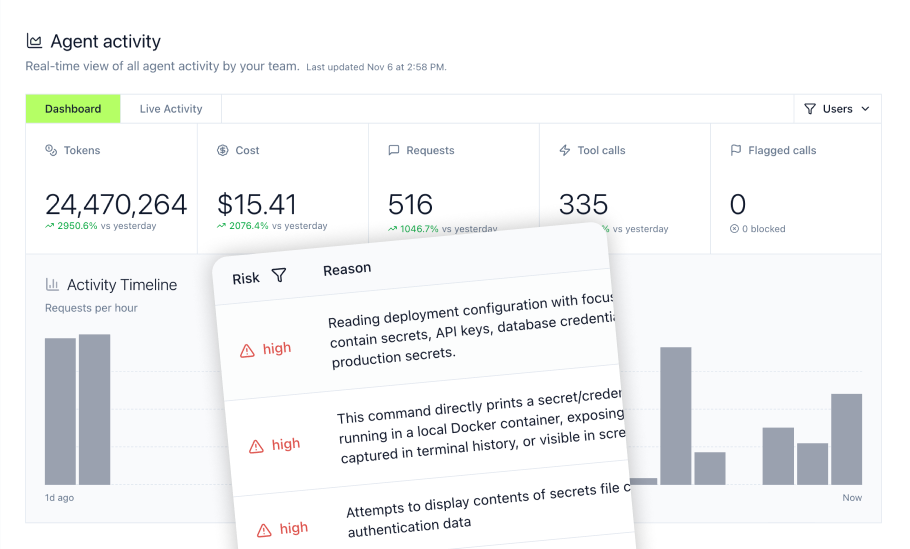
MintMCP provides comprehensive visibility through real-time monitoring dashboards:
- Real-time usage tracking: Monitor AI tool interactions across Claude, Cursor, ChatGPT, Gemini, Copilot, and other clients
- Cost analytics: Track spending per team, project, and tool with detailed breakdowns
- Performance metrics: Measure response times, error rates, and usage patterns
- Data access logs: See exactly what data each AI tool accesses and when
- Security alerts: Live notifications for anomalies and potential security events
This observability extends through MintMCP's two-layer governance model: Gateway and Agent Monitor. The Gateway covers MCP traffic, while Agent Monitor covers local non-MCP agent activity such as bash commands, file reads and writes, and prompt submissions through Claude Code and Cursor hooks.
Natoma's Monitoring Capabilities
Natoma provides monitoring through:
- Audit logging with export capabilities
- SIEM integration
- Usage tracking at the tool call level
- Discovery and visibility for unmanaged MCP usage
Both platforms provide audit trail capabilities necessary for compliance. MintMCP's advantage lies in its two-layer governance model: visibility into both MCP gateway traffic and local coding agent activity through Agent Monitor.
Extending AI Capabilities with Key Integrations
The value of an MCP gateway depends significantly on available integrations. Pre-built connectors accelerate deployment and reduce custom development requirements.
MintMCP's Integration Ecosystem
MintMCP provides hosted MCP connectors run by MintMCP, including purpose-built enterprise connectors:
- Natural language to SQL conversion using Cortex Analyst
- Semantic search against Cortex Search services
- Execute SQL queries with DML and DDL support
- Query semantic views using dimensions, metrics, and facts
Use cases span product analytics, financial reporting, and executive business intelligence, enabling teams to gain insights from data warehouses without SQL expertise.
- Perform searches using query DSL for flexible document retrieval
- Execute ES|QL queries for advanced data analysis
- List indices and retrieve field mappings
- Get shard allocation and health information
Applications include AI-powered knowledge base search, support ticket intelligence, and log analysis for troubleshooting.
- Search Gmail messages using advanced query syntax
- Retrieve complete email content including attachments
- Create and send email drafts
- Generate replies within existing threads
This enables AI-driven customer response automation, product feedback aggregation, and communication analysis.
Natoma's Integration Library
Natoma provides MCP server capabilities for:
- Custom MCP server integration via BYO feature
- OpenAPI spec conversion to MCP servers
- Private Docker registry support
- Endpoint security workflow integrations
MintMCP's hosted connector model offers broad coverage for enterprise integration needs while reducing the need for customers to operate connector runtimes, scaling, and infrastructure.
Agent Monitor: Securing Coding Agents and Production Systems
AI coding assistants like Cursor and Claude Code operate with extensive system access: reading files, executing commands, and accessing production systems through MCP tools. This creates security considerations that standard MCP gateways don't address.
MintMCP's Agent Monitor Solution
MintMCP's LLM Proxy supports MintMCP's Agent Monitor approach by providing visibility into local coding agent behavior:
Tool Call Tracking:
- Monitor MCP tool invocations, bash commands, and file operations
- Track which MCPs are installed across teams
- See what files agents access in real time
MCP Inventory:
- Complete visibility into installed MCPs and their permissions
- Usage pattern analysis across coding agents
- Identification of unauthorized or risky MCP installations
Security Guardrails:
- Block risky commands in real time
- Protect sensitive files such as .env files, SSH keys, and credentials from access
- Complete audit trail of agent operations
- Help prevent reading of environment secrets
Sensitive File Protection:
- Prevent access to configuration files containing credentials
- Block operations on SSH keys and authentication tokens
- Real-time alerts for attempts to access protected resources
MintMCP's official Cursor partnership supports this approach with validated integration for coding agent monitoring in Cursor.
Why Coding Agent Security Matters
Without monitoring, organizations have limited visibility into:
- What commands coding agents execute on developer machines
- Which files agents read or modify
- Whether agents access production credentials or sensitive data
- Patterns of agent behavior that might indicate security issues
Agent Monitor addresses these gaps, transforming coding agents from security blind spots into governed enterprise tools.
Cost Efficiency and ROI for Enterprise AI Adoption
Enterprise AI investments require clear ROI justification. Understanding both direct costs and indirect benefits helps build the business case.
Pricing Structure Comparison
MintMCP Pricing:
- Enterprise pricing available through demo consultation
- SOC 2 Type II audited infrastructure included
- Compliant with HIPAA standards, with BAAs available for eligible customers
- Uptime SLA available
- Contact enterprise@mintmcp.com for details
Natoma Pricing:
- Contact sales for Pro and Enterprise tier information
- SLA and support options should be validated during procurement
For enterprise deployments requiring compliance credentials and extensive integrations, MintMCP's comprehensive platform helps reduce the security and governance gaps that require additional investment to address.
Build vs. Buy Economics
The economics strongly favor managed MCP gateways. Custom builds require dedicated platform and security engineering effort, separate audit and attestation programs, and ongoing maintenance, while managed platforms include security programs, rapid deployment, and comprehensive monitoring in the subscription.
Enterprise Productivity Impact
Organizations typically justify AI agent investments through faster workflow execution, lower manual effort, and shorter time-to-value when governance and deployment friction are reduced. MintMCP's managed SaaS-first deployment model helps accelerate time-to-value for these benefits.
Choosing the Right Gateway: Key Considerations for Your Business
Different organizational priorities favor different platforms. Understanding your specific requirements helps identify the right fit.
Choose MintMCP When You Need:
- SOC 2 Type II audited infrastructure for enterprise procurement in regulated industries
- Compliance support including HIPAA standards, BAAs for eligible customers, penetration testing, and Trust Center documentation
- Audit trails and access controls for compliance review processes
- Fast deployment path with STDIO-to-production conversion and OAuth brokering
- Hosted MCP connectors run by MintMCP, including Snowflake, Elasticsearch, and Gmail
- Virtual MCP Bundles for per-use-case endpoints with SCIM-driven membership
- Agent Bundles for per-agent identity with M2M auth and “act as agent” flow
- Coding agent security through Agent Monitor for development teams
- Validated Cursor integration for AI coding assistant governance
Assessing Your Compliance Requirements
For organizations in regulated industries, compliance credentials should be the starting point:
- Healthcare: MintMCP is compliant with HIPAA standards, signs BAAs for eligible customers, and provides audit trails and access controls that can support healthcare review processes
- Financial Services (SOX, PCI): SOC 2 Type II audited infrastructure demonstrates security control maturity
- Government/Defense: Comprehensive audit logging may support compliance reviews
- GDPR Coverage: Complete audit trails can support European privacy accountability and review workflows
MintMCP's security documentation provides detailed information on compliance capabilities for enterprise evaluation.
Long-Term Scalability
Enterprise AI deployments grow rapidly once initial projects demonstrate value. Platform selection should consider:
- Integration breadth: Will the platform support future use cases?
- Performance at scale: Can the platform handle organization-wide deployment?
- Governance depth: Will security controls scale with usage?
- Deployment model: Does the platform match your SaaS, VPC, or self-hosted requirements?
MintMCP's managed SaaS-first deployment model supports US and EU deployment, with VPC and self-hosted options available on request.
Conclusion: MintMCP Delivers Enterprise-Grade MCP Infrastructure
For organizations prioritizing security, compliance, and rapid deployment, MintMCP provides the comprehensive MCP gateway solution enterprises need. The platform is SOC 2 Type II audited, compliant with HIPAA standards, penetration tested, and designed to audit every agent action, helping teams reduce custom security review work while maintaining governed access.
MintMCP's integration ecosystem includes hosted MCP connectors run by MintMCP, from Snowflake data warehouses to Elasticsearch knowledge bases to Gmail communications. The LLM Proxy and Agent Monitor extend governance to coding agents, providing security teams with visibility into tool calls, bash commands, and file access.
From local MCP to enterprise deployment, fast. Book a demo to see how MintMCP transforms your AI infrastructure with managed deployment, real-time monitoring, and enterprise-grade security.
Frequently Asked Questions
What is the primary difference between MintMCP and Natoma MCP Gateways?
MintMCP focuses on enterprise-grade MCP infrastructure with SOC 2 Type II audited controls, hosted MCP connectors, Virtual MCP Bundles, Agent Bundles, and managed deployment. The platform emphasizes governed production deployment and comprehensive compliance support. Natoma emphasizes Shadow AI discovery and desktop MCP server management, helping organizations identify and govern existing MCP deployments. MintMCP's approach suits organizations prioritizing compliance, hosted connector infrastructure, and data-permissions-first governance, while Natoma's discovery capabilities address organizations needing visibility into existing MCP usage.
How does MintMCP ensure compliance with regulations like SOC 2 and GDPR?
MintMCP is SOC 2 Type II audited, with continuous compliance monitoring through Drata. The platform also provides complete audit trails that can support SOC 2 evidence collection, healthcare-oriented security reviews, and GDPR accountability workflows. Every MCP interaction, access request, and configuration change is logged for compliance review. MintMCP is compliant with HIPAA standards, signs BAAs for eligible customers, and makes security documentation available through the Trust Center.
Can MintMCP's MCP Gateway connect to my existing enterprise data sources like Snowflake and Elasticsearch?
Yes. MintMCP provides purpose-built connectors for major enterprise platforms. The Snowflake MCP Server enables natural language queries against data warehouses, semantic model access, and SQL execution. The Elasticsearch MCP Server supports knowledge base search, log analysis, and advanced ES|QL queries. Additional connectors cover Gmail, databases, and development tools, with hosted MCP connectors run by MintMCP to reduce customer infrastructure burden.
What role does the MintMCP LLM Proxy play in securing AI agent operations?
The LLM Proxy supports MintMCP's Agent Monitor approach for observing and controlling coding agent behavior across tools like Cursor and Claude Code. It helps track MCP tool invocations, bash commands, and file operations in real time. Security guardrails can block risky commands and protect sensitive files such as .env files, SSH keys, and credentials from unauthorized access. Agent Monitor provides audit trails for security review and compliance documentation, which is essential visibility for organizations deploying AI coding assistants at scale.
How does MintMCP help control the costs associated with enterprise AI tool usage?
MintMCP's monitoring dashboards track spending per team, project, and tool with detailed breakdowns. Organizations gain visibility into which AI tools consume resources, enabling informed decisions about allocation and optimization. By replacing custom MCP gateway development, managed platforms like MintMCP can reduce total cost of ownership and accelerate time-to-value.