Selecting the right MCP gateway for enterprise AI deployment requires evaluating production readiness, compliance capabilities, deployment complexity, and long-term operational costs. Both MintMCP and IBM ContextForge address the growing need to connect AI assistants with enterprise data and tools, but they serve different organizational profiles through fundamentally different approaches. MintMCP's MCP Gateway provides a managed, SOC 2 Type II audited platform designed for rapid enterprise deployment, while IBM ContextForge offers an open-source, self-hosted solution with extensive customization options. This comparison examines both platforms to help engineering leaders determine which approach aligns with their infrastructure requirements and compliance mandates.
Key Takeaways
- MintMCP delivers managed SaaS-first deployment for teams that want governed MCP access without operating connector infrastructure themselves
- MintMCP provides SSO, SCIM-driven RBAC, OAuth brokering, and tool-level policy, while ContextForge also supports built-in authentication and user-scoped OAuth tokens but requires teams to configure and operate those identity flows themselves
- IBM ContextForge is released under Apache 2.0 license with optional IBM Elite Support available for v0.9.0+
- ContextForge's latest tagged release is v1.0.0, which IBM describes as its General Availability release
- MintMCP hosts MCP connectors in managed cloud infrastructure, eliminating local installation requirements across development teams
- ContextForge offers federation capabilities for multi-gateway coordination across distributed enterprise environments
Understanding the Enterprise AI Governance Challenge
Enterprise interest in MCP infrastructure has accelerated as organizations look for safer ways to connect AI assistants to internal systems and tools. This expansion reflects a broader shift from experimental AI access toward governed, production-ready deployments.
This growth introduces three specific enterprise challenges:
- Shadow AI proliferation: Teams adopt AI tools without centralized visibility or control
- Compliance gaps: Traditional AI deployments lack the audit trails required for security and privacy reviews
- Operational complexity: STDIO-based MCP servers require local installation and lack enterprise authentication
MCP gateways address these challenges by providing centralized access control, authentication enforcement, and audit logging for AI tool interactions. The choice between managed and self-hosted approaches depends on internal DevOps capabilities, compliance timelines, and customization requirements.
Why MCP Gateways Matter for Enterprise AI
Without proper governance, AI tools operate as black boxes with significant security risks. Organizations face:
- Zero telemetry into what data AI agents access
- No request history for compliance audits
- Uncontrolled access to sensitive systems and credentials
MintMCP's approach transforms shadow AI into sanctioned AI by providing visibility and control without disrupting developer workflows. For engineering teams evaluating enterprise MCP deployment, the gateway layer determines whether AI adoption accelerates productivity or creates unmanaged risk.
MintMCP Gateway: Production-Ready Enterprise Infrastructure
MintMCP Gateway transforms local MCP servers into production services with OAuth protection, enterprise monitoring, and data-permissions-first governance. The platform addresses the core challenge facing engineering teams: STDIO-based MCP servers are difficult to deploy at scale without significant infrastructure investment.
Managed Deployment and Governance
MintMCP eliminates the infrastructure overhead typically associated with MCP deployment:
- STDIO server hosting: Deploy and manage STDIO-based MCP servers with automatic hosting and lifecycle management
- MCP registry: Central registry of available MCP servers with installation and configuration workflows
- Virtual MCP Bundles: Create per-use-case endpoints with SCIM-driven membership, curated tools, and role-based access policies
- Easy connection: Simple connection to any MCP server with automatic discovery and configuration
The platform's managed SaaS-first model contrasts with the multi-month work often required for custom MCP infrastructure builds. This reduces the operational burden on engineering teams by moving connector hosting, scaling, and runtime management into the platform.
Advanced Security and Governance
MintMCP's security model addresses enterprise requirements through multiple layers:
- SSO and SCIM-driven RBAC: Enterprise authentication and group-based access control across MCP access
- Complete audit trails: Every MCP interaction, access request, and configuration change logged for compliance
- Real-time monitoring: Live dashboards for server health, usage patterns, and security alerts
- Granular tool access control: Configure tool access by role, enabling read-only operations while excluding write tools
- Credential management and OAuth brokering: Centralized handling for stdio and hosted MCP servers
- Rule-based policy: Tool-level allowlisting, policy enforcement, and tool-update controls for upstream server changes
The platform supports both shared service accounts at the admin level and individual OAuth flows, providing flexibility for different organizational authentication models. For teams exploring MCP gateway architecture, this authentication flexibility proves critical for enterprise adoption.
Monitoring and Securing AI Agents with MintMCP Agent Monitor
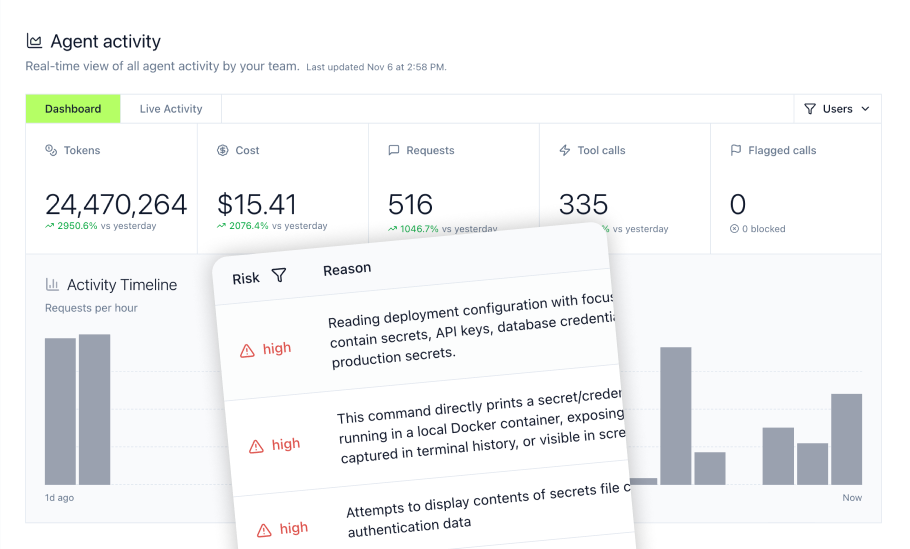
Coding agents operate with extensive system access, reading files, executing commands, and accessing production systems through MCP tools. MintMCP's Agent Monitor and gateway layer provide the visibility and control that organizations require to manage this access safely.
Real-Time Tool Call Tracking
The Agent Monitor tracks interactions between AI clients, local developer environments, and enterprise tools:
- Tool call tracking: Monitor MCP tool invocations, bash commands, and file operations from coding agents
- MCP inventory: Complete visibility into installed MCPs, their permissions, and usage patterns across teams
- Command history: Complete audit trail of bash commands, file access, and tool calls for security review
This observability extends across Claude, Cursor, ChatGPT, Gemini, and Copilot governance workflows, providing centralized visibility regardless of which AI tools teams adopt.
Sensitive File Protection and Security Guardrails
The platform protects against common security risks associated with AI agent access:
- Block dangerous commands: Real-time prevention of risky operations like reading environment secrets or executing destructive commands
- Protect sensitive files: Prevent access to .env files, SSH keys, credentials, and other sensitive configuration
- Policy enforcement: Automatically enforce data access and usage policies across AI tool interactions
- PII detection and external guardrails: Support policy checks and integrations with external DLP and guardrails systems
The monitoring layer operates alongside the MCP gateway so organizations can govern both MCP traffic and local non-MCP agent activity without disrupting existing developer workflows. For organizations evaluating LLM proxy security, this architecture provides protection without adding friction to AI adoption.
Seamless Enterprise Integrations: Elasticsearch, Snowflake, and Gmail
MintMCP provides pre-built connectors that enable AI agents to access enterprise data sources with proper authentication and governance. These integrations transform how teams interact with critical business systems.
Knowledge Management with Elasticsearch
The Elasticsearch MCP Server enables AI-powered search across enterprise knowledge bases:
- search: Perform Elasticsearch searches using query DSL for flexible document retrieval
- esql: Execute Elasticsearch ES|QL queries for advanced data analysis
- list_indices: List all available Elasticsearch indices in your cluster
- get_mappings: Retrieve field mappings for specific Elasticsearch indices
HR teams build AI-accessible knowledge bases from company documentation, policies, and training materials for instant employee assistance. Support teams empower AI agents to search historical support tickets, resolution patterns, and help articles for faster customer issue resolution.
Data-Driven Insights with Snowflake
The Snowflake MCP Server connects AI agents to enterprise data warehouses with natural language querying:
- cortex_analyst: Natural language to SQL conversion using Cortex Analyst with semantic models or views
- cortex_search: Semantic search against configured Cortex Search services with filtering
- run_snowflake_query: Execute SQL queries in Snowflake with support for DML and DDL operations
- query_semantic_view: Query semantic views using dimensions, metrics, and facts
Product management teams enable AI-driven analytics and user behavior analysis directly from Snowflake with natural language queries. Finance teams automate financial reporting, variance analysis, and forecasting with AI agents accessing governed financial data models.
Automating Communication with Gmail
The Gmail MCP Server allows AI assistants to manage email workflows within approved governance frameworks:
- search_email: Search Gmail messages using advanced query syntax with labels and filters
- get_email: Retrieve complete email content including metadata and attachments
- draft_email: Create Markdown-formatted email drafts
- draft_reply: Generate replies within existing threads with threading integrity
- send_draft: Dispatch prepared drafts through a controlled command flow
This integration enables AI-driven customer response automation while maintaining security oversight and audit trails for all email operations.
IBM ContextForge: Licensing, Support, and Technical Capabilities
IBM ContextForge is an open-source MCP gateway with visible community adoption and a broad feature set for teams that want a self-hosted option. The platform provides protocol support and customization capabilities for organizations with DevOps expertise.
Licensing and Support Options
ContextForge is released under the Apache 2.0 license, providing complete source code access and modification rights. Organizations can deploy, modify, and extend the gateway without licensing fees.
For organizations requiring vendor support, IBM Elite Support is available for ContextForge v0.9.0+ running on Python 3.11 or higher. This optional paid support tier provides technical assistance for production deployments.
ContextForge's latest tagged release is v1.0.0, which IBM describes as its General Availability release.
Protocol Support and Federation
ContextForge offers broader protocol support than many MCP gateways:
- Transport support: HTTP and Stdio, with additional bridging and protocol-conversion capabilities for broader integration scenarios
- Protocol translation: Built-in REST-to-MCP and gRPC-to-MCP conversion
- Multi-gateway federation: Auto-discovery via mDNS, Redis-backed coordination, and health monitoring across instances
- Plugin framework: 40+ plugins for custom transports, protocols, and integrations
The federation capability supports multi-gateway coordination across regions and teams, which can be valuable for large distributed enterprises. The gRPC-to-MCP translation via server reflection allows legacy microservices to become accessible to AI agents without rewriting APIs.
AI Agent Framework Support
ContextForge integrates with multiple AI development frameworks:
- LangChain and LangGraph
- CrewAI and AutoGen
- OpenAI SDK
- Custom MCP-compatible agents
This framework compatibility supports complex agent workflows where one agent delegates to specialized sub-agents through the A2A protocol support.
Enterprise Compliance and Security: MintMCP's Robust Framework
Compliance requirements drive many enterprise MCP gateway decisions. Regulated industries, including healthcare, finance, and government, require documented security controls and audit capabilities before AI tools can access sensitive systems.
SOC 2 Type II Audited
MintMCP is SOC 2 Type II audited, with security controls that support enterprise review across:
- Security: Protection of system resources against unauthorized access
- Availability: Accessibility of the system as agreed upon
- Processing integrity: System processing is complete, valid, accurate, and timely
- Confidentiality: Information designated as confidential is protected
This audit status, combined with continuous compliance monitoring and ready access to security documentation, can streamline vendor review and evidence collection. Organizations can review MintMCP's security posture through the Trust Center.
Comprehensive Audit Trails
MintMCP's audit logging supports multiple compliance and security review workflows:
- SOC 2: Complete logs of access, authentication, and configuration changes
- HIPAA standards: Customers handling protected health information can request HIPAA documentation, and MintMCP signs BAAs
- GDPR-oriented requirements: Data access and processing records that support privacy reviews and incident investigations
Every MCP interaction generates an audit record, enabling security teams to demonstrate control during audits and investigate potential incidents.
Regional Deployment Considerations
For organizations with data sovereignty requirements, MintMCP currently supports deployment planning through:
- US and EU deployment options: Confirm how data handling aligns with internal jurisdiction and residency expectations
- Managed SaaS-first deployment: Validate deployment constraints during security and procurement review
- VPC/self-hosted on request: Discuss stricter infrastructure requirements directly with MintMCP
- Enterprise SLA discussions: Confirm uptime commitments and operational expectations directly with MintMCP
Key Differentiators: Observability, Governance, and Rapid Deployment
The fundamental difference between MintMCP and ContextForge reflects a broader industry pattern: managed services that prioritize time-to-production versus open-source platforms that maximize customization flexibility.
Beyond Basic Monitoring: Deep Observability
MintMCP provides comprehensive visibility into AI tool usage:
- Real-time usage tracking: Monitor AI tool interactions across Claude, Cursor, ChatGPT, Gemini, Copilot, and more
- Centralized observability: Track usage per team, project, and tool with detailed breakdowns
- Performance metrics: Measure response times, error rates, and usage patterns
- Data access logs: See exactly what data each AI tool accesses and when
This observability enables organizations to understand how teams use AI tools, identify operational patterns, and detect anomalous access patterns before they become security incidents.
Streamlined Policy Enforcement
MintMCP's governance model operates without requiring custom development:
- Role-based access control: Define who can use which AI tools and access what data
- Policy enforcement: Automatically enforce data access and usage policies
- Enterprise SSO: SAML and OIDC integration with existing identity providers
- Centralized credentials: Manage AI tool API keys and tokens in one place
- Virtual MCP Bundles: Provide per-use-case endpoints with curated tools and SCIM-driven membership
- Agent Bundles: Give agents their own identities with M2M auth and scoped tool access
ContextForge provides the building blocks for similar governance through its plugin framework and configuration options, but organizations must implement and maintain these controls independently.
Accelerating AI Adoption with Managed Deployment
MintMCP enables production deployment through managed infrastructure, while ContextForge basic setup can be faster for technical teams but enterprise hardening often requires additional work across hosting, identity, compliance, and operations. Custom MCP infrastructure builds can require a full development lifecycle investment.
For teams exploring MCP deployment strategies, this deployment-model comparison often determines platform selection. Organizations with aggressive AI deployment schedules may not be able to absorb multi-month infrastructure projects.
Adoption Statistics and Business Impact of Enterprise AI Gateways
The business case for governed AI deployment extends beyond security compliance. Organizations adopting governed AI infrastructure typically aim to improve rollout speed, auditability, and operational consistency.
Measuring the ROI of AI Governance
As generative AI adoption expands across enterprises, the gap between experimentation and governed deployment becomes more visible. Organizations with clearer AI operating models tend to move faster on rollout, security review, and cross-functional adoption than teams relying on fragmented pilot projects.
The infrastructure layer, including MCP gateways, helps determine whether AI adoption scales safely or creates unmanaged technical debt.
Impact on Customer Experience and Efficiency
Properly governed AI deployments can support operational improvements:
- Customer service efficiency: AI can reduce cost per interaction when applied to repeatable support workflows
- Query deflection: Governed agents can help resolve standard queries and free human agents for complex issues
- Customer satisfaction: Faster response workflows can improve customer experience when implemented with appropriate controls
- Processing time: Routine task automation can reduce manual work across internal operations
- Error rates: Policy-controlled automation can reduce repetitive manual errors in well-scoped workflows
Most organizations implementing governed AI infrastructure evaluate payback based on rollout speed, reduced manual review, operational consistency, and risk reduction. The gateway investment represents a small fraction of overall AI deployment costs while determining whether those deployments succeed or fail.
Getting Started: Deployment Options and Roadmap
Both platforms offer paths to production deployment, though with different prerequisites and timelines.
MintMCP: Managed SaaS with Enterprise SLAs
MintMCP operates as a managed SaaS-first platform with:
- Uptime SLA: Defined uptime commitments
- Zero infrastructure management: No connector runtimes, scaling systems, or Kubernetes pods for customers to operate
- Rapid onboarding: Production deployment through managed infrastructure and hosted connectors
- US and EU availability: Deployment options for organizations with regional requirements
- VPC/self-hosted on request: Options for organizations with stricter infrastructure constraints
Organizations interested in exploring MintMCP can book a demo to evaluate the platform against specific use cases and compliance requirements.
ContextForge: Self-Hosted Open Source
ContextForge deployment requires:
- Infrastructure provisioning: Cloud compute, database, and Redis for federation
- Security implementation: Authentication, encryption, and access control configuration
- Operational expertise: Ongoing maintenance, updates, and security patching
- Optional IBM Elite Support: Available for organizations requiring vendor-backed assistance
For organizations with established DevOps capabilities and customization requirements that exceed managed platform options, ContextForge provides the flexibility to build tailored MCP infrastructure.
Conclusion: Why MintMCP Delivers Enterprise-Ready MCP Infrastructure
MintMCP transforms the enterprise AI deployment challenge from a multi-month infrastructure project into a managed governance layer. The platform's SOC 2 Type II audited security posture, SSO and SCIM-driven RBAC, and managed deployment model address the core barriers that slow AI adoption in regulated industries.
For engineering leaders evaluating MCP gateway options, MintMCP's value proposition centers on three factors:
Speed: Managed SaaS-first deployment enables faster time-to-value for AI initiatives. Organizations avoid custom infrastructure builds that delay AI adoption and tie up engineering resources.
Compliance: Built-in audit trails and SOC 2 Type II audited controls reduce custom security and logging work for regulated deployments. Every MCP interaction, authentication event, and configuration change generates audit records that support security review and compliance workflows.
Simplicity: Managed deployment, cloud-hosted MCP connectors, and centralized governance reduce operational burden on engineering teams. The platform handles authentication, permissions, audit trails, and monitoring while teams focus on building AI-powered workflows.
The platform bridges the gap between AI assistants and enterprise data while handling authentication, permissions, and audit trails. Organizations gain MCP observability, meet compliance requirements, and enable AI tools safely without slowing developer workflows or requiring extensive infrastructure investment.
Engineering teams ready to explore enterprise MCP deployment can review the MintMCP documentation or schedule a demo to evaluate the platform against specific organizational requirements.
Frequently Asked Questions
What core problems does MintMCP solve for enterprises adopting AI?
MintMCP addresses three critical enterprise challenges: shadow AI proliferation, where teams adopt AI tools without visibility; compliance gaps, where teams lack audit trails for security and privacy reviews; and operational complexity, where STDIO-based MCP servers require local installation. The platform provides centralized governance, complete audit logging, and managed deployment to transform unmanaged AI usage into sanctioned, governed infrastructure.
How does MintMCP ensure compliance with regulations like SOC 2 and GDPR?
MintMCP is SOC 2 Type II audited with independent review of security controls. The platform generates complete audit trails for every MCP interaction, access request, and configuration change. GDPR-oriented support includes audit records and access visibility that help with privacy reviews and compliance workflows. Organizations receive ready-made compliance evidence rather than implementing basic logging controls from scratch.
What are the integration capabilities of MintMCP with existing enterprise data sources?
MintMCP provides pre-built connectors for Elasticsearch, Snowflake, Gmail, and additional enterprise systems. These connectors enable AI agents to access data with proper authentication and governance controls. The platform also supports custom MCP server integration through its registry, hosted connector runtime, and governance layer.
How does MintMCP compare to IBM ContextForge in terms of support and licensing for enterprise use?
MintMCP operates as a managed SaaS with enterprise support included. IBM ContextForge is Apache 2.0 licensed open-source software with optional IBM Elite Support available for v0.9.0+. MintMCP provides production-ready infrastructure with defined SLAs, while ContextForge requires organizations to provision, secure, and maintain their own deployment, though with complete customization flexibility. The choice depends on internal DevOps capabilities and whether managed services or self-hosted control better matches organizational requirements.
Can MintMCP monitor and secure individual coding agent activities?
Yes. MintMCP's Agent Monitor tracks tool calls, bash commands, and file operations from coding agents, while the MCP Gateway governs MCP traffic. The platform can block dangerous commands, protect sensitive files such as .env files, SSH keys, and credentials, and maintain complete audit trails. Security teams gain visibility into what data agents access while developers maintain their existing workflows without disruption.