The Model Context Protocol has become the standard for connecting AI assistants to enterprise data and tools, with support from Anthropic, OpenAI, Google, and Microsoft. Yet most organizations struggle with a critical gap: discovery is easy, but production deployment with proper governance remains complex. While GitHub offers free MCP server discovery, enterprises need authentication, audit trails, and compliance controls before AI agents can safely access internal systems. The MintMCP MCP Gateway bridges this gap by adding enterprise governance on top of the discovery ecosystem, enabling teams to deploy MCP servers in minutes rather than months.
This article compares MintMCP's dedicated enterprise MCP registry with GitHub's discovery-focused approach, covering security capabilities, deployment workflows, compliance requirements, and integration strategies to help you choose the right solution for your organization.
Key Takeaways
- MintMCP's MCP Directory provides access to 10,000+ available servers, while GitHub focuses on free public discovery
- GitHub MCP Registry launched in September 2025 to centralize scattered server discovery, solving fragmentation but not enterprise deployment
- MintMCP enables deployment in minutes to hours versus months for DIY infrastructure, eliminating the need for custom gateway development
- Organizations building custom MCP gateways face significant development and maintenance costs that often require dedicated platform engineering teams
- MintMCP provides OAuth wrapping for MCP-compatible servers deployed through the gateway, addressing a key enterprise security requirement
- Role-based Virtual MCP endpoints enable per-team tool access with SCIM-driven membership, a capability GitHub's registry lacks entirely
- The Official MCP Registry provides a community-driven metadata layer for MCP server discovery, serving as an upstream reference point for registry implementations
What Is an MCP Registry and Why Enterprises Need One
An MCP registry serves as a centralized catalog where organizations discover, evaluate, and deploy Model Context Protocol servers. These servers enable AI agents to interact with databases, APIs, and internal tools through standardized connections. Without a registry, teams waste time searching through scattered repositories, community forums, and documentation to find appropriate MCP servers for their use cases.
The enterprise challenge extends beyond discovery. Production deployments require authentication enforcement, access control, audit logging, and compliance documentation. GitHub addressed the discovery problem when it launched its MCP Registry in September 2025, noting that "MCP servers were scattered across numerous registries, random repositories, and buried in community threads." However, discovery alone does not solve governance.
Why enterprises need more than discovery:
- Authentication gaps: Most MCP servers lack built-in OAuth or SSO integration
- Compliance requirements: SOC 2, HIPAA, and GDPR audits demand complete access logs
- Access control: Different teams need different tool permissions based on roles
- Shadow AI risk: Ungoverned AI tool usage creates security and compliance exposure
- Operational overhead: Managing individual server deployments across teams becomes unsustainable
MintMCP's approach treats governance as the foundation rather than an afterthought. The platform starts with data permissions, SSO integration, and audit trails, then enables AI agents on top of that governed infrastructure.
MintMCP's Dedicated Enterprise MCP Registry: Features and Benefits
MintMCP's MCP Directory shows a small sampling of the 10,000+ servers available on MintMCP, with enterprise governance applied through the MintMCP Gateway. Unlike discovery-only registries, the platform handles authentication, deployment, monitoring, and compliance as integrated capabilities.
One-Click Deployment and STDIO Server Support
Traditional MCP deployment requires containerization, infrastructure provisioning, authentication development, and ongoing maintenance. MintMCP's one-click deployment transforms local stdio MCP servers into production-ready hosted endpoints within minutes.
Deployment capabilities include:
- Automatic hosting and lifecycle management for STDIO-based MCP servers
- OAuth wrapping without modifying server code
- Auto-scaling and sandboxed execution per connector
- No Kubernetes pods, runtimes, or scaling infrastructure for customers to manage
The platform operates MCP connector instances on behalf of customers, handling infrastructure complexity that would otherwise require dedicated platform engineering resources.
Advanced Security and Compliance Features
Enterprise deployments require security controls that free registries cannot provide. MintMCP is SOC 2 Type II audited and compliant with HIPAA standards, offering complete audit trails for regulatory compliance. The MintMCP pricing page details Teams tier audit log retention at 30 days and unlimited retention for Enterprise customers.
Security capabilities:
- OAuth 2.0, SAML, and SSO integration for all MCP servers
- Role-based virtual MCP endpoints (Bundles) with SCIM-driven group membership
- Tool-level access control by role, enabling read-only access while excluding write tools
- Sensitive file protection preventing access to .env files, SSH keys, and credentials
For organizations managing data risks, MintMCP's data risk assessment provides frameworks for evaluating MCP security implications before deployment.
Real-time Monitoring and Observability
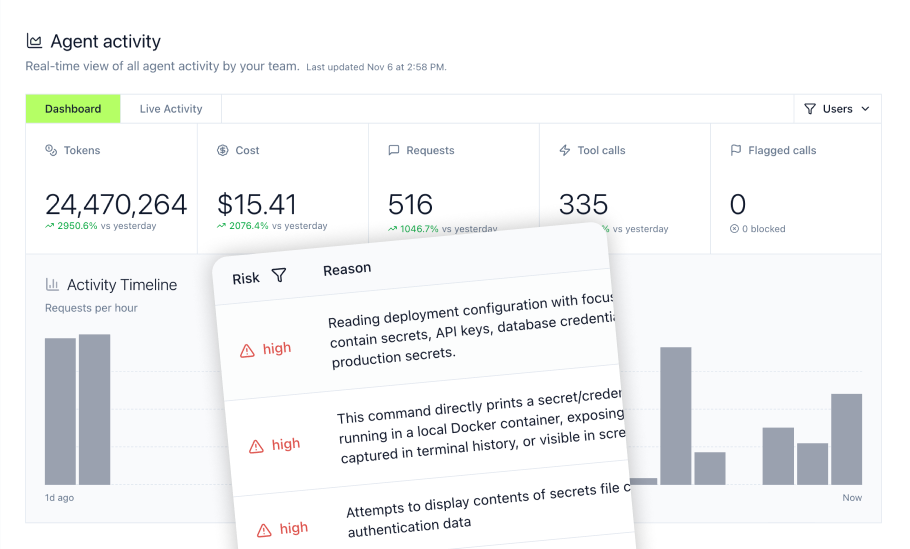
Production AI deployments require visibility into agent behavior, tool usage patterns, and potential security anomalies. MintMCP provides real-time dashboards for server health, usage patterns, and security alerts through its LLM Proxy component.
Observability features:
- Tool call tracking for every MCP invocation, bash command, and file operation
- MCP inventory showing installed servers, permissions, and usage across teams
- Command history with complete audit trails for security review
- Performance metrics including response times, error rates, and usage patterns
Leveraging GitHub for MCP Management: Opportunities and Limitations
GitHub's MCP Registry excels at solving the discovery problem for developers exploring the MCP ecosystem. The platform provides free access to browse available servers, view source code, and evaluate community contributions.
GitHub's Role in Code and Tool Management
GitHub brings natural strengths to MCP discovery:
- Version control integration: MCP servers stored as repositories benefit from standard Git workflows
- Community transparency: Source code visibility enables security review before adoption
- GitHub Copilot integration: Native integration with GitHub's AI coding assistant
- Zero cost barrier: Free access for exploration and evaluation
For individual developers and small teams testing MCP capabilities, GitHub provides an appropriate starting point without financial commitment.
Challenges of Using GitHub as an MCP Registry
GitHub's design as a code hosting platform creates inherent limitations for enterprise MCP governance:
- No built-in authentication: GitHub does not wrap MCP servers with OAuth or SSO
- No access control: Role-based permissions for tool access are not supported
- No audit trails: Enterprise compliance logging is absent from the registry
- No deployment infrastructure: Customers must provision their own hosting
- No registry-specific compliance package: SOC 2 or HIPAA documentation for MCP server deployment governance is not provided by the registry itself
Organizations using GitHub for discovery still need a separate governance layer for production deployment. This creates a natural complement: use GitHub or the Official MCP Registry for discovery, then deploy through MintMCP for governance.
Security and Compliance: MintMCP vs GitHub for MCPs
Security and compliance represent the primary differentiators between enterprise MCP platforms and discovery-focused registries.
Enterprise-Grade Authentication and Access Control
MintMCP provides OAuth wrapping for MCP-compatible servers deployed through the gateway without requiring teams to rebuild authentication from scratch. This capability addresses the authentication gap that blocks most enterprise deployments.
Authentication features:
- SSO enforcement with OAuth 2.0 and SAML support
- SCIM directory synchronization for Enterprise customers
- Per-agent identity with M2M authentication (Agent Bundles)
- Bearer API keys with independent rotation and revocation
GitHub's registry provides discovery links but delegates all authentication to individual server implementations, creating inconsistent security postures across deployments.
Comprehensive Audit Trails and Regulatory Compliance
Regulated industries require complete documentation of AI system access patterns. MintMCP maintains audit logs capturing every MCP interaction, access request, and configuration change.
Compliance documentation includes:
- SOC 2 Type II audit reports
- Documentation for HIPAA standards and BAA signing
- GDPR-conscious data handling with encryption, access controls, and audit trails
- Complete audit exports for security review
Organizations handling protected health information can access MintMCP's HIPAA documentation through the Trust Center.
Real-time Threat Detection and Command Blocking
The LLM Proxy provides security guardrails that block dangerous commands and restrict file access in real-time. This protection layer addresses risks from AI agents operating with extensive system access.
Security guardrails include:
- Blocking risky tool calls like reading environment secrets
- Preventing access to sensitive configuration files
- Restricting dangerous bash command execution
- Complete audit trails for all blocked operations
Governance and Observability for AI Tools
Effective AI governance requires understanding what tools agents use, what data they access, and how policies are enforced across the organization.
Centralized Control over AI Agent Interactions
MintMCP's Virtual MCP Bundles provide the foundation for centralized governance. Each Bundle represents a per-use-case endpoint with curated tools, access policies, and SCIM-driven membership. The same primitive applies to both human teams and agent identities.
Governance capabilities:
- Tool-level allowlisting and blocklisting per Bundle
- Tool-update policies requiring admin approval for new capabilities
- Unified policy enforcement across Claude, Cursor, ChatGPT, Gemini, and Copilot
- Admin MCP for conversational platform management
Understanding MCP gateways provides additional context on how centralized control improves enterprise security postures.
Monitoring Usage, Costs, and Performance
Enterprise AI deployments require visibility into resource consumption and performance characteristics. MintMCP tracks spending per team, project, and tool with detailed breakdowns.
Monitoring metrics:
- Per-tool and per-team usage tracking
- Cost allocation across projects
- Response time and error rate measurement
- Usage pattern analysis for capacity planning
One-Click Deployment and Developer Experience
Developer experience determines adoption velocity. Complex deployment processes delay AI initiatives while frustrating engineering teams.
Streamlining STDIO Server Deployment
MintMCP transforms deployment from a multi-week infrastructure project into a same-day operation. The platform hosts and runs custom MCP servers alongside pre-built connectors, handling auto-scaling and sandboxed execution.
Deployment workflow:
- Select MCP server from the registry or upload custom implementation
- Configure authentication and access policies
- Deploy with one click to production infrastructure
- Connect AI clients through the SSO-fronted endpoint
For teams building custom MCP implementations, MintMCP's deployment guide provides detailed guidance on packaging and configuration.
Empowering Developers with Self-Service Access
Self-service access reduces bottlenecks in AI tool adoption. Developers can request MCP server access through defined workflows, with automatic provisioning based on role membership.
MintMCP's Claude tips help developers maximize productivity once access is provisioned.
Extensibility and Integrations: Connecting MCPs to Enterprise Data
Enterprise value comes from connecting AI agents to internal systems. MintMCP provides managed MCP server access for common business systems through its connector catalog and hosted gateway.
Integrating with Key Enterprise Data Sources
Pre-built connectors enable immediate connectivity without custom development:
- Snowflake MCP: Natural language queries against data warehouses, Cortex integration, semantic view support
- Elasticsearch MCP: Knowledge base search, log analysis, support ticket intelligence
- Gmail MCP: Email search, draft creation, and response automation with security oversight
Additional connectors support databases including PostgreSQL, MongoDB, and BigQuery.
AI-Powered Data Analysis and Reporting
Finance teams automate reporting and variance analysis through Snowflake integration. Product teams enable user behavior analysis with natural language queries. Executive teams generate business intelligence dashboards without SQL expertise.
Supported AI Clients and Ecosystem Compatibility
MintMCP supports a comprehensive range of AI clients, ensuring deployment flexibility regardless of your organization's AI tool choices.
Supported clients include:
- Claude Desktop
- Claude Web
- Claude Code
- ChatGPT
- Microsoft Copilot
- Cursor
- Gemini
- Goose
- LibreChat
- Open WebUI
- Windsurf
- Custom MCP-compatible agents
The Claude Code setup and ChatGPT configuration provide implementation details for popular clients.
Enterprise Adoption Roadmap: Deploying MCP with Confidence
Successful MCP adoption follows a phased approach that balances rapid deployment with appropriate governance controls.
Strategic Phased Implementation
Phase 1: Discovery and Evaluation
Use GitHub or Official MCP Registry to identify relevant servers. Evaluate security requirements and compliance needs.
Phase 2: Governed Deployment
Deploy selected servers through MintMCP with authentication, access control, and audit logging enabled. Start with limited teams to validate workflows.
Phase 3: Scale and Optimization
Expand access across teams using Virtual MCP Bundles. Implement cost tracking and usage monitoring. Refine policies based on observed patterns.
MintMCP's quickstart guide accelerates Phase 2 implementation for teams ready to move from discovery to production.
Flexible Deployment Options
MintMCP operates as a managed SaaS service with uptime SLA options. VPC or self-hosted deployment options may be available on request for organizations with specific infrastructure requirements.
For enterprises evaluating MCP governance approaches, the enterprise deployment guide provides detailed implementation frameworks.
Why MintMCP for Enterprise MCP Deployment
MintMCP transforms enterprise AI governance from a multi-month infrastructure project into a production-ready deployment completed in hours. While GitHub and community registries solve discovery, they leave the hardest problems unsolved: authentication, compliance, audit trails, and policy enforcement. Organizations choosing discovery-only approaches face months of custom development to build governance layers, then ongoing maintenance costs to keep pace with evolving security requirements.
MintMCP's enterprise-first architecture addresses these challenges through integrated governance that starts with data permissions and identity management, not as an afterthought. The platform's OAuth wrapping eliminates authentication development work, while role-based Virtual MCP Bundles provide granular access control without complex infrastructure. SOC 2 Type II audited operations and compliance with HIPAA standards give security teams a stronger starting point for regulated deployments, rather than requiring compliance workflows to be bolted on after deployment.
The platform's operational advantages extend beyond security. Real-time monitoring through the LLM Proxy provides visibility into agent behavior that discovery registries cannot offer. Complete audit trails document every tool invocation, enabling security teams to detect anomalies and respond to threats before they escalate. Tool-level access policies prevent capability creep as MCP servers update, giving administrators control over what new operations become available to agents.
For engineering teams, MintMCP's one-click deployment and self-service access model accelerates AI adoption while maintaining governance. Developers provision approved MCP servers through defined workflows without waiting for infrastructure teams to build custom hosting solutions. The platform handles auto-scaling, sandboxed execution, and lifecycle management, freeing platform engineers to focus on business value rather than operational overhead.
Organizations deploying MintMCP gain immediate access to 10,000+ MCP servers with enterprise-grade security controls, not just discovery links. This combination of breadth, governance, and operational simplicity makes MintMCP the fastest path from MCP discovery to compliant production deployment.
Frequently Asked Questions
How do MintMCP and GitHub complement each other for enterprise MCP adoption?
GitHub and MintMCP serve different phases of the MCP adoption journey. GitHub's registry provides free discovery where teams explore available servers, review source code, and evaluate community contributions. MintMCP adds the production governance layer with authentication, audit trails, and compliance controls. The recommended approach: discover on GitHub, deploy through MintMCP. This combination leverages free community innovation while meeting enterprise security requirements.
What happens to existing MCP server investments when adopting MintMCP?
MintMCP wraps existing MCP servers without requiring code modifications. The platform's OAuth wrapping adds enterprise authentication to servers that lack built-in security controls. Organizations can bring their custom MCP implementations alongside the pre-built connector catalog. This non-disruptive approach protects existing investments while adding governance capabilities.
How does MintMCP handle agent-to-agent communication and autonomous workflows?
MintMCP's Agent Bundles provide per-agent identity with M2M authentication using OAuth 2.0 client credentials. Each agent receives independent bearer API keys with separate rotation and revocation from human users. The "act as agent" admin flow enables connectors requiring per-agent OAuth to maintain proper identity chains. This architecture supports autonomous agent workflows while maintaining audit trails for every action.
Can MintMCP integrate with existing identity providers and directory services?
MintMCP supports enterprise identity infrastructure including OAuth 2.0, SAML, and SSO integration. Enterprise tier customers receive SCIM directory synchronization for automated user provisioning and group membership management. The platform integrates with major identity providers, enabling centralized access management through existing IT workflows.
What governance options exist for controlling which tools agents can access?
Virtual MCP Bundles enable granular tool-level access control. Administrators create per-use-case endpoints with curated tool lists, defining which operations each role can perform. Tool-update policies require admin approval before new capabilities are enabled, preventing silent capability expansion in upstream MCP servers. Organizations can configure read-only access for certain teams while enabling write operations for others.
How does MintMCP address the challenge of shadow AI usage in enterprises?
MintMCP provides visibility into AI tool usage across Claude, Cursor, ChatGPT, Gemini, and Copilot through its gateway and Agent Monitor components. The platform tracks every MCP tool invocation, bash command, and file operation, revealing previously invisible AI activity. Policy enforcement automatically blocks unapproved tools while audit trails document all access attempts, enabling security teams to identify and govern shadow AI usage.