The Model Context Protocol has become an emerging standard for connecting AI agents to enterprise data, with growing support across major AI platforms. Yet 92% of MCP servers carry high security risk and 24% have zero authentication, creating a governance gap that stalls enterprise adoption. An enterprise MCP registry solves this by providing centralized discovery, authentication, audit logging, and policy enforcement for every MCP server your organization operates. For discovery, MintMCP's MCP Directory gives teams access to a sampling of 10,000+ available MCP servers across categories like developer tools, productivity, communication, data and analytics, project management, DevOps, AI and ML, finance, and customer support.
MintMCP's MCP Gateway extends this discovery layer with governed deployment, authentication, monitoring, logging, and compliance workflows, helping teams connect approved MCP servers to Claude, ChatGPT, Cursor, and more.
This guide covers what an enterprise MCP registry is, why your organization needs one in 2026, and how to implement governed MCP access across your AI tool ecosystem.
Key Takeaways
- Enterprise MCP registries implement a four-pillar architecture: centralized catalog, SSO/RBAC, structured audit logging, and real-time policy enforcement
- 92% of MCP servers carry high security risk while 43% are vulnerable to command injection, making governance infrastructure essential before production deployment
- Public registries generally do not provide the full access control, audit logging, and governance workflows regulated teams need; private or hybrid registries are often required for production use
- One reported enterprise example saw a 700% increase in AI usage within 60 days after implementing enterprise MCP features, showing how governance can support broader adoption
- Implementation usually works best as a phased maturity model, moving from visibility to authentication, authorization, monitoring, and compliance
- Major EU AI Act obligations become applicable August 2, 2026, with penalties up to €35 million or 7% of global revenue for certain violations involving required data governance and human oversight
What is an Enterprise MCP Registry?
An enterprise MCP registry is a centralized, governed catalog that manages which Model Context Protocol servers exist in an organization, who can access them, what they are permitted to do, and what gets recorded when they are used. Unlike public MCP directories that simply list available tools, enterprise registries integrate authentication, authorization, audit logging, and policy enforcement.
Defining Model Context Protocol (MCP)
MCP is the open standard that connects AI assistants like Claude, ChatGPT, Gemini, and Copilot to your internal data and tools. MCP registry guidance explains that the protocol standardizes how AI agents discover, authenticate with, and invoke external tools. This standardization enables agents to query databases, access CRM systems, search knowledge bases, and execute workflows through a consistent interface.
The Role of a Central Registry
The registry serves the same architectural role as API gateways serve for REST APIs. A strong MCP registry functions as part of the enterprise control plane, combining identity, discovery, policy-aware metadata, lifecycle controls, security guardrails, and observability data.
Key Benefits for Enterprises
Enterprise registries provide three capabilities that public registries cannot:
- Unified catalog of both public and internal MCP servers in a single controlled location
- Approval workflow restrictions preventing shadow MCP usage before agents can access servers
- Version control and rollback functionality providing deployment stability
Why Your Enterprise Needs an Intelligent MCP Registry in 2026
Addressing Shadow AI Challenges
Developers deploy or connect to MCP servers without IT review, skipping vendor security assessments, data access classification, and access provisioning workflows. Without a central registry, basic security questions have no reliable answers: which MCP servers are running, what credentials do they hold, which databases can they query, and which external services can they call.
This invisibility keeps servers out of vulnerability assessments, vendor risk reviews, and penetration testing scope entirely. MintMCP addresses this by helping organizations turn shadow AI into sanctioned AI through unified authentication, audit logging, and rate control for all MCP connections.
Ensuring Compliance and Governance
Major EU AI Act obligations become applicable August 2, 2026, with fines up to €35 million or 7% of global revenue for certain violations involving required data governance and human oversight. Articles 9, 14, and 15 require data governance, human oversight, and cybersecurity measures that ungoverned MCP deployments can make difficult to evidence.
Additional compliance requirements include:
- HIPAA requires audit trails attributable to identifiable users for every protected health information access
- SOC 2 CC6 requires access controls with evidence of enforcement
- GDPR accountability principle requires demonstrating data processing was authorized and documented
Boosting Operational Efficiency
Governance accelerates adoption rather than hindering it. One reported enterprise example saw a 700% increase in AI usage within 60 days after implementing enterprise MCP features. Proper governance creates confidence enabling broader rollout across the organization.
MintMCP's MCP Directory and Gateway: From Discovery to Enterprise Deployment
MintMCP combines the MCP Directory for discovery with the MCP Gateway for governed deployment, monitoring, logging, and compliance workflows. The directory shows a small sampling of the 10,000+ servers available on MintMCP and helps teams find connectors across developer tools, productivity, communication, data and analytics, sales and CRM, project management, DevOps and infrastructure, AI and ML, finance, and customer support.
Hosted Deployment for STDIO Servers
MintMCP deploys and manages STDIO-based MCP servers with automatic hosting and lifecycle management. Instead of running containers locally, teams can move STDIO servers into a managed gateway workflow. The platform handles containerized execution, auto-scaling, and isolated sandboxed runtime per connector.
Securing MCP with OAuth and SSO
The gateway fronts MCP servers with OAuth 2.0 and SSO through managed authentication wrapping. Enterprise authentication wrapping means clients connect through one SSO-fronted remote MCP endpoint regardless of upstream variety. This includes OAuth brokering for stdio/hosted servers that works around hosted-container redirect-URI limitations.
Centralized Management of Virtual MCP Servers
MintMCP introduces Virtual MCP Bundles as the unit of deployment, RBAC, audit, and administration. Each Bundle creates one endpoint per role or use case with SCIM-driven group membership, curated tool lists, and per-Bundle access policy. The same primitive applies to human teams and agent identities.
Achieving Security, Governance, and Accessibility with MintMCP
Comprehensive Compliance Features
MintMCP is SOC 2 Type II audited and compliant with HIPAA standards. The platform provides complete audit trails that support SOC 2 Type II audit workflows, HIPAA standards, and GDPR accountability requirements. Data residency options are available for organizations with regional deployment requirements.
Review MintMCP's full security documentation for detailed compliance information and Trust Center access.
Granular Access Control and Audit Trails
Many AI systems still lack structured audit trails. MintMCP addresses this gap with:
- Tool-level access control configuring access by role, enabling read-only operations while excluding write tools
- Complete audit trail of every MCP interaction, access request, and configuration change
- Real-time monitoring with live dashboards for server health, usage patterns, and security alerts
Bridging AI Assistants with Internal Data
MintMCP bridges the gap between AI assistants like ChatGPT and Claude with your internal data and tools. The platform handles authentication, permissions, audit trails, and the complexity that comes with enterprise deployments.
Key Features of an Enterprise-Grade MCP Registry
Enterprise MCP governance frameworks typically identify four interdependent capabilities that registries should implement:
Dynamic MCP Server Registry
- Centralized catalog maintaining metadata on every approved MCP server
- Owner identification, approval status, and access scope tracking
- Version control with rollback functionality
Advanced Monitoring and Analytics
- Real-time dashboards for server health and usage patterns
- Cost analytics tracking spending per team, project, and tool
- Performance metrics measuring response times and error rates
Unified Policy Management
- OAuth 2.0 authentication with external credential storage
- Per-operation authorization defaulting to deny
- Rate limiting and sensitivity label evaluation
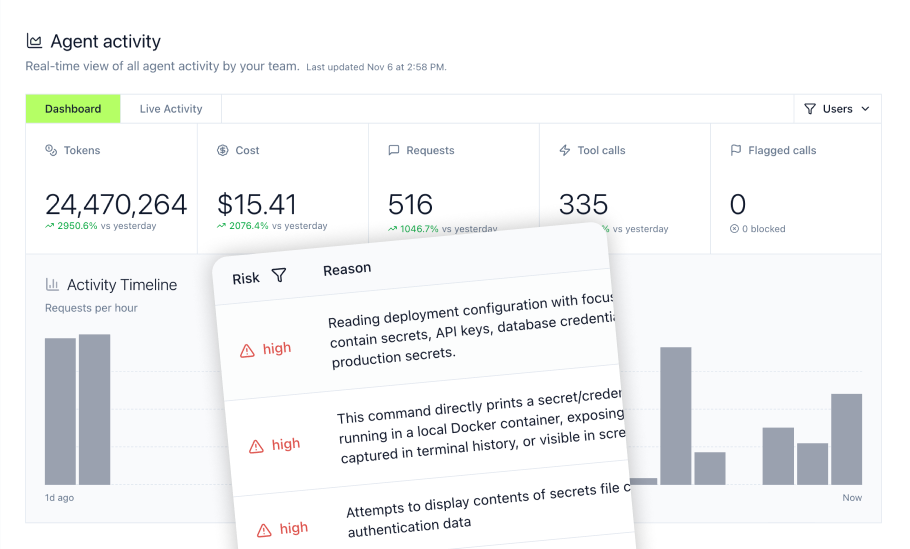
MintMCP's Agent Monitor extends governance beyond MCP to monitor every tool invocation, bash command, and file operation from coding agents, providing visibility into installed MCPs and their usage patterns across teams.
Integrating Your Enterprise Data with MCP Servers
Connecting Search and Knowledge Workflows
MintMCP's Elasticsearch connector helps teams connect search and knowledge workflows to AI assistants through MCP. This allows enterprise teams to make internal search systems more accessible to approved AI workflows while maintaining governance through the gateway layer.
Accessing Snowflake for Data Analytics
The OSS Snowflake MCP Server connects AI agents to Snowflake data workflows through an MCP-compatible server. Teams can use governed MCP access to support analytics workflows while keeping authentication, access control, and auditability centralized.
Automating Communications with Gmail Integration
MintMCP's Gmail connector connects Gmail for email management and AI assistance through OAuth-based access. This gives teams a governed path for connecting email workflows to AI assistants while maintaining enterprise access controls.
Supported AI Clients and Universal Compatibility
Broad Client Support for AI Agents
MintMCP works with the AI clients your teams already use, including:
- Claude
- ChatGPT
- Cursor
- Other MCP-compatible clients and agents
Ensuring Seamless Integration
The platform operates without major changes to developer workflows. Teams connect existing AI tool deployments through MintMCP's gateway, gaining governance without unnecessary disruption. AI gateway adoption is expected to increase as more software engineering teams build multimodal and agentic applications.
Building Your 2026 Roadmap for Enterprise MCP Deployment
Strategic Implementation Roadmaps
Effective MCP governance progresses through five maturity levels with specific timelines:
- Level 1 - Visibility (Week 1-2): Discover and catalog all MCP servers
- Level 2 - Authentication (Week 2-4): Mandate OAuth 2.0 and eliminate static credentials
- Level 3 - Authorization (Month 2): Deploy per-operation RBAC/ABAC policies
- Level 4 - Monitoring (Month 2-3): Enable attribution-level audit logging with anomaly detection
- Level 5 - Compliance (Month 3-4): Integrate sensitivity labels and automate regulatory reporting
Organizations should not skip levels. Enforcement requires authentication in place, auditing requires attribution, and compliance requires all previous layers functioning.
Accelerating Deployment with Pre-configured Policies
MintMCP helps teams move faster by reducing the amount of custom infrastructure required for enterprise MCP governance:
- Pre-configured policy templates for common governance scenarios
- Self-service workflows where developers request access to approved AI tools
- Centralized credential management for AI tool API keys and tokens
Optimizing Cost and Performance
Track spending per team, project, and tool with detailed breakdowns. Monitor response times, error rates, and usage patterns across your MCP infrastructure. The platform provides centralized visibility into tool usage, health, failures, monitoring, optimization, cost management, and compliance workflows.
Download MintMCP's Executive Guide to MCP & Enterprise AI Governance for detailed implementation roadmaps with metrics.
Why MintMCP for Enterprise MCP Registry
MintMCP transforms MCP from experimental tool sprawl into governed enterprise infrastructure. Organizations adopting MintMCP gain immediate value through three core capabilities:
Faster Path to Governed Production: Move MCP infrastructure from experimentation toward governed production deployment faster than building the control layer from scratch. MintMCP's hosted MCP server workflows, pre-configured policy templates, and OAuth wrapping reduce the amount of custom infrastructure teams need to build themselves. Teams can use self-service workflows to request access to governed MCP endpoints, accelerating AI adoption while maintaining security controls.
Complete Governance Without Complexity: MintMCP provides the full enterprise governance stack through a single platform. Virtual MCP Bundles unify authentication, authorization, audit logging, and policy enforcement at the role or use case level. SCIM-driven group membership automatically provides access based on identity systems, while tool-level RBAC ensures agents access only approved operations. This removes the burden of building custom governance infrastructure from scratch.
Compliance-Ready Architecture: Built for regulated industries, MintMCP is SOC 2 Type II audited and compliant with HIPAA standards. Complete audit trails capture MCP interactions with user attribution, supporting SOC 2 Type II audit workflows, HIPAA standards, and GDPR accountability requirements. Data residency options are available for organizations with regional deployment requirements, while real-time policy enforcement helps prevent unauthorized access before it occurs. As EU AI Act obligations become applicable in August 2026, MintMCP's governance infrastructure can help teams evidence data governance, human oversight, and cybersecurity workflows.
Visit MintMCP's MCP Gateway to see how enterprise teams deploy governed MCP infrastructure at scale.
Frequently Asked Questions
What is the difference between a public MCP registry and an enterprise MCP registry?
Public MCP registries like the Official MCP Registry, Smithery, and Glama excel at discovery and experimentation but cannot satisfy every enterprise governance requirement on their own. They generally do not provide the full institutional governance structures, access control mechanisms, audit logging capabilities, and approval workflows required for production enterprise use. Enterprise registries add unified catalogs of both public and internal servers, approval workflows preventing shadow MCP usage, and version control with rollback functionality. Organizations subject to GDPR, HIPAA, or operating in regulated industries often require private or hybrid registry approaches.
How does tool-level RBAC differ from server-level access control?
Server-level access control only determines whether a user can connect to an MCP server. Tool-level RBAC determines which specific operations within that server a user can invoke. The distinction matters because a customer support agent might need read-only CRM operations but not delete operations. Tool-level permissions, where MCP methods like logs.read or incidents.trigger map to explicit scopes, are an enterprise requirement rather than an optional enhancement.
What security vulnerabilities should organizations address before deploying MCP?
Analysis reveals 92% of publicly available MCP servers carry high security risk. Specific documented vulnerabilities include CVE-2025-49596 (CVSS 9.4) enabling remote code execution through MCP Inspector, and CVE-2025-6514 affecting mcp-remote with 437,000+ downloads enabling OS command injection, later patched in v0.1.16. Tool poisoning attacks embed malicious instructions in tool metadata causing agents to execute unintended actions. Organizations should implement the four-pillar architecture: catalog, SSO/RBAC, audit logging, and policy enforcement before production deployment.
Can MCP governance be implemented incrementally or must it be all-at-once?
Implementation should be sequential but can be incremental. The five-level maturity model spans visibility, authentication, authorization, monitoring, and compliance phases. Organizations should not skip levels because each depends on the previous. However, value accrues at each stage: visibility alone addresses shadow MCP sprawl, authentication alone satisfies basic security requirements, and authorization enables regulated workloads.
How do Agent Bundles differ from human user access in MintMCP?
MintMCP provides Agent Bundles with machine-to-machine authentication, giving each agent its own identity with bearer API keys plus OAuth 2.0 client-credentials. Rotation and revocation operate independently of human users. This means an agent's permissions are explicitly scoped through Virtual MCP Bundles rather than shared service-account keys. The "act as agent" admin flow handles connectors requiring per-agent OAuth. This architecture ensures agents operate under the same least-privilege constraints as internal APIs rather than inheriting overly broad human permissions.