The Model Context Protocol has become the industry standard for connecting AI assistants to enterprise data and tools, with support from Anthropic, OpenAI, Google, and Microsoft. Yet 70% of organizations regularly using generative AI face a critical gap: only 18% have enterprise-wide AI governance councils to manage this adoption. Platform teams need a centralized approach to vetting, deploying, and governing MCP servers. The MCP Gateway addresses this challenge by providing a central registry for approved MCP servers, with built-in authentication, audit trails, and role-based access controls.
This article explains how platform teams can establish an enterprise MCP catalog, covering vetting processes, deployment workflows, security requirements, and ongoing governance to transform shadow AI into sanctioned AI infrastructure.
Key Takeaways
- Platform teams can discover 10,000+ MCP servers through MintMCP's catalog and deploy approved hosted MCP servers through MintMCP's gateway, reducing the need to build and operate connector infrastructure from scratch
- Virtual MCPs enable role-based endpoints where each team receives only their approved tools, solving the N×M configuration problem
- One-click deployment reduces MCP server rollout time from months to minutes, with automatic OAuth wrapping and hosting
- Organizations with structured AI governance are better positioned to turn pilots into repeatable, approved AI infrastructure
- Shadow AI makes centralized governance essential for compliance because teams can adopt tools faster than IT and security teams can review them manually
Bringing Order to Chaos: Why an Enterprise MCP Catalog Matters
The Rise of Shadow AI and Its Risks
Employees across engineering, data, and support teams are already connecting AI tools to internal systems through MCP servers. Without centralized visibility, IT and security teams cannot see which servers are installed, what data they access, or who authorized their use. This shadow AI problem creates compliance gaps, security vulnerabilities, and inconsistent tool access across the organization.
The risks compound quickly:
- Credential exposure: Developers hardcode API keys and database passwords into local MCP configurations
- Audit trail gaps: No record of which employee accessed what data through AI assistants
- Inconsistent access: Some teams have powerful tools while others lack basic integrations
- Compliance exposure: GDPR, HIPAA, and SOC 2 audit needs often require clear access logging that shadow AI deployments may bypass
Establishing Enterprise-Wide AI Governance
Organizations that turn AI pilots into repeatable infrastructure share a common characteristic: centralized governance infrastructure. The NIST AI Risk Management Framework emphasizes that effective governance requires visibility, control, and continuous monitoring. Platform teams serve as the control point, establishing which MCP servers are approved, who can access them, and how activity is monitored.
Effective governance requires:
- Single source of truth: A curated catalog of vetted MCP servers
- Role-based provisioning: Automatic tool assignment based on team function
- Credential management: Centralized secrets without hardcoded tokens
- Continuous monitoring: Real-time visibility into all AI-to-data interactions
The MCP Gateway transforms local MCP servers into production-ready services by adding OAuth protection, audit logging, and enterprise SSO to any MCP endpoint.
MintMCP's MCP Registry: Your Central Hub for Vetting and Discovery
Streamlined Discovery of Production-Ready MCPs
The MCP server catalog provides platform teams with access to 10,000+ MCP servers and the ability to deploy approved hosted MCP servers through MintMCP's gateway. Rather than evaluating individual MCP servers across GitHub repositories and npm packages, teams browse a searchable registry with standardized documentation, authentication requirements, and tool descriptions.
Featured enterprise connectors include:
- Notion: Documentation and knowledge management workflows
- Linear: Project and issue tracking workflows
- Slack: Team communication workflows
- GitHub: Repository and development workflows
- Salesforce: CRM data access with OAuth authentication
- Zapier: Workflow automation across connected business apps
Each server listing displays the authentication model required, available tools, and usage context. Platform teams can evaluate servers before approval without installing or configuring anything locally.
Ensuring Compliance from Day One
The registry surfaces operational details that help teams review each MCP server before approval. Teams can review authentication type, data access scope, and operational fit before approving a server. Teams can compare per-user OAuth and shared-service-account models, helping platform teams choose appropriate security models for different use cases.
The quickstart guide walks through initial registry setup, SSO configuration, and first server deployment.
One-Click Deployment: Accelerating MCP Server Rollouts
From Local Development to Enterprise Scale
Traditional MCP deployment requires local installation, manual configuration, and custom authentication integration. Platform teams spend weeks building infrastructure before a single user can access a new connector. MintMCP's one-click deployment eliminates this friction entirely.
The deployment process:
- Browse and select: Find the required MCP server in the registry
- Configure authentication: Choose shared service account or per-user OAuth
- Set access policy: Define which teams or roles can access the server
- Deploy: Click to activate with automatic hosting and scaling
MintMCP hosts and operates the connector instances on the platform team's behalf. Hosted MCP connectors become accessible to clients without local installations, with auto-scaling and isolated execution per connector.
Automating the Deployment Pipeline
For teams with custom MCP servers, the Hosted CLI enables deployment through a single command:
npx @mintmcp/hosted-cli deploy -n "my-server"
This wraps any STDIO-based server with OAuth protection, adds it to the organization's private registry, and makes it available through the gateway. Custom servers gain the same monitoring, logging, and access controls as prebuilt connectors.
The result: faster deployment compared to self-hosted MCP infrastructure, with platform teams focusing on tool curation rather than container orchestration.
Security and Governance at Scale: Protecting Your Enterprise MCPs
Unified Authentication and Access Control
Every MCP connection through the gateway inherits enterprise authentication. OAuth 2.0, SAML, and SSO integration ensure employees authenticate with existing corporate credentials. No separate passwords or manual token management.
Authentication models available:
- Shared service account: All users access the server with the same credentials, simpler setup for read-only tools
- Per-user OAuth: Each employee authenticates individually, respecting their personal permissions in the underlying system
- API keys: Centrally managed keys for service-to-service access
The authentication models guide details when to use each approach based on data sensitivity and compliance requirements.
Comprehensive Audit Trails for Compliance
Complete audit logs capture every MCP interaction with user attribution. Platform teams can answer "who accessed what data when" for any time period, supporting SOC 2 and GDPR audit needs, while MintMCP is SOC 2 Type II audited and compliant with HIPAA standards.
Audit data includes:
- User identity linked to SSO
- MCP server and tool invoked
- Request timestamp and duration
- Data accessed or modified
- Success or failure status
Logs can be reviewed and exported for incident review, compliance workflows, and broader security monitoring. The security documentation covers audit configuration and retention policies.
Safeguarding Sensitive Data
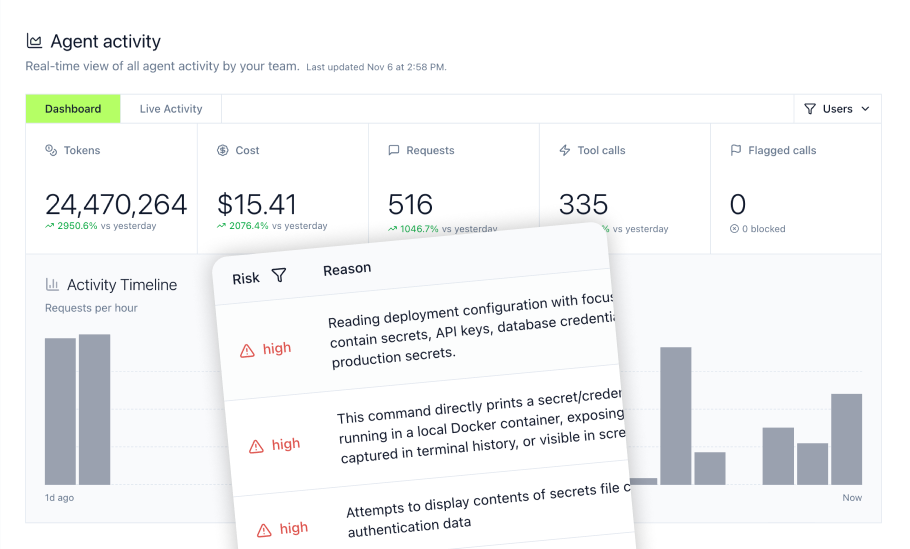
The LLM Proxy extends governance beyond MCP to cover all coding agent activity. Platform teams gain visibility into:
- Every bash command executed
- All file reads and writes
- Prompt submissions to LLM providers
- MCP tool invocations from Claude Code, Cursor, and other agents
Security guardrails help block risky actions in real time, protecting sensitive configurations from unauthorized access.
Integrating Mission-Critical Data: Examples from the MintMCP Catalog
Unlocking Value from Elasticsearch with AI
The Elasticsearch MCP Server enables AI agents to search enterprise knowledge bases, log repositories, and document collections. Available tools include:
- search: Perform queries using Elasticsearch DSL for flexible document retrieval
- esql: Execute ES|QL queries for advanced data analysis
- list_indices: Enumerate available indices in the cluster
- get_mappings: Retrieve field mappings for specific indices
HR teams build AI-accessible knowledge bases from company documentation. Support teams search historical ticket data for faster diagnosis. Product teams enable customer-facing documentation search with contextual help.
AI-Powered Insights from Snowflake Data
The Snowflake MCP Server connects AI agents to data warehouses with specialized tools:
- cortex_analyst: Natural language to SQL conversion using semantic models
- cortex_search: Semantic search against configured Cortex Search services
- run_snowflake_query: Execute SQL queries with DML and DDL support
- query_semantic_view: Query semantic views using dimensions and metrics
Finance teams automate revenue reporting and variance analysis. Product teams query user engagement metrics through natural language. Executive teams generate real-time business intelligence without SQL expertise.
Automating Communication with Gmail MCP
The Gmail MCP Server empowers AI assistants to manage email within governed workflows:
- search_email: Find messages using advanced query syntax
- get_email: Retrieve complete content including attachments
- draft_email: Create Markdown-formatted drafts
- draft_reply: Generate replies within existing threads
- send_draft: Dispatch prepared drafts through controlled flows
Customer support teams allow AI to draft responses within approved templates. Product teams aggregate feedback from incoming messages with automated prioritization.
Observability and Control: Monitoring Your Enterprise MCP Ecosystem
Gaining Full Visibility into AI Tool Usage
Real-time dashboards track every AI tool interaction across Claude, Cursor, ChatGPT, Gemini, and Copilot. Platform teams monitor:
- Usage patterns: Which MCP servers are most active, by team and time
- Performance metrics: Response times, error rates, and availability
- Data access logs: Exactly what data each AI tool accesses
- Anomaly detection: Unusual patterns that may indicate misuse
The LLM Proxy overview explains how monitoring extends to non-MCP agent activity including file operations and bash commands.
Managing Costs and Performance Effectively
Cost analytics track spending per team, project, and tool. Platform teams identify which MCP servers drive the most value and where optimization opportunities exist. Performance metrics highlight slow connectors requiring attention or replacement.
Comprehensive observability helps platform teams proactively address issues before users report them.
Seamless Integration with AI Clients: Empowering Your Teams
Connecting AI with Internal Data and Tools
MintMCP works with the AI clients employees already use:
- Claude Desktop and Web
- ChatGPT via Custom GPTs and Actions
- Microsoft Copilot
- Cursor
- Gemini
- Windsurf
- Custom MCP-compatible agents
Users configure their AI client once with the MintMCP endpoint URL. All approved tools become available automatically based on their team membership. No per-server configuration required.
Making AI Accessible to Everyone
The Virtual MCP concepts documentation explains how role-based endpoints work. Platform teams create Virtual MCPs for each team function:
- Engineering VMCP: GitHub, Terraform, database connectors
- Data VMCP: Snowflake, analytics, visualization tools
- Support VMCP: Zendesk, Salesforce, communication tools
When employees join a team, SCIM integration automatically provisions their AI tool access. When they change roles, access updates accordingly. Platform teams configure once; individual access scales automatically.
Building a Compliant and Future-Proof AI Infrastructure
Ensuring Reliability and Scalability
Enterprise deployments require infrastructure that scales with usage. MintMCP provides:
- High availability: Enterprise SLAs with automatic failover
- Data residency options: Residency options are available, but MintMCP should not be described as offering multi-region data residency controls
- Auto-scaling: Connector instances scale based on demand
- Redundancy: No single points of failure in the gateway architecture
MintMCP is SOC 2 Type II audited and compliant with HIPAA standards. Customers handling protected health information can request HIPAA documentation, and MintMCP signs BAAs.
Strategic Implementation for Long-Term Success
Platform teams following a phased approach achieve the strongest outcomes:
Phase 1 (Weeks 1-4): Pilot deployment with 5-10 low-risk MCP servers and a small team of early adopters
Phase 2 (Months 2-3): Expand to production data sources with per-user OAuth and full audit logging
Phase 3 (Months 4-6): Organization-wide rollout with role-based Virtual MCPs and automated provisioning
The enterprise deployment guide provides detailed timelines, success metrics, and common pitfalls to avoid at each phase.
Why MintMCP for Enterprise MCP Management
Platform teams evaluating AI infrastructure solutions face a critical decision: build internal governance systems or adopt a purpose-built platform. Organizations that choose MintMCP gain access to infrastructure that addresses the lifecycle of MCP server management.
The platform reduces the technical burden of hosting, scaling, and securing connectors while providing the governance controls necessary for enterprise review. By centralizing authentication, audit logging, and access control, MintMCP transforms shadow AI deployments into sanctioned, monitored infrastructure that security and IT teams can support.
MintMCP's role-based Virtual MCPs solve the configuration complexity that typically prevents enterprise-wide AI tool adoption. Instead of managing N users × M servers configurations, platform teams define team-level policies once and let SCIM integration handle individual provisioning automatically. This approach scales from pilot teams to thousands of employees without proportional administrative overhead.
The combination of MCP server discovery, custom server hosting, and comprehensive observability means platform teams can focus on strategic tool curation rather than infrastructure operations. Organizations achieve faster time-to-value for AI initiatives while maintaining stronger security controls, audit trails, and compliance documentation for enterprise review. As AI adoption accelerates across the enterprise, MintMCP provides the centralized control plane that turns experimental AI use into repeatable, auditable business processes.
Frequently Asked Questions
How does MintMCP handle MCP servers that require write access to production systems?
Platform teams configure tool-level access controls within each MCP server. For database connectors, you can enable read-only operations while excluding write and delete tools. The Virtual MCP system allows creating separate endpoints for analysts with read-only access and administrators with broader access, with audit logging capturing all operations regardless of permission level.
What happens when an MCP server vendor releases new tools or capabilities?
MintMCP's tool-update policy gives platform teams control over capability expansion. You can configure automatic enablement of new upstream tools or require admin approval before they become available. This prevents silent capability expansion where an MCP server update suddenly grants access to sensitive operations without review.
Can platform teams deploy internal or proprietary MCP servers alongside public connectors?
Yes. The Hosted CLI deploys custom STDIO-based servers with the same OAuth wrapping, monitoring, and access controls as prebuilt connectors. Internal servers appear in the organization's private registry, accessible only to authorized teams. Platform teams maintain full control over which custom servers are available and who can access them.
How does MintMCP integrate with existing identity providers beyond SSO?
SCIM integration enables automatic user provisioning and deprovisioning based on identity provider groups. When HR adds an employee to the "Data Team" group in Okta or Azure AD, MintMCP automatically grants access to the Data VMCP. When employees leave the organization, their access revokes immediately through the same integration, helping prevent orphaned access.
What visibility do platform teams have into MCP servers running outside the gateway?
The LLM Proxy component monitors coding agent activity at the LLM client level, not just the gateway. This captures MCP tool invocations, bash commands, and file operations from Claude Code, Cursor, and similar tools even when connecting to servers outside the managed gateway. Platform teams gain visibility into shadow MCP usage to inform their governance strategy.