Selecting the right MCP gateway for enterprise AI deployment requires evaluating security posture, deployment speed, governance capabilities, and integration support. MintMCP's MCP Gateway delivers SOC 2 Type II audited infrastructure with one-click deployment measured in minutes, not weeks. While Airia MCP Gateway positions itself around integration catalog breadth, MintMCP addresses what enterprises actually need: production-ready security, role-based access control, and compliance frameworks for regulated industries. This comparison examines both platforms to help determine which approach aligns with enterprise requirements.
Key Takeaways
- MintMCP's one-click deployment transforms local STDIO-based MCP servers into production services in minutes rather than weeks required by Kubernetes-based alternatives
- MintMCP's Virtual MCP Bundles enable role-based access control, exposing curated tool sets per team or use case without exposing entire server capabilities
- MintMCP supports PII detection, secret scanning, and external DLP and guardrails integrations to help prevent sensitive data exposure before reaching AI models
- MintMCP is managed SaaS-first in the US and EU, with VPC and self-hosted options available on request for organizations that need greater infrastructure control
- MintMCP is listed in the Cursor Hooks Partners Program, validating its architecture for coding agent governance
MintMCP Gateway: Bridging the Gap for Enterprise AI
The Model Context Protocol has become the industry standard for connecting AI clients to enterprise data and tools, supported by Anthropic, OpenAI, Google, and Microsoft. However, MCP servers introduce deployment, security, and governance challenges that generic solutions fail to address adequately.
MintMCP focuses on transforming local MCP servers into enterprise-ready infrastructure without requiring months of configuration or specialized DevOps expertise. MintMCP addresses the specific pain points enterprises face when deploying AI tools at scale: authentication, tool-level access control, credential management, logging, rule-based policy, and agent governance.
Why MCP Gateways Matter Now
Shadow AI is growing rapidly, with employees adopting AI tools faster than IT teams can evaluate them. Without proper governance, these tools operate as black boxes with significant security risks:
- Zero Telemetry: No visibility into what data AI agents access
- No Request History: Unable to audit interactions for compliance
- Uncontrolled Access: Full system permissions without appropriate restrictions
MintMCP solves these challenges by providing centralized governance, authentication enforcement, and real-time monitoring for all MCP connections. For a deeper understanding of gateway architecture, see the guide on understanding MCP gateways.
One-Click Deployment and Ease of Use: MintMCP's Advantage
Deployment speed separates production-ready solutions from development experiments. MintMCP's architecture eliminates the infrastructure overhead that delays enterprise AI adoption.
Rapid Deployment: From Local to Enterprise in Minutes
Most MCP servers use STDIO-based protocols that are difficult to deploy at scale. Traditional approaches require:
- Kubernetes cluster configuration
- Container orchestration expertise
- Manual OAuth implementation
- Custom monitoring setup
MintMCP eliminates these requirements through one-click deployment:
- STDIO Server Support: Deploy and manage STDIO-based MCP servers with automatic hosting and lifecycle management
- Hosted MCP Connectors: MintMCP runs hosted MCP connectors with isolated execution and managed scaling
- OAuth Brokering: Add SSO and OAuth protection to STDIO and hosted MCP servers without code changes
- Built-in Monitoring: Real-time dashboards for server health, usage patterns, and security alerts
Where Kubernetes-based alternatives like TrueFoundry require 1-2 weeks setup, MintMCP measures deployment time in minutes. This speed advantage compounds across teams. Every new MCP server deployment maintains the same rapid timeline.
Streamlined Connection and Configuration
MintMCP's Virtual MCP Bundles simplify enterprise deployment by exposing curated tool sets per team or use case:
- Role-Based Endpoints: Create Virtual MCP Bundles with one endpoint per role or use case, auto-configured with appropriate tools
- SCIM-Driven RBAC: Use SSO, SCIM, and IdP groups to govern who can access each Bundle
- Granular Tool Access: Configure tool-level access by role, enabling read-only operations while excluding write tools
- Centralized Credentials: Manage AI tool API keys and tokens in one place
This architecture addresses a core enterprise challenge: enabling AI tool access without exposing entire server capabilities to every user. For step-by-step implementation guidance, see the deploying MCP servers guide.
Unpacking Security and Compliance for Your MCP Tools
Enterprise AI deployment demands security controls that satisfy auditors, protect sensitive data, and maintain regulatory compliance. MintMCP's security architecture addresses these requirements comprehensively.
SOC 2 Type II Audited Infrastructure and Regulatory Compliance
MintMCP is SOC 2 Type II audited, with continuous compliance monitoring via Drata. This matters for enterprises because:
- Regulated Industries: Healthcare, finance, and government organizations often require audited security controls from vendors
- Audit Readiness: Complete audit trails help security teams review MCP activity, access requests, and configuration changes
- Enterprise Procurement: SOC 2 Type II audited infrastructure streamlines vendor evaluation and approval processes
Beyond SOC 2, MintMCP provides:
- HIPAA Support: Customers handling protected health information can request MintMCP's HIPAA documentation, and MintMCP signs BAAs
- Security Documentation: Security teams can review MintMCP's full security posture in the Trust Center
- Data Residency Options: Regional deployment options are available, but strict data-location requirements should be reviewed directly with MintMCP
Centralized Governance and Observability
MintMCP Gateway enforces governance through centralized authentication and monitoring:
- OAuth 2.0, SAML, and SSO Integration: Enterprise authentication wrapping for all MCP endpoints
- SCIM-Driven RBAC: Govern access through IdP groups and role-based membership
- Complete Audit Trail: Every MCP interaction, access request, and configuration change logged
- Real-Time Monitoring: Live dashboards for server health, usage patterns, and security alerts
- Policy Enforcement: Enforce tool-level allowlisting and rule-based policies across all connections
Protecting Sensitive Data and IPs
Coding agents operate with extensive system access, reading files, executing commands, and accessing production systems through MCP tools. MintMCP's security features help prevent sensitive data exposure:
- Real-Time PII Detection: Identification and redaction of personally identifiable information
- Secret Scanning: Block leakage of API keys, credentials, tokens, and SSH keys before reaching AI models
- External DLP and Guardrails Integrations: Integrate with systems such as AWS Bedrock Guardrails, Google Cloud DLP, Microsoft Purview, Nightfall, and Skyflow
- Sensitive File Protection: Prevent access to .env files, credentials, and configuration files
Advanced Tool Call Monitoring with MintMCP Agent Monitor
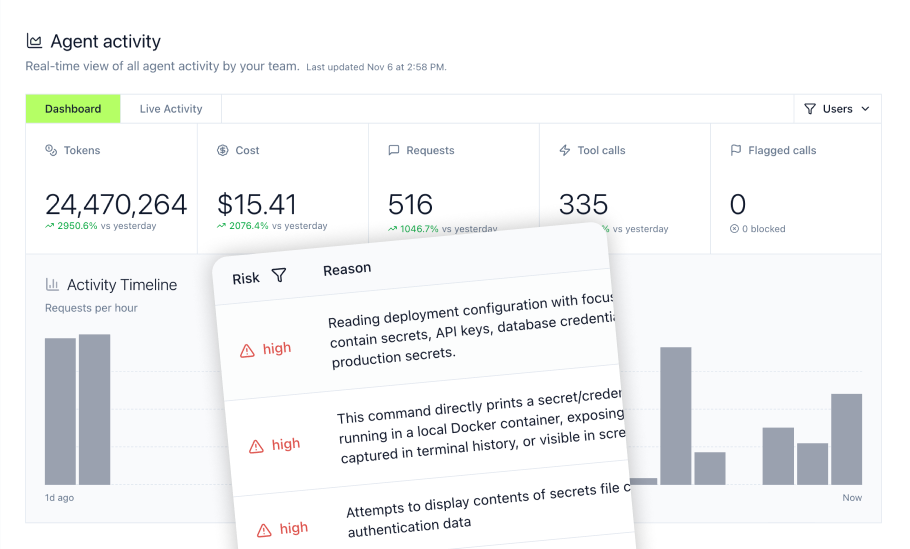
MintMCP's Agent Monitor provides observability into how employees use LLM clients, including what tools the LLMs invoke. This lightweight service sits between LLM clients, such as Cursor or Claude Code, and the model itself, forwarding and monitoring requests.
Visibility into Agent Behavior
Without monitoring, organizations cannot see what agents access or control their actions. MintMCP Agent Monitor addresses this gap:
- Tool Call Tracking: Monitor every MCP tool invocation, bash command, and file operation from coding agents
- MCP Inventory: Complete visibility into installed MCPs, their permissions, and usage patterns across teams
- Command History: Complete audit trail of bash commands, file access, and tool calls for security review
- File Access Monitoring: Track which files agents read, modify, or create
Real-Time Security Guardrails
Agent Monitor enables proactive security rather than reactive incident response:
- Block Dangerous Commands: Prevent risky operations like reading environment secrets or executing destructive commands in real-time
- Restrict File Access: Protect .env files, SSH keys, credentials, and sensitive configuration from agent access
- Control MCP Permissions: Enforce allowed tool sets and block unauthorized MCP access attempts
For organizations using coding agents like Cursor or Claude Code, Agent Monitor provides essential visibility without disrupting developer workflows.
Why an MCP Gateway Matters for Enterprise AI Governance
Enterprise AI adoption is moving faster than governance maturity in most organizations. This gap creates significant risk, and significant opportunity for organizations that implement proper governance early.
Addressing the Challenges of Shadow AI
Shadow AI represents one of the fastest-growing risks in enterprise technology. Employees adopt AI tools to improve productivity, often without IT awareness or approval. MintMCP transforms shadow AI into sanctioned AI:
- Turn Shadow AI into Sanctioned AI: Provide visibility and control without disrupting workflows
- Self-Service Access: Developers request and receive AI tool access instantly through governed channels
- Usage Analytics: Monitor tool usage, performance, and cost allocation across teams
The Executive Imperative for AI Governance
Organizations with formal AI strategies consistently report better outcomes than those taking ad hoc approaches. MintMCP Gateway provides the infrastructure for successful AI strategy execution:
- Cost Control: Track spending per team, project, and tool with detailed breakdowns
- Compliance Assurance: Support regulatory review with complete audit trails
- Risk Reduction: Prevent data breaches and credential exposure through proactive monitoring
According to Gartner's 2025 Software Engineering Survey, 75% of API gateway vendors will include MCP features by 2026, validating MCP as a fast-emerging standard for AI tool integration.
Integrating Your Data with AI Tools: Snowflake, Elasticsearch, and Gmail
MintMCP provides pre-built connectors for popular enterprise systems, enabling AI agents to access business data securely. Each connector inherits MintMCP's governance controls. Authentication, audit logging, and access restrictions apply automatically.
Custom Connectors for Business Applications
Data Analysis with Snowflake
The Snowflake MCP Server enables AI-driven analytics directly from your data warehouse:
- Natural Language Queries: Execute SQL queries using Cortex Analyst's natural language to SQL conversion
- Semantic Search: Search against Cortex Search services with filtering and column selection
- Financial Reporting: Automate revenue reporting, expense tracking, and budget variance analysis
Use cases include product analytics, financial reporting, and executive business intelligence, all through governed MCP connections.
Enterprise Search with Elasticsearch
The Elasticsearch MCP Server connects AI agents to your knowledge bases:
- Knowledge Base Search: Query documentation, policies, and training materials for instant employee assistance
- Support Ticket Intelligence: Search historical tickets and resolution patterns for faster diagnosis
- Log Analysis: Perform semantic searches across application logs to identify error patterns
Email Integration with Gmail
The Gmail MCP Server enables AI-driven email workflows:
- Search and Retrieve: Search Gmail messages using advanced query syntax with labels and filters
- Draft and Reply: Create email drafts and generate replies within existing threads
- Customer Response Automation: Allow AI assistants to draft customer communications within approved workflows
Leveraging Your Internal Data with AI
Beyond pre-built connectors, MintMCP supports custom MCP server deployment. Host STDIO servers on MintMCP instead of running locally. Containerized servers become accessible to clients without local installations.
This flexibility means any internal system with an API can become AI-accessible through MintMCP's governed infrastructure.
Compatibility and Ecosystem: MintMCP Works with Your Existing AI Clients
MintMCP integrates with the AI clients teams already use, eliminating the need to change workflows or adopt new tools.
Broad AI Client Support
MintMCP Gateway supports all major AI clients:
- Claude (Desktop and Web)
- ChatGPT (via Custom GPTs and Actions)
- Microsoft Copilot
- Cursor
- Gemini
- Goose
- LibreChat
- Open WebUI
- Windsurf
- Custom MCP-compatible agents
This compatibility ensures MintMCP adds governance to existing workflows rather than requiring migration to new tools.
Seamless Integration into Your AI Stack
MintMCP's Cursor Hooks Partners Program listing validates its architecture for coding agent governance. As coding agents operate with extensive system access, reading files, executing commands, and accessing production systems, this listing demonstrates MintMCP's fit for coding-agent security workflows.
For ChatGPT integration, see the guides on MCP Custom GPTs and tips for Custom Actions.
Real-World Impact: Metrics and Case Studies from MintMCP Deployments
Enterprise AI investment delivers measurable returns when deployed with proper governance. Industry data provides context for expected outcomes.
Demonstrable Value for Your Enterprise
Organizations implementing AI agents strategically report significant improvements across key metrics:
- Customer Service Efficiency: AI can materially lower support costs in well-scoped service workflows
- Query Deflection: Automated handling can deflect routine queries, freeing human teams for more complex issues
- Customer Satisfaction: Well-governed AI workflows can improve response consistency and customer experience
- Processing Time: Automation can reduce turnaround time for repetitive workflows
- Error Rates: Validation and policy controls can reduce manual handling errors
Quantifying the Benefits of Enterprise AI Governance
Payback periods vary widely based on use case, rollout scope, and implementation quality. MintMCP accelerates this timeline through:
- Faster Deployment: Minutes versus weeks reduces time to value
- Reduced Compliance Costs: Built-in SOC 2 Type II audited controls can reduce vendor security review overhead
- Lower Integration Development: Pre-built connectors reduce custom development effort
- Centralized Management: Single platform reduces operational overhead across multiple AI tools
Beyond the Basics: MintMCP Platform Features for Enterprise Scalability
MintMCP's platform features support large-scale enterprise deployments with comprehensive analytics and management capabilities.
Comprehensive Analytics and Control
- Real-Time Usage Tracking: Monitor every AI tool interaction across Claude, Cursor, ChatGPT, Gemini, Copilot, and more
- Cost Analytics: Track spending per team, project, and tool with detailed breakdowns
- Performance Metrics: Measure response times, error rates, and usage patterns
- Data Access Logs: See exactly what data each AI tool accesses and when
Self-Service Access and Centralized Management
- User Management: Centralized user provisioning with team-based access controls
- Role-Based Access Control: Define who can use which AI tools and access what data
- Enterprise SSO: SAML and OIDC integration with your identity provider
- SCIM-Driven RBAC: Keep access aligned with IdP groups and organizational roles
- Rapid Deployment: Deploy MCP servers in minutes with pre-configured policies
For detailed setup instructions, see the quickstart guide.
Deployment Flexibility and Roadmap: Cloud and Self-Hosted Options
MintMCP offers deployment flexibility to match infrastructure requirements and organizational control needs.
Choosing Your Deployment Model
Cloud Deployment
MintMCP's managed SaaS-first service provides:
- Regional deployment options in the US and EU
- Managed infrastructure without operational overhead
- Automatic updates and security patches
- VPC and self-hosted options available on request
Self-Hosted Deployment
For organizations requiring additional infrastructure control, MintMCP offers self-hosted options on request:
- Deploy on your own infrastructure
- Maintain greater control for sensitive environments
- Review strict data-location requirements directly with MintMCP
- Integrate with existing security and monitoring tools
This flexibility distinguishes MintMCP from cloud-only alternatives. Enterprises can choose the deployment model that matches their requirements.
Conclusion: Why MintMCP Delivers Enterprise-Grade MCP Infrastructure
Enterprise AI deployment demands more than integration breadth. It requires production-ready security, governance frameworks that satisfy auditors, and deployment speed that doesn't bottleneck adoption. MintMCP delivers on all three requirements.
With SOC 2 Type II audited infrastructure, HIPAA support, and complete audit trails, MintMCP provides the compliance foundation many regulated teams require. One-click deployment measured in minutes, not the weeks required by Kubernetes-based alternatives, accelerates time to value. Virtual MCP Bundles enable granular access control without exposing entire server capabilities.
MintMCP's Agent Monitor adds essential visibility into coding agent behavior, tracking tool calls, bash commands, and file access while blocking dangerous operations in real-time. Pre-built connectors for Snowflake, Elasticsearch, Gmail, and other enterprise systems reduce integration development effort.
For organizations evaluating MCP gateways, MintMCP offers a fast path from local MCP to enterprise deployment, with the security, governance, and observability that production environments demand.
Book a demo to see MintMCP in action, or get started with the quickstart guide.
Frequently Asked Questions
What is the key difference between MintMCP and generic MCP gateways?
MintMCP focuses specifically on enterprise requirements: SOC 2 Type II audited infrastructure, role-based access control through Virtual MCP Bundles, SSO and SCIM-driven RBAC, and one-click deployment measured in minutes. Generic MCP gateways often require extensive Kubernetes expertise, manual OAuth implementation, and custom monitoring setup. MintMCP eliminates this infrastructure overhead while providing security controls that help satisfy regulated industry requirements.
How does MintMCP ensure compliance for enterprise AI deployments?
MintMCP provides SOC 2 Type II audited infrastructure with complete audit trails and HIPAA documentation available for eligible customers. Every MCP interaction, access request, and configuration change is logged for compliance review. PII detection, secret scanning, and external DLP and guardrails integrations help prevent sensitive data exposure before reaching AI models. Role-based access control ensures users access only the tools and data appropriate for their role.
Can MintMCP integrate with existing enterprise data sources like Snowflake and Elasticsearch?
Yes. MintMCP provides pre-built connectors for Snowflake, Elasticsearch, Gmail, and other enterprise systems. Each connector inherits MintMCP's governance controls automatically. Authentication, audit logging, and access restrictions apply without additional configuration. For systems without pre-built connectors, MintMCP supports custom MCP server deployment through one-click hosting.
What AI clients are supported by MintMCP?
MintMCP Gateway supports all major AI clients including Claude (Desktop and Web), ChatGPT (via Custom GPTs and Actions), Microsoft Copilot, Cursor, Gemini, Goose, LibreChat, Open WebUI, Windsurf, and custom MCP-compatible agents. This broad compatibility ensures MintMCP adds governance to existing workflows without requiring teams to adopt new tools.
How does MintMCP help mitigate 'shadow AI' risks?
Shadow AI, meaning unauthorized AI tool usage by employees, creates security and compliance risks. MintMCP transforms shadow AI into sanctioned AI by providing visibility into tool usage, enforcing authentication through OAuth and SSO, and maintaining complete audit trails. Self-service access allows developers to request AI tool access through governed channels, while usage analytics track activity across teams.