Meta prompting represents a fundamental shift in how organizations interact with large language models. Rather than crafting individual prompts for specific tasks, meta prompting creates reusable structural frameworks that guide AI behavior across multiple contexts. For enterprises deploying AI agents through Claude, Cursor, ChatGPT, or custom systems, this approach transforms prompt engineering from artisanal craftsmanship into systematic, scalable infrastructure. Organizations using MCP Gateway for governed AI tool access can combine meta prompting with centralized access controls, monitoring, and auditability across supported AI workflows.
This article explains what meta prompting is, why it matters for enterprise AI governance, and how teams can implement it to improve accuracy, maintain compliance, and scale AI operations effectively.
Key Takeaways
- Meta prompting creates reusable prompt templates that guide AI reasoning across entire task categories, not just individual queries
- The prompt engineering market was valued at about $213 million in 2023 and projected to reach about $2.52 billion by 2032 at a 31.6% CAGR, reflecting broader growth in prompt engineering tools and services
- Meta prompting can improve consistency and task performance in some applications, but gains vary by model, task, implementation, and evaluation method
- Three architectural patterns serve different needs: user-provided templates for compliance, recursive meta prompting for adaptive workflows, and conductor models for complex multi-step processes
- Meta prompting enables systematic compliance by embedding policy constraints directly into prompt generation, making governance auditable and scalable
- Structure-first design prioritizes the "how" of problem-solving over specific content, allowing consistent policy enforcement across thousands of AI interactions
What is Meta Prompting? Understanding the Core Concept
Meta prompting is an advanced prompt engineering technique where large language models generate, refine, or optimize prompts for other LLMs, or even for themselves. Unlike traditional prompting that instructs a model on a single task, meta prompting establishes reusable guidance that standardizes how task-level prompts are constructed.
Defining Meta Prompting
Meta prompting is an approach that gives LLMs a reusable, step-by-step prompt template in natural language, allowing models to solve entire categories of complex tasks rather than single problems. The key distinction lies in focus: while basic prompting tells a model what to produce, meta prompting teaches a model how to think about producing it.
This technique operates on formal mathematical foundations, specifically type theory and category theory, where meta prompting creates a systematic relationship between problem domains and solution structures. This theoretical framing provides a formal way to describe relationships between task categories and their corresponding structured prompts.
The Evolution of Prompt Engineering
Traditional prompt engineering requires manual crafting of individual prompts for each use case. As organizations scale AI deployments, this approach creates:
- Consistency issues - Different team members write prompts differently, producing variable outputs
- Maintenance overhead - Thousands of prompts require individual updates when requirements change
- Limited scalability - Manual crafting cannot keep pace with expanding AI use cases
- Compliance gaps - Undocumented prompts make regulatory audits difficult
Meta prompting addresses these challenges by shifting from content-driven to structure-oriented approaches. Instead of showing the model what to produce through examples, meta prompts provide frameworks for how to reason about problems.
Why Meta Prompting Matters for AI Governance
For organizations managing AI agents across multiple clients and tools, meta prompting can standardize behavioral instructions, but it does not replace enterprise governance infrastructure. Teams still need controls that can:
- Manage agent identity and permissions
- Govern access to enterprise tools and data
- Monitor agent activity and usage
- Maintain attributable audit trails
- Enforce runtime security policies
Meta prompting can complement these controls by making behavioral instructions more consistent, while governance infrastructure determines what agents can access, what actions are allowed, and how activity is monitored and attributed.
The Value Proposition: Why Teams Need Advanced AI Prompting
Gartner projected in 2023 that by 2026 more than 80% of enterprises would have used generative AI APIs or models and/or deployed GenAI-enabled applications in production. As adoption expands, organizations face a critical question: how do you ensure AI agents follow company policies consistently across thousands of interactions?
Addressing Enterprise AI Challenges
Traditional prompt engineering fails at enterprise scale for several reasons:
- Limited visibility into agent activity - Security teams cannot see which tools agents use, what files they access, or what actions they take when prompts are scattered across individual configurations
- Dangerous or unpredictable agent actions - Agents can make tool calls that expose data, misuse credentials, or create unwanted changes when prompt governance is absent
- No unified governance layer - Different AI tools have separate permission models, logs, and security controls, making comprehensive oversight impossible
- Missing agent identity - Autonomous agents often operate through human credentials or generic service accounts, weakening attribution and credential hygiene
Organizations using Agent Monitor gain visibility into these activities, but meta prompting provides the upstream control that reduces risky behaviors before they occur.
Improving AI System Predictability
Meta prompting can improve performance on some reasoning tasks by giving models a consistent structure for approaching a problem. Published results are model and task-specific, so teams should benchmark meta-prompted outputs against their own baselines rather than assume a fixed accuracy or efficiency gain.
These gains stem from meta prompting's ability to create consistent reasoning patterns. When models follow structured frameworks rather than ad-hoc instructions, output quality becomes more predictable and verifiable.
Bridging the Gap in AI Governance
The prompt engineering market was valued at about $213 million in 2023 and projected to reach about $2.52 billion by 2032 at a 31.6% CAGR, reflecting growing investment in prompt engineering tools and services. Organizations that establish meta prompting foundations now position themselves to:
- Scale AI operations without proportional increases in governance overhead
- Maintain compliance across evolving regulatory requirements
- Reduce the risk of AI-related incidents through systematic controls
- Enable consistent quality across diverse teams and use cases
Crafting Effective Meta Prompts: Best Practices and Techniques
Meta prompting requires different design principles than traditional prompt engineering. The focus shifts from crafting perfect individual prompts to building reusable frameworks that generate appropriate prompts for varied situations.
Structured Prompt Design
Effective meta prompts share common structural elements:
- Role definition - Establish the persona and expertise the model should embody when generating task-level prompts
- Reasoning framework - Specify the logical steps the model should follow when approaching problem categories
- Output constraints - Define format requirements, length limits, and quality criteria for generated prompts
- Context handling - Describe how the model should incorporate task-specific information into its templates
The distinction between meta prompting and few-shot prompting is critical. Few-shot prompting provides examples of desired outputs. Meta prompting provides frameworks for how to think about generating those outputs, making it adaptable to scenarios the template designer never explicitly anticipated.
Leveraging Context and Constraints
Meta prompts can embed compliance requirements directly into their structure. Meta prompting can embed language and region-specific context as standardized instructions, enabling outputs aligned with local norms without requiring separate prompt designs for each region.
Key contextual elements to incorporate:
- Regulatory constraints - Embed jurisdiction-specific requirements into the meta-prompt framework
- Brand guidelines - Ensure generated prompts maintain consistent voice and positioning
- Security policies - Include restrictions on data handling, external calls, and sensitive information
- Quality standards - Define accuracy thresholds, citation requirements, and verification steps
Organizations using Mint Guard can layer additional runtime protections on top of meta-prompted interactions, screening for prompt injection, credentials, PII, and harmful content before execution.
Iterative Testing and Refinement
Meta prompts require systematic evaluation rather than one-off testing. Recommended practices include:
- Cross-scenario validation - Test meta prompts against diverse task types to verify framework robustness
- Edge case analysis - Identify situations where the meta prompt produces suboptimal task-level prompts
- Comparative benchmarking - Measure meta-prompted outputs against manually crafted prompts for the same tasks
- Feedback incorporation - Establish loops where prompt outcomes inform meta-prompt refinement
Human review of prompt outcomes validates meta-instructions produce reliable and compliant outputs over time. This ongoing validation ensures systems meet enterprise standards as policies evolve.
Meta Prompting in Action: Use Cases Across Enterprise Teams
Meta prompting's value becomes concrete through specific enterprise applications. These use cases demonstrate how structured prompt generation solves real operational challenges.
Enhancing Developer Workflows
Software development workflows benefit from meta prompting's ability to orchestrate multi-phase processes. Practitioners report using planning meta-prompts that generate YAML specifications, execution meta-prompts that produce code iteratively, and task-selection meta-prompts that determine next steps.
This approach automates the full development lifecycle while maintaining consistency. Each generated prompt follows the same structural principles, making code review and quality assurance more predictable. Organizations connecting development tools like GitHub through governed MCP endpoints can apply meta prompting to ensure agent-assisted coding follows security policies and coding standards.
Streamlining Content Creation
Marketing and content teams use meta prompting to maintain brand consistency across AI-generated materials. The meta-prompt framework encodes:
- Voice and tone guidelines
- Messaging hierarchies and positioning
- Compliance language for regulated industries
- Format specifications for different channels
Rather than writing separate prompts for blog posts, social content, and email campaigns, teams create meta-prompts that generate channel-appropriate prompts while maintaining unified brand standards.
Automating Data Insights
Business intelligence teams face the challenge of querying diverse data sources with consistent analytical approaches. Meta prompting enables:
- Contract triage in legal operations - Legal teams rapidly sort high volumes of contracts to identify urgent items. Meta prompting allows review tools to dynamically adjust extraction logic based on contract type or governing law
- Compliance tagging in pharmaceutical documentation - Teams managing global submissions apply different tagging standards for clinical trial records across regulatory bodies. Meta prompting lets content tagging tools shift logic based on embedded cues without reprogramming
- Financial model validation - Risk teams validate forecasting models against evolving regulations using meta prompting to change assessment criteria based on model type and jurisdiction
Customer Service Automation
Support operations achieve efficiency gains through meta-prompted chatbots. The technique enables self-checking mechanisms where initial responses are evaluated against company policies before delivery.
Teams can use meta prompting to standardize response structures, escalation logic, and self-checking steps in customer-service workflows, but performance improvements should be validated against application-specific baselines.
Governing Meta Prompts: Security and Compliance Considerations
Meta prompting introduces governance capabilities, but also governance requirements. Organizations must address security risks inherent in automated prompt generation.
Preventing Prompt Injection Attacks
When meta prompts generate task-level prompts, malicious inputs can cascade through the system. A prompt injection at the task level could potentially influence the meta-prompt's output generation, amplifying the attack's impact.
Effective defenses include:
- Input sanitization - Validate all inputs before they reach the meta-prompt layer
- Output validation - Screen generated prompts for injection patterns before execution
- Separation of concerns - Isolate meta-prompt processing from untrusted user inputs
- Layered detection - Apply multiple screening methods at different processing stages
Organizations using gateway middleware can implement custom security logic that screens every tool call for injection attempts, PII exposure, and policy violations.
Ensuring Data Privacy and Compliance
Meta prompting workflows must prevent sensitive data from inadvertently appearing in generated prompts. Key considerations include:
- Data classification - Identify which information categories should never appear in prompts
- Redaction rules - Automatically mask PII, credentials, and confidential business data
- Audit requirements - Log meta-prompt inputs, outputs, and the generated task prompts
- Jurisdiction handling - Ensure generated prompts comply with geographic data protection requirements
Under the EU AI Act, high-risk classification depends on an AI system's intended purpose and whether it falls within specified high-risk use cases, not on its use of meta prompting itself. Under the GDPR, additional transparency and safeguards can apply when personal data is used in qualifying automated decision-making that produces legal or similarly significant effects.
Establishing Auditability for AI Interactions
Compliance teams need complete records of AI decision-making processes. For meta-prompted systems, this means logging:
- The meta-prompt template used
- Input parameters provided
- Generated task-level prompts
- Model responses at each stage
- Any modifications or filtering applied
Organizations can export these records through SIEM integration for centralized security monitoring and compliance reporting.
Managing and Monitoring Meta Prompting with Centralized AI Governance
Effective meta prompting requires infrastructure that supports systematic prompt management across the organization. Scattered implementations undermine the consistency benefits meta prompting provides.
Using Virtual MCPs to Govern Tool Access
Virtual MCPs (VMCPs) govern the tools and data that AI systems can access. A VMCP bundles approved connectors and a curated tool surface behind one governed endpoint for a particular team, role, use case, or agent.
Meta-prompt templates require their own prompt-management and version-control process. VMCPs complement that process by centrally controlling which enterprise systems and tools an AI system can reach when it executes those instructions.
Attributing Meta-Prompts to Agent Identities
When autonomous agents use meta prompting, attribution becomes critical. Questions that governance systems must answer:
- Which agent executed which meta-prompt?
- What permissions applied to that interaction?
- What data did the generated prompts access?
- Who owns the output and bears responsibility for its use?
Organizations using agent identities can assign each autonomous agent its own non-human identity with scoped permissions, credentials, and audit trails. This separation ensures meta-prompt usage is attributable even when agents operate independently.
Monitoring Prompt Usage and Costs
Meta prompting workflows can multiply LLM calls. A single user query might trigger:
- One call to the meta-prompt model
- Generation of one or more task-level prompts
- Execution of those prompts against the task model
- Optional evaluation or refinement passes
Organizations must track:
- Token consumption by meta-prompt template
- Call volumes across different prompt categories
- Cost attribution to teams, projects, or agents
- Performance metrics for generated prompt quality
This visibility enables optimization of meta-prompt efficiency and accurate cost allocation across the organization.
The Future of AI: Integrating Meta Prompting with Autonomous Agents
Meta prompting's strategic importance grows as organizations deploy increasingly autonomous AI agents. The technique provides the behavioral consistency layer that makes agent autonomy manageable at scale.
Enabling Persistent Agent Workflows
Long-running agents that continue work across days require consistent behavioral frameworks. Meta prompting ensures these agents:
- Apply the same reasoning approaches regardless of when they execute
- Maintain compliance with policies that may have updated since their last run
- Generate contextually appropriate prompts for varied situations they encounter
- Adapt to new scenarios within defined behavioral boundaries
Coworker Agents that operate through Slack, schedules, or manual triggers benefit from meta-prompted instruction sets that guide their behavior while allowing contextual adaptation.
Governing Agent Memory and Context
As agents accumulate context and memory, meta prompting helps govern how that information influences behavior. Key principles include:
- Scoped memory access - Meta prompts can specify which memory categories the agent should consult
- Context prioritization - Frameworks define how to weight recent versus historical information
- Privacy boundaries - Templates enforce which stored information can inform generated prompts
- Audit trails - Memory usage in prompt generation becomes traceable and reviewable
This approach aligns with treating agent memory as governed enterprise infrastructure rather than opaque vendor-managed storage.
Scaling Autonomous Operations
The long-term vision for enterprise AI includes systems of record for agent workforces across models, channels, and execution environments. Meta prompting contributes to this vision by providing:
- Behavioral consistency - Agents follow the same reasoning patterns regardless of underlying model
- Model independence - Well-designed meta prompts work across different LLM providers
- Governance portability - Compliance requirements encoded in meta prompts transfer with the agent
- Operational flexibility - Organizations can adjust agent behavior by updating meta prompts rather than retraining models
Governing Meta Prompts with MintMCP
Meta prompting creates consistent behavioral frameworks for AI agents, but it still needs a broader governance layer. MintMCP adds the access controls, monitoring, runtime protections, and identity needed to operate meta-prompted agents securely at enterprise scale.
- MCP Gateway governs which tools and data agents can access. Tool calls routed through the gateway can be subject to centralized permissions and runtime controls by agent, role, or use case.
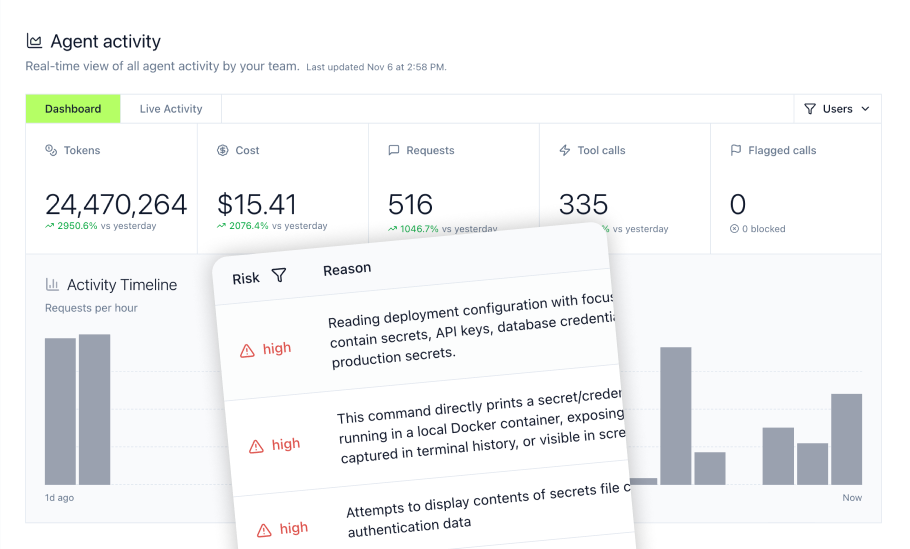
- Agent Monitor provides visibility into supported agent activity, including prompts, commands, file access, MCP tool calls, usage, and token costs.
- Mint Guard adds managed runtime detection for prompt injection, credentials, PII, and harmful content.
- Agent identities give autonomous agents their own scoped credentials, permissions, and audit trails instead of relying on generic service accounts.
Together, these controls complement meta prompting with governed access, visibility, runtime enforcement, and attributable agent identity.
Frequently Asked Questions
How does meta prompting differ from regular prompt engineering?
Traditional prompt engineering crafts individual prompts for specific tasks, telling models what to produce through examples and instructions. Meta prompting creates reusable frameworks that guide how prompts should be generated, focusing on reasoning structure rather than content. While a traditional prompt might say "Summarize this contract and highlight key terms," a meta prompt provides the reasoning framework for generating appropriate summarization prompts across any contract type, jurisdiction, or purpose. This distinction enables scaling prompt engineering efforts across organizations without proportional increases in manual prompt crafting.
What computational overhead does meta prompting add?
Meta prompting workflows can generate multiple LLM calls per user query. A typical pattern includes one call to the meta-prompt model, generation of task prompts, execution against task models, and optional evaluation passes. Organizations must architect carefully to avoid unsustainable API costs. Best practices include caching generated prompts when task parameters remain stable, batching similar requests, and monitoring token consumption by template to identify optimization opportunities. The efficiency gains in output quality and consistency typically justify the additional computational costs, but this trade-off requires active management.
Can meta prompting help address "shadow AI" concerns?
Meta prompting contributes to shadow AI governance by establishing standard frameworks for AI interactions. When organizations provide well-designed meta-prompt templates through approved channels, teams have less incentive to develop ad-hoc prompting approaches that bypass governance. However, meta prompting alone does not detect unauthorized AI usage. Organizations need complementary capabilities like agent monitoring that can identify AI tool usage across the environment, regardless of whether those interactions follow approved meta-prompt patterns.
What are common pitfalls when implementing meta prompting?
Organizations frequently encounter three issues. First, over-engineering meta prompts with excessive constraints that reduce flexibility without proportional governance benefits. Second, under-investing in evaluation, leading to meta prompts that generate suboptimal task prompts in edge cases. Third, treating meta prompting as a replacement for runtime security controls rather than a complement to them. Effective implementations balance structure with adaptability, maintain continuous evaluation pipelines, and layer meta prompting with additional security mechanisms like output screening and access controls.
How should organizations handle meta prompt version control?
Meta prompts require the same version control discipline as production code. Best practices include maintaining meta prompts in version-controlled repositories, documenting the purpose and constraints of each template, tracking performance metrics across versions, requiring review and approval for changes to production meta prompts, and maintaining rollback capabilities. This discipline becomes critical as organizations build dependencies on meta prompting for compliance-sensitive applications where template changes could affect regulatory alignment.