Alibaba Cloud's Qwen 3 represents a significant shift in the enterprise AI landscape, offering organizations full control over their large language model deployments without vendor lock-in or per-token API fees. Released in April 2025, the original Qwen3 open-weight release included eight distinct variants ranging from 0.6B to 235B parameters, all available under Apache 2.0 licensing. For enterprises deploying AI agents across tools like Claude, Cursor, ChatGPT, or custom implementations, understanding how to govern and integrate open-weight models like Qwen 3 becomes critical. MintMCP's MCP Gateway provides a governed connection layer between AI systems and enterprise tools, centralizing authentication, credentials, data and tool access, policies, and audit for supported deployments, including Qwen 3-powered agents.
This article explains Qwen 3's architecture, capabilities, enterprise applications, and the governance considerations that make open-source LLMs viable for regulated industries.
Key Takeaways
- The original April 2025 Qwen3 release included 8 open-weight model variants from 0.6B to 235B parameters under Apache 2.0 licensing with zero licensing fees
- The original flagship 235B Mixture-of-Experts model activates 22B parameters per token, substantially reducing active computation relative to similarly large dense architectures
- Hybrid thinking mode allows switching between extended reasoning and faster direct responses, with compatible deployments able to expose reasoning content that should not be treated as a guaranteed faithful or audit-grade explanation of the model's internal process
- Qwen 3 supports 119 languages with context windows extending from 32K to 128K tokens for enterprise knowledge base applications
- Self-hosted Qwen3 avoids model-license fees for the Apache 2.0 checkpoints, but actual inference cost depends on hardware, quantization, utilization, context length, and operational overhead
- Air-gapped deployment capability can support data-residency and regulated-industry security requirements by keeping inference within controlled infrastructure, but HIPAA or other regulatory compliance depends on the organization's broader technical, administrative, and operational controls
- Organizations using AI agents built on open-weight models like Qwen 3 still require governance infrastructure for identity management, tool access control, and activity monitoring
Understanding Qwen 3: Alibaba's Open Source LLM Initiative
Qwen 3, also known as Tongyi Qianwen, marks Alibaba Cloud's most comprehensive open-source AI release. Unlike closed proprietary models that operate as black-box API services, Qwen 3 provides full model weights that organizations can download, modify, fine-tune, and deploy on their own infrastructure.
The model family addresses a fundamental enterprise concern: dependency on external AI providers creates compliance risks, unpredictable costs, and limited customization options. With Qwen 3, organizations gain complete control over their AI infrastructure while eliminating per-token usage fees.
Core Architecture
- Dense models (0.6B to 32B parameters): Standard transformer architectures optimized for predictable latency and simpler deployment
- Mixture-of-Experts models (30B-A3B and 235B-A22B): Selective activation architectures where only a fraction of parameters engage per inference
- Hybrid thinking capability: Allows users to toggle between extended reasoning and immediate responses
The "A" notation in model names indicates active parameters. The 235B-A22B variant contains 235 billion total parameters but activates only 22 billion per token, delivering flagship performance at a fraction of the computational cost.
Qwen 3 in the LLM Ecosystem: A Comparison with Leading Models
Understanding where Qwen 3 fits among competing models helps enterprises make informed deployment decisions. The model demonstrates strong performance across coding, mathematics, and multilingual tasks.
Performance Benchmarks
| Benchmark | Qwen3-235B-A22B (Thinking) | Qwen3-32B (Thinking) |
|---|---|---|
| AIME '24 | 85.7 | 81.4 |
| AIME '25 | 81.5 | 72.9 |
| LiveCodeBench v5 | 70.7 | 65.7 |
| Codeforces Rating | 2056 | 1977 |
Key Differentiators from Other Open-Source LLMs
Qwen 3 distinguishes itself through several technical advantages:
- Thinking mode visibility: Compatible deployments can expose reasoning content through
<think>output, although these traces should not be treated as guaranteed faithful explanations of the model's internal reasoning - MoE efficiency: The flagship model activates only 22B of its 235B total parameters per token, reducing active computation through selective expert routing
- Extended context: Support for 128K token context windows enables processing of lengthy documents, complex conversations, and enterprise knowledge bases
- Tool-calling support: Qwen3 is optimized for tool use, and Qwen-Agent can connect it to tools exposed through MCP configurations
For organizations running AI agents across multiple platforms, these capabilities become particularly valuable when combined with governance infrastructure that can monitor and control agent behavior across supported heterogeneous environments.
Key Features and Capabilities of the Qwen 3 Model Family
From Text to Code: Qwen 3's Versatile Applications
Qwen 3 excels across multiple task categories that enterprises commonly require:
Natural Language Processing:
- Document summarization and analysis
- Multi-turn conversation with maintained context
- Translation across 119 supported languages
- Instruction following with high accuracy
Code Generation and Analysis:
- Multi-language code completion (Python, JavaScript, SQL, and others)
- Code review and debugging assistance
- Technical documentation generation
- Competitive programming performance exceeding many proprietary alternatives
Mathematical and Analytical Reasoning:
- Complex problem-solving with step-by-step explanations
- Data analysis and interpretation
- Financial modeling assistance
- Scientific computation support
Multilingual Support and Global Reach
The 119-language support makes Qwen 3 particularly valuable for global enterprises. Unlike maintaining separate models for different markets, organizations can deploy a single Qwen 3 instance serving multilingual customer support, document processing, and internal communications.
This capability proves especially relevant for enterprises using AI agents to interact with international tools and data sources. Through a governed MCP Gateway, organizations can connect Qwen 3-powered agents to enterprise systems like Salesforce, Slack, or Snowflake while maintaining consistent access controls across languages and regions.
Practical Applications: Where Qwen 3 Excels for Enterprises
Enterprise Code Assistant Deployment
Business Problem: Development teams need code suggestions and debugging assistance without sending proprietary code to external APIs, which creates compliance risk in regulated industries.
Implementation Approach:
- Deploy Qwen3-32B on-premise with appropriate GPU infrastructure
- Integrate with VS Code or other development environments
- Enable thinking mode for complex debugging scenarios
- Use non-thinking mode for autocomplete to maintain speed
Expected Outcomes:
- Reduced exposure to third-party model APIs by keeping inference on controlled infrastructure
- Potentially faster code-review workflows when appropriately integrated and validated
- Cost savings compared to per-seat commercial alternatives
Multilingual Customer Support Automation
Business Problem: Supporting customers across 119 languages without maintaining separate models or relying on expensive translation APIs.
Implementation Approach:
- Deploy Qwen3-14B on cloud GPU infrastructure
- Integrate with customer support platforms through governed MCP connections
- Configure non-thinking mode for speed-critical responses
- Implement RAG integration with product knowledge bases
Expected Outcomes:
- High ticket deflection rates across all supported languages
- Reduced per-agent costs compared to multilingual API services
- Faster response times through local inference versus API latency
Boosting Productivity with Qwen 3-Powered Agents
For organizations building autonomous AI agents, Qwen 3 provides a foundation that can be governed through enterprise infrastructure. MintMCP's Agent Gateway enables organizations to assign first-class identities to autonomous agents across supported heterogeneous AI environments, including Qwen 3-powered deployments, ensuring that each agent has:
- Its own scoped permissions and tool access
- Independent credential management
- Attributable audit trails
- Governed memory and operating context
This separation becomes critical as enterprises scale from experimental agent deployments to production workloads where "who did what" must be clearly attributable.
Regulatory Document Analysis for Healthcare
Business Problem: Analyzing medical research papers and regulatory documents requires HIPAA-appropriate, auditable AI that keeps all data within controlled infrastructure.
Implementation Approach:
- Deploy Qwen3-235B-A22B on air-gapped infrastructure
- Enable extended thinking budget (up to 38K tokens) for complex reasoning
- Apply custom safety alignment fine-tuning as needed
- Implement audit logging for prompts, outputs, tool calls, and exposed reasoning content
Expected Outcomes:
- Greater control over data residency by eliminating external model API calls when configured to remain within organizational infrastructure
- Potential reduction in manual document-review effort, depending on workflow design, document complexity, and human verification requirements
- Ability to log prompts, outputs, tool calls, and exposed reasoning content where appropriate, without treating
<think>blocks as a compliance-grade record of internal reasoning
Integrating Qwen 3 into Your AI Workflow: A Developer's Guide
Getting Started with Qwen 3 Deployment
Qwen 3 deployment requires understanding model sizes, infrastructure requirements, and integration frameworks. The setup process varies based on chosen model variant and deployment target.
Step 1: Select Model Variant Based on Use Case
| Use Case | Recommended Model | Hardware Requirements |
|---|---|---|
| Mobile/edge applications | Dense 0.6B-4B | 8GB VRAM (quantized) |
| Enterprise chatbots, RAG | Dense 8B-32B | Varies by model and precision; Qwen3-32B uses about 63GB in BF16, 33GB in FP8, or 19GB in INT4 at short context |
| Multi-domain reasoning | MoE 30B-A3B | About 59GB in BF16 or 30GB in FP8 at short context |
| Complex agentic workflows | MoE 235B-A22B | Multi-GPU or offloaded deployment; memory requirements depend heavily on precision and quantization, with full-precision weights requiring hundreds of GB |
Step 2: Infrastructure Setup
For cloud deployment:
- Provision GPU instances (A100/H100 recommended for models larger than 14B)
- Install dependencies: Python environment with transformers, torch, and inference frameworks
- Configure networking for internal API access
For local deployment:
- Verify GPU memory meets model requirements
- Install Ollama for simplified deployment:
ollama pull qwen3:8b - Apply quantization (INT4/INT8) if memory constraints exist
Step 3: Configure Thinking Modes
The hybrid thinking capability requires explicit configuration:
- Set
enable_thinking=Truein API templates for complex reasoning tasks - Use
/thinkand/no_thinkprompt flags for dynamic mode switching - Configure maximum thinking tokens (default 32K, extendable to 38K)
Step 4: Deploy API Endpoint
For production deployments, inference frameworks like vLLM or SGLang provide OpenAI-compatible API servers:
- vLLM deployment offers optimized attention mechanisms
- SGLang provides supported serving and reasoning-parser options, with performance depending on model, hardware, workload, and serving configuration
Customizing Qwen 3 for Specific Tasks
Fine-tuning Qwen 3 for domain-specific applications involves:
- Data preparation: Curate training datasets reflecting target domain vocabulary and use cases
- LoRA adaptation: Apply low-rank adaptation for efficient fine-tuning without full model retraining
- Evaluation: Test against domain-specific benchmarks before production deployment
Domain-adaptation timelines vary substantially based on dataset preparation, model size, evaluation requirements, compute availability, and the chosen fine-tuning method.
The Role of Governance and Security with Open-Source LLMs Like Qwen 3
Deploying open-weight models eliminates some compliance concerns while introducing others. Organizations gain data residency control and model transparency but assume responsibility for security, access management, and audit infrastructure.
Addressing Security Concerns in Open-Source AI Deployments
Data Security Advantages:
- No external API calls means no data transmission to third parties
- Full control over encryption at rest and in transit
- Air-gapped deployment possible for maximum security
- Model weights can be stored in controlled artifact repositories
New Responsibilities:
- Organizations must implement their own access controls
- Audit logging requires custom infrastructure
- Runtime policy enforcement needs additional tooling
- Credential management for integrated systems falls to the deploying organization
Ensuring Responsible AI Use with Qwen 3
For enterprises deploying Qwen 3-powered agents that connect to enterprise systems, runtime guardrails become essential. MintMCP's guardrails architecture provides three complementary layers:
Mint Guard: Managed detection policies for:
- Prompt injection attempts
- Credential and secret exposure
- PII detection
- Harmful content screening
Rules: Declarative matching and enforcement on:
- Tool names and arguments
- Content patterns via regex
- Actions including flag, block, ask, mask, or notify
Gateway Middleware: Customer-authored logic for:
- Integration with external DLP systems
- Custom classification and resource policies
- Data redaction and transformation
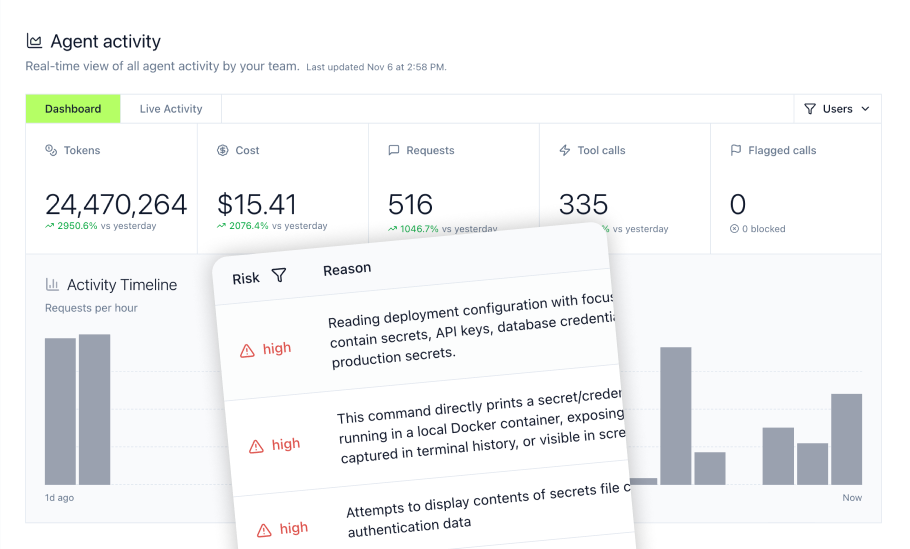
This layered approach ensures that even when using open models like Qwen 3, organizations maintain control over what agents can access and what data flows through their systems. The Agent Monitor provides visibility into supported agent activities including prompts, file access, commands, and MCP tool calls, helping security teams understand Qwen 3-powered agent activity where monitoring coverage is supported.
Qwen 3 vs. Proprietary Models: Openness, Customization, and Control
The Advantages of Open-Source with Qwen 3
Cost Structure:
- No model-license fee for the original Apache 2.0 checkpoints
- Self-hosted inference costs depend on hardware, quantization, utilization, context length, and operational overhead
- Break-even versus managed APIs depends on the specific workload, infrastructure model, staffing costs, and current provider pricing
Data Control:
- All processing occurs within organizational infrastructure
- No prompts or responses transmitted to external providers
- Self-hosting can reduce some third-party data-transfer and processor-management considerations, while GDPR obligations for lawful processing, security, retention, and data-subject rights still apply
- HIPAA-appropriate deployment possible with appropriate broader infrastructure and controls
Customization Freedom:
- Full model weights enable domain-specific fine-tuning
- Quantization options allow deployment across diverse hardware
- No vendor restrictions on use cases or modifications
Vendor Independence:
- No dependency on provider pricing changes
- Model access cannot be revoked by external parties
- Switching between Qwen 3 variants requires no vendor negotiation
Trade-offs to Consider
Open-source deployment introduces considerations that API services handle automatically:
- Infrastructure management: Organizations bear responsibility for GPU provisioning, scaling, and maintenance
- Support model: Community forums rather than vendor SLAs for troubleshooting
- Security hardening: Air-gapped and production-grade deployments require internal expertise
- Model updates: Organizations must evaluate and deploy new model versions independently
For many enterprises, these trade-offs favor open-source deployment when:
- Data privacy requirements prohibit external API usage
- Token volumes create significant API cost exposure
- Customization needs exceed what API providers offer
- Long-term cost predictability matters more than variable pricing
The Future of Qwen 3: Alibaba's Vision for Open AI
Alibaba's Commitment to Open AI Innovation
Alibaba Cloud has positioned Qwen 3 as part of a broader strategy to democratize access to capable AI models. The release of full model weights under permissive licensing reflects a commitment to open development that benefits the broader AI ecosystem.
Key elements of this strategy include:
- Ongoing model releases: The Qwen team continues releasing updated variants with improved capabilities
- Community engagement: Active participation in open-source AI development through model sharing platforms
- Enterprise focus: Deliberate attention to features that matter for production deployments, including tool-calling and extended context
What's Next for the Qwen Model Family
Since the original Qwen3 release, Alibaba has expanded the family substantially through Qwen3-Coder, Qwen3-Next, Qwen3.5, Qwen3.6, and Qwen3.7 models. These later releases have already introduced broader multimodal capabilities, longer context windows, new sparse architectures, and further improvements in reasoning and agentic workloads.
For organizations building on Qwen 3 today, the governance infrastructure they establish through platforms like MintMCP will remain valuable regardless of which specific model version powers their agents. The separation between the AI model layer and the governance layer enables organizations to upgrade models without rebuilding their security, identity, and monitoring infrastructure.
Making Qwen 3 Enterprise-Ready with Governed Infrastructure
Deploying Qwen 3 in production requires more than model access. Open weights provide greater control over inference and data residency, but enterprises still need governance for tool access, agent identity, monitoring, and runtime security.
MintMCP provides these controls across several layers:
- Governed tool access: Virtual MCPs bundle approved connectors and curated tools behind governed endpoints, helping Qwen 3-powered agents access only authorized systems and data.
- Agent identity: Agent Gateway gives autonomous agents their own identities, scoped permissions, credentials, and attributable audit trails instead of relying on human credentials.
- Activity monitoring: Agent Monitor provides visibility into supported prompts, tool calls, file access, commands, usage, and agent activity.
- Runtime controls: Mint Guard, declarative Rules, and Gateway Middleware can detect, restrict, mask, or block risky actions and data flows.
Together, these controls help make Qwen 3 deployments governable, measurable, and swappable while preserving the flexibility of open-weight models. Enterprises can keep model inference within controlled infrastructure while applying consistent identity, permissions, monitoring, and security policies around the agents that use it.
Frequently Asked Questions
What makes Qwen 3 different from other open-source large language models?
Qwen 3 distinguishes itself through its hybrid thinking mode, which allows users to dynamically toggle between extended reasoning chains with visible <think> blocks and fast direct responses. Compatible deployments can expose reasoning content, although these traces should not be treated as guaranteed faithful explanations of the model's internal reasoning. The Mixture-of-Experts architecture in flagship models delivers comparable performance to much larger dense models while activating only a fraction of parameters, reducing inference costs significantly. Additionally, the 119-language support exceeds most alternatives, making Qwen 3 particularly suited for global enterprise deployments.
Can Qwen 3 be fine-tuned for specific industry applications, and what does that process involve?
Yes, Qwen 3's open weights enable domain-specific fine-tuning. The process typically involves curating a training dataset that reflects your target domain's vocabulary and use cases, applying parameter-efficient techniques like LoRA (Low-Rank Adaptation) to avoid full model retraining, validating performance against domain-specific benchmarks, and deploying the fine-tuned model to production infrastructure. The time and cost of domain adaptation vary substantially with dataset preparation, model size, training method, compute infrastructure, evaluation requirements, and deployment complexity.
How does Qwen 3's cost compare to proprietary API services for high-volume enterprise use?
Self-hosted Qwen3 has no universal per-token cost because infrastructure expense varies with model size, hardware, quantization, utilization, context length, and operational overhead. Enterprises should compare the total cost of ownership for their specific deployment against current API input and output pricing at the expected workload rather than relying on a fixed break-even threshold. The Apache 2.0 license means no model licensing fees, but organizations must account for GPU provisioning, maintenance, ML operations tooling, and staffing costs when evaluating total deployment economics.
What hardware is required to run Qwen 3 models effectively?
Hardware requirements vary significantly by model size. The smallest dense models (0.6B-4B parameters) can run on consumer GPUs with 8GB VRAM when quantized. Medium-sized models vary substantially by size and precision; Qwen3-32B uses about 63GB of GPU memory in BF16, 33GB in FP8, or 19GB in INT4 at short context. The flagship 235B-A22B MoE model requires multi-GPU or offloaded deployment with memory requirements depending heavily on precision and quantization; full-precision weights require hundreds of GB. Quantization (INT4/INT8 formats) can reduce memory requirements by 50-75% with modest performance trade-offs for many use cases.
Does Qwen 3 have any known limitations enterprises should consider before deployment?
Qwen 3 has several documented limitations. The model can hallucinate on general knowledge topics, particularly pop culture, sports, and entertainment facts, making RAG (Retrieval-Augmented Generation) important for factual grounding. As a model trained in China, Qwen 3 may decline certain geopolitically sensitive queries, which enterprises should test thoroughly if their applications involve such content. The MoE architecture, while efficient, introduces latency jitter and deployment complexity compared to dense models. Finally, open-source deployment means community support rather than vendor SLAs, so organizations should ensure internal ML expertise or consulting relationships for troubleshooting.
How can organizations ensure compliance when deploying Qwen 3 for regulated industries?
Qwen 3's open-weight nature enables several governance advantages: data residency control through on-premise or region-specific cloud deployment, access to model weights for internal inspection and customization, and the ability to deploy in air-gapped environments where inference can remain within organizational infrastructure. However, the model itself carries no compliance certifications. Organizations achieve HIPAA, SOC 2, or other compliance through their deployment architecture and governance practices, not through the model. This requires implementing proper access controls, audit logging, runtime guardrails, and encryption. Platforms like MintMCP can add governance controls relevant to regulated deployments, including SSO, RBAC, audit trails, and SIEM export capabilities.
Can Qwen 3 be used alongside other AI models in the same enterprise environment?
Yes, and this is where governance infrastructure becomes particularly important. Enterprises commonly run multiple AI models for different use cases, including proprietary APIs for some tasks and open-weight models like Qwen 3 for others. The challenge lies in maintaining consistent identity, permission, audit, and policy enforcement across heterogeneous AI deployments. Organizations should avoid rebuilding governance infrastructure for each model. Instead, a unified governance layer can manage tool access, monitor supported agent activity, and enforce security policies across heterogeneous deployments that may include Qwen 3, Claude, GPT, and other supported models, helping the governance architecture remain swappable as model preferences evolve.