Meta's Llama 4 represents a fundamental shift in how enterprises deploy large language models. Unlike closed proprietary models, Llama 4 provides downloadable model weights that organizations can run on their own infrastructure or through managed cloud services. Yet this openness creates a governance challenge: enterprises gain unprecedented control while bearing full responsibility for securing, monitoring, and auditing every interaction. Organizations deploying Llama 4-powered agents alongside tools like Claude, Cursor, and ChatGPT need centralized infrastructure to govern system access. MintMCP's MCP Gateway provides that governed entrypoint, connecting AI clients to enterprise tools through one authenticated, audited endpoint.
This article outlines how enterprises can deploy Llama 4 effectively, covering model selection, deployment strategies, governance requirements, and the infrastructure needed to maintain control over open-weight AI systems at scale.
Key Takeaways
- Llama 4's Mixture-of-Experts architecture uses 17B active parameters while storing 109B total parameters in Scout and 400B in Maverick, reducing computation required during inference compared with activating the full model
- Llama 4's downloadable weights give enterprises choice between self-hosting and managed inference providers, with costs varying substantially by provider, token mix, hardware, utilization, and deployment model
- Scout's 10M-token reference context window enables unusually large long-context workloads, although RAG or chunking may still be appropriate depending on data size and deployment provider
- Open weights provide greater model access and control, allowing organizations to run their own evaluations, inspect released weights and architecture, fine-tune models, and pin specific versions
- In Box AI's contract-extraction evaluation, Maverick achieved roughly 85-92% accuracy on fields requiring complex logic, with a 33% accuracy gain over Llama 3 Nemotron
Understanding Llama 4: Meta's Open-Weight AI Model for Enterprise
Llama 4 arrives as Meta's most capable open-weight model family, designed for enterprise deployment. Meta released two Llama 4 variants: Scout for efficient long-context workloads and Maverick for higher-capability general-purpose applications. Meta also previewed Behemoth, a roughly 2T-parameter teacher model, but it is not listed among the released Llama 4 checkpoints.
What distinguishes Llama 4 from previous generations
- Mixture-of-Experts (MoE) Architecture: The model activates only the parameters needed for each task, reducing compute requirements while maintaining quality
- Multimodal Capabilities: Native text and image understanding through early fusion architecture; Meta also used video-frame data during training
- Massive Context Windows: Scout offers 10M tokens, Maverick supports 1M tokens, enabling analysis of large documents and codebases
- 12-Language Support: Enhanced multilingual fluency for global enterprise applications
- Open Customization: Fine-tune with proprietary data and deploy on infrastructure you control, subject to the Llama 4 Community License and applicable restrictions
The open-weight nature means enterprises receive actual model parameters rather than API access to a black box. This access enables organizations to run their own behavioral evaluations, pin model versions for stable governance assessments, and deploy the weights in air-gapped environments where appropriate.
Llama 4 Model Variants Compared
| Feature | Llama 4 Scout | Llama 4 Maverick |
|---|---|---|
| Parameters (Active/Total) | 17B / 109B | 17B / 400B |
| Context Window | 10M tokens | 1M tokens |
| Multimodal Input | Text/Image | Text/Image |
| API Pricing | Provider-dependent | Provider-dependent |
| Reference Hardware | 1x H100 with INT4 quantization | Single H100 DGX host with FP8 checkpoint |
| Best Use Case | Long-context analysis | General-purpose assistants and multimodal workloads |
Choose Scout when you need extreme long-context analysis, such as processing large codebases, multi-hundred-page documents, or customer support conversations with extensive history. The 10M-token reference context window enables unusually large long-context workloads, although RAG or chunking may still be appropriate depending on the data size, retrieval requirements, and deployment provider.
Choose Maverick when you need balanced performance for general enterprise applications. Maverick handles conversational AI, multilingual support, document extraction, and creative content with strong price-performance for most business needs.
Governing Open-Weight LLMs: The Enterprise Platform Gap
Open-weight models like Llama 4 can provide more control over deployment and data handling, but costs and compliance obligations still depend on the infrastructure and operating model. Self-hosting also shifts more responsibility for access control, auditability, credential management, and runtime security to the deploying organization.
Governance challenges enterprises face
- No built-in access control: Anyone with infrastructure access can query the model with any data
- Missing audit trails: Self-hosted inference servers do not automatically log who asked what and what the model accessed
- Scattered credentials: Llama 4 agents connecting to enterprise systems accumulate API keys and OAuth tokens across deployment environments
- Shadow AI proliferation: Developers spin up Llama 4 instances without visibility from security teams
- Unpredictable agent behavior: Models can decide at runtime which tools to call, creating security surface area that may require AI-specific controls beyond conventional API-gateway functions
The MCP data risk guide details how Model Context Protocol connections create new attack vectors when ungoverned. Llama 4 deployments face the same risks: the model itself may be transparent, but its connections to enterprise systems require governance.
Why standard enterprise governance falls short
Traditional API gateways handle capabilities such as authentication, authorization, routing, and traffic logging, but AI-agent deployments can require additional controls for prompt injection, tool poisoning, sensitive-data handling, and agent-specific attribution. The availability of those controls depends on the gateway and policy stack.
Enterprises deploying Llama 4 need governance infrastructure that understands AI agent behavior patterns. This means:
- Identity systems that recognize autonomous agents as distinct principals separate from the humans who created them
- Monitoring that tracks prompts, tool calls, and activity across the full interaction lifecycle
- Runtime controls that can block dangerous actions before execution based on content analysis
- Audit trails that capture full context of AI decisions for compliance and incident response
Centralized Connections: Managing Llama 4 Access with MCP Gateway
When Llama 4 agents connect to enterprise systems through Model Context Protocol or direct API integrations, each connection typically requires separate authentication, creates independent audit logs, and operates with whatever permissions the deploying developer configured.
MintMCP's MCP Gateway provides a single governed entrypoint between AI clients and enterprise tools. The gateway authenticates users through your identity provider, curates which tools each role can access, injects credentials per call, and logs every interaction.
How Virtual MCPs streamline deployments
The core abstraction is the Virtual MCP (VMCP), which bundles multiple connectors and a curated tool surface behind one governed endpoint.
- One endpoint, one auth model: Users authenticate through SSO and receive access to all approved tools through a single connection
- Tool curation by role: Data science teams see database connectors; engineering sees code repositories; sales sees CRM tools
- Credential injection: Connectors never hold long-lived secrets; the gateway injects credentials per call, with stored secrets encrypted at rest using rotating encryption keys
- Private network access: Reach private or on-premises enterprise connectors and internal systems without exposing them publicly
Securing Llama 4's access to enterprise tools
- RBAC policies driven by SCIM directory groups determine who can connect which tools
- Read-only and read-write access configured as separate VMCPs over the same underlying connector
- Tool curation reduces context window bloat by exposing only relevant capabilities to each agent
- Every tool call logged with full context for compliance reporting and security investigation
For enterprises using Claude, Cursor, ChatGPT, or Copilot alongside Llama 4, the gateway provides consistent governance across all AI clients.
Identity and Permissions: Agent Gateway for Autonomous Systems
Llama 4's deployment flexibility enables sophisticated autonomous agents that run CI jobs, scheduled summarizations, on-call assistants, and background coding tasks. These agents need their own identities separate from the humans who created them.
MintMCP's Agent Gateway builds on the MCP Gateway foundation by extending governed data and tool access to first-class agent identities. Each autonomous agent receives its own credentials, scoped MCP access, and audit trail.
Why agent identity matters
When Llama 4 agents operate through human credentials or shared service accounts:
- Audit logs collapse - you cannot distinguish whether the human or their agent performed an action
- Over-privileging - agents inherit all permissions of the credential they use
- Rotation becomes dangerous - rotating credentials breaks agents
- Attribution fails - incident response cannot determine which specific agent caused a problem
Agent Gateway capabilities
- Named agent identities: Each agent becomes a first-class principal with its own name, credential, and permissions
- Scoped MCP access: Create purpose-built VMCPs for specific agents rather than reusing broad human access
- Independent credential lifecycle: Rotate or revoke agent credentials without affecting human users
- Per-agent audit trails: Every action attributed to the specific agent that performed it
Authentication options from simplest to most secure
- Bearer keys: Static key on every request; named, with expiry, individually revocable
- M2M tokens: OAuth client-credentials exchange for short-lived tokens
- Workload identity federation: Agent infrastructure mints short-lived OIDC tokens; MintMCP holds no secret at all
For containerized Llama 4 agents, workload identity federation eliminates stored credentials entirely.
Real-time Visibility: Monitoring Agent Activity
Deploying Llama 4 creates blind spots if you only monitor infrastructure metrics. CPU utilization and API call counts do not reveal what prompts your agents receive, what data they access, or what actions they attempt.
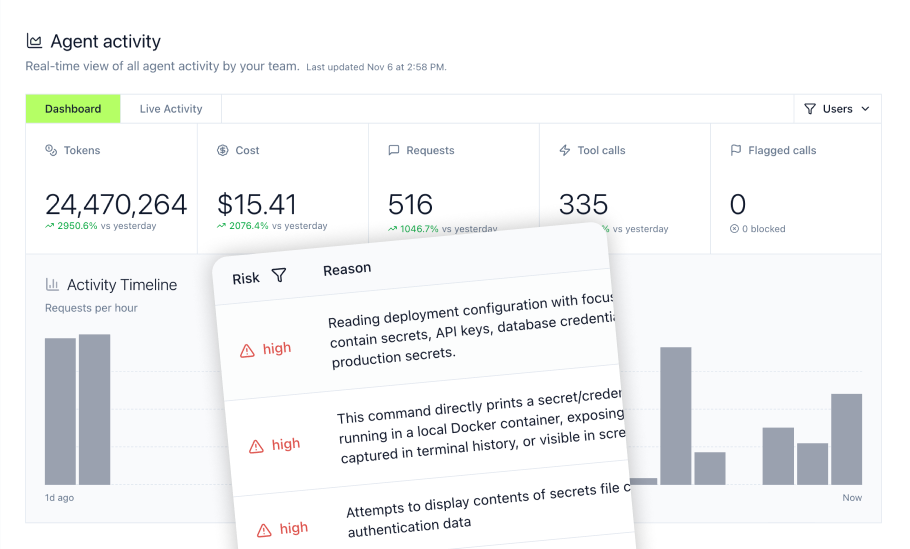
Agent Monitor provides organizational visibility into supported AI-agent activity, including supported coding-agent environments such as Claude Code, Cursor, Codex, and GitHub Copilot. Coverage varies by client, agent, and hook phase.
What Agent Monitor captures
- Prompt submissions: Prompts captured from supported agent environments
- Tool calls: Every MCP tool invocation with full argument context
- File access: Reads of .env files, SSH keys, configuration, and source code
- Commands: Shell executions, package installations, git operations
Tracking interaction with enterprise systems
The live activity feed shows supported captured agent activity across the organization in real time. Filter by user, agent, tool, or time period to investigate specific patterns.
Usage and cost tracking provides:
- Token spend by model, user, agent, and session
- Human versus agent usage split for accurate chargeback
- Cache-hit rates to optimize context reuse
Identifying security anomalies
Agent Monitor applies rules to detect concerning patterns:
- Secrets or credentials detected in supported captured activity
- Prompt injection patterns where supported
- Tool-permission violations
- Custom tool-argument or regex patterns defined by security teams
SIEM export via OTLP or Splunk HEC feeds this visibility into existing security operations.
Runtime Protection: Implementing Guardrails
Visibility shows what happened; guardrails determine what can happen. Llama 4's open nature means organizations must implement their own runtime controls rather than relying on provider-side moderation.
MintMCP's guardrail architecture provides three complementary layers that screen and control supported gateway tool calls.
Mint Guard: Managed Detection Policies
Mint Guard offers out-of-the-box detection for common risks:
- Prompt injection detection: Detects prompt injection in supported gateway content and can block high-confidence threats in enforcing mode
- Credential/secret detection: Detects credentials and secrets in supported gateway content
- PII detection: Detects personal information in supported gateway content
- Harmful content detection: Detects harmful content where the policy is applied
Mint Guard operates in monitoring or enforcing modes.
Rules: Declarative Pattern Matching
Teams define custom rules for specific security requirements:
- Match tool names to restrict which capabilities agents can invoke
- Evaluate arguments to prevent operations on sensitive resources
- Apply regex patterns to block specific data patterns
- Actions include flag, block, ask-user, mask, or notify based on policy
Gateway Middleware: Custom Security Logic
Gateway Middleware enables customer-authored JavaScript for sophisticated policy enforcement:
- Transform or redact sensitive data before it reaches agents
- Call external DLP classifiers to apply existing data protection policies
- Enforce resource allowlists based on business context
- Integrate with security tools your organization already operates
Building Persistent Agents: Coworker Agents Infrastructure
Llama 4's cost efficiency and self-hosting capability make it attractive for persistent agents that work alongside employees, answering questions, running scheduled tasks, and maintaining context across days or weeks.
Coworker Agents provide infrastructure for long-running autonomous agents with governance built in from the start.
What Coworker Agents enable for model-flexible autonomous work
- Slack-native interaction: Agents live in channels, responding to mentions and maintaining conversation context
- Scheduled execution: Run daily reports, weekly summaries, or periodic maintenance tasks
- Manual triggers: Initiate agent work through a Run button when needed
- Persistent work across days: Agents continue complex tasks across sessions without losing context
The repo-as-memory architecture means configuration, instructions, and memory are reviewable files:
CLAUDE.mdcontains agent instructionsprogress.mdmaintains working memory between sessionsinbound/receives task inputs for processing
Company-owned memory for enterprise AI
Unlike vendor-managed memory systems where agent state disappears into a black box, Coworker Agents use git-backed memory the company owns:
- Version history: See how agent memory evolved over time
- Reviewability: Audit what information an agent retained
- Portability: Export memory if changing platforms
- Scoped access: Different memory silos for organization, team, and individual contexts
Swappable intelligence for model flexibility
Coworker Agents are designed around swappable model choice so organizations can change underlying intelligence without rebuilding the governance, tool-access, and memory layer. Organizations can:
- Start with one model for cost efficiency on routine tasks
- Route complex reasoning to larger models when needed
- Switch underlying models without rebuilding agent infrastructure
- Avoid lock-in to any single AI provider
Governance built into autonomous execution
Coworker Agents inherit the full MintMCP governance stack:
- VMCP-scoped tool allowlists
- Agent Monitor session visibility for audit
- Sandboxed execution with restricted egress
- Secret brokering (agents see placeholders, not actual credentials)
Enterprise-Grade Security: SSO, SCIM, and Audit
Self-hosted open-weight model deployment shifts more responsibility for enterprise security and governance infrastructure to the deploying organization than managed model APIs do. MintMCP's Security and Enterprise capabilities supply the identity, audit, and operational control foundation.
Authentication and directory integration
- Enterprise SSO: Okta, Entra ID, and Google authentication for all platform access
- SCIM provisioning: Directory groups drive both admin roles and tool access; suspend in the IdP and access revokes immediately
- Domain verification: Ensure only verified domains can access organizational resources
Access control and permissions
RBAC operates at two independent layers:
- Org-level roles: Member, admin, and custom roles for administrative access
- VMCP access policies: Determine which tools each role can invoke through directory-group membership
Audit and compliance
Every tool call, credential lifecycle event, and access-policy change is logged. MintMCP also maintains tamper-evident access-grant history signed at write time:
- Access-grant history signed at write time
- Verifiable offline via published JWKS
- Exportable for compliance reporting
- Full context including prompts, arguments, and results for incident investigation
Operational controls
When something goes wrong, immediate response options include:
- Org-wide kill switch: Immediately halt organization-wide access through the governed MintMCP gateway
- Per-VMCP disable: Shut down specific tool surfaces while others continue
- Per-connector restart: Reset problematic integrations without broader impact
- Credential rotation: Invalidate and replace credentials instantly
Configuration as code enables declarative management of gateway configuration and global rules.
Total Cost of Ownership: Deployment Economics
Understanding the full cost picture helps organizations make informed deployment decisions. Llama 4's open weights create different economics than API-based models.
Cost comparison
Llama 4 deployment costs vary substantially by inference provider, input/output token mix, context length, quantization, GPU utilization, and operational overhead. Managed APIs minimize infrastructure management, while self-hosting adds hardware, engineering, maintenance, and capacity-planning costs. Use current provider pricing and a clearly defined workload before calculating a break-even point or multi-year TCO.
Hidden costs to account for
- Fine-tuning cycles: Compute, evaluation, and ML engineering time
- Data and RAG infrastructure: Ingestion, indexing, storage, retrieval, and ongoing maintenance
- Security and compliance work: Assessments, controls, documentation, and operational review
- Staffing and training: Infrastructure, ML operations, security, and governance expertise
Governance infrastructure costs
Managed model APIs may provide provider-side authentication, logging, and safety controls. Self-hosted Llama 4 requires organizations to operate more of that security and governance infrastructure themselves. MintMCP provides the identity, monitoring, and control layers that enable open-weight model deployment with enterprise-grade governance.
Cost optimization strategies
- Start with managed APIs during testing; migrate to self-hosted once volume justifies infrastructure investment
- Evaluate quantization such as INT4 to materially reduce model-memory requirements; actual quality and memory impact depends on the quantization method, workload, KV cache, and inference stack
- Batch non-urgent workloads for lower compute costs than real-time inference
- Right-size model selection: Use Scout where its quality and long-context capabilities meet the workload, and evaluate Maverick for tasks that benefit from stronger general-purpose and multimodal performance
Why MintMCP for Llama 4 Enterprise Deployments
Open-weight models promise unprecedented control and flexibility, but they shift governance responsibility entirely to the deploying organization. Meta provides the model weights and separate safety tooling, while enterprises remain responsible for integrating identity, permissions, monitoring, auditability, and operational controls appropriate to their deployment.
MintMCP transforms Llama 4 from a powerful but ungoverned model into a production-ready enterprise asset. The platform addresses each gap systematically:
- Centralized access control can replace scattered credentials for governed tool access. Llama 4 agents connected through Virtual MCPs can receive scoped permissions, credential injection, and auditable access to approved enterprise tools. New Llama deployments must be explicitly integrated with MintMCP's governed access layer to receive those controls.
- Real-time visibility adds supported agent-activity context beyond infrastructure and inference metrics alone. Agent Monitor tracks prompts, tool calls, file access, and commands from supported environments, feeding security teams the context they need to detect anomalies, investigate incidents, and understand how AI systems interact with enterprise data. Usage tracking attributes token consumption and costs to specific users, agents, and workloads for accurate chargeback and capacity planning.
- Runtime enforcement implements the controls that open-weight deployments lack by default. Guardrails screen tool calls for prompt injection, credential leakage, PII exposure, and policy violations before execution. Organizations can apply detection rules consistently across supported governed AI clients and agent environments, independent of the underlying model where supported.
- Enterprise integration connects Llama 4 to existing identity, security, and compliance infrastructure. SSO and SCIM provisioning tie user and VMCP access policies to directory groups, while Agent Gateway gives autonomous agents their own scoped identities and permissions. Tamper-evident audit logs export to SIEM platforms for correlation with other security signals. Configuration as code enables teams to manage policies through version-controlled infrastructure alongside their Llama deployments.
The result: enterprises capture the cost advantages, data control, and customization benefits of open-weight models without sacrificing the governance, security, and operational control that closed APIs provide automatically. Teams can route governed tool interactions through authenticated, monitored, policy-enforced infrastructure that scales from pilot projects to organization-wide production.
Frequently Asked Questions
How does Llama 4's licensing work for commercial enterprise use?
Meta's Llama 4 Community License permits commercial and research use subject to its terms. If the licensee or its affiliates had more than 700 million monthly active users across their products or services on the Llama 4 release date, a separate license from Meta is required. The license also includes redistribution and attribution requirements and incorporates the Llama 4 Acceptable Use Policy. For the multimodal models, individuals domiciled in the EU and companies with their principal place of business in the EU are not granted the Section 1(a) rights, although that restriction does not apply to end users of products or services that incorporate the models.
What infrastructure do I need to self-host Llama 4 Maverick?
Maverick's 400B-total-parameter weights require substantially more memory at BF16 or FP16 than 206GB. The roughly 206GB figure is an INT4 estimate. Meta also provides an FP8 Maverick checkpoint that fits on a single H100 DGX host, while alternative quantized deployments require enough aggregate accelerator memory for the chosen weights, KV cache, and runtime overhead. For production deployment, plan for high-bandwidth NVMe storage, redundant power and cooling, load balancing infrastructure for multiple inference servers, and monitoring for GPU utilization and inference latency.
How do I migrate existing GPT-4 or Claude workloads to Llama 4?
Migration does not require data movement since you switch API endpoints rather than transferring datasets. The main effort involves re-testing prompts for performance parity. Llama 4 uses different instruction formats than GPT-4 or Claude, so existing prompts may need adjustment. Migration effort depends on the number of workflows, prompt complexity, tool integrations, latency requirements, and evaluation standards. Use shadow testing or offline evaluation to compare outputs before cutover, then retune prompts and application logic where Llama 4 behaves differently from the previous model.
What happens if Meta discontinues Llama 4 support or changes licensing terms?
Because self-hosted deployments use downloaded model weights, a future service discontinuation would not technically remove those files from your infrastructure. Continued use would still be governed by the license terms applicable to your deployment and by applicable law, so organizations should not assume how future licensing changes would affect existing or derivative models. Discontinuation could also mean losing upstream model updates, security guidance, optimizations, and managed-provider support.
How does Llama 4 handle multilingual content for global enterprises?
Llama 4 supports 12 languages with enhanced fluency beyond English, making it suitable for global customer support, multilingual document processing, and international team collaboration. Maverick particularly excels at maintaining conversation quality across language switching. For enterprises operating in regulated markets with language requirements, Llama 4 can process inputs and generate outputs in the required language while maintaining context from mixed-language sources. Fine-tuning on domain-specific multilingual data further improves accuracy for specialized terminology in each supported language.