The Model Context Protocol ecosystem now spans over 10,000 servers, creating unprecedented opportunity for enterprises to connect AI agents to internal data and tools. Yet this rapid expansion introduces significant security and governance challenges that platform teams cannot address through manual review alone. As AI agent adoption accelerates across enterprise workflows, security leaders need structured frameworks for vetting, deploying, and monitoring MCP servers at scale. The MintMCP Gateway provides centralized governance that transforms shadow AI into sanctioned AI while enabling business units to deploy MCP tools in minutes rather than months.
This guide outlines actionable strategies for enterprise platform teams to secure MCP infrastructure, covering registry-based deployment, API security, vendor risk management, zero trust architecture, compliance frameworks, and real-time monitoring.
Key Takeaways
- Manual vetting cannot scale to 10,000+ MCP servers; automated security frameworks with registry-based deployment pipelines are essential for enterprise adoption
- Three-phase deployment (sandbox with synthetic data, limited production with monitoring, scaled rollout with automated compliance) reduces exposure compared with direct production deployment by adding review, monitoring, and policy checks before broad rollout
- Public security claims vary by vendor, meaning enterprise platform teams must verify SOC 2 Type II audited status, compliance scope, and supporting documentation rather than assume security maturity from market presence
- Authentication fragmentation creates credential management complexity across OAuth, API keys, open-access tools, bearer tokens, headers, and custom credential patterns
- Shadow AI grows as business units adopt AI agents faster than traditional security review can track through no-code platforms that connect agents to sensitive data sources such as Salesforce, Google Drive, and Slack without IT oversight; centralized gateway governance closes this gap
- Autonomous AI agents now execute code, modify systems, and create resources, requiring new permission models that traditional chatbot security frameworks cannot address
- Virtual MCP Bundles enable per-use-case endpoints with SCIM-driven membership and tool-level access control, providing the granularity enterprises need for least-privilege enforcement
Understanding the Enterprise Security Landscape for MCP Servers
Enterprise adoption of AI agents has accelerated as teams move from passive chatbots to systems that can file code, run scans, create channels, and write responses autonomously. This represents a fundamental shift: AI agents are no longer merely answering questions, which means platform teams need stronger governance around the tools and data those agents can access.
The Rise of Shadow AI in Enterprise Environments
The democratization of AI tools has created a shadow AI problem as business units adopt AI agents faster than traditional security review can track. Many no-code and low-code AI platforms now let non-technical teams deploy agent-like workflows quickly, often before security teams have reviewed the connected data sources.
This accessibility bypasses traditional security review processes. Business users connect AI agents to:
- CRM systems like Salesforce and HubSpot
- Document repositories including Google Drive and SharePoint
- Communication platforms such as Slack and Microsoft Teams
- Support systems like Zendesk and Freshdesk
Without centralized governance, enterprises cannot see what data AI agents access or control their actions.
Key Security Concerns in MCP Deployments
The MintMCP server registry shows why authentication fragmentation matters across the ecosystem. MCP servers can rely on OAuth, API keys, bearer tokens, headers, open access, or custom credential patterns, which creates inconsistent security and review requirements across tools.
Mixing OAuth-protected production servers with API-key community servers in the same infrastructure introduces privilege escalation risks and audit trail gaps. Platform teams need unified authentication enforcement regardless of upstream server capabilities.
Leveraging MintMCP's Registry for Secure MCP Deployment
The MintMCP registry provides a central repository of available MCP servers that platform teams can use as the starting point for discovery, review, and governed deployment. This registry-based approach addresses the impossible manual vetting burden by enabling automated evaluation against pre-defined security policies.
Centralizing MCP Server Discovery
Rather than allowing business units to discover and deploy MCP servers independently, enterprise platform teams can establish approved server catalogs through the registry. The MintMCP approach enables:
- One-click installation for vetted servers through governed deployment workflows
- Virtual MCP Bundles that group servers by role and use case
- SCIM-driven membership that automatically provisions access based on IdP groups
- Tool-level curation that enables specific capabilities while blocking others
For teams building internal knowledge bases, the Elasticsearch integration demonstrates this pattern: search, ES|QL queries, index listing, and mapping retrieval tools are exposed through a governed endpoint rather than raw database access.
Ensuring Software Supply Chain Security
Supply chain integrity for MCP servers requires the same rigor enterprises apply to software dependencies. Platform teams should distinguish between official vendor servers, internal servers, and community-built solutions when establishing tiered approval processes.
Key supply chain security considerations:
- Verification of server provenance and maintainer reputation
- Analysis of upstream dependencies and update frequency
- Assessment of authentication method and encryption standards
- Review of data handling practices and residency claims
MintMCP's hosted connector model runs and scales connector instances on the customer's behalf with auto-scaling and isolated execution per connector.
Implementing Robust API Security for MCP Tools
API security for MCP servers requires authentication normalization across diverse upstream implementations. The MintMCP Gateway provides OAuth protection and enterprise authentication with OAuth 2.0, SAML, and SSO integration for MCP servers, regardless of their native authentication method.
Securing MCP Endpoints with OAuth
The gateway normalizes upstream transports and authentication methods into a single SSO-fronted remote MCP endpoint. This approach means:
- Developers connect through one authenticated endpoint regardless of upstream variety
- OAuth brokering for stdio and hosted servers works around hosted-container redirect-URI limitations
- Enterprise SSO policies apply uniformly across MCP traffic
- API keys and tokens are managed centrally rather than scattered across developer machines
For data warehouse integrations, the Snowflake MCP Server exposes Cortex Agent, Cortex Analyst, and SQL query capabilities through this governed endpoint, enabling finance teams to automate reporting while security teams maintain access control.
API Access Control Best Practices
Granular tool access control enables platform teams to configure access by role. For example, a data analyst Virtual Bundle might enable read-only operations such as search, list indices, and get mappings while excluding write tools such as create, drop, and alter.
The security documentation outlines implementation patterns for:
- Role-based tool allowlisting and blocklisting
- Per-user versus shared authentication models
- Rate limiting to prevent resource exhaustion
- Input validation to block injection attacks
Vendor Risk Management for Third-Party MCP Integrations
As the AI agent ecosystem expands across vendors, connectors, and community-built tools, third-party risk assessment becomes critical. Enterprises cannot assume security maturity from market presence alone, especially when vendor security pages vary in how clearly they document audit scope, data handling, identity controls, and compliance documentation.
Assessing and Mitigating External Provider Risks
Effective vendor vetting requires evaluation across multiple dimensions:
- Compliance posture: SOC 2 Type II audited status, documented privacy controls, and compliance with HIPAA standards where applicable
- Data handling: Documentation of processing locations, retention policies, and encryption standards
- Operational documentation: Availability of incident response procedures, support channels, and escalation paths
- Governance fit: Ability to support identity controls, audit trails, access reviews, and policy enforcement requirements
Platform teams should establish tiered approval frameworks: Gold tier for fully vetted enterprise vendors, Silver for community servers with verified security practices, and Bronze for experimental use in sandboxed environments only.
Ensuring Compliance in Third-Party Partnerships
MintMCP provides data residency options, but the platform should not be described as supporting data residency controls for multi-region compliance. For organizations with strict geographic processing requirements, teams should validate deployment scope, documentation, and contractual terms directly with MintMCP before relying on the platform for regional compliance needs.
Service level agreements should address:
- Uptime guarantees and failover mechanisms
- Incident notification timeframes
- Data breach response procedures
- Right to audit provisions
Building a Zero Trust Architecture for Enterprise MCPs
Traditional perimeter-based security models fail when AI agents operate with extensive system access. Zero trust architecture applies least-privilege principles continuously, verifying every request regardless of source.
Applying Zero Trust Principles to Agents
The shift from passive chatbots to autonomous agents requires new security models. Agents can execute code, modify systems, and create resources, which means a compromised agent can cause significantly more damage than a compromised chatbot.
Zero trust implementation for MCP environments includes:
- Per-agent identity: Agent Bundles with M2M authentication provide bearer API keys and OAuth 2.0 client-credentials per agent
- Scoped tool access: Virtual MCP Bundles limit each agent's permissions to explicitly approved capabilities
- Continuous verification: Every tool call is validated against current policy rather than assuming trust from initial authentication
- Rotation and revocation: Agent credentials rotate and revoke independently of human user accounts
Implementing Granular Access Controls
The MintMCP platform implements access control at the tool level rather than the server level. This granularity enables security teams to approve database query capabilities while blocking administrative operations, or allow email search while restricting send capabilities.
For customer support use cases, the Gmail MCP Server demonstrates this pattern: search and retrieval tools might be broadly available, while draft and send capabilities require additional approval workflows.
Real-Time Monitoring and Observability for Enterprise Compliance
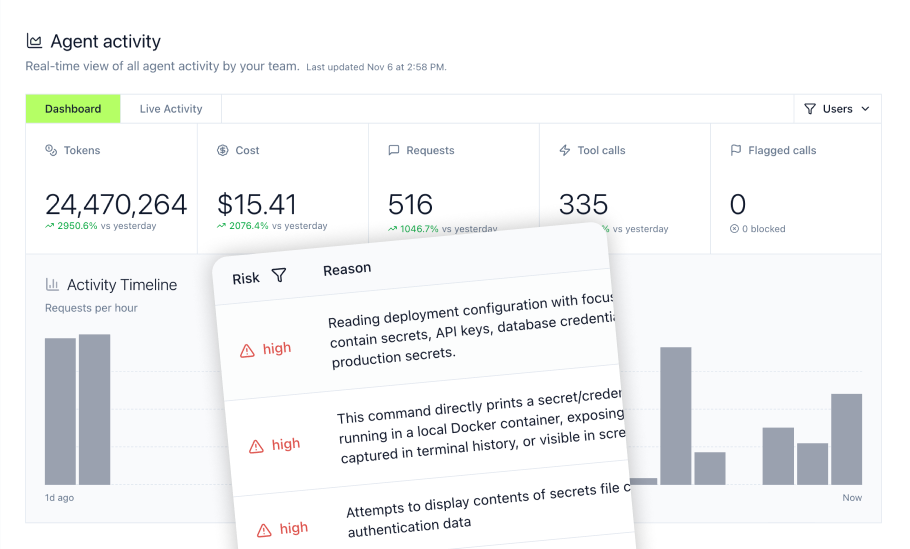
Complete audit trails of every MCP interaction, access request, and configuration change form the foundation of enterprise compliance. The MintMCP Gateway provides live dashboards for server health, usage patterns, and security alerts through its audit and observability capabilities.
Achieving Compliance with Audit Trails
Frameworks and regulatory obligations such as SOC 2, HIPAA, and GDPR require demonstrable controls around data access, auditability, privacy, and security operations. The platform generates audit logs that capture:
- Which user or agent initiated each request
- What tools were invoked and with what parameters
- When actions occurred with precise timestamps
- Whether requests were approved, modified, or blocked by policy
These logs enable security teams to investigate incidents, demonstrate compliance to auditors, and identify anomalous access patterns before they become breaches.
Detecting and Responding to Security Incidents
Real-time monitoring surfaces threats as they occur rather than during post-incident review. The platform's observability features enable:
- Usage pattern analysis to detect anomalous agent behavior
- Alert configuration for policy violations and access attempts
- Integration with existing SIEM systems for consolidated security monitoring
- Automated response actions for high-confidence threat indicators
Protecting Sensitive Data with MCP LLM Proxy Security Guardrails
Coding agents operate with extensive system access, reading files, executing commands, and accessing production systems through MCP tools. The MintMCP LLM Proxy provides essential visibility and control over agent behavior beyond MCP traffic.
Preventing Dangerous Commands with Guardrails
MintMCP governance helps teams manage AI tool activity across Claude, Cursor, ChatGPT, Gemini, and Copilot, while the LLM Proxy adds deeper monitoring for local coding-agent behavior such as MCP tool invocations, bash commands, and file operations. Security guardrails block dangerous commands in real time, protecting against:
- Execution of destructive system commands
- Access to sensitive configuration files
- Exfiltration of credentials or secrets
- Unauthorized modifications to production systems
The platform's tool governance capabilities enable security teams to define policies that automatically block risky operations while allowing legitimate development workflows.
Safeguarding Credentials and Sensitive Files
Sensitive file protection prevents AI agents from accessing .env files, SSH keys, credentials, and other sensitive configuration. The LLM Proxy maintains a complete audit trail of all file operations, enabling security teams to:
- Identify which agents accessed which files and when
- Detect attempts to read credential files or configuration secrets
- Enforce access policies based on file paths and patterns
- Generate compliance reports for security audits
For organizations concerned about MCP data risks, this two-layer governance approach (Gateway for MCP traffic, LLM Proxy for local agent activity) provides comprehensive coverage.
Ensuring Compliance: SOC 2, HIPAA, and GDPR with MintMCP
Enterprise deployments in regulated industries require demonstrated compliance with frameworks governing data protection, privacy, and security controls. The MintMCP platform supports these requirements through its security architecture and compliance documentation.
Meeting Enterprise Compliance Standards
MintMCP is SOC 2 Type II audited, with continuous compliance monitoring via Drata. Enterprise SSO, complete audit trails, PII detection, and role-based access control are built into every layer of the platform. MintMCP is compliant with HIPAA standards, customers handling protected health information can request HIPAA documentation, and MintMCP signs BAAs.
The compliance framework addresses:
- SOC 2 Type II: Continuous monitoring and annual audit cycles
- HIPAA: BAA availability, PHI handling controls, and required safeguards
- GDPR: Privacy controls, audit trails, and documentation to support customer review of data handling requirements
Organizations can review MintMCP's security posture through the Trust Center or contact the security team directly for compliance documentation.
Implementing Policy Enforcement for Regulated Data
Gateway Middleware enables customer-authored JavaScript in a sandbox with allowed-domains fetch, secret injection, and built-in templates. Pre-configured integrations support:
- AWS Bedrock Guardrails for content filtering in block and mask modes
- OpenAI moderation for content safety
- Jailbreak detection for prompt injection attempts
- PII detection and masking for sensitive data protection
These inline middleware capabilities enable enterprises to enforce data handling policies before information reaches MCP servers or returns to AI clients.
Securing Enterprise AI: The MintMCP Approach
Enterprise platform teams face a fundamental challenge: AI agents deliver productivity gains while introducing security risks that traditional IT governance cannot address. The MintMCP Gateway solves this by providing centralized visibility and control over MCP interactions without slowing innovation.
By consolidating authentication across diverse MCP servers into a single SSO-fronted endpoint, MintMCP eliminates credential sprawl while enabling granular tool-level access control through Virtual Bundles. Security teams gain audit trails, real-time monitoring, and policy enforcement capabilities that regulated enterprise environments require. The LLM Proxy extends this governance to local agent activity, creating coverage of both MCP traffic and unstructured agent behavior.
Organizations deploying the platform benefit from compliance monitoring, pre-built integrations with enterprise identity providers, and registry-based deployment workflows that transform manual security review into scalable policy enforcement. Rather than choosing between agent velocity and security posture, enterprises can deploy AI tools with confidence that access controls, audit requirements, and compliance obligations are enforced consistently across interactions. This approach enables business units to leverage the full MCP server ecosystem while platform teams maintain the governance that enterprise security demands.
Frequently Asked Questions
How do I evaluate MCP server safety for production?
Evaluate MCP servers across four dimensions: authentication method (prefer OAuth over API keys or open access), vendor reputation (official vendor servers versus community contributions), compliance documentation (SOC 2 Type II audited status, not marketing claims), and data handling practices (documented processing locations, retention policies, encryption standards). Establish a tiered approval framework where fully vetted servers receive immediate approval while others require additional security review or sandbox-only deployment.
What distinguishes Gateway governance from LLM Proxy monitoring?
MCP Gateway governance controls traffic between AI clients and MCP servers, enforcing authentication, access control, and audit logging for tool invocations. LLM Proxy monitoring covers local agent activity that does not traverse MCP, including bash commands, file operations, and prompt submissions from coding-agent workflows, while the broader MintMCP governance layer helps teams manage AI tool access across Claude, Cursor, ChatGPT, Gemini, and Copilot. Together, these provide visibility: Gateway handles structured MCP interactions while LLM Proxy captures unstructured agent behavior on developer machines.
How should enterprises handle MCP servers adding new tools?
Tool-update policy addresses silent capability expansion. Configure whether new upstream tools are auto-enabled or require admin approval before becoming available to users. This prevents scenarios where a vetted server adds write capabilities that your initial security review did not anticipate. The policy applies per Virtual Bundle, enabling different approval workflows for different user populations based on risk tolerance.
Can enterprises use open-source MCP servers in production?
Open-source MCP servers can be appropriate for production with proper vetting. The transparency of open-source code enables security teams to audit implementations directly, often providing more confidence than closed platforms that rely mainly on marketing claims. However, open-source servers require developer expertise to secure properly and may lack enterprise support agreements. Consider hosting open-source servers through MintMCP's hosted connector model, which provides auto-scaling, isolation, and operational management without requiring your team to maintain Kubernetes infrastructure.
What compliance documentation should enterprises request before deploying integrations?
Request SOC 2 Type II audit reports, data processing agreements specifying handling practices, incident response procedures with notification timeframes, and business associate agreements if processing protected health information. Verify that the vendor's compliance scope covers the specific services you plan to use, as SOC 2 reports often exclude certain product features or deployment models. For vendors claiming regulatory compliance, request evidence of continuous monitoring programs and recent audit reports.