Your developers are using dozens of AI tools right now. IT knows about a fraction of them. The rest? Shadow AI connecting to your customer database, CRM, and codebase with zero audit trail. As McKinsey found that 70% of organizations regularly use generative AI, platform teams face a critical challenge: enabling AI productivity while maintaining security and compliance.
An internal MCP registry solves this by creating a centralized catalog where AI agents discover approved tools, platform teams enforce access policies, and security teams get complete visibility into every AI-to-system connection. The MCP Gateway provides this foundation with one-click deployment, OAuth protection, audit logs, PII detection, secret scanning, and role-based governance for organizations scaling AI tool adoption.
This article outlines how platform teams can implement an internal MCP registry to transform scattered AI tool chaos into governed infrastructure, covering architecture decisions, security controls, compliance requirements, and practical integration patterns.
Key Takeaways
- An internal MCP registry serves as the "single source of truth" for all MCP servers, enabling dynamic tool discovery by AI agents while enforcing access policies at runtime
- Registry-gateway integration reduces brittle hardcoded tool connections by centralizing discovery, metadata, and runtime policy enforcement
- Virtual servers enable role-based tool access, allowing HR teams to access employee data tools while restricting engineering tools to developers
- Complete audit trails capture who accessed what tools, when, and what data flowed through for regulatory compliance
The Rise of AI Tools and the Challenge of Shadow AI in the Enterprise
The proliferation of AI tools across organizations has created unprecedented productivity gains alongside significant governance gaps. While Gartner found that 55% of organizations have an AI board, employees continue adopting Claude, ChatGPT, Cursor, Gemini, and Copilot for daily workflows without centralized oversight.
Understanding Shadow AI in the Context of MCP Tools
Shadow AI refers to uncontrolled AI usage where employees connect AI assistants to internal systems without IT approval or security review. This creates multiple risks:
- Data exfiltration: AI tools accessing sensitive customer or financial data without proper controls
- Compliance violations: Unaudited data flows that violate SOC 2, HIPAA, or GDPR requirements
- Security exposure: API keys and credentials stored in developer configurations without rotation policies
- Integration failures: Inconsistent tool versions causing downstream system errors
The Model Context Protocol has become the industry standard for connecting AI clients to enterprise data, supported by Anthropic, OpenAI, Google, and Microsoft. However, MCP introduces new challenges with deployment, security, and governance that platform teams must address.
The Growing Demand for AI Tools Across Business Functions
AI agents now serve every department. Data analysis teams query databases and generate reports using real-time data. Customer support teams access CRM data, support tickets, and customer history. Development teams connect AI coding assistants to repositories, issue trackers, and CI/CD systems. Each use case requires different tools, permissions, and security controls.
Building a Centralized Internal MCP Registry for Enterprise AI Governance
An MCP registry maintains structured metadata about every MCP server in your organization: what tools they expose, where they are deployed, who can access them, authentication requirements, and operational health. AI agents query the registry at runtime to discover approved tools without hardcoded configurations.
What Is an MCP Registry and Why Is It Crucial?
Unlike a static directory, an effective MCP registry functions as a dynamic discovery layer that AI agents query programmatically. This enables:
- Dynamic tool discovery: Agents find and connect to approved tools via API queries
- Namespace verification: GitHub-based or domain-based identity verification prevents impersonation
- Metadata management: Stores tool capabilities, versions, authentication methods, and deployment details
- Federation support: Sub-registries for decentralized teams while maintaining unified governance
The MintMCP servers directory demonstrates this approach, showing a curated sampling of the 10,000+ MCP servers available on MintMCP with one-click installation and configuration. MintMCP Gateway also works with MCP-compatible servers beyond the visible directory.
Key Features of an Effective Internal MCP Registry
Platform teams should evaluate registries based on several capabilities:
- Role-based virtual servers: Organize tools by team function with granular permissions
- Authentication normalization: Handle OAuth, SAML, bearer tokens, and API keys through unified interfaces
- Audit trail generation: Log all tool access, usage patterns, and security events
- Version control: Track tool updates and require approval before enabling new capabilities
One-Click Deployment and Real-time Monitoring
Traditional MCP server deployment requires local installations, manual configuration, and ongoing maintenance. Platform teams report spending significant engineering hours managing scattered MCP instances across developer machines.
Accelerating AI Tool Deployment with Simplified Processes
The MCP Gateway transforms this through STDIO server support with automatic hosting and lifecycle management. Rather than each developer running local MCP servers, containerized servers become accessible to clients without local installations.
Key deployment capabilities include:
- One-click installation: Deploy STDIO-based MCP servers instantly with built-in hosting
- OAuth protection: Add SSO and OAuth to compatible MCP servers automatically
- Virtual server creation: Create and manage virtual MCP servers for teams with role-based access
- Automatic discovery: Simple connection to any MCP server with automatic configuration
Gaining Visibility into MCP Server Performance
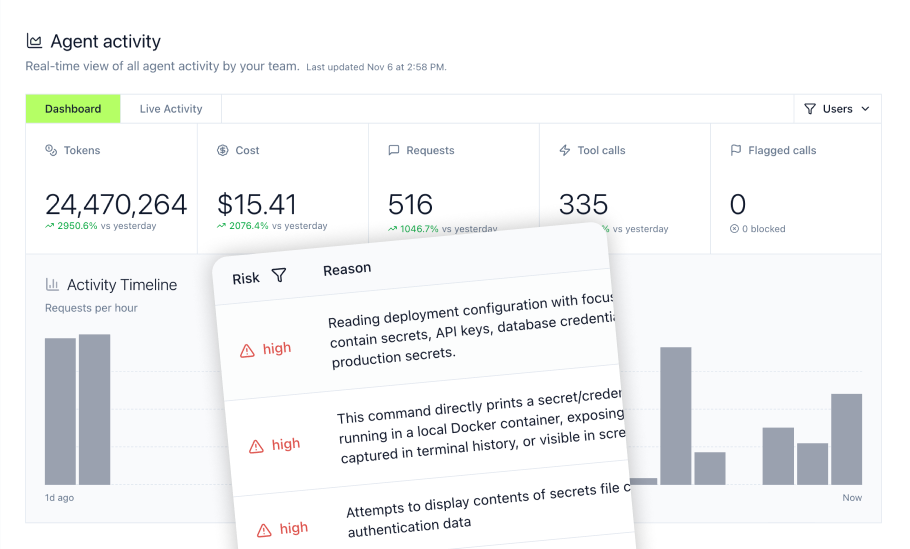
Real-time monitoring provides live dashboards for server health, usage patterns, and security alerts. Platform teams can track:
- Which tools teams are using and how frequently
- Response times and error rates across MCP connections
- Anomaly detection for unusual access patterns
- SLA compliance for critical business tools
Security and Compliance Controls for Internal AI Tool Access
Security represents the primary concern for organizations deploying AI tools at scale. AI agents operate with extensive system access, reading files, executing commands, and accessing production systems through MCP tools.
Implementing Robust Authentication and Authorization
Enterprise authentication requires OAuth 2.0, SAML, and SSO integration for all MCP servers. The token brokering pattern addresses credential security: the control plane holds raw credentials and issues scoped tokens to agents, preventing API key sprawl.
Authentication best practices include:
- Enterprise SSO integration: Connect with Entra ID, Okta, and other identity providers
- Short-lived tokens: 15-60 minute expiration with automatic refresh
- Per-agent identity: Unique credentials for each AI agent with independent rotation
- OAuth brokering: Handle redirect URI limitations for hosted container environments
Ensuring Data Privacy Across AI Interactions
Zero-trust strategies for AI agents require unique identities per agent, micro-segmentation, and continuous behavioral monitoring. Platform teams should implement:
- Granular tool access control by role, enabling read-only operations while excluding write tools
- PII filtering for sensitive data traversing MCP connections
- Data residency options where required by customer and regulatory needs
Turning Shadow AI into Sanctioned AI: The Governance Framework
Effective governance transforms uncontrolled tool usage into managed, auditable infrastructure. This requires policy enforcement, access request workflows, and centralized credential management.
Establishing Clear Policies for AI Tool Usage
Policy-as-code approaches enable automated enforcement:
- Tool allowlisting: Only approved MCP servers appear in discovery queries
- Approval workflows: New server publication requires platform team review
- Usage quotas: Rate limiting per user, team, or agent
- Data classification: Different policies for tools accessing sensitive versus public data
The understanding MCP gateways guide provides detailed architecture patterns for implementing these controls.
Empowering Developers with Secure Self-Service Access
Governance should not impede productivity. Self-service access allows developers to request and receive AI tool access instantly within policy boundaries. Platform teams define guardrails; developers operate freely within them.
Compliance and Auditability: Meeting SOC 2, HIPAA, and GDPR Requirements
Regulated industries require documented tool access, audit trails, and human oversight for AI systems. The EU AI Act, with full enforcement for high-risk systems beginning in August 2026, creates additional requirements for such systems.
Leveraging Audit Trails for Compliance Reporting
Complete audit logs capture every MCP interaction, access request, and configuration change. This supports:
- SOC 2 requirements: Demonstrate access controls and monitoring capabilities
- HIPAA-related requirements: Document data access patterns for protected health information
- GDPR obligations: Maintain right-to-deletion capabilities for audit data
- Incident investigation: Trace security events to specific tool invocations
MintMCP is SOC 2 Type II audited, compliant with HIPAA standards, penetration tested, and encrypts data in transit and at rest. Customers handling protected health information can request HIPAA documentation, and MintMCP signs BAAs.
Observability and Control: Monitoring AI Tool Usage at Scale
The Agent Monitor extends governance beyond MCP to track MCPs, bash commands, and file access from coding agents in real time.
Tracking Usage Patterns and Cost Allocation
Usage analytics provide visibility into:
- Tool call tracking: Monitor every MCP tool invocation across teams
- MCP inventory: Complete visibility into installed MCPs and their permissions
- Cost attribution: Track spending per team, project, and tool
- Performance metrics: Measure response times and error rates
Protecting Sensitive Files and Commands
Security guardrails block dangerous operations in real-time:
- Block access to .env files, SSH keys, and credentials
- Prevent execution of destructive commands
- Maintain complete audit trails of all operations
- Alert on anomalous access patterns
Integrating Key Business Tools via MCP
MCP connectors bridge AI assistants with internal data sources. The enterprise MCP deployment guide covers integration patterns for common enterprise systems.
Connecting AI with Enterprise Data Sources
Elasticsearch integration: The Elasticsearch MCP Server enables AI-powered knowledge base search, support ticket intelligence, and log analysis. Tools include search using query DSL, ES|QL queries, index listing, and mapping retrieval.
Snowflake integration: The Snowflake MCP Server allows natural language to SQL conversion using Cortex Analyst, semantic search against Cortex Search services, and direct query execution. Finance teams automate reporting while executives generate real-time business intelligence without SQL expertise.
Gmail integration: The Gmail MCP Server enables AI assistants to search, draft, and reply to customer emails within approved workflows. Support teams aggregate product feedback with automated prioritization.
Practical Use Cases Across Teams
- HR teams: Build AI-accessible knowledge bases from company documentation and policies
- Product teams: Enable AI-powered customer-facing documentation search
- Support teams: Search historical tickets and resolution patterns for faster issue resolution
- Finance teams: Automate financial reporting and variance analysis from governed data
Future-Proofing Your Enterprise AI Strategy
AI client compatibility determines long-term registry value. MintMCP supports Claude Desktop and Web, ChatGPT via Custom GPTs, Microsoft Copilot, Cursor, Gemini, Goose, LibreChat, Open WebUI, Windsurf, and custom MCP-compatible agents.
Ensuring Extensibility and Scalability
Sustainable registry architecture requires:
- Data residency options: Support customer and regulatory data-location requirements where available
- High availability: Enterprise SLAs with automatic failover
- Custom server support: Deploy proprietary MCP servers alongside pre-built connectors
- API token management: Centralized credential storage with rotation policies
The MCP data risk guide provides additional context on securing AI-to-data connections as your deployment scales.
Why MintMCP Gateway Delivers Production-Ready Registry Infrastructure
Organizations implementing internal MCP registries face a fundamental choice: build custom infrastructure or adopt a managed platform. MintMCP Gateway provides production-ready registry capabilities that reduce custom infrastructure work while adding authentication, audit logging, monitoring, and role-based governance from day one.
The platform transforms MCP server deployment through automatic hosting for STDIO-based servers, removing the burden of managing scattered local installations across developer machines. OAuth protection can be layered onto compatible MCP servers, integrating with existing enterprise SSO infrastructure through providers such as Entra ID and Okta without requiring broad connector rewrites.
Virtual server architecture enables role-based access control at the tool level. HR teams access employee data tools while developers work with repository and CI/CD connectors, all from the same underlying registry with granular permission boundaries. Complete audit trails capture every tool invocation, supporting SOC 2 audit readiness, HIPAA-related documentation needs, and GDPR governance obligations with detailed access logs and behavioral monitoring.
Real-time dashboards provide visibility into server health, usage patterns, and security alerts across your entire MCP infrastructure. Platform teams track which tools teams use most frequently, identify performance bottlenecks, and detect anomalous access patterns before they become security incidents. The MintMCP servers directory offers immediate access to a curated sampling of the 10,000+ MCP servers available on MintMCP while supporting custom MCP servers for proprietary systems, providing the flexibility to scale from initial deployment to broader adoption without architectural changes.
Frequently Asked Questions
How does an MCP registry differ from an API gateway?
An API gateway manages HTTP request routing, rate limiting, and authentication for traditional REST or GraphQL APIs. An MCP registry specifically handles discovery and governance for Model Context Protocol servers, which use different transport mechanisms including stdio and Streamable HTTP, with legacy SSE compatibility where supported. The registry provides metadata about available tools, their capabilities, and access requirements, while an MCP gateway enforces runtime policies on actual tool invocations. Most enterprise deployments use both: a registry for discovery and a gateway for enforcement.
What happens to existing MCP server configurations during migration?
Migration follows a phased approach. During the transition period, agents can query the registry first and fall back to hardcoded configurations if a tool is not found. This parallel operation allows teams to migrate servers in batches based on risk level: low-risk tools like documentation and calendars first, medium-risk tools like internal CRM second, and high-risk tools like production databases last. Migration timelines depend on server count, risk level, approval workflows, and identity requirements.
Can platform teams restrict specific tool functions within an MCP server?
Yes. Granular tool access control allows administrators to enable specific operations while blocking others. For example, a finance team might access read-only database queries while write operations remain restricted to automated pipelines. This tool-level policy applies per virtual server, so the same underlying MCP server can expose different capabilities to different teams based on their role requirements.
How do registries handle MCP servers that require user-specific authentication?
The token brokering pattern addresses this. For servers requiring per-user OAuth flows, the registry supports "act as agent" administration where admins configure OAuth connections that agents inherit. For user-specific authentication, the registry can prompt users through their identity provider during first access, then cache tokens appropriately. Both shared service accounts and per-user auth flows are supported depending on the connector and compliance requirements.
What metrics should platform teams track to measure registry adoption success?
Key indicators include: percentage of AI tool usage flowing through the governed registry, developer satisfaction scores before and after implementation, shadow AI detection rate trending downward, mean time to provision new tool access, and security incident rates related to AI tool misuse. Quarterly reviews should also assess unused server pruning, metadata accuracy, and policy alignment with current business needs.