Model Context Protocol has rapidly become a common standard for connecting AI agents to enterprise infrastructure, with public adoption signals across developer platforms, enterprise software ecosystems, and internal AI tooling. Yet security research has found widespread MCP implementation risks, including command injection, unsafe command execution, overprivileged agents, and weak authentication practices. For platform engineers moving MCP from experimentation to production, pre-deployment security audits are no longer optional. This article provides an actionable audit checklist covering authentication, authorization, monitoring, compliance, and governance to ensure your MCP deployment meets enterprise security standards before go-live. A centralized MCP Gateway serves as the foundation for addressing these risks through unified policy enforcement and audit logging.
Key Takeaways
- MCP implementation flaws can include command injection, unsafe command execution, overprivileged agents, and weak authentication practices, making pre-deployment audits critical
- Shadow AI is expanding with broader AI adoption, requiring governance frameworks that transform ungoverned AI tool usage into sanctioned, policy-compliant deployments
- Many organizations lack centralized AI governance, creating compliance gaps that pre-go-live audits must address
- Least-privilege access is non-negotiable: poorly governed agents can accumulate broad permissions across connected tools, making overprivileged access compound across workflows
- Complete audit trails linking prompts to tool calls to outcomes support SOC 2, HIPAA, and GDPR audit readiness, and serve as your primary forensic record
- Single prevented data breach pays for 5+ years of security program investment, with average breach costs reaching $4.44 million
- Centralized gateway architecture provides the single control plane necessary for unified policy enforcement, authentication brokering, and incident response
Understanding the Evolving Landscape of MCP Data Risk
MCP standardizes how AI agents interact with enterprise resources including databases, APIs, file systems, and cloud services. Unlike traditional APIs where humans control each request, MCP enables autonomous agents to chain multiple tool calls, access sensitive data, and execute commands based on natural language instructions. This architectural shift introduces risk dimensions that require dedicated audit attention.
Core risk categories requiring audit focus:
- Prompt injection: Malicious instructions embedded in tool outputs or external data can manipulate agent behavior without visible exploitation
- Overprivileged access: Agents can accumulate excessive permissions across connected MCP servers when access is not scoped per user, role, or workflow
- Supply chain exposure: Community-built MCP servers may contain backdoors, exfiltration logic, or vulnerable dependencies
- Data exfiltration: Trusted tool connectors become covert channels for extracting sensitive information
- Confused deputy attacks: Servers executing with their own privileges instead of user-bound permissions violate least privilege principles
The NSA's MCP Security Guidance emphasizes implementation rigor, validation, and production security controls for organizations adopting MCP. A single control plane through a gateway architecture provides the unified policy enforcement, audit capabilities, and incident response necessary for production deployments.
Pre-Go-Live Security Audit Essentials
Authentication and Authorization Controls
Replace static credentials with identity-based authentication. Every MCP request must tie to an authenticated user or service identity. For remote MCP deployments, use OAuth-based authorization patterns with PKCE, resource indicators (RFC 8707) to bind tokens to specific servers, and either dynamic client registration or explicit client allowlisting.
Audit checklist for authentication:
- All MCP servers require SSO integration (SAML or OIDC)
- No static API keys in production configurations
- mTLS enabled for server-to-server communication
- Token audience validation configured
- OAuth redirect URIs properly restricted
Enforce least-privilege scopes. Define granular OAuth scopes per tool rather than blanket access. An analyst role might receive query.anonymized scope while explicitly excluding query.customers or update.records. This approach ensures each user or agent sees only authorized tools scoped to minimum required permissions.
MintMCP's Virtual MCP concepts enable role-based tool subsets through Virtual Bundles, allowing platform teams to define per-use-case endpoints with SCIM-driven membership and curated tool lists rather than granting all tools to all users.
Input and Output Sanitization
Deploy content filtering on all tool interactions. DLP scanning must detect PII, credentials, and proprietary data in both prompts and responses before they reach models or external systems.
Detection rules to implement:
- PII: Names, emails, SSNs, credit cards, health data
- Credentials: API keys, cloud tokens, passwords, SSH keys
- Proprietary content: Confidential project names, internal URLs, trade secrets
Enable prompt injection detection. Scan tool descriptions and external data for hidden instructions that attempt to manipulate agent behavior. Static analysis of tool metadata combined with runtime monitoring of unusual tool call patterns provides defense in depth.
Auditing API Security for Enterprise AI
OWASP's guidance on secure MCP server development identifies token mismanagement, overprivileged tools, and insufficient auditability as top risks requiring API-level controls.
API Security Requirements
- Transport security: TLS encryption mandatory for all MCP traffic, certificate validation enabled
- Rate limiting: Configured per tool and per user to prevent abuse
- Input validation: All tool parameters validated before execution
- Token lifecycle: Short-lived tokens (1 hour maximum) with automatic revocation
- Scope minimization: Database queries limited to specific tables and rows
Runtime Guardrails Configuration
High-risk actions including database writes, financial transactions, and external communications require human approval workflows. Configure enforcement modes based on deployment phase:
- Audit mode: Log violations without blocking during initial rollout
- Enforce with fallback: Block on violation, allow if guardrail unavailable for production
- Strict enforce: Block on any violation or guardrail error for sensitive systems
Ensuring Compliance in AI Deployments
Building Complete Audit Trails
Regulatory and audit readiness for SOC 2, HIPAA, and GDPR requires forensic trails linking every prompt to its resulting tool calls and downstream outcomes. Complete audit logging should capture minimum data points for each MCP interaction:
- User or agent identity with correlation ID
- Timestamp and MCP server accessed
- Tool name and parameters submitted
- Outcome status (success, failure, anomaly)
- Data classification level accessed
- Approval status (automatic, manual, rejected)
Audit log retention requirements vary by regulation:
- SOC 2: Retention should align with the organization’s control commitments, auditor expectations, and incident response needs
- HIPAA: Retain required policies, procedures, and compliance documentation for the applicable retention period, and align PHI access logs with legal and security requirements
- GDPR: Retention period should be tied to processing purpose, minimization principles, and data subject rights
MintMCP provides complete audit logs for audit readiness, with every MCP interaction tracked and exportable for review. MintMCP is SOC 2 Type II audited and compliant with HIPAA standards, with BAAs available for customers handling protected health information.
Regulatory Documentation
Prepare compliance evidence packages before go-live:
- Complete MCP server inventory with risk classifications
- User access matrix documenting who can use which tools
- Authentication and authorization architecture diagrams
- Incident response procedures specific to MCP threats
- Vendor due diligence records for third-party servers
EU AI Act penalties can reach up to €35 million or 7% of worldwide annual turnover, making compliance documentation a business-critical requirement rather than a checkbox exercise.
Monitoring and Auditing AI Agent Behavior
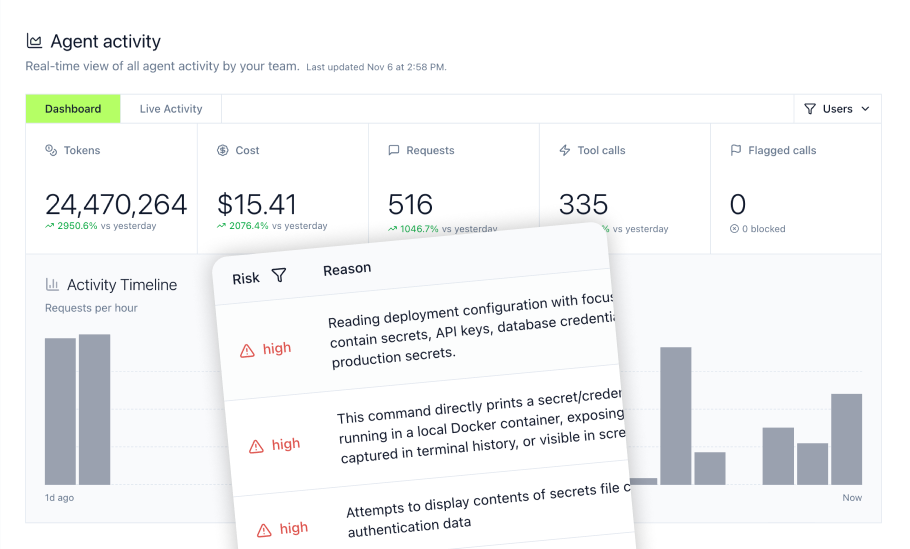
Coding agents operate with extensive system access, reading files, executing commands, and accessing production systems through MCP tools. Without monitoring, organizations cannot see what agents access or control their actions.
Critical Monitoring Capabilities
- Tool call tracking: Every MCP tool invocation, bash command, and file operation logged
- MCP inventory: Complete visibility into installed servers, permissions, and usage patterns
- Security guardrails: Real-time blocking of dangerous commands and sensitive file access
- Behavioral baselines: Track average execution times, network patterns, and data volumes
MintMCP's Agent Monitor provides visibility into local agent activity across tools like Claude Code and Cursor, while the MCP Gateway governs MCP traffic through centralized authentication, policy, and audit controls.
SIEM Integration Requirements
Export MCP logs to centralized security platforms and configure correlation rules for:
- Unusual data volume spikes indicating potential exfiltration
- After-hours activity from privileged agents
- Repeated authentication failures
- Authorization scope escalation attempts
- Anomalous tool call sequences
Define incident playbooks targeting 1-hour mean time to detect and 4-hour mean time to respond for MCP-specific threats.
Deploying Audit-Ready Infrastructure
Centralized Gateway Architecture
A centralized gateway intercepts all agent-to-tool requests, validates identity, checks permissions, logs complete request and response data, and blocks unauthorized or anomalous patterns. This architecture aligns with NSA's MCP guidance by centralizing validation, policy enforcement, logging, and incident response controls.
Gateway deployment checklist:
- Route all MCP traffic through single control plane
- Use gateway-mediated auth patterns for hosted or wrapped stdio servers where direct OAuth redirect handling is not practical
- Enable allowlisting for approved MCP servers only
- Set rate limits per user, team, and tool
- Establish audit logging with correlation IDs
MintMCP's gateway enables one-click deployment of STDIO-based MCP servers with built-in hosting, transforming local servers into production-ready services with monitoring and compliance controls already configured.
Tool Isolation and Supply Chain Security
Sandbox MCP server execution. Deploy each server in isolated runtime environments with restricted system calls:
- Filesystem: Block by default, read-only for specific paths only
- Network: Block outbound except whitelisted endpoints
- Memory: No shared memory access between tools
- Resources: CPU and memory quotas with hard execution timeouts
Verify supply chain integrity. Implement code signing verification, scan dependencies for CVEs, and maintain an approved server registry. Pin specific versions rather than allowing auto-updates, and require Software Bill of Materials (SBOM) documentation for all dependencies.
Governing Shadow AI and Internal Use Cases
Shadow AI risk expands as employees install AI tools without IT oversight. Pre-go-live audits must establish governance frameworks that transform ungoverned usage into sanctioned, policy-compliant deployments.
Governance Implementation Steps
- Discover existing MCP deployments: Scan for STDIO processes, HTTP endpoints, and SSE connections across developer environments and CI/CD pipelines
- Classify servers by risk tier: Critical (production databases, PII), High (internal tools with write permissions), Medium (read-only internal data), Low (public data sources)
- Verify server provenance: Check against approved registry, scan for unsigned packages or typosquatting
- Establish approval workflows: Require security review before new MCP server deployment
For teams across HR, finance, product, and support functions, MintMCP's understanding of gateways provides the foundation for enabling AI tools safely while maintaining centralized control over data access and tool permissions.
Go-Live Readiness Validation
Execute final checklist before production deployment:
- All MCP servers authenticated and authorized through gateway
- Least-privilege access enforced with tool-level scoping
- Audit logging operational and tested with sample queries
- Guardrails configured and validated against test cases
- Incident response plan documented and stakeholder-approved
- Compliance evidence package complete for auditor review
- Penetration test findings remediated or formally accepted
- Rollback plan tested with confirmed 15-minute recovery time
Red flags requiring immediate remediation:
- Unauthenticated MCP servers accessible from network
- Plaintext credentials in logs or configuration files
- No audit trail for the previous 24 hours
- Production data accessible to development-environment agents
- Over-scoped permissions granting database admin when read-only suffices
A single prevented data breach at $4.44 million average cost can offset years of comprehensive MCP security program investment.
MintMCP: Production-Ready MCP Security and Governance
Platform engineers face a critical choice: build comprehensive MCP security infrastructure in-house or deploy a purpose-built solution that addresses authentication, authorization, audit logging, and governance through a single control plane.
MintMCP provides a centralized gateway architecture aligned with the NSA’s MCP security guidance, with unified policy enforcement across MCP traffic. Virtual Bundles enable role-based access control, ensuring analysts, developers, and support teams see only the tools and data appropriate to their roles. Complete audit trails capture every prompt, tool call, and outcome with correlation IDs that support SOC 2, HIPAA, and GDPR audit readiness.
For coding agent workflows, MintMCP's Agent Monitor provides visibility into local agent activity including shell commands, file access, and database operations across tools like Claude Code and Cursor. Combined with the MCP Gateway's centralized controls, this two-layer architecture delivers comprehensive governance without disrupting developer productivity.
MintMCP is SOC 2 Type II audited and compliant with HIPAA standards, with Business Associate Agreements available for healthcare and life sciences organizations. The platform provides DLP scanning, prompt injection detection, and runtime guardrails that enforce human approval for high-risk operations. One-click STDIO server hosting transforms community-built MCP servers into production-ready services with monitoring and compliance controls already configured.
Platform teams moving MCP to production need infrastructure that makes pre-deployment audits straightforward rather than months-long exercises. MintMCP delivers audit-ready MCP deployments that meet enterprise security standards while enabling teams to leverage AI agents safely and compliantly.
Frequently Asked Questions
How should platform engineers handle MCP servers that developers install locally without IT approval?
Establish a parallel approach combining automated scanning with self-reporting processes. Network scans detect STDIO processes and HTTP endpoints, but local installations may evade detection. Create a low-friction registration process where developers can submit servers for security review, with clear timelines for approval. Implement technical controls at the gateway level that block unregistered servers from accessing production resources, creating natural incentives for compliance without blocking experimentation in sandboxed environments.
What specific penetration testing scenarios should cover MCP deployments?
Focus on MCP-specific attack vectors beyond standard application security testing. Inject malicious instructions via tool description fields to test prompt injection defenses. Attempt privilege escalation through scope manipulation requests. Test data exfiltration through legitimate tool connectors like email or cloud storage. Poison tool responses to influence agent decision-making. Attempt session hijacking via compromised or replayed tokens. Document each scenario with expected detection mechanisms and validated blocking behavior.
How do multi-agent workflows change the audit requirements?
Agent-to-agent communication introduces additional risk surfaces where compromised agents can send malicious prompts to trusted agents in chained workflows. Audit requirements expand to include cryptographic proof of agent identity at each hop, monitoring of cross-agent communication patterns, and flagging of unusual instruction sequences. Limit server chaining depth through policy and enforce allowlisting at each hop in the chain. The emerging SPIFFE/SPIRE standards provide zero-trust identity verification between agents that should be evaluated for complex multi-agent deployments.
What ongoing audit cadence is recommended after initial go-live?
Establish tiered review cycles: daily automated vulnerability scans of MCP servers, weekly review of anomaly detection alerts with threshold tuning, monthly audit of access permissions with removal of unused tools, quarterly penetration testing and security control effectiveness review, and annual full compliance audit with updated threat modeling. Continuous validation ensures security controls remain effective as the MCP ecosystem evolves and new capabilities are added.
How should audit findings be prioritized when multiple issues are discovered?
Apply risk-based prioritization using the Critical, High, Medium, Low framework. Critical issues including unauthenticated servers, plaintext credentials, and missing audit trails require immediate remediation before any production traffic. High issues including over-scoped permissions and unsigned servers require remediation within one sprint. Medium issues including slow log ingestion and missing behavioral baselines can be addressed in the next quarter. Document risk acceptance decisions for any deferred items with explicit executive sign-off and compensating controls.