Connecting AI agents to Slack has become essential for enterprises deploying tools like Claude, ChatGPT, and Cursor across their organizations. But without proper infrastructure, these connections create security gaps, compliance risks, and operational chaos. An MCP Gateway acts as the centralized control plane that handles authentication, routing, security policies, and observability for all AI agent-to-tool interactions, transforming scattered integrations into governed, production-ready infrastructure.
Below, we evaluate the top MCP gateways for Slack integration, comparing their security certifications, deployment complexity, and enterprise readiness. Before selecting a gateway, understand the core capabilities that separate enterprise-grade solutions from developer tools: OAuth 2.0/SAML/SSO authentication, complete audit trails, role-based access control at the tool level, SOC 2 Type II audited status, one-click deployment, automatic OAuth token management, high availability with enterprise SLAs, and real-time monitoring dashboards.
Key Takeaways
- MCP Gateways solve the N×M integration problem by providing a unified control plane between AI agents and enterprise tools like Slack, eliminating credential sprawl and simplifying governance.
- MintMCP is SOC 2 Type II audited, and several other platforms also publish SOC 2 Type II reports. Regulated teams should validate report scope and system boundaries during procurement.
- Setup time ranges from 15 minutes to 2 weeks depending on whether you choose a managed SaaS solution or self-hosted deployment.
- Teams frequently target measurable time savings via automated Slack workflows; validate with a time-boxed pilot (before/after baselines for response time, interruptions, and tool-call volume).
- Managed gateways typically reduce operational burden (auth flows, credential lifecycle, hosting, monitoring), while self-hosted options can require substantial upfront platform work and ongoing maintenance.
1. MintMCP Gateway: Enterprise-Grade Security with One-Click Deployment
MintMCP is SOC 2 Type II audited, compliant with HIPAA standards, penetration tested, and built with audit logs for every agent action. Security teams can review MintMCP’s security posture in its Trust Center.
What Makes MintMCP Different
MintMCP transforms local MCP servers into production-ready services with one-click deployment, OAuth brokering for stdio and hosted MCP servers, and enterprise monitoring. Unlike gateways that require DevOps expertise, MintMCP handles authentication, permissions, credential management, and audit trails, letting teams deploy AI tools in minutes rather than weeks.
Core Capabilities
- SOC 2 Type II audited with documentation available via Trust Center
- Compliant with HIPAA standards with HIPAA documentation available for eligible customers
- OAuth brokering for stdio and hosted MCP servers
- Complete audit trails for every AI interaction, access request, and configuration change
- SSO and SCIM-driven RBAC with tool-level allowlisting and rule-based policy
- Virtual MCP Bundles for per-use-case endpoints with SCIM-driven membership
- Agent Bundles with M2M auth and “act as agent” flow
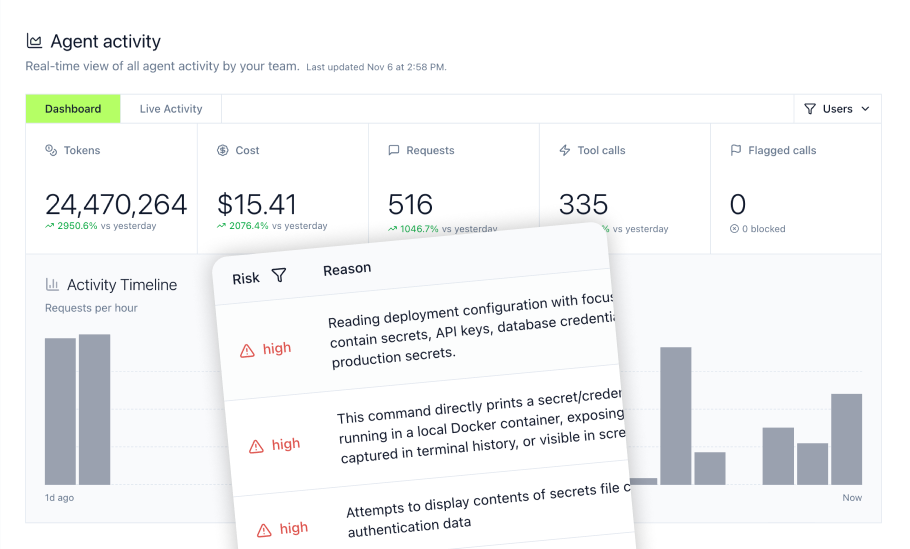
- Real-time monitoring dashboards for usage patterns and security alerts
- Gateway + Agent Monitor governance across MCP traffic and local agent activity
- High availability options and enterprise monitoring
Slack Integration Features
MintMCP supports governed Slack integration via Slack’s MCP endpoint, aligning with Slack’s model where workspace admins can approve and manage MCP client integrations, while MintMCP adds centralized policy, credential controls, and auditing across agents. MintMCP’s Managed Agents platform also supports Slack-native invocation, so teams can interact with governed agents from Slack while preserving scoped tool access through Virtual MCP Bundles.
Business Applications
- Data analysis: Let AI agents query databases and post findings to Slack channels
- Customer support: AI assistants access CRM data and respond in Slack threads
- Development workflows: Connect coding assistants to repos, issue trackers, and CI/CD with Slack notifications
Compliance: SOC 2 Type II audited; compliant with HIPAA standards
Best For: Regulated industries requiring compliance-first infrastructure; organizations wanting MCP working in production without infrastructure overhead
Getting Started: Book a demo at mintmcp.com
2. Composio
Composio offers rapid deployment when you need immediate access to hundreds of additional SaaS tools. Their managed OAuth handles authentication across 500+ integrations, eliminating the complexity of maintaining individual API connections.
Core Capabilities
- 500+ managed integrations including Slack, GitHub, Jira, and major CRM platforms
- Automatic OAuth token management and refresh across all connections
- Developer-friendly SDK for custom workflow development
- Free tier available for smaller teams and proof-of-concept projects
- Pre-built MCP servers for common enterprise tools
Slack Integration Features
Composio provides a step-by-step Slack setup that works with Claude Desktop, Cursor, and other MCP clients. The platform handles Slack OAuth scopes automatically, requesting the Slack MCP-required scopes based on enabled tools (for example, chat:write, history scopes like channels:history, and the appropriate search:read.* scopes).
Tradeoffs to consider
Composio is strongest for developer and AI engineering teams building agentic apps across many SaaS integrations. Teams that need IT/Security-led governance should also evaluate whether they need MintMCP-style SSO and SCIM-driven RBAC, Virtual MCP Bundles, Agent Bundles, rule-based tool policy, and centralized audit across internal employee and internal-agent access.
3. TrueFoundry
TrueFoundry offers performance-oriented MCP gateway capabilities, including best-case sub-3ms latency and 350+ requests per second per vCPU, making it a performance option among managed MCP gateways. Organizations already using TrueFoundry for AI infrastructure benefit from unified LLM and tool management.
TrueFoundry's Primary Focus
TrueFoundry combines MCP gateway capabilities with broader AI infrastructure, including model serving, fine-tuning, and observability. For teams building high-throughput production systems, this unified approach can reduce operational complexity.
Core Capabilities
- Best-case sub-3ms latency for time-critical workflows
- 350+ RPS per core scaling capacity
- Hybrid deployment options for on-premise and cloud
- Unified AI infrastructure combining LLM management with tool access
- Published pricing should be verified during procurement
Slack Integration Features
TrueFoundry provides standard Slack MCP connectivity with OAuth setup. The platform's performance advantages become most apparent in high-volume scenarios, such as many agents posting updates simultaneously or real-time incident response workflows.
Tradeoffs to consider
TrueFoundry fits platform engineering and ML platform teams that want MCP gateway features as part of a broader AI infrastructure stack. Teams prioritizing data-permissions-first governance should compare its setup against MintMCP’s SSO and SCIM-driven RBAC, Virtual MCP Bundles, Agent Bundles with M2M auth, and Gateway + Agent Monitor two-layer governance.
4. Docker MCP
Docker MCP provides control for organizations that require self-hosted infrastructure or have strict infrastructure ownership requirements. The open-source approach reduces vendor lock-in, but demands significant DevOps resources.
Docker MCP for Self-Hosted Deployments
Docker MCP Gateway runs MCP servers in isolated Docker containers and centralizes lifecycle, routing, and authentication; it's commonly used with Docker Desktop/Engine workflows and can be integrated into broader platform setups as needed. For security-conscious enterprises with existing container orchestration expertise, this provides more control over the MCP security surface.
Core Capabilities
- Open-source, self-hosted deployment
- Container-based architecture for Docker environments
- Self-hosted control over gateway execution and logging
- Customizable security policies managed at the infrastructure level
- No recurring platform licensing costs for open-source components, with infrastructure and operations costs still required
Slack Integration Features
Docker MCP requires manual configuration of Slack OAuth credentials and scopes. You'll set up the Slack MCP server as a container, configure environment variables for authentication, and manage token refresh logic yourself.
Tradeoffs to consider
Docker MCP can suit teams that want self-hosted container control, but it places more responsibility on the customer to run connector runtimes, manage scaling, maintain OAuth flows, and operate monitoring. MintMCP addresses those gaps with managed SaaS-first deployment, hosted MCP connectors run by MintMCP, OAuth brokering, centralized audit logs, and tool-level policy.
5. Zapier MCP
Zapier MCP extends Zapier's automation platform to AI agents, providing access to 8,000+ app integrations without coding. For organizations already invested in Zapier, this provides a path to connecting AI tools with existing workflows.
Zapier MCP for Business Teams
Zapier MCP inherits the platform's no-code philosophy, so business users can configure AI agent connections without engineering support. The task-based pricing model makes costs predictable for low-volume use cases but can become expensive at scale.
Core Capabilities
- 8,000+ app connectors across every major software category
- No-code configuration accessible to business teams
- Existing Zapier triggers and actions available to AI agents
- Vendor security documentation should be reviewed during procurement
- Task-based pricing aligned with existing Zapier plans
Slack Integration Features
Zapier provides native Slack integration with triggers for new messages, reactions, and channel events. AI agents can post messages, update channels, and search history through Zapier's abstraction layer.
Tradeoffs to consider
Zapier is useful for no-code workflow automation, but teams should evaluate whether it provides the MCP-specific governance primitives needed for internal AI rollout, such as SCIM-driven RBAC, per-use-case Virtual MCP Bundles, per-agent identity, tool-level allowlisting, and unified audit logs across Claude, Cursor, ChatGPT, Gemini, and Copilot.
6. Workato MCP
Workato MCP targets large enterprises requiring deep integrations with legacy systems and complex approval workflows. With 1,000+ pre-built connectors (and additional custom/community connectors), Workato supports complex enterprise integrations and multi-step approval workflows.
Workato for Enterprise Automation
Workato combines MCP connectivity with enterprise automation, including conditional logic, approval chains, and multi-system orchestration. For organizations with existing Workato investments, extending to AI agents follows familiar patterns.
Core Capabilities
- 1,000+ enterprise app connectors including legacy systems
- Complex workflow orchestration with conditional logic
- Vendor security documentation should be reviewed during procurement
- Low-code recipe builder for workflow development
- Advanced governance including approval chains
Slack Integration Features
Workato's Slack MCP integration supports bidirectional workflows. AI agents can read messages, post updates, manage channels, and trigger complex multi-step automations. The platform handles enterprise Slack configurations including workspace federation.
Tradeoffs to consider
Workato is built around enterprise automation and workflow orchestration. Teams using it for AI agents should still assess whether they need MintMCP’s MCP-specific controls, including OAuth brokering for stdio and hosted MCP servers, Virtual MCP Bundles, Agent Bundles, rule-based tool policy, and Gateway + Agent Monitor governance.
Deploying Production AI with MintMCP Gateway
Choosing the right MCP gateway for Slack determines whether your AI stays a pilot or scales to production. For regulated orgs, SOC 2 Type II audited status and Trust Center documentation can streamline security review. Managed gateways typically reduce operational burden (OAuth/auth, credential lifecycle, hosting, monitoring) versus self-hosted options that require substantial platform work, so choose based on DevOps capacity. Start with Slack plus 2–3 critical tools, prove ROI, then expand.
MintMCP supports this path with one-click deployment that turns local MCP servers into production services with OAuth brokering, monitoring, and governance like granular tool access control, rule-based policy, and least-privilege Virtual MCP Bundles. It unifies governed connectors such as Elasticsearch, Snowflake, and Gmail, plus Gateway + Agent Monitor visibility across MCP and local agent activity. Learn more at the MintMCP Gateway or mintmcp.com.
Frequently Asked Questions
What is an MCP Gateway and how does it enhance Slack integration?
An MCP Gateway acts as a centralized control plane between AI agents (like Claude, ChatGPT, or Cursor) and tools like Slack. Instead of configuring separate connections for each agent-tool pair, the gateway provides a single unified endpoint that handles authentication, permissions, audit logging, and security policies. For Slack specifically, this means every AI agent interaction with your workspace flows through governed infrastructure with complete visibility.
How does MintMCP ensure compliance and security for AI tools integrated with Slack?
MintMCP is SOC 2 Type II audited and compliant with HIPAA standards, with documentation available through its Trust Center. The platform provides OAuth brokering for Slack connections, complete audit trails of every AI interaction, SSO and SCIM-driven RBAC, tool-level allowlisting, and rule-based policy for regulated organizations. Verify privacy/security controls and DPAs against your requirements during vendor review.
Can MintMCP integrate with our existing internal data sources for Slack AI applications?
Yes. MintMCP provides connectors for Elasticsearch, Snowflake, Gmail, and dozens of databases and enterprise tools. AI agents can query internal knowledge bases, retrieve customer data, or access business intelligence, then surface findings in Slack channels through the same governed gateway.
What kind of monitoring and governance features does MintMCP offer for AI agent activity within Slack?
MintMCP’s Gateway + Agent Monitor governance tracks MCP traffic as well as local agent activity such as bash commands, file reads/writes, and prompt submissions. Real-time dashboards show usage patterns, security alerts, and cost analytics. Administrators can enforce tool-level policy, protect sensitive workflows, and maintain audit logs without disrupting developer workflows.
How quickly can I deploy AI tools with MintMCP for my Slack environment?
MintMCP provides one-click deployment for STDIO-based MCP servers, transforming local tools into production services in minutes. Slack deployment timelines depend on OAuth setup, admin approvals, and scope review. Managed deployment is typically faster than self-hosted alternatives that require container configuration and manual credential management.