Connecting AI assistants to Confluence without proper governance creates significant security risks: credential sprawl, uncontrolled data access, and missing audit trails. MCP Gateways solve this by providing centralized authentication, tool-level access control, credential management, and centralized observability for every AI-to-Confluence interaction.
The Model Context Protocol (MCP) is an open standard rapidly becoming a common integration layer. Anthropic originated it, and OpenAI, Google, and Microsoft now publish first-party MCP support in specific product surfaces, for example OpenAI’s MCP docs for ChatGPT/apps, Google’s managed MCP servers for Google services, and Microsoft’s MCP support in Copilot Studio. But MCPs introduce new challenges with deployment, security, and governance that often require a gateway layer, especially when you need centralized policy, cross-tool auditing, and consistent identity controls beyond a single vendor ecosystem.
Here are the six leading options for enterprise Confluence integration in 2026.
Key Takeaways
- MCP Gateways act as secure bridges between AI assistants (Claude, ChatGPT, Cursor, Gemini, and Copilot) and Confluence, solving credential sprawl and enabling governed AI access to enterprise documentation
- Setup time ranges from minutes for vendor-hosted options to days/weeks for production-hardened self-hosted deployments (identity, secrets, logging/SIEM, change management), with costs spanning free to enterprise custom pricing depending on features and scale
- Organizations report meaningful productivity gains when AI tools can search and act on Confluence safely. Research indicates AI investments can average ~3.7× returns, and organizations commonly report meaningful time savings on day-to-day knowledge work when AI is rolled out with governance and training.
- SOC 2 Type II audited status, OAuth 2.x/SSO integration, and complete audit trails are essential for enterprise compliance
- The right gateway choice depends on your security requirements, existing tech stack, and whether you prioritize ease of deployment versus maximum customization
1. MintMCP Gateway: Enterprise-Grade Deployment in Minutes
MintMCP focuses on enterprise MCP deployment with centralized authentication, policy enforcement, credential management, and auditability designed for production rollouts. MintMCP is data-permissions-first: it starts with SSO, SCIM-driven RBAC, IdP groups, Virtual MCP Bundles, tool-level policy, and audit, then enables agents on top. This helps organizations deploy AI-Confluence integrations quickly without building and operating the full gateway, connector, and governance layer themselves.
What Makes MintMCP Different
MintMCP's Virtual MCP Bundles create per-use-case endpoints with SCIM-driven membership, curated tools, and access policy. This means your sales team can see only approved Confluence tools and spaces while engineers access technical documentation, with each group governed through its own scoped endpoint. The platform can broker OAuth for stdio and hosted MCP servers, run hosted MCP connectors on MintMCP-managed infrastructure, and add monitoring, logging, and compliance controls around Confluence access.
Enterprise Capabilities
- Hosted MCP connectors run by MintMCP, with managed connector runtime and scaling
- SSO and SCIM-driven RBAC for MCP access
- OAuth brokering for stdio and hosted MCP servers
- Complete audit logs to support SOC 2 control evidence and regulated workflows
- Centralized observability for usage monitoring and security review
- Granular tool-level allowlisting and rule-based policy by role or use case
- Credential management for shared service accounts and per-user OAuth flows
- Agent Bundles with M2M auth and “act as agent” flow for scoped internal-agent access
- Gateway + Agent Monitor two-layer governance across MCP traffic and local agent activity
Security & Compliance
- SOC 2 Type II audited (Trust Center available)
- Compliant with HIPAA standards, with HIPAA documentation available for customers handling protected health information
- Penetration tested
- Data encrypted in transit and at rest
- Enterprise SSO, audit trails, PII detection, and role-based access control built into the platform
- SAML and OIDC integration with existing identity providers
Cost Structure: Contact sales for enterprise pricing; uptime SLA and dedicated support options are available
Ideal For: Organizations needing production-ready Confluence AI access without infrastructure overhead, especially those with strict compliance requirements or multi-team access control needs
Getting Started: Visit mintmcp.com to book a demo
2. Atlassian Remote MCP Server
Atlassian's official Remote MCP Server provides a direct path to connecting AI assistants with Confluence and Jira. Developed in partnership with Anthropic, this solution requires minimal setup beyond clicking "Authorize," making it suitable for teams already invested in the Atlassian ecosystem.
Key Features
- 5-minute setup with browser-based OAuth flow
- Automatic permission inheritance from Confluence
- MCP tool invocations are recorded in Atlassian organization audit logs with per-event details (tool name/action/user), supporting monitoring and reviews
- Available to Atlassian Cloud customers, with plan-based rate limits and admin controls; confirm suitability for regulated requirements
- Hosted on Cloudflare infrastructure
Tradeoffs to consider
A native Atlassian MCP server is useful for teams focused on Atlassian access, but organizations with multiple AI clients and tool ecosystems should evaluate whether they also need a gateway layer for cross-tool audit streams, SCIM-driven RBAC, Virtual MCP Bundles, tool-level policy, credential management, and internal-agent governance.
3. Cequence AI Gateway
Cequence AI Gateway emphasizes broad Confluence coverage by letting teams expose selected Confluence REST API endpoints via MCP, with optional API protection controls. Its security approach includes API protection and threat detection alongside MCP routing.
Technical Capabilities
- Confluence REST API exposure through MCP
- Custom scope selection (read:page, write:page, read:space, etc.)
- API protection with threat detection
- Cloud deployment or self-hosted deployment
- OAuth callback configuration for enterprise identity systems
- Support for Confluence whiteboards and advanced content types
Tradeoffs to consider
An API protection-first approach can help teams secure exposed endpoints, but buyers should also evaluate whether they need MCP-specific governance primitives such as SCIM-driven RBAC, per-use-case Virtual MCP Bundles, Agent Bundles, tool-update policy, and hosted MCP connector operations.
4. TrueFoundry MCP Gateway
TrueFoundry's gateway combines MCP routing with LLM proxy capabilities, creating a unified control plane for organizations managing both model access and tool integrations. Its architecture emphasizes low added latency, but teams should distinguish best-case gateway overhead from tool-call latency, end-to-end latency, and throughput in their own workloads.
Key Features
- Combined LLM proxy and MCP gateway functionality
- Full observability with distributed tracing
- RBAC enforcement at gateway level
- Okta/Azure AD SSO integration
- Pre-built Confluence connector
Tradeoffs to consider
TrueFoundry can fit platform and ML teams that want MCP routing alongside model gateway controls. Teams centered on IT, Security, and AI Operations should also evaluate whether they need data-permissions-first governance, SCIM-driven Virtual MCP Bundles, Agent Bundles with M2M auth, and Gateway + Agent Monitor coverage across Claude, Cursor, ChatGPT, Gemini, and Copilot.
5. Composio Platform
Composio positions itself as a universal MCP gateway with SOC 2 Type II audited status available and pre-built connectors for over 850 SaaS applications. Its Confluence toolkit includes 62 distinct tools covering everything from page creation to space management.
Confluence Toolkit Tools
- Page CRUD operations (create, read, update, delete)
- Space management and permissions
- Content search with CQL support
- Label and attachment management
- Template operations
- Analytics and audit data retrieval
Tradeoffs to consider
Composio can be a strong fit for developer and AI engineering teams building customer-facing agentic applications. Organizations focused on internal employee and internal-agent governance should also evaluate enterprise governance needs such as SSO and SCIM-driven RBAC, per-use-case Virtual MCP Bundles, centralized audit, credential management, and scoped Agent Bundles.
6. Self-Hosted MCP Gateway/Proxy
For organizations requiring complete infrastructure control, open-source Docker-based MCP gateways provide maximum flexibility at the cost of increased operational complexity. This approach suits teams with strong DevOps capabilities who cannot use cloud-managed solutions due to regulatory or air-gapped requirements.
Where Self-Hosting Fits
Docker MCP gateways run entirely on your infrastructure. You control every aspect of security, logging, and scaling. However, this means your team handles maintenance, updates, and troubleshooting.
Technical Requirements
- Kubernetes or Docker environment
- An MCP server runtime appropriate to your chosen implementation (language/runtime varies by server)
- DevOps expertise for deployment and scaling
- Manual OAuth/authentication configuration
- Custom audit logging implementation
Setup Considerations
- 4+ hours minimum for initial deployment
- Client-specific MCP configuration (format varies by client), plus validation/testing in CI
- No built-in compliance certifications
- Community forum support only
- Scaling requirements depend on concurrency, rate limits, and observability/log retention, so plan capacity testing before broad rollout
Tradeoffs to consider
Self-hosting gives teams infrastructure control, but it can require the customer to operate connector runtimes, scaling, secrets, logging pipelines, policy updates, and Kubernetes infrastructure. MintMCP addresses this with managed SaaS-first deployment, hosted MCP connectors, centralized audit logs, tool-level policy, and OAuth brokering for stdio and hosted MCP servers.
Securing Your Confluence AI Integration
Connecting AI to Confluence without governance creates what security teams call the "lethal trifecta": AI agents with private data access and potential external connectivity. Understanding MCP gateways helps mitigate these risks.
Authentication Best Practices
- Use OAuth 2.x and per-user OAuth flows where possible instead of long-lived API tokens
- Integrate with existing SSO/SAML for consistent identity management
- Implement MFA for gateway admin access
- Rotate credentials on a defined security schedule
Access Control Essentials
- Start with read-only access to non-sensitive spaces
- Use role-based tool access to limit operations by team
- Never grant delete permissions without human approval workflows
- Audit permission configurations quarterly
Monitoring Requirements
- Track every tool call with user attribution
- Alert on unusual access patterns such as bulk downloads or off-hours activity
- Export logs to SIEM for compliance reporting
- Review audit trails weekly
The Agent Monitor Layer: Monitoring AI Behavior
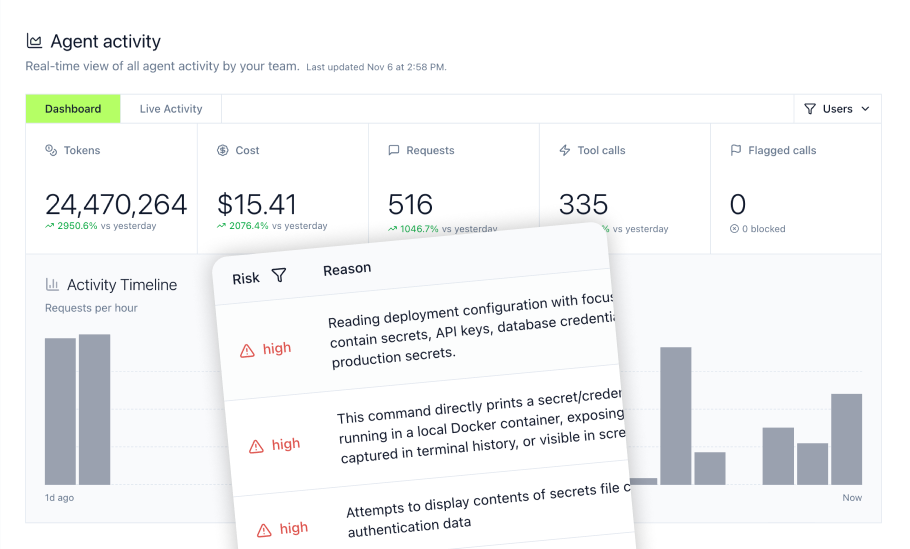
Beyond MCP gateway security, organizations need visibility into what AI assistants do with Confluence access and what coding agents do locally. MintMCP's Agent Monitor extends governance beyond MCP traffic, covering local non-MCP agent activity such as Bash commands, file reads and writes, and prompt submissions through Claude Code and Cursor hooks.
Why This Matters
Coding agents like Claude Code and Cursor can operate with extensive system access, reading files, executing commands, and accessing production systems through MCP tools. Without monitoring, organizations cannot see what agents access or control their actions.
Agent Monitor Capabilities
- Monitor MCP tool calls from AI clients
- Track which MCPs are installed across your organization
- Block risky commands in real time
- Protect sensitive files from unauthorized access
- Create audit trails for security review
This layer helps transform ungoverned AI experiments into sanctioned, observable enterprise tools.
Real-World Implementation: Enterprise Deployment Phases
Successful Confluence MCP deployments follow a structured rollout rather than organization-wide launch:
Phase 1: Pilot (Week 1-2)
- Deploy with 5-10 power users in one department
- Read-only access to non-sensitive Confluence spaces
- Gather feedback on effective prompts and use cases
- Validate audit logging captures required data
Phase 2: Security Review (Week 2-4)
- Test RBAC configurations across team boundaries
- Verify compliance requirements are met for SOC 2 audit preparation
- Conduct prompt injection testing aligned with OWASP Top 10 for LLMs
- Document approved use cases and prohibited actions
Phase 3: Phased Expansion (Week 4-12)
- Week 4: Expand to second department
- Week 6: Add write permissions for proven use cases
- Week 8: Third department rollout
- Ongoing: Train power users as internal champions
Structured rollouts help sustain usage, validate controls, and reduce policy drift as you expand beyond the pilot.
Connecting Confluence Data Through Elasticsearch
Many enterprises index Confluence content in Elasticsearch for advanced search capabilities. MintMCP's Elasticsearch MCP Server enables AI agents to query this indexed content with powerful search capabilities:
Available Tools
- search: Perform Elasticsearch queries using full DSL for flexible document retrieval
- esql: Execute ES|QL queries for advanced data analysis
- list_indices: Discover available indices in your cluster
- get_mappings: Retrieve field mappings for specific indices
- get_shards: Get shard allocation and health information
Use Cases
- AI-powered knowledge base search across indexed Confluence content
- Support ticket intelligence: search historical resolutions and patterns
- Log analysis correlating documentation with system events
This approach lets organizations leverage existing Elasticsearch investments while adding AI-powered natural language querying.
Deploy Enterprise AI with Confidence
The Model Context Protocol has fundamentally changed how enterprises connect AI assistants to their data and tools. But deploying MCP at scale requires more than just protocol support. It demands enterprise-grade security, governance, and monitoring that transforms experimental AI into production-ready infrastructure.
MintMCP Gateway stands out as a fast path from pilot to production, offering managed deployment that would otherwise require significant configuration and operational work. With SOC 2 Type II audited status, hosted MCP connectors for enterprise data sources, SSO and SCIM-driven RBAC, and comprehensive audit logging, MintMCP removes the technical barriers that keep organizations stuck in AI pilot mode.
Whether you're securing access to Snowflake warehouses, Elasticsearch knowledge bases, or custom enterprise tools, MintMCP provides the infrastructure that makes AI deployment practical, compliant, and secure.
For a deeper understanding of architecture, see our guide to MCP gateways.
Ready to transform your AI infrastructure? Visit mintmcp.com to schedule a demo and see how MintMCP Gateway can accelerate your enterprise AI deployment.
Frequently Asked Questions
What is an MCP gateway and why is it important for Confluence?
An MCP gateway acts as a secure proxy between AI assistants (Claude, ChatGPT, Cursor, Gemini, and Copilot) and enterprise tools like Confluence. Instead of each developer storing API tokens locally, which creates credential sprawl and security risks, the gateway provides centralized authentication, role-based access control, and complete audit logging. Think of it as an "API gateway for AI" that enables questions like "Summarize our Q4 planning docs" directly in your AI assistant while maintaining enterprise security and compliance.
How do MCP Gateways ensure data security with Confluence?
Enterprise MCP gateways provide multiple security layers: OAuth 2.x/SSO integration ties access to existing identity systems; role-based access control limits AI to specific Confluence spaces per team; complete audit trails log every interaction with user attribution; and Virtual MCP Bundles expose only minimum required tools rather than full API access. Solutions like MintMCP are SOC 2 Type II audited, supporting AI-Confluence connections that meet enterprise security review requirements.
Can MintMCP integrate with existing Confluence deployments?
Yes. MintMCP can connect to existing Confluence environments through governed MCP access patterns without requiring teams to rebuild their documentation workflows. Access can be scoped through SSO, SCIM-driven RBAC, Virtual MCP Bundles, tool-level policy, and audit logs so teams can roll out Confluence AI access with centralized governance.
Which AI clients work with Confluence MCP integrations?
Supported clients vary by gateway but commonly include: Claude (Desktop and Web), ChatGPT, Cursor IDE, VS Code with Copilot, GitHub Copilot CLI, Google Gemini, and custom MCP-compatible agents. Atlassian's official Remote MCP Server supports multiple clients including ChatGPT, Claude, Gemini, and GitHub Copilot CLI, while gateways like MintMCP are designed for governance across Claude, Cursor, ChatGPT, Gemini, and Copilot.
What ROI can organizations expect from Confluence AI integration?
Research indicates AI investments average approximately 3.7× returns, with MCP deployments supporting time savings in information gathering tasks when rolled out with proper governance and training. Specific gains depend on documentation quality, user adoption, workflow design, and how much Confluence content is safely exposed to AI assistants. Most organizations should measure ROI through reduced search time, faster onboarding, faster incident response, and lower manual documentation effort.