Connecting AI agents to Google Workspace data, including Gmail, Calendar, and Drive, requires more than standard API integrations. MCP (Model Context Protocol) Gateways serve as the secure bridge that enables AI tools to read emails, create calendar events, and access files while maintaining enterprise-grade governance. As organizations scale AI adoption, choosing the right MCP gateway determines whether you achieve production-ready AI infrastructure or struggle with ungoverned shadow AI.
Most Google Workspace MCP implementations rely on OAuth-based authorization, often aligned to OAuth 2.1 guidance, but enterprise setups may also use service accounts and domain-wide delegation depending on the integration pattern and admin policy. The setup process follows a standard pattern: enable the APIs required for your specific workflow, commonly Calendar, Gmail, and People, with Drive and/or Chat added only when your agent needs those capabilities, configure an OAuth consent screen with appropriate scopes, and create OAuth client credentials with authorized redirect URIs for your chosen platform. Access control best practices include implementing role-based controls for agent deployment, limiting agent permissions to specific resources, and enabling audit logging for all agent interactions.
Key Takeaways
- MCP Gateways enable AI agents to securely access Google Workspace data with built-in authentication, audit trails, and compliance controls
- Setup times range from 1 hour for no-code platforms to 2 to 4 weeks for enterprise governance solutions
- Google Workspace Studio is included with Google Workspace plans and supports Workspace apps plus third-party connectors, but stays within the Google ecosystem rather than acting as a multi-LLM routing gateway
- Enterprise platforms like Boomi Agentstudio and MintMCP Gateway provide multi-cloud governance for organizations managing dozens or hundreds of AI agents
- Certification coverage varies by vendor: Google Workspace/Gemini cite SOC reports and ISO/IEC 42001, Boomi lists SOC reports and ISO/IEC 42001, and other gateways should be verified individually
- Reported outcomes vary widely by workflow maturity, permissions design, and rollout scope; organizations should use case studies as directional and validate impact with pilots
1. MintMCP Gateway: Production-Ready MCP Infrastructure in Minutes
MintMCP Gateway transforms MCP from developer utility to production-grade infrastructure, providing the security, governance, and observability enterprises need for AI tool deployment at scale. As an official Cursor Hooks partner, MintMCP addresses the core barrier to MCP adoption: the gap between developer experimentation and production deployment.
What Makes MintMCP Different
MintMCP converts local MCP servers into managed infrastructure with OAuth brokering, enterprise SSO, SCIM-driven RBAC, audit logging, and centralized observability without requiring code changes. Most MCP servers are STDIO-based and difficult to deploy. MintMCP provides one-click deployment, OAuth protection, tool-level policy, and enterprise monitoring for stdio and hosted MCP servers, including Gmail and Google Calendar integrations.
Core Capabilities
- One-click deployment of STDIO-based MCP servers with automatic hosting
- Enterprise SSO with SCIM-driven RBAC
- OAuth brokering for stdio and hosted MCP servers
- Complete audit trails and centralized observability designed to support security review and regulated reporting workflows
- Credential management for governed access to enterprise tools
- Real-time monitoring dashboards for server health and usage patterns
- Virtual MCP Bundles that expose only minimum required tools per team, use case, or agent identity
- Granular tool-level allowlisting and rule-based policy, including read-only operations and excluded write tools by role
- Shared and per-user authentication flexibility
- Hosted MCP connectors run by MintMCP
- Admin MCP for operating the platform from MCP clients
- Tool-update policy to control whether new upstream tools are enabled automatically or require admin approval
- Gateway + Agent Monitor two-layer governance across MCP traffic and local agent activity
- Managed Agents platform with scoped tool access and Slack-native invocation
- Central registry of available MCP servers
Setup and Deployment
Included with custom enterprise pricing. SOC 2 Type II audited, compliant with HIPAA standards, penetration tested, and designed with complete audit trails for agent actions. A pilot can start quickly; full enterprise rollout typically runs 2 to 4 weeks depending on SSO, policy design, and approval workflows. If data residency is a requirement, validate deployment and data-handling constraints during the security review and contracting process.
For teams evaluating options, the enterprise MCP guide provides a detailed implementation framework.
Best For
Organizations seeking production-ready MCP infrastructure with enterprise-grade security, governance, and the ability to deploy governed MCP servers beyond Google-native solutions.
2. Google Workspace Studio
Google Workspace Studio provides a quick path to AI-powered Workspace automation for existing subscribers. Workspace Studio uses Gemini to generate pre-configured automation flows from plain language descriptions. Request "send daily email summary of unread messages" and the platform builds a complete workflow with Gmail connectors, scheduling logic, and output formatting, no coding required.
Core Capabilities
- Natural language flow creation powered by Gemini
- Native connectors for Gmail, Calendar, Drive, Chat, and Meet
- Third-party integrations, for example Asana, Mailchimp, and Salesforce, with some integrations/features in limited preview depending on your Workspace Studio rollout
- Admin controls for organizational governance
- Data Loss Prevention (DLP) integration for sensitive content
Scope Considerations
Optimized for Workspace plus supported third-party connectors; deeper integrations may require custom extensions and admin review. No multi-LLM support, since it is Gemini-only. Basic governance features compared to enterprise MCP gateway platforms.
Best For
Teams seeking quick, no-code automation within Google Workspace without multi-LLM or custom enterprise integration requirements.
3. Gemini Enterprise with Agent Development Kit
For organizations needing custom agent logic beyond Workspace Studio's capabilities, Gemini Enterprise combined with the Agent Development Kit (ADK) enables production-grade AI deployments within the Google ecosystem.
Advanced Agent Development
Gemini Enterprise provides access to Google-managed MCP servers, NotebookLM integration, and advanced data stores that index Gmail, Calendar, and Drive content for AI retrieval. The ADK allows Python developers to build custom agents with sophisticated reasoning capabilities.
Core Capabilities
- Data stores for Gmail, Calendar, Drive, and NotebookLM content indexing
- Agent Designer for natural language agent creation
- Agent hosting via Vertex AI Agent Engine, including access to Google-managed MCP servers, for example Vertex AI Search MCP, and custom tools as needed
- OAuth 2.0 and SAML enforcement
- Grounding with Google Search for real-time information
Best For
Organizations with development resources seeking custom AI agents with advanced logic while staying within the Google ecosystem.
4. Boomi Agentstudio
Boomi Agentstudio addresses organizations managing AI agents across multiple clouds and applications, providing centralized governance for large-scale deployments.
Multi-Cloud Agent Orchestration
Boomi's platform is designed for organizations managing agents across many systems. Its connector ecosystem extends beyond Google Workspace to Microsoft 365, Salesforce, SAP, NetSuite, Snowflake, ServiceNow, and other enterprise systems.
Core Capabilities
- Multi-cloud agent governance and lifecycle management
- Pre-built connectors for Google Workspace, Microsoft 365, Salesforce, SAP
- Agent-to-agent communication orchestration
- Centralized policy enforcement across AI tools
- SOC and ISO certifications
Best For
Large enterprises managing multiple AI platforms across Google Workspace, Microsoft 365, and third-party applications requiring unified governance.
Enhancing Google Workspace Functionality with MCP Integrations
MCP Gateways unlock AI capabilities that extend far beyond basic automation. AI agents can search emails, draft responses, and send messages with full security oversight. Use cases include customer response automation where AI assistants search, draft, and reply within approved workflows; feedback aggregation that extracts structured feedback with automated sentiment tagging; and communication analysis that reveals response patterns for operational intelligence.
MintMCP's Gmail MCP Server provides tools for search, retrieval, drafting, and sending, all governed by enterprise authentication and audit trails.
For calendar integration, AI agents can schedule meetings, check availability, and create events. The Google Calendar connector supports both read and write operations with configurable permission levels, enabling agents to query upcoming meetings and conflicts, generate meeting summaries from transcripts, and automate scheduling based on natural language requests.
Organizations deploying AI-Workspace integrations should use case studies as directional and validate impact with pilots that measure time-to-resolution, error rates, and adoption. Reported outcomes vary widely by workflow maturity, permissions design, and rollout scope.
Compliance and Security for Google Workspace AI
Enterprise deployments require robust compliance frameworks. Certification coverage varies by vendor: Google Workspace/Gemini cite SOC reports and ISO/IEC 42001, Boomi lists SOC reports and ISO/IEC 42001, and other gateways should be verified individually against their trust and compliance pages.
Data Security Features
Most enterprise platforms provide encryption in transit and at rest, alongside Workspace/Gemini privacy and security controls. Access controls include SAML-based SSO with Okta and Azure AD support. For Google-managed deployments, Gemini Enterprise offers data location options, for example US or EU. Scope data residency discussions to the specific vendor and deployment model during security review. Complete logging of every AI interaction enables compliance review and audit trails.
For detailed security documentation, see MintMCP's security overview covering authentication, tool governance, and audit observability.
Real-Time Monitoring and Observability
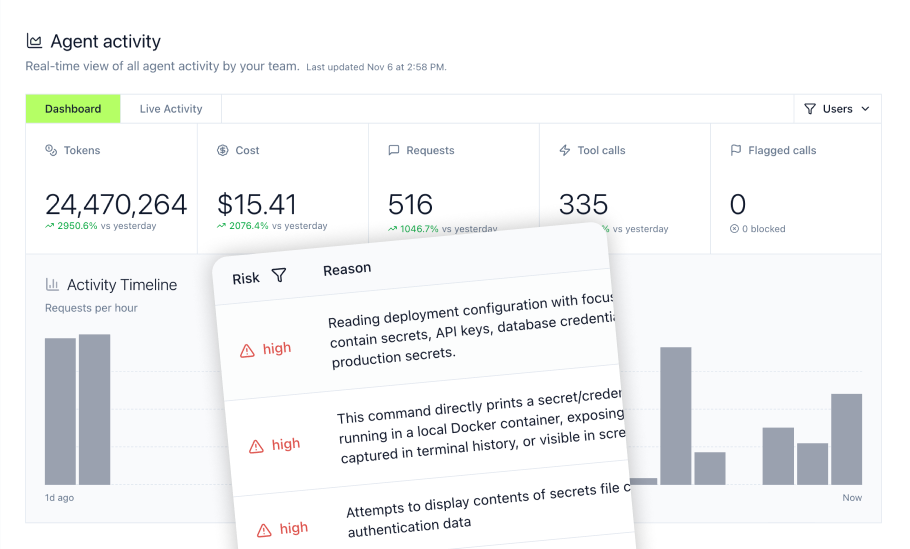
Production AI deployments require visibility into agent behavior. Key monitoring capabilities include tracking every MCP tool invocation and API call, identifying which agents access which Workspace resources, and recognizing usage patterns and anomalies. Cost analytics help organizations track prompts per user against daily limits, provide cost allocation by agent and integration, and offer team-level usage breakdowns. Performance metrics cover response times, error rates, data connector sync status, and agent availability.
MintMCP's LLM Proxy provides additional observability for coding agents, tracking every tool call, bash command, and file access with the ability to block risky operations in real-time.
Deploy Enterprise AI with MintMCP Gateway
The Model Context Protocol has fundamentally changed how enterprises connect AI assistants to Google Workspace data and tools. But deploying MCP at scale requires more than protocol support. It demands enterprise-grade security, governance, and monitoring that transforms experimental AI into production-ready infrastructure.
MintMCP Gateway offers one-click deployment that would otherwise take weeks of configuration. With SOC 2 Type II audited infrastructure, compliance with HIPAA standards, pre-built connectors for enterprise data sources including Snowflake and Elasticsearch, and an official Cursor Hooks partnership, MintMCP removes the technical barriers that keep organizations stuck in AI pilot programs.
MintMCP provides the infrastructure that makes AI deployment practical, compliant, and secure for Google Workspace integrations. Whether you're securing access to Gmail, Calendar, Drive, or custom enterprise tools, MintMCP Gateway accelerates enterprise AI deployment.
For a deeper understanding of MCP gateway architecture, see the guide to understanding MCP gateways.
Ready to transform your AI infrastructure? Visit mintmcp.com to schedule a demo and see how MintMCP Gateway can accelerate your enterprise AI deployment.
Frequently Asked Questions
What is an MCP gateway and why do enterprises need it for Google Workspace?
An MCP gateway acts as a secure intermediary between AI assistants like Claude, ChatGPT, Gemini, Cursor, or Copilot and Google Workspace data sources including Gmail, Calendar, and Drive. It provides authentication, authorization, audit logging, and policy enforcement that the base MCP protocol lacks. MCP gateways transform Workspace from a productivity suite into an AI-accessible data platform with complete visibility into what agents access and when.
How does MintMCP ensure compliance for AI agent operations?
MintMCP Gateway is SOC 2 Type II audited, compliant with HIPAA standards, penetration tested, and built with complete audit trails for agent actions. Enterprise SSO, audit logging, PII detection, and role-based access control are built into the platform. Customers handling protected health information can request HIPAA documentation, and MintMCP signs BAAs. Every MCP interaction, access request, and configuration change is logged for accountability through MintMCP's security overview.
Can I use MCP gateways with existing enterprise tools like Gmail and Calendar?
Yes. Platforms like MintMCP offer pre-built connectors for popular enterprise tools including Gmail and Google Calendar. These connectors provide secure, governed access without custom development, supporting both read and write operations with configurable permission levels.
How quickly can I deploy an MCP Gateway for Google Workspace integration?
Setup times vary by platform: Google Workspace Studio deploys in under 1 hour, Gemini Enterprise with custom agents takes 1 to 2 days, and enterprise platforms typically require 1 to 4 weeks for full implementation including governance configuration and team training. MintMCP pilots can start quickly, with full enterprise rollout typically running 2 to 4 weeks depending on SSO configuration, policy design, and approval workflows.
What security risks do MCP servers present without a gateway?
Without governance controls, AI agents can operate as black boxes with limited visibility. MCP Gateways address this by providing centralized authentication that enforces OAuth/SAML for every agent interaction, complete audit trails of all data access for compliance review, role-based access controls limiting agent permissions to specific resources, and real-time monitoring dashboards for usage patterns and anomaly detection. These controls transform ungoverned AI usage into sanctioned, auditable AI operations.