Connecting AI agents to BigQuery data warehouses requires more than just a database connection. Organizations need secure, governed access that enables business users to query enterprise data using natural language while maintaining compliance requirements. MCP (Model Context Protocol) Gateways provide this infrastructure layer, handling authentication, audit logging, credential management, and tool-level policy to transform local database connections into production-ready AI services. The MintMCP Gateway delivers this capability with SOC 2 Type II audited infrastructure and deployment workflows measured in minutes rather than lengthy custom infrastructure projects.
This guide examines the leading MCP gateway solutions for BigQuery integration, covering enterprise managed platforms, self-hosted options, and no-code alternatives. Whether your priority is compliance, cost efficiency, or development flexibility, these options represent the current state of production-grade AI-to-BigQuery connectivity.
Key Takeaways
- MCP Gateways enable AI agents to query BigQuery using natural language while enforcing security policies and generating complete audit trails
- Managed gateway solutions can be deployed far faster than self-hosted infrastructure, which typically requires additional installation, configuration, and operational setup
- Enterprise platforms with SOC 2 Type II audited infrastructure can reduce security-review friction for compliance-focused organizations
- SSO and SCIM-driven role-based access control help ensure marketing teams see only marketing data while finance accesses financial datasets exclusively
- Cost controls prevent runaway BigQuery bills by enforcing query governance and usage monitoring
1. MintMCP Gateway: From Local MCP to Enterprise Deployment, Fast
MintMCP transforms BigQuery access for enterprise teams by providing infrastructure backed by SOC 2 Type II audited controls with deployment workflows that can be completed in minutes. The platform addresses the gap between AI assistants like Claude, ChatGPT, Gemini, Cursor, and Copilot and internal data, handling authentication, permissions, credential management, and audit trails without requiring DevOps expertise.
What Makes MintMCP Different
The MCP Gateway brokers OAuth for stdio and hosted MCP servers, enabling teams to move from local development to production services with one-click deployment. For BigQuery specifically, administrators can configure governed connections, apply tool-level policy, and expose controlled data access to AI clients across the organization.
Unlike DIY approaches that require manual security configuration, MintMCP provides centralized governance with complete audit trails for every MCP interaction, access request, and configuration change. The platform supports granular tool access control, allowing teams to configure access by role so analysts can run read-only queries while restricting higher-risk operations to approved users.
Core Capabilities for BigQuery Integration
- One-click deployment for STDIO-based MCP servers with automatic hosting and lifecycle management
- OAuth, SSO, and SCIM-driven RBAC for enterprise identity providers and group-based access control
- Centralized observability through dashboards tracking server health, usage patterns, and security alerts
- Virtual MCP Bundles that expose per-use-case endpoints with curated tools and SCIM-driven membership
- Hosted MCP connectors run by MintMCP so teams do not need to manage connector runtimes, scaling, or Kubernetes infrastructure
- Agent Bundles with M2M authentication and scoped tool access for internal agents
Enterprise Governance Features
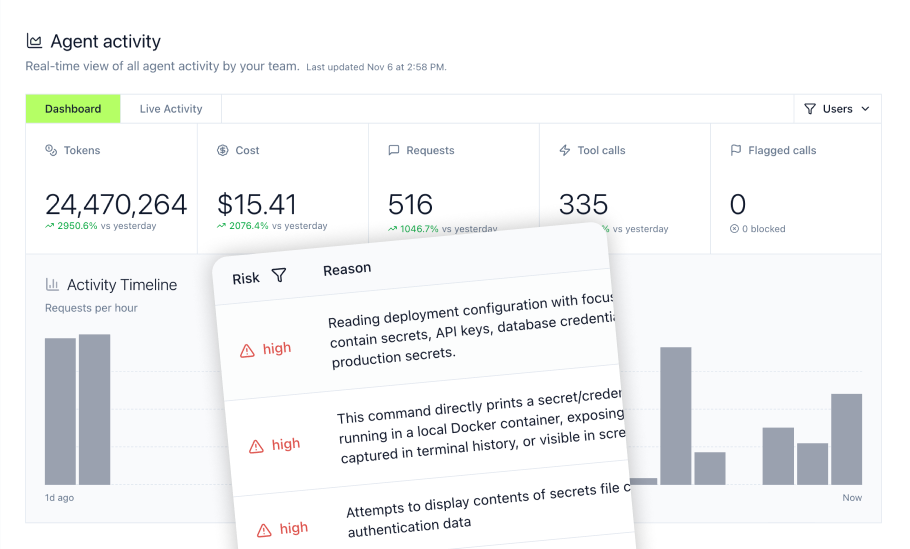
The MintMCP Agent Monitor component tracks every tool call, bash command, and file operation from coding agents. Security teams gain visibility into which MCPs are installed, what data agents access, and can block dangerous commands in real time. This addresses the growing challenge of shadow AI adoption across enterprises. MintMCP turns unauthorized AI usage into sanctioned, governed access that aligns with organizational AI governance frameworks.
Implementation Path
Setup requires three steps: create a MintMCP account, provide your BigQuery connection details through the connection form, then copy the endpoint URL into your AI client configuration. The platform validates connections automatically and displays available BigQuery tools within minutes.
Availability: Serves enterprise customers via managed cloud deployment with an uptime SLA
Getting Started: Visit the BigQuery integration page or book a demo to discuss enterprise requirements
2. Google Native MCP Server
Google's official BigQuery MCP server provides direct BigQuery connectivity for teams already embedded in the Google Cloud ecosystem. The server supports standard MCP operations including examining BigQuery resources, generating SQL, executing queries, and interpreting results through compatible AI clients.
Where Google Native Fits
Organizations with existing GCP expertise can deploy Google's server without additional vendor relationships. The solution works well for GCP-native teams that want direct BigQuery connectivity through Google-managed infrastructure, especially when their governance needs are concentrated within the Google Cloud ecosystem.
Technical Requirements
- Google Cloud Platform account with billing enabled
- BigQuery API enabled in your GCP project
- OAuth 2.0 and IAM-based authentication
- Required IAM roles such as MCP Tool User, BigQuery Job User, and BigQuery Data Viewer, depending on the task
Implementation Considerations
Setup is manageable for teams already familiar with GCP IAM configuration, but still requires project setup, authentication, and permission configuration. The server connects through Google Cloud's managed MCP infrastructure, which includes OAuth 2.0 authentication, IAM authorization, and Google Cloud auditability. Organizations that want broader cross-tool governance or a unified control plane across third-party MCP servers may still prefer a dedicated gateway layer.
Tradeoffs to consider
A native BigQuery MCP server can be a strong fit when BigQuery is the primary target and Google Cloud is the main governance plane. Teams that need MCP-specific controls across multiple tools, such as Virtual MCP Bundles, SCIM-driven membership, Agent Bundles, hosted connector runtime, or centralized observability across Claude, Cursor, ChatGPT, Gemini, and Copilot, should evaluate whether a broader gateway layer is needed.
Cost: Free (BigQuery usage costs apply separately)
Audience: GCP-native teams with DevOps expertise for manual security configuration
3. Skyvia MCP Endpoint
Skyvia delivers BigQuery connectivity through a visual, no-code interface designed for business users who need to configure AI data access without engineering support. The platform emphasizes fast, no-code setup through a visual interface for teams that want to configure database access without writing infrastructure code.
Skyvia's Primary Focus
The platform serves organizations where non-technical team members need to establish database connections. Marketing analysts, finance professionals, and operations managers can create MCP endpoints through dropdown menus and form fields rather than YAML configuration files.
Connector Ecosystem
Beyond BigQuery, Skyvia supports over 200 data sources including Salesforce, HubSpot, and other SaaS applications. Teams running attribution analysis across Google Ads, Facebook Ads, and CRM data can establish connections to multiple sources through the same interface.
Setup Process
Configuration involves three actions: create a Skyvia connection to BigQuery, generate an MCP endpoint URL through the interface, then add that URL to your AI client configuration. The platform handles OAuth authentication through Google account integration.
Tradeoffs to consider
Skyvia's no-code approach is useful for teams prioritizing visual setup, but organizations should evaluate whether it provides the MCP-specific governance primitives they need for enterprise AI usage. MintMCP focuses on SSO and SCIM-driven RBAC, tool-level allowlisting, rule-based policy, audit logs, credential management, and per-use-case Virtual MCP Bundles for internal employee and agent governance.
Pricing: Skyvia lists MCP Endpoint plans starting below enterprise custom pricing; at the time of review, the Professional tier is shown at $99/month billed monthly ($79/month billed annually)
Audience: Business teams requiring no-code database connectivity
4. MCP Toolbox for Databases
Google's MCP Toolbox provides a self-hosted option for organizations requiring complete control over their infrastructure and data flow. The open-source solution supports multiple database types through a unified configuration approach.
MCP Toolbox for Custom Deployments
DevOps teams with infrastructure expertise can deploy the Toolbox on internal servers or cloud VMs, maintaining full control over network routing and security rules. This approach suits organizations with strict infrastructure-control requirements that prevent using managed cloud services.
Configuration Requirements
Implementation requires creating a tools.yaml file that defines allowed datasets, tables, and query parameters. Teams should expect time for initial setup including learning the configuration format and validating the YAML syntax.
Infrastructure Considerations
Running self-hosted infrastructure means accepting responsibility for availability, scaling, and security patching. Organizations processing high query volumes will need to plan capacity, observability, and scaling as part of their self-hosted deployment design.
Tradeoffs to consider
A self-hosted toolbox can give infrastructure teams more control, but it also makes the customer responsible for operating connector runtimes, scaling, security patching, and production observability. MintMCP addresses those operational requirements with managed SaaS-first deployment, hosted MCP connectors, centralized observability, and policy controls built into the gateway layer.
Cost: Free (infrastructure hosting costs apply)
Audience: DevOps teams requiring self-hosted deployment or maximum customization
5. Kong AI Gateway
Kong extends its established API management platform to support MCP endpoints, enabling organizations with existing Kong infrastructure to add AI capabilities without deploying separate systems.
Kong for API-Heavy Organizations
Teams already routing API traffic through Kong can expose existing REST APIs as MCP tools through automatic conversion. This approach leverages existing Kong deployments while adding AI agent connectivity.
Integration Architecture
The gateway sits within existing Kong deployments, applying the same rate limiting, authentication, and logging policies used for traditional API traffic. Organizations gain unified observability across REST APIs and MCP endpoints through a single management plane.
Deployment Requirements
Implementation assumes familiarity with Kong's configuration model and operational practices. Teams new to Kong face a steeper learning curve because deployment requires familiarity with Kong's configuration model and operational practices in addition to MCP setup.
Tradeoffs to consider
Kong can fit teams already standardized on API gateway infrastructure, especially when the primary need is to expose existing APIs as MCP tools. Organizations should evaluate whether an API gateway extension provides MCP-specific primitives such as Virtual MCP Bundles, Agent Bundles, stdio and hosted-server OAuth brokering, tool-update policy, and cross-client governance for internal AI tools.
Pricing: Enterprise tier (contact for pricing)
Audience: Organizations with established Kong API infrastructure
6. TrueFoundry
TrueFoundry positions its MCP gateway for performance-oriented workloads, while MintMCP differentiates around governed deployment, auditability, enterprise access control, and operational visibility across AI tool usage.
TrueFoundry for Performance-Intensive Workloads
The platform targets scenarios where throughput and latency are important, such as interactive analytics, customer-facing data experiences, and high-volume internal automation.
Deployment Options
TrueFoundry supports hybrid deployment across cloud and on-premises infrastructure. Organizations can run the gateway in their own data centers while maintaining managed control plane features.
Technical Specifications
The platform emphasizes high-throughput, low-latency gateway performance for production AI workloads, with vendor materials highlighting performance-oriented architecture and hybrid deployment flexibility. Setup requires familiarity with the platform's developer-focused tooling and is best suited to technically mature teams.
Tradeoffs to consider
TrueFoundry can be a fit for platform teams prioritizing hybrid deployment and performance-oriented AI infrastructure. Teams evaluating internal employee and internal-agent governance should also compare support for SSO and SCIM-driven RBAC, per-use-case Virtual MCP Bundles, Agent Bundles with M2M auth, hosted MCP connectors, audit logs, credential management, and centralized observability across AI clients.
Pricing: Contact for enterprise pricing
Audience: Teams with high-throughput analytics requirements
Choosing the Right Gateway for Your BigQuery Integration
The MCP gateway landscape offers distinct approaches depending on organizational priorities. For teams requiring immediate compliance documentation with minimal setup overhead, MintMCP Gateway provides SOC 2 Type II audited infrastructure that deploys in minutes. The platform's combination of one-click deployment, OAuth brokering, SCIM-driven RBAC, credential management, and complete audit trails addresses the core challenges enterprises face when connecting AI agents to production data.
MintMCP's approach, turning shadow AI into sanctioned AI without disrupting developer workflows, reflects a production-first philosophy. Rather than requiring teams to build governance infrastructure themselves, the platform provides security controls quickly. The Virtual MCP Bundles capability enables administrators to expose curated toolsets to specific teams, ensuring marketing accesses marketing data while finance queries remain isolated.
Enterprise organizations adopting AI-powered analytics face a critical decision: build custom governance infrastructure or adopt managed platforms that deliver governed access from day one. As employees increasingly adopt AI tools across business workflows, governed data access becomes a strategic requirement rather than a technical experiment. MintMCP addresses this shift by providing the security controls, audit capabilities, and access management that enterprise security teams require without forcing teams to assemble those controls from scratch.
The platform aligns with NIST AI Risk Management Framework principles by maintaining complete visibility into AI-data interactions, enforcing least-privilege access policies, and generating audit logs for compliance reporting. For organizations in regulated industries or those subject to SOC 2, ISO 27001, or similar frameworks, MintMCP's audited posture can reduce vendor security diligence overhead and help accelerate procurement cycles. Enterprise AI adoption often slows when governance gaps remain unresolved. MintMCP helps address that barrier by making secure, governed BigQuery access available through the same AI tools employees already use.
For organizations evaluating BigQuery AI integration, MintMCP offers a path from proof-of-concept to production deployment without the typical security review cycles. Book a demo to see how teams can query BigQuery through Claude Desktop with enterprise governance in place from day one.
Frequently Asked Questions
What is an MCP Gateway and why does BigQuery integration require one?
An MCP Gateway sits between AI applications like Claude Desktop and BigQuery data warehouses, providing centralized authentication, audit logging, credential management, and access control. Without a gateway, organizations face security risks from uncontrolled AI access, including limited visibility into what data agents query and no audit trails for compliance reporting. Gateways transform direct database connections into governed, production-ready services that track every tool call to support auditability, internal controls, and broader privacy and compliance programs.
How quickly can I start querying BigQuery through an AI agent?
Managed platforms like MintMCP deploy in minutes from account creation to first query. Self-hosted options require longer timeframes including infrastructure setup and configuration. The difference reflects whether teams are configuring managed infrastructure or building custom solutions. Teams prioritizing speed choose managed gateways while those requiring maximum control accept longer setup times.
What compliance standards do MCP gateways support for BigQuery access?
Enterprise gateways provide audit trails that support SOC 2 evidence collection, internal security reviews, and broader privacy and governance programs. MintMCP is SOC 2 Type II audited, compliant with HIPAA standards, penetration tested, and maintains complete audit logs capturing user identity, timestamp, and data accessed for every interaction. Customers handling protected health information can request HIPAA documentation and BAAs. Organizations in regulated industries should verify specific compliance capabilities with their chosen vendor before deployment.
How do MCP gateways prevent expensive BigQuery bills from AI queries?
Without cost controls, a single poorly constructed AI prompt can generate thousands of dollars in BigQuery scanning charges. Gateways address this through policy-based query controls, rate limiting, and usage monitoring that help administrators detect and reduce costly query patterns. MintMCP's real-time monitoring displays query patterns so administrators can identify and address cost anomalies before they impact budgets.
Can non-technical business users query BigQuery through MCP gateways?
Yes. This represents a primary use case for MCP gateways. Business users describe what they need in natural language ("Show me Q4 revenue by region"), and the AI agent translates requests into SQL queries executed against BigQuery. The gateway ensures users can only access data appropriate for their role. Organizations can reduce analyst bottlenecks when business users are able to self-serve routine analytics through governed natural-language access instead of waiting for analyst support.