The Model Context Protocol has become the standard for connecting AI agents to enterprise data and tools, but this rapid adoption has outpaced security frameworks. Research analyzing 67,057 MCP servers across six public registries found 833 contain exploitable vulnerabilities and 304 are susceptible to redirection attacks. For organizations deploying AI assistants like Claude, Cursor, ChatGPT, Gemini, and Copilot, understanding these risks requires a structured approach. This article maps MCP security failures into four actionable categories and explains how MCP gateway architecture addresses each one.
As organizations move from human-operated AI assistants to autonomous agents, MCP Gateway establishes governed data and tool access, while Agent Gateway extends that foundation with agent identities, permissions, memory, and monitoring for agents that operate alongside users.
Key Takeaways
- MCP security depends heavily on implementation choices, creating a two-stage attack surface where registry weaknesses allow malicious servers to enter hosts, followed by post-integration attacks where metadata influences AI reasoning without verification
- Credential aggregation can increase blast radius when MCP servers use broad shared credentials without token isolation, rotation, or per-user scoping
- One of the first widely reported malicious MCP packages operated in September 2025, showing how quickly supply chain threats can emerge around new AI infrastructure
- NSA guidance published May 2026 frames MCP security as important for production, national security, and high-assurance environments, requiring implementation rigor and robust validation
- Four distinct risk categories require different controls: Data-Driven risks need behavioral AI detection, Supply Chain risks need pre-integration analysis, Configuration risks need OAuth 2.1 enforcement, and Operational risks need centralized logging
Understanding Data Security Risks in AI Workflows
Data-driven risks in MCP stem from a fundamental architectural decision: AI models interpret tool metadata as trusted instructions. When an MCP server provides tool descriptions, parameter schemas, and return messages, the connected AI assistant treats this information as authoritative guidance for how to use the tool.
How Tool Poisoning Attacks Work
Recent MCP ecosystem research describes how attacker-controlled tool metadata can shape model reasoning and induce attacker-intended operations, with tool poisoning representing a significant data-driven threat. In this attack:
- An attacker embeds malicious instructions within a tool's description field
- The AI model reads the description when deciding how to use the tool
- Hidden directives shape the model's reasoning and induce attacker-intended operations
- The host application executes these operations without independent verification
The attack succeeds because MCP hosts "blindly trust" metadata without semantic validation. Traditional security tools fail to detect these attacks because they operate at the natural language reasoning level rather than through malicious code patterns.
Protecting Against Data-Driven Attacks
Organizations need multi-layer detection pipelines that combine:
- Pattern-based filtering for command injection attempts
- Neural detection for semantic attacks embedded in tool descriptions
- LLM-based arbitration for edge cases requiring contextual judgment
- Human-in-the-loop approval for high-risk operations
MintMCP's tool governance capabilities address this through granular tool access control, allowing administrators to configure access by role and exclude write tools for users who only need read operations. The platform's Gateway Middleware runs in a JS sandbox with pre- and post-phase hooks that can transform, mask, or block requests before they reach downstream systems.
Supply Chain Vulnerabilities in MCP Ecosystems
MCP's supply chain risks mirror traditional software supply chain attacks but with additional complexity. The decentralized registry model lacks continuous ownership validation, creating opportunities for attackers to compromise legitimate-appearing servers.
Registry-Level Attack Surface
The academic analysis of 67,057 servers across six public registries (mcp.so, MCP Market, MCP Store, Pulse MCP, Smithery, npm) identified three primary supply chain weaknesses:
- Maintainer hijacking: Attackers can reclaim deleted GitHub accounts after 90 days and push malicious updates to legitimate servers
- Redirection hijacking: 304 servers are susceptible to attackers redirecting installation URLs to malicious endpoints
- Code vulnerabilities: 833 servers contain exploitable code patterns that could allow command injection or data exfiltration
Supply Chain Security Controls
Organizations should implement:
- Pre-integration analysis tools such as MCPInspect to scan servers before deployment
- Allowlists of approved servers maintained by security teams rather than direct public installation
- Internal repositories of vetted servers with security reviews required before production deployment
- Automated update blocking that prevents npx with latest tag from bypassing security reviews
MintMCP's MCP registry provides a central catalog of available MCP servers with one-click installation and configuration, giving administrators visibility into which tools teams are using across the organization.
Configuration Management Failures in Enterprise AI
Configuration risks arise from the gap between MCP specification recommendations and real-world implementations. The protocol's official security documentation acknowledges these gaps but places compliance burden entirely on implementing organizations.
The Confused Deputy Problem
The MCP security documentation identifies confused deputy risks as a key authorization concern for MCP implementations. When MCP servers perform actions triggered by user requests, they execute using their own broad privileges rather than user-bound permissions.
This creates scenarios where:
- A user with limited access requests an action through an MCP tool
- The MCP server has elevated privileges for that service
- The server executes the action using its privileges, not the user's
- The user effectively gains unauthorized access through the MCP layer
Token Passthrough Vulnerabilities
The MCP authorization specification says MCP servers must not pass through tokens received from MCP clients, because token passthrough can create authentication bypass and token-reuse risks.
Additional configuration weaknesses include:
- Static client IDs combined with dynamic client registration enabling consent cookie theft
- Missing per-client consent storage allowing attackers to obtain authorization codes without user approval
- Absent token audience validation enabling token reuse across unintended services
Configuration Best Practices
Organizations should enforce:
- OAuth 2.1 with PKCE for user authorization flows, plus machine-to-machine authentication for agent identities where appropriate
- Per-client consent storage preventing cross-client authorization reuse
- Token audience validation ensuring tokens cannot be replayed to unintended endpoints
- Capability-level permission scoping limiting what each MCP server can access
MintMCP supports shared and per-user authentication, providing flexibility to configure service accounts at the admin level or enable individual OAuth flows. This allows organizations to implement least-privilege access patterns aligned with their security policies.
Operational Risk Management for AI Agent Infrastructure
Operational risks encompass the day-to-day security gaps that accumulate when organizations deploy MCP without adequate monitoring and incident response capabilities.
Credential Aggregation Risk
MCP servers centralize OAuth tokens for multiple enterprise services. The NVD's CVE record documented CVE-2025-49596 with a reported CVSS score of 9.4, where unauthenticated MCP Inspector instances enabled arbitrary command execution. When attackers compromise an MCP server with broad shared credentials, they may gain access beyond the originally intended tool or workflow.
A widely reported malicious MCP package, detected in September 2025, exfiltrated email data through a trojanized postmark-mcp package. This incident demonstrated how quickly supply chain threats can emerge in new AI infrastructure.
Monitoring Blind Spots
Organizations face significant visibility gaps:
- No correlation between prompts and tool calls: Security teams cannot trace which user request triggered which downstream action
- Missing behavioral baselines: Without historical patterns, anomaly detection cannot identify suspicious tool access sequences
- Shadow MCP deployments: Developers install servers without security team knowledge, creating ungoverned access paths
Building Operational Security Controls
Effective operational risk management requires:
- Centralized MCP gateway architecture that proxies all communication and inspects tool invocations
- Complete audit trails capturing tool calls with full context and maintaining immutable records
- Short-lived tokens with automatic rotation reducing the window for credential theft
- Enterprise vault integration (AWS Secrets Manager, HashiCorp Vault) for credential management
MintMCP's audit and observability features provide audit trails for MCP interactions, access requests, and configuration changes routed through the platform. The platform's real-time monitoring dashboards show server health, usage patterns, and security alerts, enabling SOC teams to investigate incidents with full context.
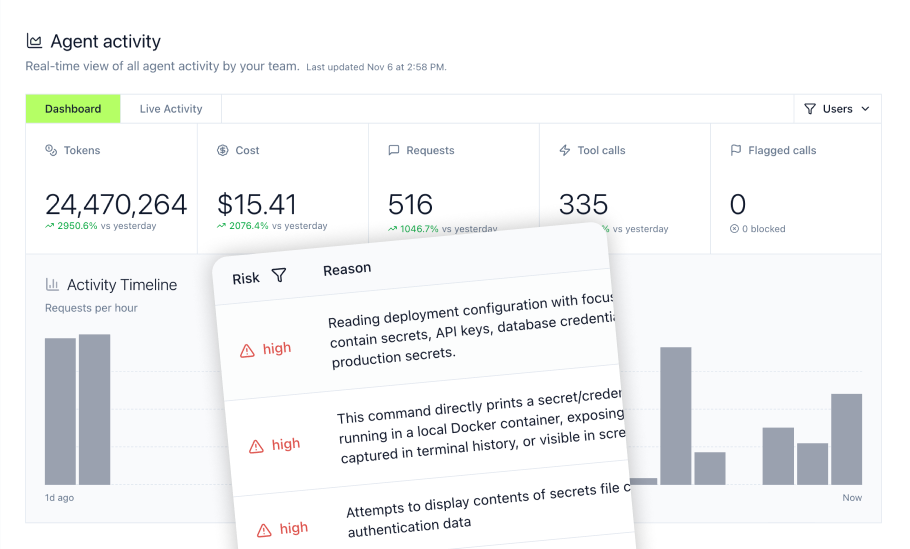
For coding agents specifically, Agent Monitor tracks MCP tool invocations, bash commands, and file operations from Claude Code, Cursor, and other AI coding assistants. Security teams can block dangerous commands in real-time and protect sensitive files like .env files, SSH keys, and credentials from agent access.
Building a Comprehensive MCP Risk Assessment Framework
The four risk categories require coordinated controls that address the complete MCP lifecycle from server selection through production operation.
Phase 1: Pre-Deployment (Days 1-30)
Focus on supply chain and configuration controls:
- Establish MCP server allowlists with security review requirements
- Implement pre-integration scanning using tools like MCPInspect
- Configure OAuth 2.1 with PKCE and per-client consent storage
- Define capability-level permissions for each approved server
Phase 2: Deployment (Days 30-90)
Implement data-driven and operational controls:
- Deploy centralized gateway architecture for policy enforcement
- Enable multi-layer detection pipelines for tool poisoning
- Establish behavioral baselines for anomaly detection
- Configure audit logging with correlation IDs linking prompts to actions
Phase 3: Ongoing Operations (Days 90+)
Maintain continuous governance:
- Monitor for new tool additions requiring admin approval
- Review audit logs for suspicious access patterns
- Update allowlists based on vulnerability disclosures
- Conduct incident response drills for MCP-specific scenarios
Regulatory Alignment
Government recognition of AI data security risks signals rising expectations for governance. CISA issued joint guidance in May 2025 emphasizing data security as essential for AI system trustworthiness. NSA published official guidance in May 2026 addressing MCP security design considerations for AI-driven automation in production, national security, and high-assurance environments.
Organizations handling regulated data must demonstrate that AI assistant data access follows the same governance as human users. This includes:
- Treating AI agents as non-human identities with explicit permission scopes
- Maintaining audit logging requirements that capture tool invocations with complete context
- Developing MCP-specific incident response procedures for credential aggregation breaches
How MintMCP Addresses the Four Risk Categories
MintMCP provides comprehensive coverage across all four MCP risk categories through its integrated gateway architecture. For data-driven risks, the platform's tool governance capabilities enable granular access control with role-based permissions and semantic filtering of tool descriptions. Gateway Middleware runs in a JS sandbox with pre- and post-phase hooks that can transform, mask, or block requests containing suspicious patterns before they reach AI models or downstream systems.
For supply chain risks, MintMCP's centralized registry provides vetted MCP servers with one-click installation, giving security teams visibility into which tools are deployed across the organization. Administrators can establish allowlists, enforce pre-integration security reviews, and prevent developers from installing unvetted servers directly from public registries.
Configuration risks are addressed through MintMCP's support for both shared and per-user authentication models. Organizations can enforce OAuth 2.1 with PKCE for user authorization flows, support machine-to-machine authentication for agent identities, and configure capability-level permissions that limit what each MCP server can access. This prevents confused deputy vulnerabilities by ensuring AI agents operate with appropriately scoped privileges.
For operational risks, MintMCP's audit and observability features provide audit trails for MCP interactions routed through the platform, with correlation IDs linking prompts to tool invocations. Real-time monitoring dashboards surface anomalous access patterns, while Agent Monitor tracks bash commands, file operations, and tool calls from coding assistants. MintMCP is SOC 2 Type II audited, compliant with HIPAA standards, and supports data residency options for organizations with geographic data governance requirements. For more guidance on managing MCP data risks, see MintMCP's MCP data risk guide.
Frequently Asked Questions
How do MCP security risks differ from traditional API security risks?
Traditional API security focuses on input validation, authentication, and rate limiting at well-defined endpoints. MCP introduces semantic attack vectors where malicious instructions embedded in natural language descriptions influence AI reasoning without triggering conventional security controls. The attack surface includes tool metadata, return messages, and prompt context that traditional WAFs and API gateways cannot inspect meaningfully. Additionally, MCP's credential aggregation model can concentrate access to multiple services in single servers when using shared credentials without proper token isolation.
What should organizations do if they suspect an MCP server has been compromised?
Immediate response should include revoking all OAuth tokens associated with the compromised server across connected services, not just the MCP layer. Review audit logs to identify which users and agents accessed the server and what downstream actions were triggered. Check for signs of credential exfiltration, particularly for any connected services that store sensitive data. Conduct forensic analysis of the server's tool descriptions and return messages for embedded malicious instructions that may have influenced AI behavior. Finally, notify affected users and implement enhanced monitoring for the compromised service accounts.
How can organizations detect shadow MCP deployments by developers?
Network monitoring can identify MCP traffic patterns, particularly the distinctive JSON-RPC message formats used by the protocol. Endpoint detection tools can scan for MCP client configurations on developer workstations. DNS monitoring can flag connections to known public MCP registries. However, the most effective approach combines technical detection with governance policies that make approved MCP access easier than shadow deployments, such as self-service provisioning through a centralized gateway that provides faster onboarding than manual server setup.
What is the relationship between MCP Gateway and Agent Gateway in enterprise security?
MCP Gateway provides governed data and tool connections for AI systems users already run, including Claude, Cursor, ChatGPT, Gemini, and Copilot. It handles authentication, access control, and audit logging for human users accessing AI tools. Agent Gateway extends this foundation to cover autonomous agents that operate alongside users, providing identities, permissions, memory management, and monitoring specifically designed for agent workloads. Organizations typically deploy MCP Gateway first to establish governed access patterns, then layer Agent Gateway capabilities as they adopt more autonomous agent workflows.
How do the four risk categories apply to AI coding assistants specifically?
Coding assistants like Cursor and Claude Code face heightened risks across all four categories. Data-driven risks include tool poisoning attacks that could manipulate code suggestions or inject vulnerabilities. Supply chain risks emerge when coding assistants install MCP servers for repository access, CI/CD integration, or documentation retrieval. Configuration risks appear when assistants receive elevated file system access without capability-level scoping. Operational risks concentrate because coding assistants often have write access to production code, credentials files, and deployment infrastructure, making credential aggregation particularly dangerous in development environments.