Your AI agents have access to everything. Does your security? Model Context Protocol enables AI assistants to query databases, send emails, execute code, and access production systems through a standardized interface. The problem: MCP was designed for capability, not security. Security controls still depend heavily on implementation: authorization exists for HTTP-based transports, while authentication choices, rate limiting, and audit logging vary across deployments. With over 40 CVEs disclosed in 2026 alone and real breaches affecting enterprise deployments at major companies, organizations connecting MCP to business systems face significant data exposure risks. An MCP gateway with centralized governance transforms this risk profile, but the first step is understanding what you are protecting against.
Key Takeaways
- 74.9% of MCP servers have no documented audit logging, leaving organizations blind to agent activity
- Real breaches in 2025-2026 affected Supabase, Asana, and GitHub through MCP-related vulnerabilities
- Average data breach cost reached $4.88 million according to IBM's 2024 study
- GDPR violations can result in fines up to 4% of global revenue, making compliance non-negotiable
- A structured 90-day assessment and remediation plan can move organizations from reactive to managed security posture
Understanding the Evolving Landscape of MCP Data Risk
MCP has become the industry standard for connecting AI clients to enterprise data and tools. Anthropic, OpenAI, Google, and Microsoft all support the protocol, driving rapid adoption across organizations. This standardization solves the integration problem but creates new challenges with deployment, security, and governance.
What MCP Data Risk Actually Means
MCP data risk refers to the potential for unauthorized access, data exposure, or malicious actions when AI agents connect to business systems through MCP servers. Unlike traditional API integrations where access patterns are predictable, AI agents can chain multiple tools together in ways that multiply risk exponentially.
The core issue stems from MCP's design philosophy. The protocol standardizes how AI hosts discover and invoke tools, while security posture depends on how each server and transport is implemented. Authorization exists for HTTP-based transports, but authentication choices, rate limiting, and audit logging remain implementation-dependent.
Why Traditional Security Models Fall Short
Traditional security models assume predictable access patterns, single-purpose integrations, human-initiated requests, and static permissions. MCP breaks all these assumptions. AI agents can:
- Discover available tools dynamically at runtime
- Chain multiple tools across different systems in a single session
- Initiate complex multi-step workflows from natural language instructions
- Access data based on the permissions granted to the MCP server, not the user's intent
The Shadow AI Problem
Shadow AI deployments grow as teams adopt AI tools without IT oversight. Developers install MCP servers locally to connect their coding assistants to databases, repositories, and cloud APIs. These deployments often use overprivileged credentials and lack any monitoring.
The result: organizations cannot see what data AI agents access or control their actions. When the Smithery registry experienced a supply chain breach in October 2025, enterprises had no visibility into which teams had installed affected MCP servers.
Implementing Granular Data Security Controls for MCP Connections
Security controls must operate at multiple layers: network, authentication, authorization, and data. MCP's flexibility means each layer requires explicit attention.
The Principle of Least Privilege for AI Agents
AI agents should never have more access than necessary to complete their designated tasks. Practical implementation requires:
- Tool-level allowlisting: Explicitly approve which tools each agent or user group can invoke
- Parameter validation: Restrict what arguments can be passed to allowed tools
- Data scoping: Limit query results to data the initiating user should access
- Action gating: Require human approval for destructive operations
For example, a customer support agent might need to search CRM records but should not be able to delete them. A coding assistant might need to read repository files but should not push directly to production branches.
Defining Least Privilege Access for AI Agents
Start by documenting each use case:
- Identify the business function: What task does the agent perform?
- Map required tools: What MCP tools are necessary for that function?
- Define data boundaries: What data does the agent need to access?
- Set action limits: What operations should the agent perform versus escalate?
Then configure access controls to match. Create Virtual MCP Bundles that expose only the required tools, configure role-based access control tied to identity provider groups, enable request logging for compliance and incident investigation, and set up alerts for attempts to access restricted tools.
Encrypting Sensitive Data in All MCP Workflows
MCP deployments vary by transport and implementation. Local STDIO servers are not the same risk profile as remote HTTP-based servers, so teams should verify that any remotely exposed MCP endpoint enforces TLS and certificate validation.
Require:
- TLS 1.3 for connections: No exceptions for "internal" traffic
- Certificate validation: Prevent man-in-the-middle attacks
- Encryption at rest: Audit logs and cached data must be encrypted
- Token security: Bearer tokens and OAuth credentials must never appear in logs
MintMCP's authentication and identity layer enforces OAuth and SSO for all MCP endpoints, eliminating the authentication gaps in raw STDIO servers.
Ensuring GDPR and Data Privacy Compliance for MCP Deployments
GDPR applies whenever AI agents process personal data of EU residents, regardless of where the organization is headquartered. Violations can result in fines up to 4% of global annual revenue, making compliance essential for any organization with European customers or employees.
GDPR Requirements for AI Agent Systems
Key GDPR principles that apply to MCP deployments:
- Lawful basis: You must have a valid legal reason to process personal data through AI agents
- Purpose limitation: Data accessed by agents must be used only for stated purposes
- Data minimization: Agents should access the minimum data necessary
- Storage limitation: Audit logs containing personal data must have retention policies
- Accountability: You must demonstrate compliance through documentation
Leveraging Audit Trails for GDPR Accountability
Article 30 of GDPR requires records of processing activities. For MCP deployments, this means logging who initiated the request, what data was accessed, when access occurred, and why access was needed.
The challenge: 74.9% of MCP servers lack audit logging. Without centralized governance, organizations cannot demonstrate accountability.
MintMCP's audit and observability features provide complete audit trails of every MCP interaction, access request, and configuration change. These logs support compliance review and incident investigation, while organizations with strict residency requirements should confirm deployment details during procurement.
Strategies for Data Residency with Global MCP Deployments
When MCP servers connect to data stores, query results may cross geographic boundaries. For GDPR compliance, know where data resides, control data flow to prevent prohibited cross-border transfers, use regional deployments, and document transfers with appropriate safeguards (Standard Contractual Clauses, adequacy decisions).
MintMCP offers data residency options, but organizations with strict multi-region compliance requirements should validate deployment details during procurement.
Integrating MCPs Securely: Best Practices for System Integration
Connecting MCP servers to production systems requires careful planning. The integration pattern determines your security posture.
Securing APIs for MCP Data Exchange
MCP servers communicate with backend systems through APIs. Secure these connections by:
- Using service accounts: Never use personal credentials for MCP server connections
- Scoping permissions minimally: Grant only the access needed for intended tools
- Rotating credentials: Automate regular rotation of API keys and tokens
- Monitoring usage: Alert on unusual patterns that may indicate compromise
When MCP servers need OAuth access to third-party services (like Gmail or Salesforce), implement OAuth brokering to manage tokens centrally rather than storing them in server configurations.
Best Practices for Integrating AI into Existing IT Infrastructure
Organizations with mature IT environments should inventory existing access controls, extend controls to MCP by integrating authentication with existing identity providers, and establish governance processes including security review for new MCP server deployments.
MintMCP's tool governance features support this integration by providing centralized policy enforcement that works with existing identity infrastructure.
Monitoring and Auditing MCP Interactions for Continuous Data Security
Security is not a deployment checklist. Effective MCP governance requires ongoing monitoring to detect anomalies, investigate incidents, and demonstrate compliance.
What to Monitor in MCP Deployments
Build dashboards and alerts for tool invocation patterns, error rates, data volumes, authentication failures, and new tool discovery. Spikes may indicate attacks, misconfigurations, or exfiltration attempts.
Establishing an MCP Incident Response Plan
Prepare for MCP-specific incidents by defining incident types (tool abuse, credential compromise, data exfiltration, policy violations), assigning response roles, documenting runbooks with step-by-step procedures, and testing regularly through tabletop exercises.
The breach timeline at Supabase demonstrates the importance of rapid response. Attackers embedded SQL instructions in support tickets, exploiting an agent running with privileged access. Without monitoring, the exfiltration would have continued undetected.
Automating Anomaly Detection in AI Agent Activity
Manual log review cannot scale with AI agent usage. Implement automated detection for behavioral baselines, policy violations, sensitive data access, and chained operations that indicate attack patterns.
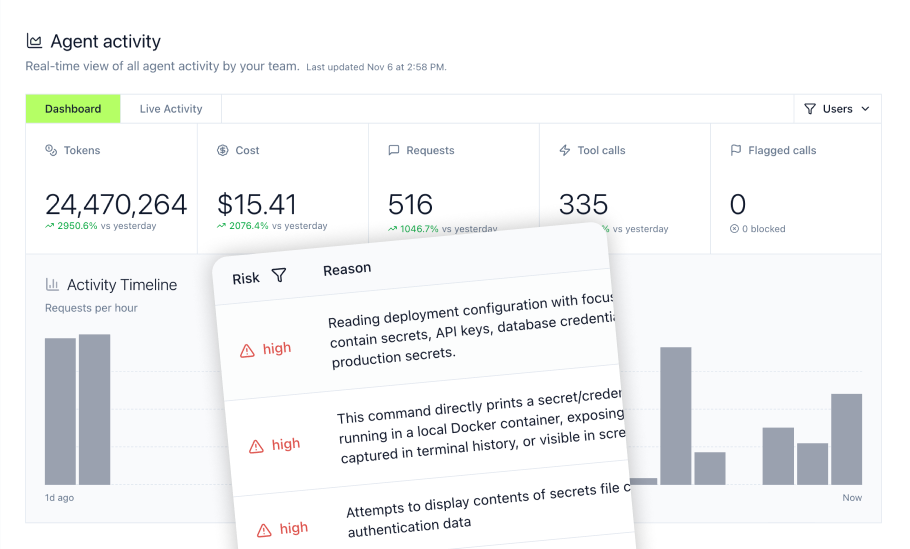
MintMCP's LLM Proxy monitors every MCP tool invocation, bash command, and file operation from coding agents. Security teams can block dangerous commands in real-time and review complete audit trails.
Navigating HIPAA Compliance for Sensitive Data in MCPs
Healthcare organizations and their business associates must comply with HIPAA when AI agents access protected health information (PHI). The Security Rule requires administrative, physical, and technical safeguards.
HIPAA Requirements for MCP Systems
When MCP servers can access PHI, implement administrative safeguards (risk analysis, policies, training), technical safeguards (access controls, audit logging, encryption, authentication), and physical safeguards (device and media controls).
Securing PHI in AI-Powered Healthcare Applications
Healthcare AI use cases require additional controls. Scope patient record lookups to patients the user is treating, ensure clinical decision support does not leak other patients' data, and prevent documentation assistance training data from including real PHI.
Essential HIPAA Safeguards for MCP Integrations
Before connecting MCP to systems containing PHI: execute a Business Associate Agreement with MCP platform providers, conduct a risk assessment specific to the MCP integration, implement audit logging with attribution to individual users, configure access controls based on treatment relationship, and test breach notification procedures for MCP-related incidents.
MintMCP is compliant with HIPAA standards, and customers handling protected health information can request HIPAA documentation. MintMCP signs Business Associate Agreements.
Developing a Comprehensive Policy Framework for AI Tool Governance
Technical controls alone cannot secure MCP deployments. Organizations need policies that define acceptable use, assign responsibilities, and establish accountability.
Building an Enterprise-Wide AI Governance Council
Effective AI governance requires cross-functional leadership from Security, Legal/Compliance, IT Operations, Business units, and HR. Organizations with formal AI governance councils report 80% success rates versus 37% for those without structured approaches.
Crafting Data Classification Standards for AI Environments
AI agents need clear data classification to enforce access controls: Public (no restrictions), Internal (authenticated employees), Confidential (specific roles), and Restricted (explicit approval). Map these classifications to MCP tool permissions.
Policy Enforcement Mechanisms
Policies without enforcement are aspirations. Implement technical controls to block policy violations, monitoring to alert on prohibited actions, consequences for violations, and formal exceptions processes.
MintMCP's policy enforcement capabilities automatically enforce data access and usage policies, turning written policies into technical controls.
Why MintMCP Strengthens Your MCP Data Risk Posture
Assessing MCP data risk is essential, but acting on that assessment requires infrastructure that most organizations lack time to build. MintMCP provides the governance layer that addresses the security gaps documented throughout this article.
MCP Gateway for Centralized Governance
MintMCP's MCP Gateway sits between AI clients and MCP servers, adding OAuth and SSO enforcement for automatic enterprise authentication, granular tool access control to configure which tools each role can access, complete audit trails logging every tool invocation with user attribution, real-time monitoring dashboards, and policy enforcement that automatically blocks actions violating security policies.
For organizations running Claude, Cursor, ChatGPT, Gemini, or Copilot, MintMCP provides vendor-neutral governance across all platforms with one audit stream.
LLM Proxy for Agent Monitoring
The LLM Proxy extends governance beyond MCP to cover local agent activity. It tracks every tool call and bash command for complete visibility, blocks dangerous commands in real-time before execution, protects sensitive files by blocking access to .env files and SSH keys, and maintains a complete audit trail of every operation.
Agent Gateway for Autonomous Agents
For organizations deploying autonomous agents that work alongside employees, MintMCP's Agent Gateway provides per-agent identity so each agent has its own identity rather than shared credentials, scoped permissions through Virtual MCP Bundles, governed long-term memory following Git-like principles, and Slack-native interaction for coworker agents in existing workflows.
Enterprise-Ready Compliance
MintMCP is SOC 2 Type II audited and compliant with HIPAA standards. The platform includes penetration testing, data encryption in transit and at rest, data residency options, and uptime SLAs.
Book a demo to see how MintMCP helps organizations deploy AI agents with the governance security teams require.
Frequently Asked Questions
What is shadow AI and how does it contribute to MCP data risk?
Shadow AI refers to AI tools deployed by employees without IT knowledge or approval. In the context of MCP, shadow AI manifests as developers installing MCP servers locally to connect their coding assistants to databases, repositories, and cloud APIs. These deployments typically use overprivileged credentials, lack monitoring, and bypass security review. Shadow AI creates risk because organizations cannot see what data agents access, cannot enforce security policies, and cannot respond to incidents they do not know about. The MCP gateway approach addresses shadow AI by providing a governed path for MCP connectivity that is easier to use than ungoverned alternatives.
What are the initial steps for assessing data risk before integrating a new MCP server?
Start with the Four-Domain Risk Taxonomy. First, evaluate Identity and Access: does the server support authentication, and how are credentials managed? Second, assess Data Access: what sensitive data can agents reach, and is data classification enforced? Third, review Operational Integrity: can agents make destructive changes, and is human approval required? Fourth, examine Supply Chain: who maintains the server, and how are vulnerabilities handled? Document findings in a risk register with Critical, High, Medium ratings.
How does MintMCP's LLM Proxy block dangerous commands and protect sensitive files?
The LLM Proxy sits between LLM clients like Cursor or Claude Code and the model itself. It monitors every tool invocation, bash command, and file operation. Security teams configure rules to block specific commands (like those that could read environment secrets or delete files), restrict access to sensitive directories, and flag unusual patterns for review. When an agent attempts a prohibited action, the proxy blocks it in real-time before execution. All operations are logged with complete context for incident investigation and compliance audits.
What specific data residency controls does MintMCP offer for global deployments?
MintMCP offers data residency options, but organizations with strict regional processing or audit-log storage requirements should confirm deployment details during procurement. For GDPR and similar frameworks, teams should map where MCP traffic, audit logs, and connected-system data are processed before production rollout.
Can MintMCP integrate with existing identity providers for enterprise SSO?
Yes. MintMCP supports OAuth 2.0, SAML, and SSO integration with major identity providers. The platform includes documented SAML SSO integration and works with other SAML 2.0 compliant providers. This allows organizations to apply existing identity governance to MCP access. Users authenticate through your existing SSO, and MCP tool permissions can be configured based on identity provider groups. This eliminates the need for separate credentials and enables centralized access management across AI tools.