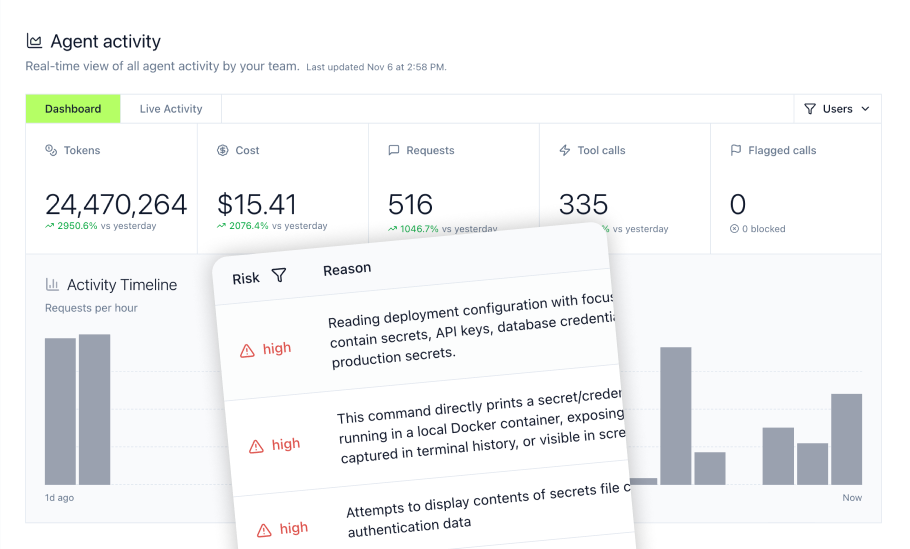
The Model Context Protocol (MCP) enables AI agents to connect directly with enterprise databases, APIs, and internal tools, creating a critical security boundary where reasoning engines interact with sensitive business systems. Without proper controls, organizations face credential theft, tool poisoning, prompt injection, and data exfiltration attacks that traditional security tools cannot detect. Building a defense framework for production MCP deployments requires multi-layered security controls spanning authentication, authorization, monitoring, and governance, all orchestrated through a centralized MCP gateway that enforces consistent policies across every AI-to-tool connection.
This article provides a step-by-step implementation framework for securing MCP data connections in production, covering foundational security principles, advanced data protection, zero trust architecture, API security, compliance requirements, and centralized governance controls.
Key Takeaways
- Gateway-first architecture is the recommended control pattern for production MCP deployments, providing a centralized enforcement point for consistent policy, monitoring, and audit trails across all AI-to-tool traffic
- User-scoped OAuth 2.1 authentication with PKCE should be prioritized over broad service-scoped credentials to reduce confused-deputy risk and prevent AI agents from acting with excessive privileges
- Tool-level RBAC provides granular access control that server-level permissions cannot achieve, enabling least-privilege enforcement where analysts can read databases but not write, and engineers can execute code but not delete production data
- A three-stage detection pipeline combining pattern-based filtering, neural detection, and LLM arbitration can improve coverage for semantic attacks that signature-based tools may miss
- Shadow AI discovery remains a critical gap because developers can deploy MCP servers outside centralized IT review, leaving security teams without a complete inventory of agent-to-tool connections
- Managed gateway solutions can shorten implementation compared to DIY deployments by packaging authentication, policy enforcement, hosted connectors, monitoring, and audit logging into one managed control plane
Understanding the Foundation: Your Data Security Framework for MCP
The Model Context Protocol, released by Anthropic in November 2024, establishes standardized client-server architecture connecting AI models to external tools and data sources. In production environments, MCP servers often sit near credentials, APIs, and sensitive tools, creating controlled access points where AI agents retrieve real-time context and execute authorized actions. This architecture introduces security challenges that require a structured framework approach.
The NSA's May 2026 security guidance supports a defense-in-depth approach for MCP deployments across four practical control layers:
- Network and Transport Security: TLS 1.3, mutual TLS for server-to-server communication, network segmentation
- Authentication and Authorization: OAuth 2.1 with PKCE, user-scoped tokens, tool-level RBAC
- Runtime Monitoring and Detection: Multi-stage threat detection, behavioral analytics, anomaly detection
- Governance and Policy Enforcement: Centralized policy management, automated compliance, audit trails
Aligning with NIST for Robust Security
Organizations should apply the MAESTRO framework to categorize MCP threats across seven layers: Foundation Models, Data Operations, Agent Frameworks, Deployment Infrastructure, Evaluation and Observability, Security and Compliance, and Agent Ecosystem. This structured approach ensures no security domain is overlooked during implementation.
A security baseline definition should establish minimum requirements based on data classification. Public data requires minimal controls, internal data needs standard controls, confidential data demands enhanced controls, and regulated data requires maximum controls including encryption, DLP integration, and comprehensive audit logging.
MintMCP's security architecture provides unified authentication, audit logging, and rate control for all MCP connections, directly supporting this layered security framework while reducing implementation complexity.
Advanced Data Protection for Production MCP Environments
Production MCP deployments handle sensitive enterprise data that requires protection beyond basic access control. Encryption, tokenization, data masking, and data loss prevention controls should be enforced through the gateway and supporting security layers.
Encryption requirements:
- TLS 1.2 minimum (TLS 1.3 recommended) for all data in transit
- Mutual TLS for server-to-server MCP connections
- Encrypted storage for OAuth tokens and secrets at rest
- Hardware security modules for key material in regulated environments
Implementing End-to-End Data Encryption
MCP servers should never store credentials in plain text. Use secrets management systems like HashiCorp Vault or AWS Secrets Manager with automatic rotation policies.
Data loss prevention integration:
Route MCP responses through enterprise DLP controls via ICAP protocol or API integration to scan tool responses for sensitive data before returning results to AI clients. This enables:
- Automatic redaction of PII, credit card numbers, and SSNs
- Alerts triggered for unusual response sizes indicating potential exfiltration
- Pattern detection for sensitive data categories
MintMCP offers data residency options for enterprise deployments, with compliance documentation available through its Trust Center. MintMCP's gateway and Agent Monitor help enforce data protection by monitoring MCP traffic and local agent activity, including risky file, command, and tool access patterns.
Zero Trust Architecture: A Pillar of MCP Data Security Services
Zero trust principles apply directly to MCP data connections: never trust any request by default, always verify identity and authorization, and enforce least-privilege access for every tool invocation.
Core zero trust principles for MCP:
- Least privilege access: Grant only the minimum permissions required for each tool and user combination
- Continuous verification: Validate identity and authorization on every request, not just at session start
- Micro-segmentation: Isolate MCP servers by risk level and data sensitivity
- Assume breach: Design controls assuming attackers already have network access
Designing a Zero Trust Model for MCP Data Flows
The confused deputy problem represents one of the most significant zero trust failures in MCP deployments. When MCP servers use their own broad credentials rather than user-bound tokens, AI agents can access data beyond what the requesting user should see.
Implementation pattern:
- Register MCP server as confidential client in your identity provider
- Configure OAuth authorization code flow with PKCE
- Implement token exchange for user-scoped permissions
- Enable refresh token rotation with short-lived access tokens (15 to 60 minutes)
MintMCP enforces granular tool access control and supports both shared and per-user authentication, aligning with zero trust principles by ensuring each request is authorized based on the actual requesting user's permissions.
Securing API Connections for MCP: Best Practices and Tools
MCP servers expose API endpoints that require the same rigorous security controls applied to any production API. The OWASP MCP Top 10 provides a foundation for identifying MCP-specific risks across agentic systems, tool connections, and context flows.
Critical API security controls:
- Rate limiting: Prevent abuse and resource exhaustion attacks
- Input validation: Sanitize all tool parameters before execution
- API versioning: Maintain backward compatibility while patching vulnerabilities
- Request authentication: Require valid tokens for all API calls
Leveraging API Gateways for MCP Security
A centralized gateway serves as the single enforcement point for all AI-to-tool traffic. In production MCP deployments, gateway-centric architecture provides a practical control point for authentication, authorization, logging, and policy enforcement.
Gateway responsibilities:
- Centralized allowlist of approved MCP servers
- OAuth 2.1 authentication enforcement
- Tool-level authorization policies
- Comprehensive audit logging
- Real-time threat detection
MintMCP Gateway provides OAuth and SAML for enterprise authentication, essential for securing API connections to MCP servers. The platform normalizes authentication across upstream MCP transport patterns, including stdio, HTTP-streamable, and legacy SSE, presenting a unified SSO-fronted interface regardless of upstream variety.
Earning Your Data Security Attestation: Compliance for MCP Data
Production MCP deployments in regulated industries must demonstrate compliance with SOC 2, HIPAA, GDPR, and other frameworks. Automated audit trails and structured logging are essential for meeting these requirements.
Compliance requirements by framework:
| Framework | Key MCP Requirements |
|---|---|
| SOC 2 Type II | Complete audit trails, separation of duties, encryption |
| HIPAA | Minimum necessary access, PHI safeguards, audit trails, BAAs where applicable |
| GDPR | Data minimization, auditability, data subject rights workflows, residency options where applicable |
| PCI-DSS | Cardholder data protection, access control, monitoring |
Achieving SOC 2 Type II for MCP Data
Organizations pursuing SOC 2 Type II attestation for MCP deployments must demonstrate:
- Complete audit trails: Every MCP interaction logged with user identity, tool name, parameters, and timestamp
- Separation of duties: RBAC enforcing distinct analyst, engineer, and admin roles
- Encryption in transit and at rest: TLS for all connections, encrypted credential storage
- Quarterly security reviews: Automated compliance dashboards with evidence collection
MintMCP provides complete audit trails and structured logs that support SOC 2 Type II audited controls, HIPAA-aligned workflows, and GDPR-related governance evidence. Visit the MintMCP Trust Center for compliance documentation.
Network Security Fundamentals for Enterprise MCP Deployments
Network-level controls provide the foundation for all other security measures. Without proper network segmentation and monitoring, attackers who gain access to one system can pivot to MCP servers and connected data sources.
Essential network security controls:
- Firewalls: Restrict MCP server access to authorized clients only
- Network segmentation: Isolate MCP servers in dedicated VLANs by risk level
- Intrusion detection: Deploy IDPS to detect anomalous MCP traffic patterns
- DDOS protection: Implement rate limiting and traffic analysis at the network edge
Segmenting Networks for Enhanced MCP Security
Production MCP deployments should implement network segmentation based on data sensitivity:
- Public data servers: Standard network with external access allowed
- Internal data servers: Restricted network with authentication required
- Confidential data servers: Isolated network with MFA and enhanced monitoring
- Regulated data servers: Air-gapped or highly restricted network with complete audit logging
For high-risk or regulated deployments, use the NSA guidance to evaluate stronger segmentation, restricted egress, secure proxying, and complete audit logging for MCP server traffic.
Real-time Monitoring and Audit Trails for MCP Data Security
Effective MCP security requires real-time visibility into all AI-to-tool interactions. Traditional SIEM rules miss semantic attacks like tool poisoning and prompt injection, requiring specialized detection approaches.
Establishing a Security Operations Center for MCP
A three-stage detection pipeline provides comprehensive threat coverage:
Stage 1: Pattern-Based Filtering
- Lightweight regex patterns detect command injection, SQL injection
- Performance impact: typically lower than semantic or LLM-based review
- Detection coverage: strongest for overt injection patterns and known signatures
Stage 2: Neural Detection for Semantic Attacks
- ML models identify tool poisoning and hidden instructions
- Performance impact: higher than pattern-based filtering
- Detection coverage: stronger for semantic attacks, hidden instructions, and obfuscated patterns
Stage 3: LLM-Based Arbitration
- Small LLM analyzes contextual appropriateness of tool invocations
- Performance impact: highest of the three stages, best reserved for sensitive or high-risk tool calls
- Combined detection coverage: strongest when pattern-based, neural, and contextual analysis are layered together
MintMCP Gateway provides real-time monitoring and complete audit trails of every MCP interaction, essential for security operations and compliance. The audit and observability capabilities include structured logging compatible with enterprise SIEM systems.
Centralized Governance and Control for Enterprise MCP Connections
Centralized governance eliminates the security gaps created when individual teams deploy MCP servers independently. Without unified control, organizations face inconsistent authentication, missing audit trails, and unmanaged credential sprawl.
Centralized governance capabilities:
- Unified authentication: Single SSO integration for all MCP connections
- Role-based access control: Centrally defined roles mapped to tool permissions
- Credential management: Secure vault for all AI tool API keys and tokens
- Policy enforcement: Automated enforcement of data access and usage policies
Implementing RBAC for Granular Access to MCP Data
Tool-level RBAC provides the granularity required for production deployments. Server-level permissions are too coarse-grained to enforce least privilege effectively.
Example role definitions:
- Analyst role: Can invoke read_database, search_files tools only
- Engineer role: Adds execute_code, deploy_service tools
- Admin role: Adds delete_database, modify_permissions tools
MintMCP offers centralized governance with unified authentication, audit logging, and rate control for all MCP connections. The platform features centralized credentials and policy enforcement for streamlined governance across Claude, Cursor, ChatGPT, Gemini, and Copilot.
Securing Multi-Capability Protocol Endpoints and Tools
MCP servers and tools represent individual security points requiring endpoint hardening, vulnerability management, and permission controls. Supply chain security is critical given the rapid growth of the MCP ecosystem.
Endpoint security requirements:
- Static Application Security Testing: Scan MCP server code before deployment
- Software Composition Analysis: Verify dependencies for known vulnerabilities
- Cryptographic signing: Only allow signed, verified servers to connect
- Version pinning: Lock server versions with change alerting
Hardening MCP Servers for Production Readiness
Organizations should implement a vetting process for MCP servers before production deployment:
- Review server source code for security issues
- Scan dependencies using tools like Snyk or GitHub Advanced Security
- Verify server publisher and code signing
- Test in isolated environment before production approval
- Monitor for updates and security advisories
MintMCP transforms local MCP servers into production-grade services with enterprise hardening, monitoring, and security features. The platform handles hosted MCP connectors with auto-scaling and isolated execution per connector, reducing the need for customers to manage connector-layer Kubernetes pods or scaling infrastructure.
For organizations seeking to understand the broader context of MCP deployment, the MintMCP whitepaper provides additional guidance on implementation roadmaps and governance frameworks.
Building Production MCP Security with MintMCP
Organizations implementing MCP security frameworks face a critical choice between DIY approaches that require extensive internal development or managed platforms that accelerate deployment while maintaining enterprise-grade controls. MintMCP delivers a production-ready gateway that eliminates the architectural complexity, credential sprawl, and monitoring gaps that emerge when teams deploy MCP servers independently.
The platform provides a unified control plane for authentication, authorization, audit logging, and policy enforcement across all MCP connections. By centralizing governance through a single gateway, security teams gain stronger visibility into AI-to-tool interactions while developers maintain the flexibility to connect approved MCP servers through standardized interfaces.
This architecture supports both shared service credentials and per-user OAuth flows, enabling organizations to implement zero trust principles without sacrificing operational efficiency.
MintMCP is SOC 2 Type II audited, with continuous compliance monitoring via Drata. The platform provides structured logs for every MCP interaction, authentication event, and configuration change, giving regulated industries the documentation infrastructure required for HIPAA, GDPR, and SOC 2 attestation. Organizations handling protected health information can request HIPAA documentation, and MintMCP signs Business Associate Agreements. Data residency options are available for enterprise deployments requiring geographic controls.
For security teams building defense frameworks around production MCP deployments, MintMCP reduces the amount of custom security infrastructure teams need to build by providing integrations with enterprise identity providers, SIEM platforms, and DLP controls. The hosted connector architecture eliminates the operational burden of managing individual MCP server instances while maintaining the isolation and security controls required for sensitive data access. Contact the MintMCP team to discuss your production security requirements.
Frequently Asked Questions
What is the typical timeline for implementing a complete MCP defense framework?
Implementation timelines vary based on approach. Managed gateway solutions like MintMCP can shorten deployment by packaging authentication, access control, hosted connectors, monitoring, and audit logging into a managed control plane. DIY implementations usually take longer because teams must build and maintain each of those layers themselves. A phased approach works best: 30 days for foundation assessment and IdP integration, 60 days for core controls including gateway deployment and RBAC, and 90 days for advanced capabilities like multi-stage detection and DLP integration.
How do I discover shadow MCP servers already deployed in my organization?
Shadow AI discovery requires active scanning because developers often deploy MCP servers without IT knowledge. Use network scanning tools that detect both authenticated and unauthenticated MCP instances through port scanning and protocol fingerprinting. Specialized tools like MCP Scanner, Ramparts, or CyberMCP can identify MCP traffic patterns. Consider offering amnesty programs where developers can self-report existing deployments without penalty. Weekly automated scans should become standard practice once initial discovery is complete.
What performance impact should I expect from MCP security controls?
Security controls add latency that varies by implementation, policy complexity, deployment location, and whether requests require lightweight filtering, semantic review, or LLM-based arbitration. Mitigation strategies include caching authentication tokens, using async scanning where possible, deploying edge gateways closer to users, and implementing fast-path routing for low-risk tools. Managed gateways are typically optimized to keep routine policy checks lightweight while reserving heavier review for sensitive or high-risk tool calls.
How should I handle the transition from DIY MCP security to a managed gateway?
Migration from unmanaged to managed MCP deployments should follow a phased approach. Start by inventorying all MCP servers and documenting existing authentication flows. Deploy the managed gateway in parallel, configuring policies that match your current state. Route a pilot group through the gateway while monitoring performance, then migrate remaining users in controlled batches with rollback capability throughout. Only decommission direct MCP connections after confirming in-scope production traffic flows through the gateway with complete audit logging.
What compliance documentation does MintMCP provide for regulated industries?
MintMCP is SOC 2 Type II audited, with continuous compliance monitoring via Drata. The platform provides complete audit trails with structured logging for MCP interactions, user authentication events, and configuration changes. Organizations handling protected health information can request HIPAA documentation, and MintMCP signs Business Associate Agreements. Data residency options are available for enterprise deployments. The MintMCP Trust Center provides access to compliance documentation, or contact security@mintmcp.com for specific requirements.