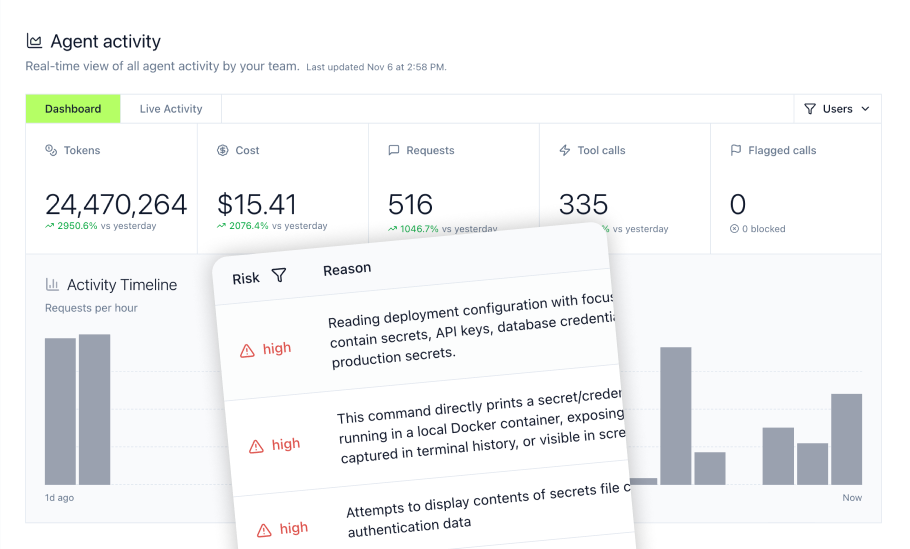
Every enterprise has a strategy for building AI agents. Almost none have a strategy for managing them. As organizations deploy agents across customer service, data analysis, and development workflows, the governance gap creates security vulnerabilities, compliance exposure, and untracked costs. An Agent Management Platform (AMP) is the infrastructure layer that closes this gap, providing centralized control over agent identity, tool access, observability, and policy enforcement across your entire AI fleet.
This article defines what an AMP is, breaks down its core components, and explains why organizations deploying AI agents need this infrastructure layer before scaling further. For teams already running agents through Claude, Cursor, ChatGPT, Gemini, or Copilot, MintMCP combines an MCP Gateway for governed data and tool connections with an Agent Gateway for agent identities, permissions, memory, and monitoring, turning ad-hoc deployments into auditable enterprise infrastructure.
Key Takeaways
- An Agent Management Platform is the enterprise control plane for agent identity, governance, orchestration, and observability, distinct from agent builders (CrewAI, LangChain) and orchestrators (LangGraph, AutoGen)
- Agent sprawl is the defining governance crisis: Fortune 500 companies will deploy 150,000+ agents by 2028 versus fewer than 15 in 2025
- Gartner identifies Agent Management Platforms as an emerging management layer for governing performance, risk, and value across heterogeneous enterprise agent ecosystems
- Protocol-aware governance (MCP, A2A) separates true AMPs from generic API proxies through method-level authorization rather than opaque HTTP routing
- Over 40% of agentic AI projects will be canceled by end 2027 due to escalating costs, unclear business value, or inadequate risk controls
- Many organizations still struggle to measure AI ROI consistently at the project level, creating a governance and capital-allocation gap
Understanding the Core: What Is an AI Agent Management Platform?
An Agent Management Platform is the runtime infrastructure that sits between autonomous AI agents and the enterprise systems they access. Unlike agent builders that help create agents or orchestrators that coordinate multi-agent workflows, an AMP enforces what agents can do, records what they did, and provides the identity layer that makes those records meaningful.
The distinction matters for enterprise buyers. Frameworks like CrewAI and LangChain help you build agents. LangGraph and AutoGen coordinate multi-agent workflows at runtime. An AMP keeps agents healthy, accountable, and compliant through observability, ROI tracking, lifecycle management, versioning, rollback, and governance. These are adjacent jobs, not competing products.
Defining the "Last Mile Problem" in Enterprise AI
The "last mile problem" in enterprise AI refers to the gap between having capable AI models and giving those models secure, governed access to internal systems and data. Organizations have invested heavily in foundation models, but connecting those models to databases, CRMs, ticketing systems, and internal tools without creating security vulnerabilities requires specialized infrastructure.
Every team shipping an agent without a control plane creates four simultaneous debts:
- Identity surface: New service accounts or hard-coded API keys with no rotation schedule
- Tool integration debt: Embedded credentials with no centralized management
- Audit gap: No logging of which agent did what on whose behalf
- Cost center: Token consumption with no attribution or quota enforcement
Centralized Control for Distributed AI
Traditional IT governance tools are often insufficient on their own because they were designed primarily for human users and deterministic applications rather than autonomous or semi-autonomous agents. Agents reason, act, and make decisions autonomously, requiring distinct identity models with delegation chains, fine-grained authorization at the tool level, and continuous monitoring of agent behavior rather than periodic batch audits.
MintMCP addresses this through a data-permissions-first architecture. Rather than starting from the agent and retrofitting data permissions afterward, MintMCP starts from data permissions (SSO, SCIM, IdP groups, Virtual MCP Bundles, tool-level policy, audit) and then enables agents on top. An agent's access is always a subset of an already-governed permission model.
Essential Components: What Makes Robust Agent Management Software?
Gartner's March 2026 research describes six core functional elements that enterprises must evaluate:
- Security: Agent identity, guardrails, and policy enforcement specific to autonomous systems
- Libraries: Approved agents, templates, and prompts with version control
- Tooling: APIs, MCP/A2A protocols, and memory resources
- Dashboard: Agent registry, usage analytics, and ROI metrics
- Marketplace: Procurement governance, credential management, and budget controls
- Observability: Testing, lifecycle management, AI performance monitoring, and audit trails
The Role of Gateways and Monitors
Within the AMP architecture, two components handle the bulk of governance work:
MCP Gateway centralizes server management across deployment scenarios: one-click activation of pre-configured connectors, hosting of custom STDIO-based MCP servers, and creation of Virtual MCPs that bundle multiple servers with role-based tool access. Gateway functions include OAuth 2.0 and SAML authentication, secure OAuth token refresh and independently rotatable agent credentials, rate limiting per user and team, and granular tool-level access control.
Agent Monitor tracks local coding-agent activity in real time, including MCP tool calls, Bash commands, and file reads and writes. MintMCP deploys these controls through supported client hooks, with MDM-based rollout available for tools such as Claude Code and Cursor. This complements the MCP Gateway, which governs data and tool connections across Claude, Cursor, ChatGPT, Gemini, and Copilot.
Securely Connecting Agents to Enterprise Resources
Protocol-aware governance separates true AMPs from generic API proxies. The dividing line is method-level authorization. A generic API gateway may treat MCP as ordinary HTTP unless configured with MCP-aware inspection. A protocol-aware AMP can enforce policies on MCP methods and specific tool names. The difference is between "this agent can talk to this MCP server" versus "this agent can call tools/list but not tools/call on the production billing tool."
Two protocols anchor modern agent ecosystems:
- Model Context Protocol (MCP) standardizes how agents discover and invoke tools through methods like tools/list, tools/call, and resources/read
- Agent-to-Agent (A2A) standardizes how independent agents discover capabilities, exchange messages, manage tasks, and delegate work while relying on standard web authentication and authorization mechanisms
Building and Deploying: Creating AI Agents with Enterprise Considerations
For organizations starting their agent journey, deployment complexity varies dramatically based on scale and security requirements. Individual developers can spin up agents quickly using open-source frameworks. Enterprise teams face additional requirements: identity management, audit trails, credential governance, and policy enforcement.
Leveraging Pre-built Connectors vs. Custom Deployments
AMPs accelerate deployment through pre-configured integrations. MintMCP's catalog includes connectors for Salesforce, GitHub, Slack, HubSpot, Notion, Linear, Gmail, Stripe, and dozens more. These one-click activations eliminate the engineering overhead of building each integration from scratch.
For custom requirements, STDIO server support automatically converts locally-run MCP servers to hosted, production-ready services with OAuth wrapping and no code changes required. This matters for organizations with proprietary internal tools or unique data sources.
Simplifying Agent Deployment with Virtualization
Virtual MCPs (VMCPs) address configuration complexity for non-technical users. A VMCP bundles multiple servers with role-based tool access into a single endpoint. Instead of managing individual server connections and permissions, teams access a curated set of tools appropriate for their function.
The practical impact: Marketing teams get connectors for analytics, content platforms, and social tools. Finance teams get database access, reporting tools, and compliance systems. Each bundle enforces appropriate access policies without requiring per-user configuration.
The Power of Orchestration: Enhancing AI Agent Workflows
As organizations move from single agents to coordinated fleets, orchestration becomes critical. An AMP provides the infrastructure for multi-step agent workflows with provenance tracking, ensuring organizations can trace decisions back through the entire chain of agent actions.
From Single Agent to Orchestrated Enterprise Workflows
The progression typically follows three stages:
- Single-agent automation: Individual agents handling discrete tasks (data extraction, report generation, ticket classification)
- Sequential workflows: Multiple agents passing outputs between stages (research agent feeds analysis agent feeds report generator)
- Collaborative systems: Agents coordinating in real-time with supervisor patterns, adaptive routing, and custom orchestration logic
REST APIs and SDKs enable programmatic management for CI/CD integration and infrastructure-as-code workflows. This allows organizations to manage agent deployments with the same rigor applied to application infrastructure.
Securing AI Operations: Why Best AI Agent Platforms Prioritize Governance
Security and compliance represent non-negotiable requirements for enterprise agent deployments. The EU AI Act entered into force on August 1, 2024 and became broadly applicable on August 2, 2026, subject to phased exceptions. For the most serious prohibited-practice violations, penalties can reach €35 million or 7% of worldwide annual turnover. GDPR, HIPAA, and SOX impose additional requirements on automated decision-making and data processing.
Mitigating Risks: From PII to Prompt Injection
AMPs address specific agent security risks:
- PII exposure detection: Identifying when agents access or transmit personally identifiable information
- Credential leakage monitoring: Flagging API keys, tokens, or passwords in agent outputs
- Prompt injection defense: Blocking attempts to manipulate agent behavior through malicious inputs
- Risky command prevention: Stopping dangerous operations (rm -rf, credential access) before execution
MintMCP's security governance includes custom policy code execution on every tool call with inline DLP integration. Supported integrations include AWS Bedrock Guardrails, Google Cloud DLP, Microsoft Purview, Nightfall, and Skyflow.
Achieving Compliance in Regulated Industries
For healthcare, financial services, and government organizations, compliance cannot be retrofitted. Organizations implementing AMPs before regulatory inquiries experience compliance as competitive advantage rather than crisis response.
Requirements vary by regulation but converge on common elements:
- Agent identity (who or what made this request)
- Action attempted (what tool call or data access)
- Policy evaluated (what rules applied)
- Enforcement decision (permit, block, or flag)
- Data involved (what information was accessed)
- Timestamps and user attribution
MintMCP is SOC 2 Type II audited, with continuous compliance monitoring via Drata, and is compliant with HIPAA standards. Customers handling protected health information can request HIPAA documentation, and MintMCP signs BAAs.
Tailored Solutions: Managed Agents for Specific LLMs
Different AI platforms require different governance approaches. Claude, ChatGPT, Gemini, Cursor, and Copilot each have distinct security models, capability surfaces, and deployment patterns.
Optimizing Claude for Enterprise Use Cases
For organizations standardizing on Anthropic's Claude, Agent Monitor provides hooks specifically for Claude Code that track local agent activity beyond what the gateway sees. This includes Bash commands, file reads and writes, and prompt submissions.
The same monitoring extends to Cursor through the Cursor Hooks Partners Program. This matters because significant agent activity occurs outside traditional network boundaries, directly in developer environments.
Extending Management Beyond the Gateway
Hook-based enforcement extends governance beyond gateway traffic for supported coding agents. MintMCP can deploy Agent Monitor configurations through MDM to capture local activity such as commands, file access, and MCP usage, giving security teams visibility into activity that would not appear in gateway logs.
Operational Efficiency: AI Workflow Automation with Agent Management
Beyond security, AMPs can improve operational efficiency by reducing manual work across data analysis, customer support, and development workflows.
Transforming Business Processes with AI Agents
Common automation targets include:
- Data analysis agents: Querying databases, generating reports, and surfacing insights
- Customer support agents: Accessing CRM and ticket systems to resolve issues
- Development workflow agents: Connecting to GitHub, Jira, and CI/CD pipelines
- Compliance agents: Generating audit-ready logs of data access
Measuring the ROI of Agent Automation
ROI attribution represents a strategic capability gap. Marketing reports satisfaction improvements, Sales claims qualified leads, Operations cites cycle time reduction, but all self-reported by agent owners with inherent bias. CFOs reviewing AI investments have no way to validate, compare, or optimize spending without unified measurement.
AMPs with financial intelligence link agent activity to business outcomes (revenue impact, cost savings, productivity gains, error reduction) with standardized baselines (manual cost per task, manual handling time, pre-AI error rate). This transforms "we believe it's working" into measurable outcomes per agent.
Advanced Governance: Leveraging Bundles for Scalable AI Agent Management
As organizations scale from dozens to thousands of agents, governance models must scale with them. The Bundle architecture provides the abstraction layer that makes this possible.
Streamlining Policy Management with Bundles
A Bundle ties SCIM group membership to a curated MCP server list, custom policy rules, and an isolated audit trail. When an employee joins a team in Okta or Azure AD, their Bundle membership updates automatically. Policies cascade from organization to team level without manual configuration.
Bundles can require admin approval for new tool additions, addressing the silent capability expansion problem where upstream MCP servers add new tools without organization review.
Ensuring Audit Attribution with Agent Identities
Agent Bundles extend the model to non-human principals. Each deployed agent receives its own persistent identity with scoped credentials that rotate independently. This solves the "shared service account" problem where multiple agents use the same credentials, making audit attribution impossible.
Agent Bundles include:
- Bearer API keys plus OAuth 2.0 client-credentials per agent
- Rotation and revocation independent of human users
- "Act as agent" admin flow for connectors requiring per-agent OAuth
- Permission scoping so agent access is explicit, not inherited from creator
MintMCP: Unified Governance for Agent Infrastructure
MintMCP addresses agent governance through a two-layer architecture that separates data access from agent operations:
- MCP Gateway: Provides governed connections to enterprise data and tools across Claude, Cursor, ChatGPT, Gemini, and Copilot. It includes pre-built connectors, STDIO server hosting, and Virtual MCP Bundles that enforce role-based access.
- Agent Gateway: Adds persistent agent identities, scoped permissions, enterprise memory, and behavioral monitoring for agents that work alongside employees.
This architecture addresses a foundational governance challenge: every agent's access must be traceable, auditable, and revocable. MintMCP starts from existing identity infrastructure, including SSO, SCIM, and IdP groups, and extends those controls to agents rather than creating a separate identity system.
In practice:
- Employee access can update automatically through SCIM-driven group membership.
- Each agent's independently scoped permissions can be reviewed, rotated, or revoked without affecting human users.
- When an agent exceeds its authorization, the system blocks the action before execution rather than relying on post-incident investigation.
For organizations deploying coworker agents, MintMCP's Agent Gateway provides the control layer these systems require. Coworker agents can:
- Hold memory across sessions
- Continue work across days
- Operate in Slack alongside employees
- Maintain scoped memory for private, team, organization, and customer contexts
That memory is company-owned, versioned, reviewable, auditable, portable, and designed around Git-like principles rather than opaque vendor-controlled stores. This becomes increasingly important as agents accumulate institutional knowledge over months of operation and that knowledge must be inspected, transferred, and governed like other enterprise data assets.
MintMCP's practitioner perspective also comes from running its own operations on agents. This creates real-world patterns for:
- Agent deployment
- Delegation boundaries
- Memory management
- ROI measurement
- Scaling from pilot projects to production fleets
These operating patterns translate directly into the product capabilities organizations need as their agent infrastructure grows.
Frequently Asked Questions
What is the difference between an Agent Management Platform and an API Gateway?
API gateways route traffic, manage rate limits, and enforce authentication for APIs. Some can be configured to inspect MCP's JSON-RPC payloads, but MCP-aware AMPs provide native policy controls for MCP methods, tool names, agent identities, and audit context. This makes it easier to allow discovery operations such as tools/list while restricting selected tools/call actions.
Can Agent Management Platforms detect "Shadow AI" usage within an organization?
Yes, for supported coding-agent environments. MintMCP's Agent Monitor uses client hooks to capture local actions such as MCP calls, Bash commands, and file access, and those configurations can be distributed through MDM. The MCP Gateway separately governs centralized data and tool connections across Claude, Cursor, ChatGPT, Gemini, and Copilot.
What role does the Model Context Protocol (MCP) play in agent management?
MCP is the standardization layer that allows agents to discover and invoke tools consistently across platforms. It defines methods like tools/list (what tools are available), tools/call (execute a tool), and resources/read (access data). AMPs govern MCP traffic by enforcing policies at the method level, managing authentication between agents and MCP servers, and logging all interactions for audit purposes. Without MCP standardization, each agent-to-tool integration requires custom governance.
How do Agent Management Platforms integrate with existing enterprise security infrastructure?
AMPs integrate with identity providers (Okta, Azure AD, Google Workspace) for SSO and SCIM-based group membership. They export logs to SIEM platforms (Microsoft Sentinel, Splunk, S3) for centralized security monitoring. DLP integrations connect to existing data protection investments (AWS Bedrock Guardrails, Google Cloud DLP, Microsoft Purview, Nightfall, Skyflow). This allows organizations to extend existing security investments to agent governance rather than building parallel infrastructure.
What distinguishes an AMP from observability tools like OpenTelemetry for LLMs?
LLM observability tools track model calls: latency, token usage, prompt and completion content. AMPs track agent actions: which tools were invoked, what data was accessed, what policies were evaluated, and what the business outcome was. Observability answers "how is the model performing?" while AMPs answer "what is the agent doing on behalf of my organization, and should it be allowed to?"