Claude Tag transforms how teams collaborate by embedding a persistent AI teammate directly into Slack channels rather than offering ephemeral chatbot interactions. With 65% of Anthropic's product team code now created through its internal version of Claude Tag, Anthropic has demonstrated substantial internal adoption. The challenge for other organizations lies in expanding existing clusters without exposing sensitive data, losing audit trails, or letting token costs grow without controls. Organizations using an MCP Gateway can centralize governed MCP tool access, enforce policies, and maintain audit visibility into MCP activity routed through the gateway as their Claude Tag footprint grows across teams and channels.
This article provides actionable guidance for expanding your Claude Tag deployment with enterprise-grade governance, covering Virtual MCP configuration, agent identity management, monitoring infrastructure, guardrails implementation, and compliance requirements to ensure your cluster scales safely.
Key Takeaways
- Claude Tag operates as a shared teammate, not a chatbot. Everyone in a channel works with the same Claude, while public channels can share workspace-level identity and memory and private channels maintain separate boundaries. Claude retains relevant context and can work asynchronously across hours or days.
- Ambient mode requires deliberate cost controls. Because Claude can act proactively rather than only when tagged, organizations should set organization-wide and per-channel spend limits, monitor actual consumption, and enable ambient behavior selectively based on observed value and risk.
- Security research found 7.2% of MCP servers contain vulnerabilities. Never connect unvetted public MCP servers directly to production Claude Tag instances. Use governed MCP infrastructure.
- The Claude in Slack migration occurred on August 3, 2026. Current administration should focus on configuring member access, channel scopes, tools, spend limits, and audit controls.
- Virtual MCPs solve configuration sprawl. Instead of N installs across N machines with N auth flows, teams connect once to a governed endpoint with SCIM-driven access policies.
- ROI should be calculated from measured deployment data. Claude Tag consumption, enterprise licensing, MintMCP contract terms, implementation costs, and productivity gains vary by organization, so generic payback claims should not be presented as expected results.
- Agent identities eliminate single-point-of-failure credentials. Claude Tag operates through Anthropic's own agent identity for channel work. Agent identities complement that model at the MCP governance layer by giving a Claude Tag integration its own MintMCP identity, scoped Virtual MCP access, credentials, and audit trail.
Why Enterprise AI Governance Matters for Claude Tag Expansion
The Challenge of Uncontrolled AI Expansion
Organizations running mixed AI environments face a recurring problem: teams adopt Claude, Cursor, ChatGPT, Gemini, and Copilot faster than security teams can govern what those systems access, whose credentials they use, what actions they take, and how those actions are attributed.
Claude Tag amplifies this challenge. Unlike single-user AI assistants, Claude Tag operates as a multiplayer agent where channel members work with shared context and tools. Anthropic provides member-access controls, channel scopes, guest controls, and Enterprise role-based restrictions on who can invoke Claude. Because channel membership can still become an access boundary for the tools Claude can reach, elevated permissions should be scoped conservatively to the users and channels that need them.
Common governance gaps in uncontrolled Claude Tag expansion:
- No visibility into which tools Claude is calling or what data it reads
- API keys scattered across developer laptops with no rotation policy
- Agents reaching any connected system without oversight
- Missing audit trails for SOC 2, HIPAA, or internal risk reporting
- Configuration sprawl where every developer configures MCP servers locally
- Tool descriptions serving as injection surfaces through list_tools changes
Why a Unified AI Governance Layer is Crucial for Scale
A unified governance layer addresses these gaps by creating a system of record for your agent workforce. This means answering questions like: Which agents exist? Who owns them? Which systems can they access? What credentials do they use? What actions have they taken? How can they be restricted or shut down?
MintMCP provides this governance layer through connected products:
- MCP Gateway: Governed data and tool connections through authentication, access control, credential handling, tool curation, and audit
- Agent Gateway: First-class non-human identities for autonomous agents with scoped permissions and attributable audit trails
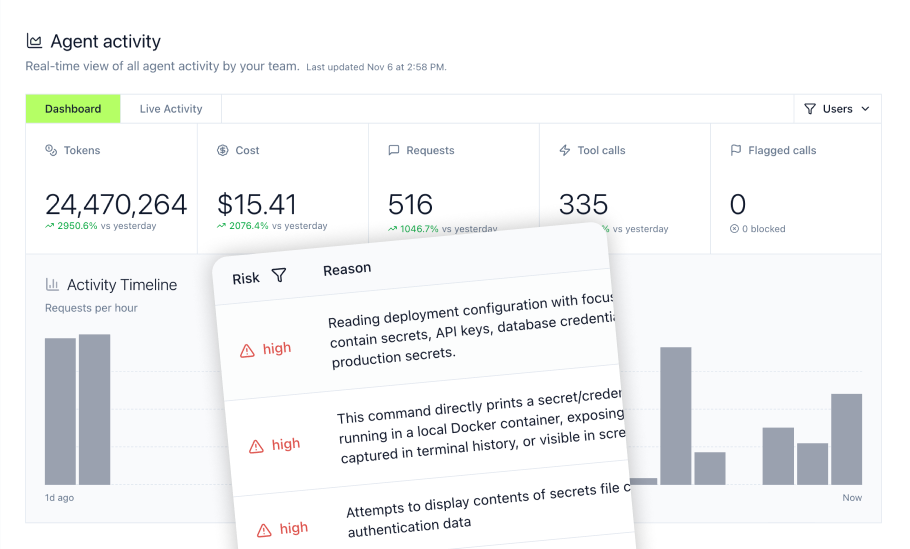
- Agent Monitor: Visibility into supported agent activity including prompts, commands, file access, MCP tool calls, and token costs
This architecture follows a data-permissions-first approach where governance is the foundation and agents are enabled on top, rather than granting broad access and attempting to restrict it afterward.
Leveraging Virtual MCPs for Claude Tag Cluster Expansion
Defining Access and Tools with Virtual MCPs
The key abstraction for governed Claude Tag deployment is the Virtual MCP (VMCP). A Virtual MCP bundles approved connectors and a curated tool surface behind one governed endpoint for a particular team, role, use case, or agent.
What a Virtual MCP provides:
- Single deployment unit: One endpoint instead of configuring each MCP server across every machine
- Centralized access control: Permissions granted at the VMCP level, not scattered across individual tools
- Tool curation: Administrators select which tools appear in each bundle, reducing context-window bloat
- Unified audit trail: Every tool call logged through one governed path
- Independent administration: Read-only versus read-write access is simply two VMCPs over the same connector with different tool curation
For Claude Tag specifically, you can create separate VMCPs for different channel types. A #sales-analytics channel might receive a VMCP with Salesforce read access and BigQuery SELECT queries, while #engineering-ops receives GitHub, Datadog, and PagerDury tools with write permissions.
SCIM Integration for Seamless Cluster Management
SCIM-driven directory groups can grant human users access to the appropriate Virtual MCPs without requiring manual configuration. Claude Tag itself uses a separate access path: Anthropic controls who can invoke Claude in Slack, while a Claude Tag integration routed through MintMCP can authenticate through its own agent identity and agent-scoped Virtual MCP.
Benefits of SCIM-driven access:
- Suspend in the IdP and access propagates immediately
- New team members receive correct tool access on day one
- Role changes automatically adjust available tools
- Compliance teams can audit access through existing directory management tools
To configure Virtual MCPs for your Claude Tag expansion, see the VMCP administration documentation.
Enhancing Security and Identity for Claude Agents in Slack
Beyond Shared Credentials: Dedicated Agent Identities
Claude Tag already operates through Anthropic's own agent identity for channel work rather than whichever employee credential happens to be available. Agent identities complement that model at the MCP governance layer by giving a Claude Tag integration its own MintMCP identity, scoped Virtual MCP access, credentials, and audit trail:
- Its own credentials that can be rotated independently
- Scoped permissions that match the specific use case
- An independent audit trail attributing every action to the agent
- Revocation that does not affect human users or other agents
Secure Authentication Methods for Autonomous Claude Agents
MintMCP supports multiple authentication mechanisms for agent identities, ranging from simplest to most secure:
- Bearer keys: Static keys included on every request with named identifiers, expiry dates, and individual revocation capability. Appropriate for internal agents with limited scope.
- M2M tokens: OAuth client-credentials exchange produces short-lived tokens while the secret stays out of the request path. Better for production agents that need regular credential rotation.
- Workload identity federation: The agent's own infrastructure (Kubernetes service account, cloud role, CI job identity) mints short-lived OIDC tokens. MintMCP holds no secret at all, eliminating credential storage risk entirely.
For Claude Tag operating in Slack, MintMCP's current setup uses an agent bearer key added to the Claude Tag Access Bundle. Identity forwarding passes the agent's identity email to cooperating upstreams, maintaining attribution through the entire tool chain.
Monitoring and Auditing Your Expanded Claude Tag Cluster
Gaining Granular Visibility into Claude's Operations
Visibility is the most consistent theme in enterprise AI governance conversations. Security teams need to see which tools agents are calling, which files they access, and which actions they take across the organization.
For Claude Tag integrations routed through MintMCP, MCP Gateway provides audit visibility into governed MCP tool calls. Agent Monitor separately provides broader activity and usage telemetry for supported monitored clients such as Claude Cowork, Claude Code, Cursor, Codex, and GitHub Copilot, including:
- Prompts: What users ask Claude to do
- Commands: Shell commands, package installs, git operations
- File access: Including .env files, SSH keys, and other sensitive paths
- MCP tool calls: Every interaction with connected systems
- Usage and cost: Token spend by model, user, agent, and session
The live activity feed shows every action across the organization in real time with filtering by monitored client, user or agent, model, and time range.
Integrating Claude Activity Logs with Enterprise SIEM Systems
Compliance teams often need AI agent activity exported to existing security infrastructure. SIEM export supports OTLP and Splunk HEC formats, forwarding:
- Tool calls with parameters and results
- Prompt submissions
- Gateway requests
- Access policy changes
- Credential lifecycle events
This integration allows security operations centers to correlate AI agent activity with other organizational events, detect anomalous patterns, and maintain unified incident response workflows. Track Claude Tag channel spend through Anthropic's native Claude Tag usage analytics. Agent Monitor provides separate usage and cost telemetry for its supported monitored clients.
Implementing Guardrails for Safe Claude Tag Interactions
Preventing Malicious Prompts and Data Exposure
The unpredictability of AI agents creates specific security concerns. Non-technical users might tell Claude to "go do something" and the agent runs curl -L to a random site piped to shell, potentially installing malicious software. Tool descriptions can inject instructions into the agent's prompt through tool poisoning attacks.
Mint Guard provides managed detection policies for:
- Prompt injection: Blocks high-confidence attempts to manipulate agent behavior through malicious inputs
- Credentials and secrets: Detects API keys, passwords, and tokens in tool calls
- PII: Identifies personal information that should not flow through certain tools
- Harmful content: Screens for dangerous or inappropriate requests
Mint Guard operates in three modes: Off, Monitoring (logs detections without blocking), and Enforcing (blocks high-confidence threats). Enterprise teams typically start in Monitoring mode to understand their traffic patterns before enabling enforcement.
Custom Policy Enforcement with Gateway Middleware
Beyond managed policies, organizations need custom logic for their specific security requirements. Gateway Middleware runs customer-authored JavaScript on every matching tool call, enabling:
- DLP integrations: Connect to AWS Bedrock Guardrails, Google Cloud Model Armor, or existing DLP systems
- Content transformation: Redact sensitive information before it reaches downstream tools
- Resource allowlists: Enforce which specific databases, repositories, or documents Claude can access
- External classifiers: Route requests through custom ML models for additional screening
Middleware runs in a JS sandbox and fails closed for policy-critical checks, ensuring that network errors do not accidentally allow dangerous operations. For organizations with existing DLP investments, templates ship for common integrations so policy enforcement stays in the tools security teams already manage.
Managing Claude Tag Deployment and IT Administration
Streamlining Rollout Across Your Enterprise
Expanding Claude Tag beyond pilot channels requires coordinated deployment across multiple teams. The setup guide for Claude Tag outlines a phased approach:
Week 1-2: Governance Planning
Answer six critical questions before touching configuration:
- Which Slack channels can Claude access (and which are explicitly off-limits)?
- Which external tools will Claude connect to and what data permissions does each grant?
- Who reviews Claude's completed outputs before they become action items?
- How long should Claude retain channel memory and what is the deletion policy?
- How will employees be notified that Claude is present or monitoring?
- What is the escalation path if Claude takes unintended actions?
Week 3-4: Bundle Configuration
For each use case, create a Virtual MCP that:
- Registers approved MCP servers (databases, APIs, document stores)
- Configures OAuth and credential wrapping for each connector
- Sets tool-level permissions (e.g., database SELECT allowed, INSERT/UPDATE/DELETE blocked)
- Creates an agent identity MCP for Claude Tag, adds its MintMCP connection to the appropriate Claude Tag Access Bundle, and attaches that Access Bundle to the Slack channel
Week 5-6: Pilot Deployment
Deploy to 2-3 pilot channels with:
- Conservative spend limits ($500-1K per channel per month initially)
- Task-only mode enabled (ambient mode disabled)
- Weekly output quality reviews (1-5% sample)
- User feedback collection
Ensuring Consistent Configuration and Access Policies
Configuration sprawl kills Claude Tag deployments at scale. When every developer configures MCP servers locally, you get N installs, N auth flows, and N points of failure.
Configuration as Code enables declarative management of Virtual MCP definitions, access policies, global rules, and connector settings. Store configuration in version control, review changes through pull requests, and deploy consistently across environments. This approach also supports disaster recovery and environment replication.
For MDM-based deployment of Claude Code hooks (which can complement Claude Tag deployments), see the guides for Intune, Kandji, and JumpCloud.
Cost Management and Usage Tracking for Your Claude Tag Cluster
Attributing Costs to Specific Teams and Agents
Claude Tag channel work is consumption-based, so costs vary with workload, model use, connected tools, and proactive activity. Anthropic provides organization-wide spend caps, optional per-channel limits, threshold alerts, and per-channel spend analytics to keep usage predictable.
This data supports usage visibility and chargeback estimates by user, model, agent, and session, which finance teams can use as an input to internal allocation workflows. Agent Monitor usage tracking provides complementary visibility including token spend by model, user, agent, and session, human versus agent activity split, cache hit rates, and filters by monitored client.
Optimizing AI Spend Across Your Organization
Cost management best practices for Claude Tag:
- Set spending limits before deployment. It is easier to raise limits than claw back after an invoice surprise. Start with $500 per channel per month and adjust based on actual usage.
- Monitor usage closely during the pilot. Review per-channel consumption and adjust limits as real usage patterns emerge.
- Enable ambient mode selectively. Start with task-triggered workflows where appropriate, then expand proactive behavior after evaluating cost, quality, and risk.
- Review tool call volume quarterly. Adjust Bundle permissions based on actual usage patterns rather than anticipated needs.
- Verify current Claude Tag launch-credit eligibility. As of September 14, 2026, Anthropic says qualifying Enterprise organizations that activate Claude Tag and link it to GitHub receive $25K in Claude Tag credit, while Team organizations with 10+ seats receive $2.5K. These credits expire October 1, 2026.
Claude Tag consumption, enterprise licensing, MintMCP contract terms, implementation costs, and productivity gains vary by organization. Measure actual consumption during a pilot and compare it with validated workflow outcomes before calculating productivity savings or payback. Use organization-wide and per-channel spend limits to establish a reliable cost baseline before projecting ROI.
Achieving Compliance and Auditability for Claude in Slack
Ensuring Regulatory Adherence for AI in Collaboration Tools
Claude Tag deployments in regulated industries must satisfy requirements across the full technology stack, not MintMCP alone. As of September 14, 2026, Anthropic states Claude Tag is not yet covered by Anthropic's Business Associate Agreement, so organizations should not route PHI through Claude Tag solely because MintMCP can sign a BAA. MintMCP provides compliance infrastructure including:
- SOC 2 Type II attestation: Platform controls independently assessed for security, availability, and confidentiality.
- HIPAA standards: Organizations handling protected health information can request documentation and sign BAAs. Note that using MintMCP does not automatically make customers compliant; appropriate controls must be configured and maintained.
- Penetration tested: Security assessments identify and remediate vulnerabilities before they reach production.
- Data encrypted: In transit and at rest.
- Data residency options: Available. Confirm current regions and deployment terms during enterprise review.
The Trust Center at trust.mintmcp.com provides current compliance documentation.
Transparent Audit Trails for Every Claude Interaction
Every tool call, credential lifecycle event, and access policy change is logged. MintMCP's tamper-evident audit history applies specifically to access-grant history, which is signed at write time and verifiable offline via published JWKS.
For a Claude Tag deployment using MintMCP alongside Anthropic's native audit surfaces, this means:
- Claude Tag tasks and Agent Identity network calls remain available through Anthropic's native audit and Slack surfaces
- MCP tool calls routed through MintMCP are recorded in MintMCP with agent attribution and tool-call context
- External-system access routed through the agent's MintMCP identity can be attributed to that agent
- MintMCP access-policy changes are tracked for audit and governance
Compliance teams can combine Anthropic's Claude Tag audit records with MintMCP's gateway and access-control logs for SOC 2 assessments, internal risk reviews, or regulatory inquiries. For comprehensive security guidance, see the MCP data risk assessment guide.
Future-Proofing Your Claude Tag: Memory, Persistence, and Autonomy
Beyond Ephemeral Conversations: Persistent Claude Agents
Claude Tag accumulates channel context over time, eliminating the need to re-explain project background in every conversation. However, this creates new governance questions around memory ownership and portability.
Coworker Agents extend the persistent agent concept with infrastructure the company owns rather than depending entirely on a single vendor's memory system:
- Repo-as-memory: Instructions (CLAUDE.md), memory (progress.md), and task queues (inbound/) live in reviewable files
- Triggers: Slack mentions, cron schedules, or manual runs
- Swappable models: Any model or harness (Claude, GPT, open-source), so model choice never blocks a rollout
- Governance built in: VMCP-scoped tool allowlists, Agent Monitor session visibility, sandbox with restricted egress
The Role of Company-Owned Memory in Scaled AI Deployments
Enterprise agent memory should follow Git-like principles: versioned, reviewable, auditable, and portable. This contrasts with memory systems that are opaque, difficult to review, or locked to a specific vendor.
Memory scopes for enterprise agents:
- Private: Individual workspace memory for personal productivity tasks
- Team: Shared context for department-level collaboration
- Organization: Company-wide knowledge accessible to appropriate agents
- Customer: Segmented memory for client-facing agent deployments
The key idea is that an enterprise should be able to understand, inspect, govern, and move the memory its agents rely on. When Claude Tag's built-in memory meets limits, Coworker Agents provide infrastructure for persistent autonomous work with company-owned memory systems. For detailed guidance on Claude Tag configuration, see the Claude Cowork guide.
Scaling Claude Tag with Governed MCP Infrastructure
As Claude Tag expands from pilot channels to wider adoption, governance needs to scale with it. MintMCP provides a consistent control layer for MCP access across teams and AI clients.
Key controls include:
- Virtual MCPs: Replace scattered local MCP configurations with one governed endpoint per team, use case, or agent.
- Agent identities: Give each Claude Tag integration its own credentials, scoped permissions, and attributable audit trail.
- Gateway Middleware: Apply custom security policies, transformations, DLP integrations, and resource controls to matching MCP tool calls.
- Mint Guard: Add managed detection for prompt injection, credentials, PII, and harmful content.
- SCIM-driven access: Keep human access to governed tool surfaces aligned with directory groups managed by IT and security teams.
As adoption grows, MCP Gateway provides the same governed MCP layer for Claude Tag, Claude Code, Cursor, and other supported AI clients. Organizations can apply consistent tool-access policies, credential controls, and gateway audit logging without rebuilding the MCP governance model for each client.
This architecture complements Anthropic's native Claude Tag controls rather than replacing them. Anthropic manages Claude Tag's channel access, agent identity, memory, task activity, and spend controls, while MintMCP governs MCP connections routed through its infrastructure.
Together, these layers help IT and security teams answer:
- Which agents have access to enterprise tools?
- Which systems and MCP tools can each agent use?
- Which credentials and permissions apply?
- What MCP actions have been recorded?
- How can access be restricted, rotated, or revoked?
MintMCP's gateway audit capabilities and SIEM export provide visibility into MCP activity routed through MintMCP, while Anthropic's native Claude Tag administration provides Claude Tag task, memory, and spend visibility.
Frequently Asked Questions
What happened to the earlier Claude in Slack experience on August 3, 2026?
Anthropic says Claude in Slack switched to the Claude Tag experience on August 3, 2026. Organizations using Claude Tag today should review their current member-access settings, channel and workspace scopes, connected tools, guest-channel controls, spend limits, memory, and audit configuration rather than planning around the now-past migration deadline.
How do we handle Claude Tag in channels with external guests or contractors?
Apply the same identity and access policy model you use for internal users. Create dedicated Virtual MCPs for guest-accessible channels with appropriately restricted tool access. Never attach elevated Bundles (database write access, code deployment tools) to channels where guests might be added. Use private channels for sensitive work and explicitly audit channel membership before attaching any Access Bundle. Use Claude Tag's native guest-channel controls to govern whether Claude responds when guests are present and what access it receives. MintMCP can separately audit MCP tool calls routed through its gateway.
Can we use Claude Tag alongside other AI tools like Copilot or ChatGPT?
Yes, and this is where unified governance becomes essential. MintMCP provides governance across Claude, Cursor, ChatGPT, Gemini, and Copilot through the same MCP Gateway infrastructure. This means consistent access policies, unified audit trails, and cross-platform visibility without rebuilding your identity, permissions, or data governance layer for each tool. Teams can use Claude Tag in Slack while developers use Cursor or Claude Code under the same MCP Gateway and Virtual MCP governance model. Agent Monitor separately provides broader activity telemetry for its supported monitored clients.
What is the difference between Claude Tag's Access Bundles and MintMCP's Virtual MCPs?
Claude Tag's Access Bundles are Anthropic's native mechanism for grouping tool access. Virtual MCPs (VMCPs) are MintMCP's abstraction that sits between any AI client (including Claude Tag) and your enterprise tools. VMCPs provide additional capabilities including SCIM-driven membership from your directory, tool-level curation independent of the upstream MCP server, gateway middleware for DLP integration, and unified audit across multiple AI clients. Organizations can place MintMCP's VMCPs behind Claude Tag's native access model when they want the same MCP governance, policy, credential, and audit layer used across other AI clients. This complements Anthropic's own Claude Tag agent identity, channel-access, spend, memory, and audit controls.
How do we prevent Claude Tag from accessing files or data it should not see?
Three layers of control work together. First, channel scoping limits which Slack channels Claude can access at all. Second, Virtual MCP configuration restricts which tools appear for each channel type, using tool curation to hide sensitive operations. Third, Guardrails apply to MCP gateway tool calls routed through MintMCP. Mint Guard blocks high-confidence prompt-injection detections, while credentials, secrets, PII, and harmful-content findings are currently logged rather than blocked by Mint Guard itself. Use Rules or Gateway Middleware when those categories require additional enforcement, masking, or custom policy logic. Start with conservative Bundle configurations and Mint Guard in Monitoring mode before enabling enforcement. Never attach write-enabled Bundles to public channels.