The Jira MCP Server enables AI agents to read and act inside Jira through the Model Context Protocol, exposing Jira's REST API as standardized tools that AI assistants can invoke with natural language commands. While developers love the productivity gains from searching issues with JQL, creating tickets, and summarizing sprints through their AI clients, security teams often need additional governance for audit trails, credential management, and visibility into what agents actually access. Through a governed MCP Gateway, organizations can bridge this gap between local experimentation and enterprise-approved AI tool access.
This article covers implementation paths, governance requirements, and the architecture decisions that satisfy both developers who want immediate productivity and security teams who need compliance controls for AI-Jira integrations.
Key Takeaways
- The official Atlassian Rovo MCP Server provides a broad tool catalog across Jira, Confluence, Jira Service Management, Bitbucket, Loom, and other Atlassian apps, with organization-level permission groups and native MCP tool-invocation audit logging
- Capacity depends on Atlassian's current Jira rate-limit model and Rovo MCP usage: Jira API quotas are measured in points rather than a fixed requests-per-hour allowance, while some enriched Rovo MCP operations also consume Rovo credits
- Direct Rovo MCP connections inherit Atlassian permissions and provide native administrative and audit controls; a gateway layer can add centralized cross-client access policies, tool curation, identity, guardrails, and audit across a broader AI environment
- Atlassian Rovo MCP v2 is now generally available at
https://mcp.atlassian.com/v2/mcp; existing v1 usage will begin exposing v2 tools on March 1, 2027 - Productivity gains depend on workflow frequency and automation depth; organizations should measure time saved from their own Jira workflows before modeling gateway ROI
What is a Jira MCP Server and Why it Matters for AI Governance
A Jira MCP Server acts as a bridge connecting AI assistants to Jira's project management capabilities. Instead of manually copying ticket data or switching between tools, users ask their AI assistant natural questions like "What's blocking the payments epic?" and the AI queries Jira directly, returning structured answers. The AI client can invoke Jira tools such as JQL search, issue creation, and status transitions based on the user's natural-language request.
Two primary implementations exist: Atlassian's official cloud-hosted Rovo MCP Server using OAuth 2.1 with zero install, and community self-hosted servers for Data Center deployments. The official server provides JQL-powered issue search alongside natural-language semantic search through Rovo Search, plus issue management capabilities including create, read, update, transition, comment, and attachment operations.
The Core Problem: Uncontrolled AI Access to Enterprise Systems
The challenge enterprises face is not technical capability but governance. Direct MCP connections work in local development but create risks at scale:
- Fragmented audit context: Atlassian records Rovo MCP tool invocations and user attribution, but security teams may still need centralized visibility across Jira and the organization's other AI clients, agents, and enterprise tools
- Credential sprawl across mixed implementations: The official Rovo MCP Server uses OAuth 2.1 by default, while optional API-token and self-hosted community deployments can still create locally managed credential sprawl
- Missing first-class agent identity in some deployment models: Atlassian can attribute Rovo MCP activity to authenticated users, while autonomous agents may still need distinct non-human identities, scoped credentials, and independent audit attribution
- Usage and quota management: Jira API quotas and Rovo credit consumption can affect high-volume workflows, making usage visibility and efficient query design important at scale
Organizations need a governance layer that sits between AI clients and Jira, providing the controls that make AI tool access enterprise-ready without slowing developer adoption.
Setting Up Your Jira MCP Server with MintMCP for Governed AI Access
Step 1: Choose Your Implementation Path
For Atlassian Cloud users, the official Rovo MCP Server offers the fastest path to initial connectivity. In Claude Code, connect using:
claude mcp add --transport http atlassian https://mcp.atlassian.com/v2/mcp
For Claude Desktop, install the Atlassian extension from Settings > Extensions. For Cursor, install the Atlassian MCP plugin from the Cursor Marketplace. OAuth 2.1 is the recommended authentication method.
Step 2: Add Enterprise Governance Layer
Direct Rovo MCP connections retain Atlassian's native permissions and audit controls, while a governed MCP Gateway adds centralized policies, tool curation, credentials, and audit across AI clients and enterprise systems. Configure an MCP Gateway between your AI clients and the Jira MCP server:
- Configure the Atlassian Rovo MCP v2 endpoint; if your gateway requires a complete flat tool list instead of dynamic discovery, use
https://mcp.atlassian.com/v2/mcp?tools=all - Set up RBAC policies and tool provisioning
- Enable audit logging and PII detection
- Connect AI clients to the gateway URL instead of direct server URL
For AI clients configured to use the gateway, this architecture routes Jira MCP traffic through governed endpoints with centralized policy and audit visibility.
Step 3: Configure Virtual MCPs for Role-Based Access
Virtual MCPs bundle approved connectors and curated tool surfaces behind one governed endpoint. Create separate VMCPs for different use cases:
- Read-only VMCP: JQL search, issue reading, sprint summaries for analysts
- Standard VMCP: Full CRUD operations for engineering teams
- Admin VMCP: Project configuration and workflow management for leads
Directory groups drive membership through SCIM, applying consistent access policies without requiring individual MCP server configuration per user.
Common Setup Challenges and Solutions
- Rate-limit or usage errors (Varies): Narrow queries, reduce repeated calls, inspect Atlassian rate-limit responses, and review Rovo credit usage where applicable.
- Permission denied on writes (Common): Verify the authenticated user has create/edit permissions in the target project and that the relevant Rovo MCP permission group is enabled.
- Tools not appearing (Occasional): Complete the OAuth flow, run
/mcpin Claude Code, and verify the required permission groups and app access. - Authentication issues after upgrading (Occasional): Use the v2 endpoint and clear cached client IDs or OAuth discovery credentials if an incompatible client continues using stale authentication metadata.
Enhancing Jira Workflows: AI Agents, Permissions, and Attribution via MCP
As organizations scale from individual AI users to dozens of autonomous agents, the governance question shifts from "can this work" to "who did what." An Agent Gateway extends governed tool access to first-class agent identities with their own permissions and audit trails.
Assigning Unique Identities to AI Agents
Each autonomous agent receives its own identity rather than inheriting human credentials or shared service accounts. This agent identity includes:
- Independent credentials: Bearer keys, M2M tokens, or workload identity federation
- Scoped MCP access: Only the Jira tools this specific agent needs
- Attributable audit trail: Every action linked to the specific agent, not "the service account"
- Independent rotation and revocation: Rotate one agent's credentials without affecting others
Authentication Mechanisms by Security Level
From simplest to most secure:
- Bearer keys: Static key on every request with name, expiry, and individual revocation
- M2M tokens: OAuth client-credentials exchange for short-lived tokens; secret stays out of request path
- Workload identity federation: Agent's own infrastructure (K8s SA, cloud role, CI job) mints short-lived OIDC tokens; no secret stored
Monitoring AI Agent Activity in Jira: Visibility and Compliance
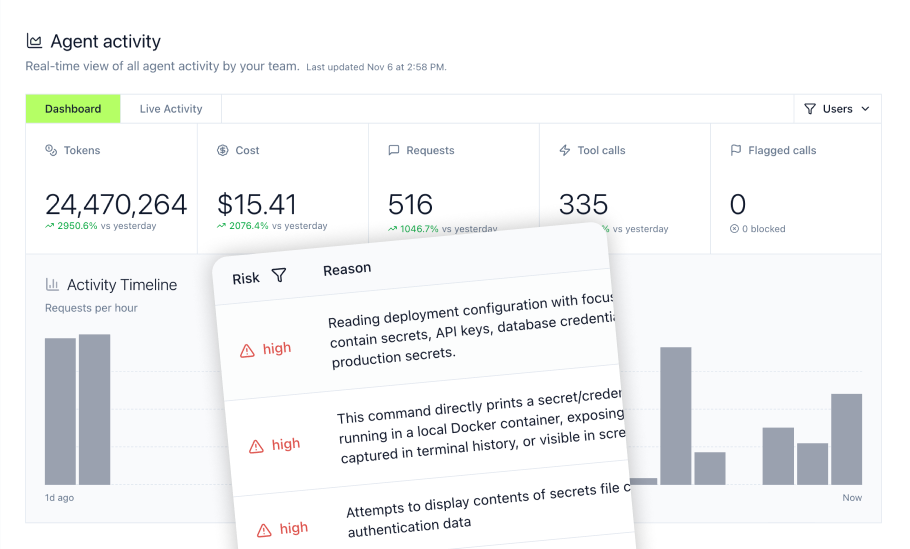
Security teams need visibility into what AI agents actually do inside Jira. Agent Monitor provides visibility into supported agent activity including prompts, commands, file access, MCP tool calls, usage, and token costs.
What Gets Captured
- Tool calls: Supported MCP tool activity such as
searchJiraIssuesUsingJql,createJiraIssue, andtransitionJiraIssueinvocations - Arguments and results: The actual JQL queries and returned data
- User attribution: Which human or agent identity made each call
- Timestamps and sessions: Full timeline of interactions
Compliance-Ready Audit Exports
For compliance requirements, SIEM export via OTLP or Splunk HEC captures tool calls, prompt submissions, gateway requests, and access-policy changes. This enables security teams to answer audit questions with specific, timestamped evidence. Audit trails, identity attribution, and access controls can support SOC 2, HIPAA, GDPR, and internal compliance requirements by providing evidence of who or what accessed Jira data and under which permissions.
Implementing Runtime Guardrails for Safe AI Interactions with Jira
Visibility alone is insufficient. Organizations need runtime controls that prevent dangerous actions before they execute. MintMCP provides three complementary guardrail layers:
Mint Guard: Managed Detection Policies
Mint Guard screens every tool call for:
- Prompt injection: Blocks malicious instructions embedded in Jira ticket descriptions
- Secrets and credentials: Detects API keys or passwords in tool arguments
- PII: Identifies personal information flowing through tool calls
- Harmful content: Catches policy violations in content creation
Rules Engine: Declarative Pattern Matching
Define custom rules matching tool names, argument patterns, or content:
- Block
deleteJiraIssuecalls entirely for certain agent identities - Require approval for bulk operations affecting more than 10 issues
- Flag any JQL query accessing customer-tagged projects
- Mask sensitive field values in returned results
Gateway Middleware: Custom Security Logic
For organizations with existing DLP investments, customer-authored JavaScript middleware integrates external classifiers and enforces custom policies. Templates ship for AWS Bedrock Guardrails, Google Cloud Model Armor, and OpenAI moderation.
Enterprise Governance for Jira MCP: SSO, RBAC, and Audit Trails
Enterprise deployment requires infrastructure that IT and security teams already manage. MintMCP integrates with existing identity providers and access management systems.
SSO and SCIM Integration
Enterprise SSO supports Okta, Entra ID, and Google. Directory groups drive both admin roles and tool access through SCIM synchronization. Suspend a user in the IdP, and access propagates automatically to all governed MCP endpoints.
Role-Based Access Control Architecture
RBAC operates at two independent layers:
- Org-level roles: Member, admin, and custom roles for administrative reach
- VMCP access policies: Tool-level reach controlled by directory group membership
This separation ensures that someone who administers the Salesforce VMCP does not automatically have access to Jira tools.
Tamper-Evident Audit Records
Access-grant history is signed at write time, verifiable offline via published JWKS. This provides compliance teams with tamper-evident access history that can support evidence collection for SOC 2 Type II audits and similar assurance requirements.
Business Use Cases and ROI
Sprint Triage Before Standup
Engineering managers can use Jira MCP before standup to prompt: "Search the current sprint for issues blocked or stale for 3+ days. Rank by risk." This can turn manual board review into a structured triage workflow, with actual time savings depending on team size and process.
Automated Bug Filing from Stack Traces
Developers can paste log excerpts and prompt: "File a bug with steps-to-reproduce from the trace, set priority based on checkout-path impact, link to epic PAY-1200, check duplicates first." Jira MCP can then create a structured ticket using the approved Jira tools and the authenticated user's permissions.
Project Handoff Briefings
New team members can use Jira MCP to ask: "Get me up to speed on the August project. What's done, in progress, blocked, and who owns what?" The agent can retrieve relevant Jira context and assemble a project handoff briefing without requiring the user to manually open each work item.
Gateway Architecture: Decision Framework
- Direct MCP Connection
- Best for: Individual testing and proof-of-concept deployments.
- Trade-offs: Relies on Atlassian native controls and does not provide cross-client governance.
- MCP Gateway with Virtual MCPs
- Best for: Enterprise teams needing centralized access policies, audit, and tool curation across AI systems.
- Trade-offs: Requires an additional governed gateway layer.
- Agent Gateway with M2M Auth
- Best for: Autonomous agents requiring attributable identity.
- Trade-offs: Adds identity management overhead.
For organizations that need centralized governance across multiple AI clients, agents, and enterprise tools, a gateway architecture can provide a consistent layer for access policies, tool curation, credentials, and audit. The MCP data risk guide provides detailed assessment frameworks for evaluating your organization's requirements.
Deploying Governed Jira MCP Access with MintMCP
MintMCP's MCP Gateway adds centralized governance on top of Atlassian's Rovo MCP Server. Atlassian handles the protocol connection and native Jira permissions, while MintMCP centralizes policy enforcement, credential handling, tool access, and audit across AI clients and enterprise systems.
Organizations can use Virtual MCPs to create role-specific tool surfaces, such as:
- Analysts: Read-only Jira search and issue access
- Engineering teams: Create, update, and transition issues
- Leads and admins: Broader project and workflow capabilities
SCIM-driven directory groups can control access centrally without configuring each user separately.
For autonomous agents, the Agent Gateway adds:
- First-class agent identities
- Independent credentials
- Scoped MCP permissions
- Attributable audit trails
- Independent credential rotation and revocation
Runtime security is handled through complementary controls:
- Mint Guard detects categories such as prompt injection, secrets, and PII.
- Rules enforce custom conditions on tools, arguments, and content.
- Agent Monitor provides visibility into supported prompts, tool calls, usage, and other agent activity, with SIEM export through OTLP or Splunk HEC.
This architecture gives organizations a consistent governance layer for Jira access across AI clients and autonomous agents while preserving Atlassian's underlying permission model.
Frequently Asked Questions
Can I use Jira MCP Server with Jira Data Center instead of Cloud?
The official Atlassian Rovo MCP Server supports Cloud only. For Data Center deployments, community servers like sooperset/mcp-atlassian provide similar functionality but require self-hosting. These community implementations use API token or Personal Access Token authentication rather than OAuth 2.1 and require additional infrastructure management.
How do rate limits differ between direct connection and gateway deployment?
Atlassian applies its own API quotas regardless of whether requests pass through a gateway. Jira Cloud rate limits use a points-based quota model, while some Rovo MCP operations also consume Rovo credits. A gateway can govern and observe requests before they reach Atlassian, but it does not remove Atlassian's underlying quotas.
What happens to existing Jira permissions when using MCP?
The MCP server respects existing Jira permissions. AI agents can only access what the authenticated user or agent identity can access in the Jira UI. This is permission-passthrough, not permission-bypass. However, without a gateway, there is no additional layer of tool-level curation or audit beyond what Jira natively provides.
How do I handle sensitive project data that should never flow through AI systems?
For Atlassian Rovo MCP, use Atlassian data security policies to block MCP access to protected Jira content at the applicable organization, app, space, or classification level. For traffic routed through MintMCP, Rules or Gateway Middleware can add another enforcement layer by inspecting tool names and arguments and blocking requests that match sensitive project or content policies.
What is the migration path from direct MCP connection to governed gateway?
Start by deploying the gateway alongside existing direct connections. Create VMCPs mirroring current access patterns, then redirect AI clients to gateway endpoints. Monitor both paths initially to verify equivalent functionality, then deprecate direct connections once confidence is established. Migration time depends on the number of AI clients, access policies, authentication flows, and testing required before direct connections are retired.