AI coding assistants have become widely used. A 2026 GitLab survey of 1,528 developers and technology buyers found that 91% of organizations had two or more AI coding tools in active use. Yet choosing between them misses the more critical question: how will you govern whichever tool you select? Both platforms support different workflows, and some engineering teams use both depending on developer preferences, usage requirements, and budget. The real challenge lies in maintaining security, compliance, and visibility across multiple AI coding tools simultaneously. This is where an MCP Gateway becomes essential, providing centralized authentication, audit logging, and policy enforcement regardless of which coding assistant your developers prefer.
This article breaks down Claude Code and Cursor across features, pricing, and enterprise deployment considerations, then explains how MintMCP enables secure governance of both tools at scale.
Key Takeaways
- Multi-tool governance is widespread: GitLab found that 91% of surveyed organizations had two or more AI coding tools in active use, while 43% could not reliably distinguish AI-generated code from human-written code
- Individual developers can combine tools: Claude Pro and Cursor Pro start at a combined $40/month, though organizations use separate team pricing and usage limits
- MintMCP provides cross-tool governance that enables secure deployment of multiple coding assistants with unified authentication, audit trails, and real-time guardrails
Understanding AI Coding Assistants: What is Cursor AI and Claude Code?
Claude Code is Anthropic's terminal-first AI coding agent, designed for autonomous task execution and multi-step work across a codebase. It also supports integrations with VS Code, Cursor, other VS Code forks, and JetBrains IDEs.
Cursor is an AI-native development environment built on the VS Code ecosystem, with an IDE-first workflow, inline autocomplete, agent functionality, and a separate CLI. Its primary strength is integrating AI assistance directly into daily editing and code-review workflows.
Core architectural differences:
- Interface philosophy: Claude Code is terminal-first with supported IDE integrations, while Cursor is IDE-first with an optional CLI. Both support agentic workflows, but their primary interaction models differ.
- Autonomy level: Both tools support autonomous, multi-file, multi-step agent workflows. Claude Code is terminal-first, while Cursor emphasizes an IDE-first experience with configurable approval and permission controls.
- Context handling: Context capacity depends on the selected model and mode. Claude models can support contexts of up to 1 million tokens, and Cursor also supports 1 million-token models in compatible configurations.
Both tools represent mature approaches to AI-assisted development, and the choice between them depends more on workflow preferences than objective capability differences.
Key Features and User Experience: Cursor AI Editor vs. Claude Code
Terminal vs. IDE: Fundamental Workflow Differences
Claude Code is terminal-first and also supports IDE integrations, including VS Code, Cursor, other VS Code forks, and JetBrains IDEs. Developers can authenticate through an eligible Claude subscription or use API-based billing.
Cursor is primarily an AI-native IDE built on the VS Code ecosystem, while also offering a CLI for terminal-based agent workflows. The Tab autocomplete feature provides inline suggestions as developers type, accepting changes with a single keystroke. Visual diff review shows proposed changes before application, giving developers granular control over AI modifications.
Feature Comparison by Use Case
Autonomous refactoring and large-scale changes:
Claude Code is well suited to autonomous, multi-file work. However, direct benchmark comparisons require the same model, agent harness, settings, and task set. A model-level SWE-bench score should not be presented as a definitive product-level comparison between Claude Code and Cursor.
Daily editing and pair programming:
Cursor's Tab autocomplete feature provides suggestions without breaking flow. Visual diff review lets developers see exactly what changes the AI proposes before accepting them. The approval-based model keeps developers in control during routine editing.
Multi-model flexibility:
Cursor supports multiple AI providers including Claude, GPT, and Gemini, allowing teams to route different tasks to different models. Claude Code works exclusively with Anthropic's Claude models, optimizing deeply for that single provider's capabilities.
Token efficiency:
One third-party comparison found that Claude Code used approximately 5.5x fewer tokens than Cursor on a single task. Because the test used different models and one workload, it should be treated as an anecdotal result rather than a general efficiency benchmark.
For detailed configuration guidance, see the Claude Code setup documentation.
Beyond Basic Coding: AI Pair Programming and Advanced Features
Modern AI coding tools extend beyond simple autocomplete into genuine pair programming capabilities. Both Claude Code and Cursor support natural language interaction, test generation, code review assistance, and documentation creation.
Where Claude Code fits:
- Multi-file refactoring with maintained context across many files
- Autonomous task execution requiring minimal human guidance
- Complex debugging sessions that span multiple system components
- Large-scale migrations and modernization projects
Where Cursor fits:
- Real-time collaborative editing with immediate AI feedback
- Incremental code improvement through continuous suggestions
- Learning new codebases through AI-assisted exploration
- Rapid prototyping with instant visual feedback on changes
The emerging pattern among engineering teams involves using both tools strategically: Cursor for daily interactive development, Claude Code for complex autonomous tasks. For individual users, Claude Pro and Cursor Pro start at a combined $40/month. Organizations should compare team pricing, usage limits, and administrative requirements before adopting both.
The Enterprise Challenge: Securely Integrating AI Coding Agents
Enterprise deployment of AI coding tools creates governance challenges that neither Claude Code nor Cursor fully addresses on their own. While both offer enterprise security features including SSO, audit logs, and role-based access control at their enterprise tiers, significant gaps remain.
The Governance Gap in Numbers
Research reveals a substantial disconnect between adoption and governance:
- 92% report governance challenges involving AI-generated code
- 80% said their organization adopted AI tools faster than it developed policies to govern them
- 91% of surveyed organizations have two or more AI coding tools in active use
- 43% cannot reliably distinguish AI-generated code from human-written code
These findings show that AI coding adoption is advancing faster than many organizations' governance and traceability controls.
What Native Tool Governance Does Not Unify
Claude and Cursor provide native administrative and MCP or connector controls within their own platforms, but organizations using multiple tools still need consistent identity, credential, policy, and audit management across them:
- Cross-tool governance: Claude and Cursor maintain separate administrative controls, policies, and audit systems
- One credential layer: Credentials and connector authorization must otherwise be managed separately across tools
- Unified agent identities: Native controls do not create one portable identity and permission model across multiple coding assistants
- One audit stream: Organizations must reconcile activity from separate vendor logs
- Consistent external policy enforcement: Controls configured in one coding platform do not automatically apply to another
For organizations running both tools, this fragmentation creates blind spots that traditional enterprise features cannot address. Understanding Claude Code security risks helps inform governance decisions.
MintMCP's Enterprise Solution: Governing Claude Code and Cursor at Scale
MintMCP functions as the governance layer that sits between your AI coding tools and your enterprise systems. Rather than competing with Claude Code or Cursor, MintMCP enables secure deployment of both through centralized authentication, policy enforcement, and observability.
MintMCP's Agent Gateway builds on this MCP Gateway foundation by providing identities, permissions, memory, and monitoring for agents operating across enterprise environments.
MCP Gateway: Centralized Control
The MCP Gateway provides a single control plane for all MCP server connections across your organization. When Claude Code, Cursor, ChatGPT, Gemini, or Copilot connections are configured through MintMCP, MCP traffic routes through governed endpoints with:
- SSO and SCIM integration: Automatic user provisioning and deprovisioning through Okta, Azure AD, or Google Workspace
- Tool-level access control: Enable database reads while blocking writes, or restrict specific API operations by role
- OAuth brokering: Centralizes connector credentials for connections routed through MintMCP, reducing token sprawl on developer machines
- Independent credential rotation: Allows agent credentials to be rotated or revoked separately from human-user access
Agent Monitor: Cross-Tool Visibility
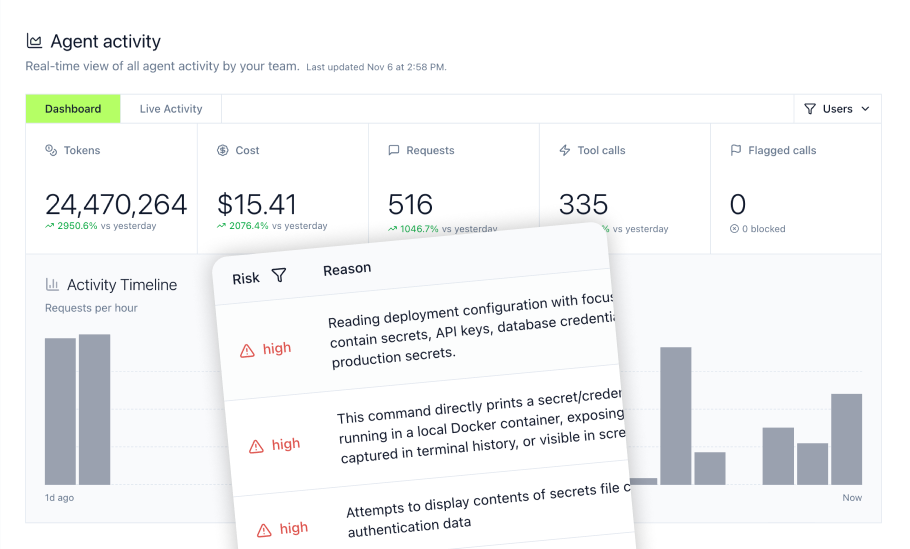
The Agent Monitor extends governance beyond MCP traffic to local agent activity. Through hooks in Claude Code and Cursor, organizations gain visibility into:
- Bash commands and file system operations
- PII exposure and credential leakage detection
- Prompt injection attempts
- Off-gateway MCP usage detection
This two-layer approach (Gateway for MCP traffic, Agent Monitor for local activity) provides comprehensive coverage that neither coding tool offers independently.
Agent Identities: Per-Agent Governance
Traditional AI tool deployment has agents operating under human OAuth credentials. This creates attribution problems and over-permissioned access. MintMCP's Agent Identities give each agent its own:
- Bearer API keys with independent rotation and revocation
- OAuth 2.0 client credentials separate from human users
- Scoped permissions based on agent function, not creator's access level
- Isolated audit trails for compliance investigations
Ensuring Compliance and Security with MintMCP for AI Agents
Pre-Execution Policy Enforcement
MintMCP adds vendor-neutral pre-execution policy enforcement for tool calls routed through its gateway using programmable middleware. Custom JavaScript policies can:
- Block operations that match risky patterns
- Mask sensitive data before it reaches AI models
- Route requests through external DLP systems (AWS Bedrock Guardrails, Google Cloud DLP, Microsoft Purview, Nightfall, Skyflow)
- Log detailed audit records for compliance review
Compliance Documentation
MintMCP is SOC 2 Type II audited, with continuous compliance monitoring. For organizations handling protected health information, MintMCP provides documentation for HIPAA compliance and signs BAAs. The platform's security posture includes:
- Data encryption in transit and at rest
- Data residency options for regional compliance requirements
- Penetration-tested infrastructure
- Uptime SLA for production reliability
Visit the Trust Center or contact security@mintmcp.com for compliance documentation.
Multi-Tool Visibility and Enforcement
GitLab's finding that 91% of surveyed organizations use multiple AI coding tools highlights the need for consistent visibility and governance across development environments. MintMCP's Agent Monitor detects off-gateway MCP usage in developer tools, giving security teams visibility into activity that bypasses governed gateway connections.
Choosing the Right AI Coding Tool for Your Team
The Claude Code vs Cursor decision depends on your team's workflow patterns, not objective superiority of either tool.
Choose Claude Code when:
- Your work involves large-scale refactoring across many files
- Developers prefer terminal-based workflows
- Tasks benefit from autonomous, multi-step execution
- You need extended context for codebase understanding
Choose Cursor when:
- Daily editing represents the primary use case
- Developers value visual diff review and inline suggestions
- Multi-model flexibility is important for different task types
Use both when:
- Your team performs both interactive editing and complex refactoring
- Different developers have different workflow preferences
- You want to match the right tool to each task type
Add MintMCP when:
- Your organization deploys AI coding tools across multiple teams or development environments
- Compliance requirements mandate audit trails and access control
- You run multiple AI tools requiring unified governance
- Credential management creates security concerns
- MCP server connections need centralized policy enforcement
Why MintMCP is the Unified Governance Layer for AI Coding at Scale
As AI coding tools proliferate across development teams, the challenge shifts from choosing the right assistant to governing all of them consistently. Organizations that deploy Claude Code, Cursor, or both face fragmented administrative controls, scattered credentials, and separate audit logs that create compliance blind spots.
MintMCP solves this by providing a vendor-neutral governance platform that sits between your developers' AI tools and your enterprise systems. Rather than forcing tool standardization, which often drives shadow AI adoption, MintMCP lets developers use their preferred coding assistants while maintaining unified authentication, policy enforcement, and observability.
The MCP Gateway centralizes all MCP server connections, whether they originate from Claude Code, Cursor, ChatGPT, or other tools. SSO integration through Okta, Azure AD, or Google Workspace ensures that access follows your existing identity infrastructure. OAuth brokering eliminates credential sprawl by managing tokens centrally rather than on individual developer machines. Per-agent identities provide granular permission scoping, so agents operate with appropriate access rather than inheriting their creator's full privileges.
The Agent Monitor extends visibility beyond MCP traffic to local agent activity, detecting bash commands, file operations, PII exposure, and off-gateway usage that would otherwise bypass governance controls. Pre-execution policy middleware written in JavaScript evaluates every tool call before it executes, blocking risky operations, masking sensitive data, and routing requests through external DLP systems when required.
For organizations facing fragmented governance across multiple AI coding tools, MintMCP provides the infrastructure layer for secure, controlled deployment at scale. Whether your team standardizes on one tool or runs multiple assistants in parallel, MintMCP ensures consistent security posture across all of them.
Frequently Asked Questions
Can I use Claude Code and Cursor together in the same development environment?
Yes. Many developers maintain both tools for different tasks. Claude Code operates through the terminal while Cursor functions as a standalone IDE, so they do not conflict. For individual users, Claude Pro and Cursor Pro start at a combined $40/month. Organizations should compare team pricing, usage limits, and administrative requirements before adopting both.
How do MCP servers work with Claude Code and Cursor, and why does this matter for security?
Both Claude Code and Cursor can connect to MCP servers that provide access to databases, APIs, file systems, and other tools. Without governance, developers can connect to any MCP server, potentially exposing sensitive data or credentials. Organizations deploying these tools at scale need an MCP Gateway to enforce authentication, access policies, and audit requirements across all MCP connections.
What happens to our governance if Anthropic or Cursor changes their enterprise features?
Vendor dependency represents a real risk. Enterprise features, pricing, and policies can change with little notice. Organizations relying solely on built-in governance from Claude Code or Cursor have limited recourse if those features change. Using an independent governance layer like MintMCP provides insurance against vendor changes. Your authentication, audit logs, and policy enforcement remain under your control regardless of what either AI coding tool vendor decides to modify.
How should we handle developers who prefer different AI coding tools?
Forcing standardization often reduces productivity and creates shadow AI problems as developers find workarounds. The better approach involves supporting multiple tools while implementing unified governance. Developers can use their preferred tool while the organization maintains centralized SSO, audit trails, and policy enforcement through an MCP Gateway. This balances developer autonomy with enterprise security requirements.
What are the data retention and privacy implications of using these AI coding tools?
Both Claude Code and Cursor offer privacy controls at enterprise tiers, including options to prevent code from being used for model training. However, data flows through vendor infrastructure regardless of training opt-outs. Organizations with strict data residency requirements or concerns about code exposure should evaluate what data reaches the AI provider, how long it persists, and what logging occurs. MintMCP's architecture can help by masking sensitive data before it reaches AI models and maintaining audit records under your control rather than vendor control.