Claude Cowork and Claude Code represent two distinct approaches to AI-assisted work from Anthropic, each with fundamentally different security architectures. While Cowork operates inside an isolated virtual machine on the user's computer, Claude Code runs more directly in the local development environment with broader access to the filesystem and shell. This architectural distinction creates security profiles that significantly impact enterprise risk, compliance capabilities, and deployment strategies. Organizations deploying these tools generally benefit from centralized governance—solutions like MCP Gateway can add authentication, audit logging, and policy enforcement that help enterprises deploy AI agents more safely at scale.
This article breaks down the security trade-offs between Claude Cowork and Claude Code, covering execution environments, access controls, compliance requirements, data integration, and monitoring strategies to help security teams make informed deployment decisions.
Key Takeaways
- Execution environment determines blast radius: Cowork's VM isolation limits damage to the sandbox; Code's native OS access means a compromise can affect the entire machine
- Critical compliance gap exists: Cowork activity is excluded from Audit Logs, Compliance API, and Data Exports across all plan tiers, which makes it a poor fit for regulated or audit-heavy workflows unless organizations accept that visibility gap as residual risk
- Prompt injection is actively exploitable: Security researchers demonstrated file exfiltration attacks using hidden instructions embedded in documents
- Sandbox mode reduces friction: Claude Code's sandboxing reduced permission prompts by 84% in Anthropic's internal usage while preserving stronger execution boundaries
- Supply chain attacks are real: CVE-2025-59536 (CVSS 8.8) was a Claude Code trust-dialog vulnerability that could allow code in an untrusted project to run before the user accepted the prompt
- Enterprise deployments can realize meaningful productivity gains when properly configured, but outcomes depend on workflow design, governance, and how broadly teams adopt the tools
- Three security postures guide deployment: Lockdown, Controlled, and Open—choose based on risk tolerance, not feature preferences
Understanding the Enterprise AI Landscape: Claude Cowork and Claude Code
The fundamental difference between Cowork and Code isn't about features—it's about where the AI executes tasks. Cowork runs inside a protected virtual machine, creating a containment boundary that limits what can go wrong. Code operates directly in your terminal with the same permissions as the developer running it.
What each tool does
- Claude Cowork: Executes tasks in an isolated VM with user-approved local file access, scheduled tasks, browser automation via the Claude in Chrome extension, and organization controls over approved plugins and connectors
- Claude Code: Operates natively on Mac, Windows, or Linux with full filesystem access, direct terminal integration, unrestricted development tools, and comprehensive IDE integration
Why the architecture matters
When Cowork encounters a malicious instruction, the blast radius is limited to the VM. When Code executes the same attack, it has access to your entire machine—SSH keys, environment variables, production credentials, and anything else the user can touch. This isn't a theoretical concern: security researchers have demonstrated real file exfiltration attacks that work against production deployments.
As shadow AI adoption continues to expand inside enterprises, choosing the right tool—and implementing proper governance—becomes critical to maintaining security without blocking productivity.
The Security Imperative for General AI Use Cases with Claude Cowork
Cowork's sandboxed architecture makes it attractive for non-technical users who need AI assistance without developer expertise. HR teams building knowledge bases, finance teams automating reports, and support teams searching ticket histories all benefit from AI capabilities without requiring the full power of native system access.
Key security properties
- User-approved local file access: Cowork operates with controlled access to local files inside its VM environment, helping organizations apply least-privilege principles
- Conservative permission model: Human-in-the-loop approvals prevent automated execution of sensitive operations
- IT governance over integrations: Organizations can limit which connectors and integrations are approved for use, reducing unnecessary exposure
- Easier security review: IT departments can approve Cowork faster than full-access coding tools
Critical limitation—browser automation risk
Cowork's Chrome extension creates the highest-risk attack surface. Anthropic testing shows approximately 1% prompt injection rate even after mitigations. Healthcare portals, HR systems, and cloud consoles are not blocked by default—organizations must build comprehensive blocklists before enabling browser automation.
Organizations deploying Cowork for data analysis or customer support workflows should consider implementing centralized authentication through an MCP Gateway to maintain visibility and control across all AI tool interactions.
Navigating the High-Stakes Security of Claude Code and Coding Agents
Claude Code provides the power developers need—full terminal capabilities, unrestricted tool access, and seamless IDE integration. That power comes with proportionally higher risk. Coding agents operate with extensive system access—reading files, executing commands, and accessing production systems through MCP tools.
Specific risks coding agents introduce
- Credential exposure: Access to
.envfiles,~/.ssh/directories, and secrets stored in configuration - Supply chain attacks: CVE-2025-59536 (CVSS 8.8) allowed code in an untrusted Claude Code project to run before the trust prompt, and CVE-2026-21852 (CVSS 5.3) allowed malicious repositories to potentially exfiltrate Anthropic API keys before users confirmed trust
- Permission bypass: Developers can use the
--dangerously-skip-permissionsflag to override safety controls - Data exfiltration: The Anthropic API domain is allowlisted in network egress controls, creating a file upload vector
Protecting sensitive files and blocking dangerous commands
Effective Code deployment requires defense-in-depth:
- Deploy managed-settings.json via MDM to enforce organizational policies and disable permission bypass
- Use sandbox mode: The
/sandboxThe /sandbox command provides OS-level isolation and, in Anthropic's internal usage, reduced permission prompts by 84% - Implement deny rules for
.env,~/.ssh/, and secrets directories - Monitor with OpenTelemetry for unusual file access or network activity
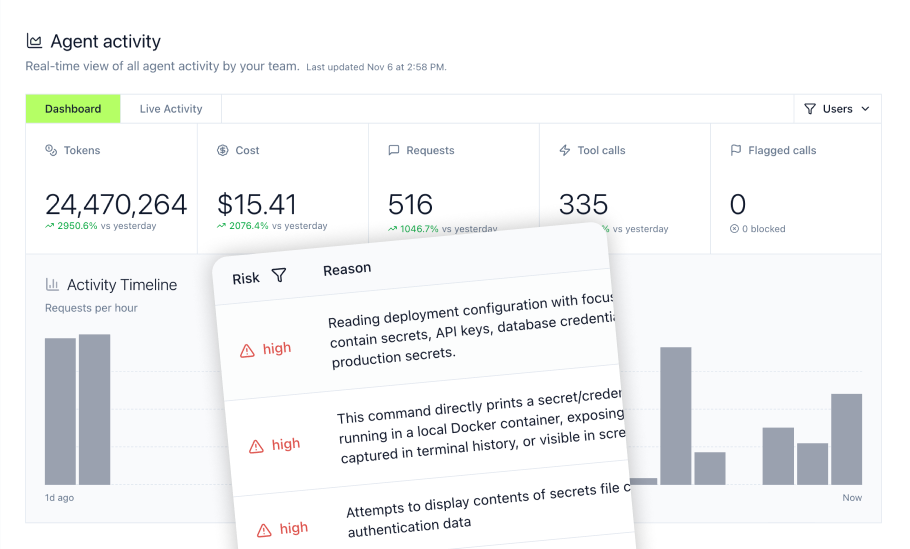
The LLM Proxy addresses these challenges by monitoring every tool invocation, bash command, and file operation in real-time—blocking risky actions like reading environment secrets before they execute.
Establishing Robust Access Controls for Both Claude Environments
Enterprise authentication isn't optional for either tool. Both Cowork and Code support SAML 2.0 and OIDC for SSO integration, but the controls available depend heavily on your subscription tier.
Authentication capabilities by tier
Pro/Max plans:
- SSO/SAML: No
- Tenant Restrictions: No
- SCIM Provisioning: No
Team plans:
- SSO/SAML: Yes
- Tenant Restrictions: No
- SCIM Provisioning: No
Enterprise plans:
- SSO/SAML: Yes
- Tenant Restrictions: Yes
- SCIM Provisioning: Yes
Tenant restrictions prevent shadow AI
Enterprise plans support Tenant Restrictions, which let administrators enforce network-level access control so users on corporate networks can only access approved organizational accounts. Without this control, developers can switch to personal Claude accounts and bypass all corporate policies.
Implementing unified authentication across AI tools
Organizations deploying multiple AI tools—Cowork, Code, ChatGPT, Cursor—need centralized authentication management. The MCP Gateway provides a centralized control plane for MCP servers, including authentication, access policy enforcement, and auditability across tools and environments, enabling:
- Role-based access control: Define who can use which AI tools and access what data
- Granular tool permissions: Configure tool access by role—enable read-only operations while excluding write tools
- Centralized credentials: Manage all AI tool API keys and tokens in one place
Ensuring Compliance and Auditability for Claude Cowork and Code Interactions
The most significant compliance distinction between Cowork and Code isn't advertised prominently: Cowork activity is excluded from Audit Logs, Compliance API, and Data Exports across all plan tiers.
What this means for regulated industries
- SOC 2 Type II: Cannot demonstrate complete audit trail for Cowork interactions
- HIPAA: Unable to prove what PHI the AI accessed or generated
- PCI-DSS: No evidence of cardholder data handling compliance
- SOX: Financial controls audits lack AI interaction records
Claude Code offers stronger native auditability than Cowork, but most enterprises still need centralized controls across tools and MCP servers
Enterprise plans provide stronger administrative and reporting capabilities for Claude Code than Cowork, which makes Code easier to fit into audit-heavy environments. Organizations can extract metadata on tool calls, file access, and command execution for security review.
Practical guidance
- Prohibit Cowork for regulated workloads until Anthropic closes the audit gap
- Document Cowork as residual risk in vendor risk registers
- Use Code with Enterprise Compliance API for compliance-critical development work
- Add centralized audit and policy controls through MCP Gateway to improve visibility across MCP-mediated actions and support enterprise governance requirements
Integrating Claude with Enterprise Data: Security Best Practices
Connecting AI tools to internal databases, search systems, and APIs multiplies both value and risk. Model Context Protocol (MCP) enables these integrations, but each connection requires careful security consideration.
MCP risk profiles differ by tool
- Cowork MCP servers run inside the VM sandbox with limited system access
- Code MCP servers run with the developer's full native permissions—a malicious server can compromise the entire development environment
Securing Snowflake and Elasticsearch connections
When connecting AI agents to sensitive data sources, use purpose-built connectors with security controls:
For data warehouse access: The Snowflake MCP Server enables AI-driven analytics with natural language queries while maintaining security through:
- Scoped credentials limiting database/schema access
- Query auditing for compliance trails
- Semantic view tools that abstract underlying data structures
For search and knowledge bases: The Elasticsearch MCP Server allows AI-powered knowledge base search with:
- Index-level access controls
- Query DSL restrictions preventing broad data exposure
- Audit logging of all search operations
Integration security principles
- Maintain an allowlist of approved MCP servers
- Review source code before deploying third-party connectors
- Use scoped credentials—never grant broader access than necessary
- Audit connector usage through centralized security monitoring
Monitoring and Observability: Real-Time Security for Claude AI Usage
Without monitoring, organizations cannot see what AI agents access or control their actions. OpenTelemetry provides the foundation for observability, but raw metrics require infrastructure to become actionable intelligence.
What to monitor
- Token usage and cost: Track spending per team, project, and tool
- Tool invocations: Which MCP tools are called, how often, by whom
- File access patterns: Detect unusual access to sensitive directories
- Command execution: Log all bash commands for security review
- Off-hours activity: Alert on usage outside expected patterns
Tracking tool calls and detecting suspicious activity
Effective monitoring requires both collection and analysis:
Collection infrastructure:
- Enable OpenTelemetry and route to your SIEM (Splunk, Datadog, CloudWatch)
- Create dashboards for tool calls, connector activity, and error rates
- Configure alerts for permission denials and policy violations
Analysis capabilities: The LLM Proxy provides:
- Complete visibility into installed MCPs and their usage
- Real-time blocking of dangerous commands
- Complete audit trail of all operations for forensic analysis
- Sensitive file protection preventing access to credentials and keys
Organizations deploying both Cowork and Code benefit from unified monitoring through an MCP Gateway, which provides live dashboards for server health, usage patterns, and security alerts across all AI tool connections.
Preventing Shadow AI: Leveraging Gateways for Sanctioned Use
Shadow AI—employees using personal accounts or unapproved tools—creates material risk. You cannot secure what you cannot see, and the spread of unsanctioned AI usage increases as tools become more capable and easier to access.
Why shadow AI happens
- Corporate controls are too restrictive, blocking legitimate use
- Approved tools lack features employees need
- Deployment takes too long—developers find workarounds
- No visibility means no consequences
How gateways enable sanctioned use
Rather than blocking AI tools entirely, gateways provide the security layer that makes enterprise deployment possible:
- Rapid deployment: Deploy MCP servers with pre-configured policies
- Self-service access: Developers request and receive AI tool access instantly
- Policy enforcement: Automatically enforce data access and usage policies
- Cost attribution: Track usage by team and project for budget management
Transforming ad-hoc AI use into secure enterprise deployments
The MCP Gateway transforms local MCP servers into production-ready services with:
- One-click deployment for STDIO-based MCP servers with built-in hosting
- OAuth protection adding SSO and enterprise authentication automatically
- Real-time monitoring for usage patterns and anomaly detection
- Enterprise hardening with high availability and security compliance
Organizations using MintMCP report significantly faster time-to-value—deploying in days rather than months while maintaining security controls that satisfy compliance requirements.
Deploying Claude Tools Securely with MintMCP Gateway
The security differences between Claude Cowork and Claude Code create distinct deployment challenges, but both tools share a common need: centralized governance over how AI agents access enterprise data and systems. MintMCP Gateway addresses this requirement by providing a unified control plane for all MCP-mediated interactions—whether Cowork users are connecting to internal knowledge bases or Code developers are querying production databases.
Unlike point solutions that secure individual tools or connectors, MCP Gateway treats AI agent security as an infrastructure concern. Organizations gain centralized visibility into MCP-mediated tool usage, connector activity, and policy events across both Cowork and Code deployments through a single monitoring dashboard. Authentication integrates with existing identity providers via OAuth 2.0 and SAML, ensuring developers and business users alike authenticate once while MintMCP enforces role-based access policies behind the scenes.
The platform's approach to MCP server deployment reduces the friction that often drives shadow AI adoption. Security teams define which connectors are approved—Snowflake, Elasticsearch, GitHub, or custom internal tools—and developers can gain approved access through a more streamlined security workflow. Policy enforcement happens automatically: deny rules prevent access to credential files, audit logs capture every interaction for compliance reporting, and cost attribution tracks spending by team and project.
For organizations deploying Claude tools at scale, MintMCP Gateway transforms AI agent security from a deployment blocker into a competitive advantage. The LLM Proxy component provides deep inspection of tool calls and commands, blocking risky operations before they execute while maintaining the developer experience that makes AI tools productive. This balance—security that enables rather than restricts—is what separates successful enterprise AI deployments from pilots that never escape IT review.
Frequently Asked Questions
What hardware requirements does Claude Cowork's VM architecture introduce?
Because Cowork runs inside a VM on the user’s computer, organizations should validate endpoint performance and resource usage during pilot deployments before broad rollout. Code runs natively without this overhead, making it more suitable for performance-constrained environments.
How should organizations handle the transition from "Open" to "Controlled" security posture?
Start by auditing current usage via OpenTelemetry to understand which commands are frequently approved and which files are accessed. Design managed-settings.json configurations that balance security with productivity based on actual usage patterns. Deploy to a 5-10 person pilot first, collect feedback on permission friction, then iterate before organization-wide rollout.
Can enterprises use both Cowork and Code simultaneously for different user populations?
Yes, hybrid deployment is often the optimal strategy. Deploy Cowork for general knowledge workers, business analysts, and non-technical staff who benefit from AI assistance without needing full system access. Deploy Code for developers and engineers who require terminal capabilities and IDE integration. Use an LLM Gateway for unified monitoring across both tools to maintain consistent visibility and policy enforcement.
What specific network controls prevent the data exfiltration attack demonstrated by PromptArmor?
The file exfiltration attack exploited the fact that the Anthropic API domain is allowlisted in network egress controls. Defense requires stronger network isolation, explicit restrictions on outbound transfer tools, and human-in-the-loop approval for operations that can move data outside approved boundaries.
How do MCP supply chain vulnerabilities affect deployment decisions?
Recent CVEs demonstrate that untrusted Claude Code projects and malicious repository configuration can trigger code execution or API-key leakage before users confirm trust. Organizations must maintain an allowlist of approved MCP servers, enable private plugin marketplaces (Enterprise plan), deploy managed-mcp.json via MDM to prevent user-added servers, and keep Claude Desktop updated. Treat MCP servers like software dependencies requiring security review before deployment.