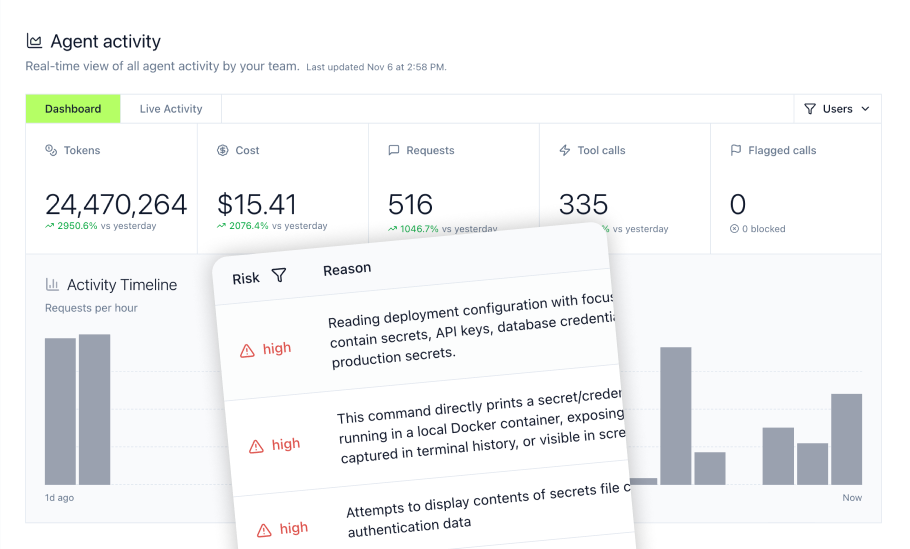
Every Claude Code session without proper sandboxing exposes your organization to data exfiltration, unauthorized system access, and compliance violations. AI coding agents operate with extensive permissions—reading files, executing bash commands, and accessing production systems through MCP tools. Without isolation, organizations have far less control over what these agents can access and a weaker ability to contain malicious or unintended actions. The solution isn't avoiding autonomous coding agents entirely—it's deploying them within proper security boundaries and pairing that isolation with governance, auditability, and policy enforcement across every tool interaction. Enterprise teams that need visibility into agent behavior can use solutions like MintMCP's Agent Monitoring to monitor every tool invocation and block dangerous commands in real-time.
Key Takeaways
- Enabling Claude's built-in sandbox delivers an 84% reduction in permission prompts while maintaining developer productivity
- Docker Sandboxes now provide microVM-based isolation with relatively low operational overhead, giving teams a stronger boundary than standard shared-kernel container models
- Virtual machines offer stronger isolation boundaries that many regulated teams prefer for higher-assurance deployments, especially when handling sensitive healthcare or payment data
- Claude's native sandbox includes an unsandboxed-command escape hatch, so organizations that need hard enforcement should treat external isolation and managed policy controls as the primary boundary
- Proper sandboxing materially reduces execution risk by limiting filesystem and network access, containing prompt-injection fallout, and making agent behavior easier to review
- Enterprise buyers typically review Anthropic's SOC 2 materials during security diligence through its Trust Portal
Understanding the Need for Sandboxing Claude Code in Enterprise AI
Claude Code runs as an autonomous agent directly in developer terminals with the same permissions as the user. Unlike IDE copilots that suggest code snippets, Claude Code can:
- Read any file the developer can access
- Execute arbitrary bash commands
- Modify entire project structures
- Connect to external services through MCP servers
- Access credentials, SSH keys, and environment variables
This capability creates genuine security risks. A compromised prompt or malicious instruction could direct Claude Code to exfiltrate sensitive data, delete production configurations, or install backdoors—all actions invisible without proper monitoring.
The Rise of Shadow AI in Development Teams
Development teams adopting AI coding agents without IT oversight create shadow AI environments. Developers install Claude Code locally, connect it to production systems, and operate without audit trails or access controls. This pattern mirrors shadow IT challenges organizations faced a decade ago—but with significantly higher risk.
Sandboxing addresses these concerns by creating controlled boundaries around agent execution. The agent can still perform useful work, but within explicit constraints that prevent unauthorized access or dangerous operations.
Balancing Developer Productivity with Security
The core challenge isn't blocking Claude Code entirely—it's enabling its productivity benefits while managing risk. Overly restrictive policies frustrate developers and drive adoption underground. The goal is implementing security controls that operate transparently, allowing developers to work efficiently while protecting organizational assets.
Leveraging Docker for Container Security in Claude Deployments
Docker Sandboxes isolate Claude Code inside a lightweight microVM with its own private Docker daemon, reducing host exposure while still giving the agent a usable development environment. This approach provides stronger security boundaries than standard shared-kernel containers.
Why Docker Sandboxes Work for AI Agent Isolation
Docker's sandbox architecture provides several security advantages for AI agents:
- MicroVM isolation: Separate lightweight virtual machines prevent direct host kernel access
- Private Docker daemon: Each sandbox runs its own isolated container runtime
- Filesystem separation: Agents access only explicitly mounted directories
- Network controls: Sandboxes can run with no network access or restricted egress
- Resource limits: CPU, memory, and I/O constraints prevent resource exhaustion attacks
- Reproducibility: Identical environments across development, testing, and production
Setting Up Docker for Claude Code
Docker now provides official sandbox templates for Claude Code deployment. The basic setup requires:
Step 1: Pull the Official Template
docker sandbox run claude ~/project
This single command creates an isolated sandbox with Claude Code pre-installed, mounting only your project directory.
Step 2: Configure Network Restrictions
For selective network access, configure an allowlist proxy through the sandbox settings.
Step 3: Run with External Permission Enforcement
With external isolation in place, teams may choose to relax some in-tool approvals, but that should be treated as an explicit policy decision rather than a default assumption.
Docker Container Security Best Practices
When deploying Claude Code in sandboxes, follow these runtime security principles:
- Use minimal base images: Reduce attack surface by excluding unnecessary packages
- Run as non-root: Configure sandboxes to execute as unprivileged users
- Enable read-only filesystems: Mount project directories read-only where possible
- Implement resource quotas: Prevent denial-of-service through resource exhaustion
- Scan images regularly: Use tools like Docker Scout to identify vulnerabilities
Implementing Virtual Machines for Robust Claude Code Sandboxing
Virtual machines provide the strongest isolation guarantees through complete hardware-level separation. Unlike containers that share the host kernel, VMs run independent operating systems with their own kernel, memory space, and device drivers.
When VMs Are Necessary
Choose virtual machine isolation when:
- Processing PHI (Protected Health Information) in environments that require higher-assurance isolation and documented HIPAA safeguards
- Handling PCI cardholder data
- Operating in regulated industries with strict data handling requirements
- Requiring defense-in-depth with multiple isolation layers
- Needing complete network isolation from corporate infrastructure
VM vs. Container: Trade-offs
Docker Sandbox characteristics:
- Lower resource overhead (microVM vs full OS)
- Faster boot times (seconds vs minutes)
- Process and microVM-level isolation
- Minimal ongoing costs
- Straightforward operational setup
Virtual Machine characteristics:
- Higher resource overhead (full OS per instance)
- Longer boot times (minutes)
- Hardware-level hypervisor isolation
- Higher costs ($50-500/month for cloud VMs)
- Strongest security guarantees for regulated workloads
Deploying Claude in Virtual Machine Environments
For cloud deployments, AWS offers private connectivity patterns for Bedrock through VPC endpoints and PrivateLink, which can help organizations keep model traffic off the public internet and align deployments with internal network controls. This approach requires:
- Provision isolated VPC: Configure security groups blocking all non-essential traffic
- Set up IAM federation: Integrate with corporate identity providers
- Install Claude Code: Deploy via SSH into the isolated VM
- Configure egress controls: Allowlist only required external services
Lightweight alternatives like Firecracker microVMs reduce overhead while maintaining strong isolation boundaries.
Essential Container Security Tools and Strategies for AI Agents
Container security extends beyond basic isolation to include runtime protection, vulnerability scanning, and network segmentation. Effective Claude Code deployments layer multiple security controls.
Runtime Protection for Coding Agents
Runtime security monitors container behavior and blocks anomalous actions:
- System call filtering: Tools like seccomp restrict which kernel calls containers can make
- File integrity monitoring: Detect unauthorized modifications to critical files
- Process monitoring: Alert on unexpected process spawns or privilege escalation attempts
- Network analysis: Identify suspicious outbound connections or data exfiltration patterns
MintMCP's LLM Proxy provides runtime protection specifically designed for AI agents—tracking every tool call, blocking dangerous commands, and maintaining audit trails of all operations.
Image Security and Vulnerability Scanning
Before deploying Claude Code containers, scan base images for known vulnerabilities:
- Use Docker Scout or equivalent tools to identify CVEs
- Implement admission controls preventing deployment of unscanned images
- Maintain a curated registry of approved base images
- Automate scanning in CI/CD pipelines
Network Segmentation Strategies
Isolate AI agent networks from production systems:
- Deploy Claude Code containers in dedicated subnets
- Implement allowlist-only egress rules
- Use service mesh for encrypted inter-service communication
- Monitor east-west traffic for anomalous patterns
Protecting Sensitive Data: Data Security in Sandboxed Claude Environments
Sandboxing addresses execution isolation, but data security requires additional controls. Claude Code processes sensitive information—source code, credentials, customer data—that demands explicit protection.
Preventing Access to Sensitive Files
Configure sandbox policies to block access to:
- Environment files:
.env,.env.local, and configuration files containing secrets - SSH keys:
~/.ssh/directory and private key files - Cloud credentials: AWS credentials, GCP service accounts, Azure tokens
- Git credentials:
.gitconfigand credential helpers - Password stores: KeePass databases, 1Password vaults
Anthropic supports managed settings for organization-wide policies that users cannot override, including server-managed settings, MDM/OS-level policies, and file-based managed settings:
{

  "sandbox": {

    "filesystem": {

      "denyRead": ["~/.ssh", "~/.aws", ".env*"]

    }

  }

}
Encryption and Data Residency
For enterprise deployments, configure:
- Encryption in transit: TLS for all API communications
- Encryption at rest: Confirm storage, retention, and encryption behavior for your specific deployment model during vendor security review
- Data residency: Use regional deployments to meet GDPR or other geographic requirements
- Retention policies: API-based deployments allow configuring data retention windows
Implementing Least Privilege Access
Apply least privilege principles to Claude Code deployments:
- Mount only necessary project directories (not entire home folders)
- Use read-only mounts where write access isn't required
- Create dedicated service accounts with scoped permissions
- Rotate credentials regularly and audit access patterns
Beyond VMs and Containers: Advanced Sandboxing Techniques
Claude's built-in sandboxing uses OS-level isolation primitives—Linux bubblewrap and macOS seatbelt—to restrict agent capabilities without container overhead.
Claude's Native Sandbox Architecture
When enabled via the /sandbox command, Claude's internal sandbox:
- Restricts filesystem access to explicitly allowed paths
- Blocks network requests to non-allowlisted domains
- Limits command execution to approved binaries
- Reduces permission prompts by 84%
Configuration happens through ~/.claude/settings.json:
{

  "sandbox": {

    "filesystem": {

      "allowWrite": ["/tmp/build", "~/.kube"]

    },

    "network": {

      "allowedDomains": ["github.com", "npmjs.com"]

    }

  }

}
The Critical Limitation: Self-Disabling
Claude's native sandbox includes an unsandboxed-command escape hatch, so organizations that need hard enforcement should treat external isolation and managed policy controls as the primary boundary—so external enforcement is still important for production use.
Mitigation approaches:
- Use Docker or VM isolation as the primary control; Claude's sandbox as defense-in-depth
- Deploy organization-managed settings that Claude cannot modify
- Monitor for sandbox disable events through audit logging
Zero-Trust Architecture for AI Agents
Building zero-trust models for Claude Code requires:
- Verify explicitly: Authenticate every MCP server connection
- Least privilege access: Grant minimum permissions for specific tasks
- Assume breach: Design systems assuming the agent could be compromised
- Segment networks: Isolate AI agent traffic from production systems
- Monitor continuously: Track all tool calls and command executions
Achieving Compliance: SOC 2, HIPAA, and GDPR with Sandboxed Claude Code
Regulated enterprises require compliance assurance before deploying AI coding agents. Sandboxing enables meeting audit requirements while enabling AI-assisted development.
SOC 2 Requirements for AI Workloads
SOC 2 compliance for Claude Code deployments requires:
- Access controls: Documented policies for who can use Claude Code and with what permissions
- Audit logging: Complete trails of all commands, file access, and tool invocations
- Change management: Procedures for updating sandbox configurations
- Incident response: Plans for responding to security events involving AI agents
Enterprise buyers typically review Anthropic's SOC 2 materials during security diligence; Anthropic publicly states it maintains SOC 2 Type I and Type II and provides compliance documentation through its Trust Portal. MintMCP is SOC 2 Type II compliant and provides the operational governance layer—authentication, auditability, and policy enforcement around MCP access and tool execution—that many organizations still need even after model-provider diligence is complete.
HIPAA Compliance Considerations
Healthcare organizations handling PHI must follow HIPAA security requirements including:
- Deploy Claude Code in VPC-isolated environments
- Evaluate Zero Data Retention where appropriate; for Claude Code, Anthropic documents ZDR availability on Claude for Enterprise, enabled per organization through Anthropic
- Implement BAA (Business Associate Agreement) with Anthropic
- Document data flows showing PHI handling controls
- Maintain retention policies that align with your regulatory obligations, including HIPAA documentation-retention requirements where applicable
GDPR and Data Privacy Requirements
European deployments require:
- Regional deployment choices and provider-specific data handling controls, including EU-region options where required by policy
- Clear data processing documentation
- Right to erasure procedures for any user data processed
- Privacy impact assessments for AI coding agent deployments
Monitoring and Auditing Sandboxed Claude Code for Continuous Security
Effective sandboxing requires ongoing monitoring—not just initial configuration. Security posture degrades without continuous verification.
Real-Time Monitoring Capabilities
Production Claude Code deployments need visibility into:
- Every MCP tool invocation and response
- All bash commands executed and their outputs
- File read/write operations and targets
- Network requests and responses
- Permission prompt outcomes
The LLM Proxy approach sits between the AI client and model, forwarding and monitoring all requests. This provides complete visibility without modifying developer workflows.
Analyzing Audit Logs for Security Events
Structure audit review processes to detect:
- Anomalous access patterns: Unusual file access or command sequences
- Policy violations: Attempts to access denied paths or domains
- Sandbox bypass attempts: Events indicating the agent tried to disable restrictions
- Data exfiltration indicators: Large data transfers or connections to unexpected endpoints
Establishing Incident Response Procedures
Document procedures for:
- Detection: How security events are identified (automated alerts, log review)
- Containment: Immediately revoking Claude Code access and isolating affected systems
- Investigation: Determining scope through audit log analysis
- Remediation: Fixing vulnerabilities and updating sandbox policies
- Post-incident: Documenting lessons learned and updating procedures
How MintMCP Enables Production-Ready Claude Code Governance
Sandboxing Claude Code with Docker or VMs addresses execution isolation, but enterprise deployments require centralized governance, real-time monitoring, and complete auditability across every AI tool interaction. MintMCP provides the governance layer that turns isolated Claude Code sessions into centrally managed, enterprise-auditable agent infrastructure.
While Docker Sandboxes and VMs prevent agents from accessing unauthorized host resources, they don't inherently log what the agent does inside that boundary, enforce business policies on tool usage, or provide centralized control across multiple developers and teams. MintMCP fills that gap by sitting between your AI clients and MCP servers—intercepting, inspecting, and controlling every tool call before it executes.
For production Claude Code deployments, MintMCP delivers:
- Complete audit trails: Track tool calls, command execution, and agent activity across coding workflows—critical for SOC 2 evidence collection, GDPR accountability, and HIPAA-compliant audit workflows
- Real-time security guardrails: Block dangerous commands before execution, protect sensitive files from access, and enforce MCP permissions organization-wide
- Centralized governance: Unified authentication, policy enforcement, and access control for all MCP connections—not just individual sandboxed sessions
- Sensitive file protection: Prevent access to
.envfiles, SSH keys, credentials, and configuration files across every developer environment
Unlike Claude's built-in sandbox that includes an escape hatch, MintMCP's LLM Proxy operates externally—providing enforcement the AI cannot circumvent. Organizations deploying Claude Code at scale benefit from pairing sandbox isolation with MintMCP's governance: maintain developer velocity while ensuring every AI agent interaction is logged, controlled, and auditable. Contact our team to see how MintMCP governance works with your existing Claude Code deployments.
Frequently Asked Questions
What are the primary benefits of sandboxing Claude Code?
Sandboxing provides three core benefits: security isolation, compliance enablement, and operational safety. Security isolation prevents Claude Code from accessing files, networks, or systems outside explicit boundaries—blocking data exfiltration and unauthorized access. Compliance enablement creates the audit trails and access controls required for SOC 2, HIPAA, and GDPR requirements. Operational safety prevents accidental damage from misconfigured prompts or agent errors—a sandboxed agent that receives a destructive command cannot execute it against production systems. Organizations report materially improved security postures when using proper sandboxing.
How do Docker Sandboxes differ from Virtual Machines for sandboxing AI agents?
Docker Sandboxes and virtual machines provide different isolation levels with corresponding trade-offs. Docker Sandboxes use lightweight microVMs with private Docker daemons, providing strong isolation with relatively low operational overhead. VMs run complete guest operating systems with independent kernels, providing hardware-level isolation through hypervisors. This stronger isolation requires longer setup time, minutes for boot, and higher ongoing costs ($50-500/month for cloud VMs). Choose Docker Sandboxes for most development workloads; reserve VMs for regulated industries processing PHI or PCI data where maximum isolation is required.
Can MintMCP solutions help with sandboxing Claude Code for compliance?
MintMCP provides the governance layer that turns isolated Claude Code sessions into centrally managed, enterprise-auditable agent infrastructure. While Docker or VMs provide execution isolation, MintMCP adds complete audit trails of every AI tool interaction, real-time monitoring of agent behavior, and centralized policy enforcement. For compliance specifically, MintMCP produces audit-ready records that support SOC 2 evidence collection, GDPR accountability, and HIPAA-compliant review workflows. The LLM Proxy operates externally to Claude Code, providing enforcement the agent cannot disable.
What happens if Claude Code tries to disable its own sandbox?
Claude's native sandbox includes an unsandboxed-command escape hatch that allows the agent to run commands outside sandbox restrictions if it determines the sandbox interferes with legitimate operations. This represents a fundamental limitation of self-enforced security controls. Mitigation requires external enforcement—Docker Sandboxes, VMs, or gateway-based monitoring that operates independently of Claude's internal systems. The most robust approach layers external isolation (Docker/VM) as the primary control with Claude's sandbox providing defense-in-depth. Monitor for sandbox disable events through audit logging to detect when the agent attempts to modify its own restrictions.
Is it possible to integrate sandboxed Claude Code with existing enterprise systems?
Sandboxed Claude Code integrates with enterprise systems through carefully controlled MCP (Model Context Protocol) servers. Rather than granting Claude direct access to databases, APIs, or production systems, MCP servers provide mediated access with built-in authentication and logging. For example, a database MCP connector allows Claude to query data without direct database credentials—the MCP server handles authentication and enforces access policies. This architecture enables useful integrations while maintaining security boundaries. MCP Gateway helps organizations centralize authentication, access control, and auditability around Claude Code integrations and MCP connectivity.