Claude Cowork transforms Anthropic's Claude AI from a conversational chatbot into an autonomous desktop agent capable of reading and writing files, executing commands, browsing the web, and running scheduled tasks on employee machines. Unlike traditional AI assistants that provide advice, Cowork takes direct action—making it powerful but introducing enterprise-grade security risks that demand comprehensive governance frameworks. Organizations deploying Claude Cowork without proper controls face data exfiltration, compliance failures, and operational security gaps that an MCP Gateway can address through centralized authentication, audit logging, and real-time monitoring.
This article outlines enterprise risks, documented vulnerabilities, and security best practices for Claude Cowork deployments, covering implementation frameworks, compliance requirements, and governance strategies to protect sensitive data while enabling productivity gains.
Key Takeaways
- Cowork activity is excluded from Anthropic audit logs, Compliance API, and data exports: Anthropic explicitly says Cowork should not be used for regulated workloads because these audit and export capabilities do not currently capture Cowork activity
- Published security research demonstrates real attack vectors for agentic AI: Vulnerabilities in adjacent products like Claude Code reveal risks including remote code execution via malicious config files and API key exfiltration
- Prompt injection risk remains non-zero even with Anthropic's mitigations—which means enterprises should assume successful attacks are possible and deploy compensating controls accordingly
- Team or Enterprise is required for meaningful governance: Pro and Max include Cowork but lack organization-level admin controls, while Team and Enterprise add centralized administration, plugin governance, and connector controls
- Three security tiers exist: Lockdown (Cowork disabled), Controlled (org-vetted plugins only), and Open (user discretion)—most enterprises should target Controlled
- OpenTelemetry provides operational visibility into Cowork usage, costs, and tool activity, but Anthropic explicitly states it does not replace audit logging for compliance purposes
Understanding Claude's Role in Enterprise AI Workflows
Claude Cowork operates as an agentic AI assistant with direct filesystem access, command execution capabilities, and browser automation through the Claude in Chrome extension. It connects to enterprise tools through Model Context Protocol (MCP) servers, enabling integration with Slack, Gmail, Google Drive, Notion, and databases like Elasticsearch and Snowflake.
The agent can autonomously execute multi-step workflows including file organization, document generation, research synthesis, and scheduled recurring tasks—all running locally on user machines with the same permissions as the logged-in user.
Key capabilities that introduce risk:
- Local file system access (read/write/delete with user permission)
- Scheduled task automation running unattended
- Browser automation through Claude in Chrome extension
- MCP server connections to internal data sources
- Parallel sub-agent execution for complex multi-step tasks
- Plugin/Skills marketplace for extending capabilities
Enterprise adoption requires understanding that Cowork operates with system access—reading files, executing commands, and accessing production systems through MCP tools. Without monitoring, organizations cannot see what agents access or control their actions.
Identifying Enterprise Risks with Unsecured Claude Deployments
Organizations deploying Claude Cowork face several categories of risk when proper security controls are absent.
Data Privacy and Confidentiality Concerns
Claude Cowork can access any file the logged-in user can access. Without restrictions, this means:
- Sensitive credentials in .env files and SSH keys
- Customer data in local databases and exports
- Intellectual property in code repositories
- Financial documents and contracts
Security research has demonstrated that attackers can exfiltrate files without stealing credentials—they simply provide their own API key within a prompt injection, causing Claude to upload victim files to the attacker's Anthropic account.
Compliance and Regulatory Violations
Cowork creates critical compliance gaps for regulated industries. Anthropic explicitly states that Cowork activity is not captured in Audit Logs, the Compliance API, or Data Exports, which means:
- SOC 2 Type II: Cowork excluded from audit logs—OpenTelemetry required as compensating control
- HIPAA: No PHI audit trail; Zero-Data-Retention requires separate addendum
- PCI-DSS: No audit trail for cardholder data access
- FedRAMP: Anthropic Claude not FedRAMP authorized
Organizations subject to regulatory audit requirements should prohibit Cowork for regulated workloads until Anthropic confirms audit coverage.
Operational Security Gaps
Shadow AI grows when users bypass organizational controls. Without Enterprise tenant restrictions, organizations have less control over ensuring employees access Claude through approved organizational accounts and policies. This requires TLS inspection capability that many organizations lack.
Addressing Key Vulnerabilities in Claude Cowork Environments
Documented Vulnerabilities
Published research documents critical vulnerabilities in Claude Code—Anthropic's separate coding assistant product—that demonstrate attack patterns relevant to Cowork's local agent architecture:
CVE-2025-59536 (CVSS 8.7): Remote code execution via malicious .claude/settings.json in cloned repositories. Attackers could place malicious config files in GitHub repos that execute arbitrary code before users see the trust dialog. This vulnerability was identified in Claude Code and patched in October 2025.
CVE-2026-21852 (CVSS 5.3): API key exfiltration via ANTHROPIC_BASE_URL override, allowing attackers to redirect API calls to capture credentials. This vulnerability was identified in Claude Code and patched in January 2026.
Data Exfiltration via Files API: An architectural vulnerability where attackers provide their own API key in prompt injection, causing the agent to upload victim files to the attacker's account. This pattern remains unpatched and requires sandbox configuration and deny lists.
These vulnerabilities in Claude Code demonstrate the types of risks that agentic AI systems face and underscore the need for defense-in-depth approaches when deploying similar local agent architectures.
Lack of Centralized Monitoring and Control
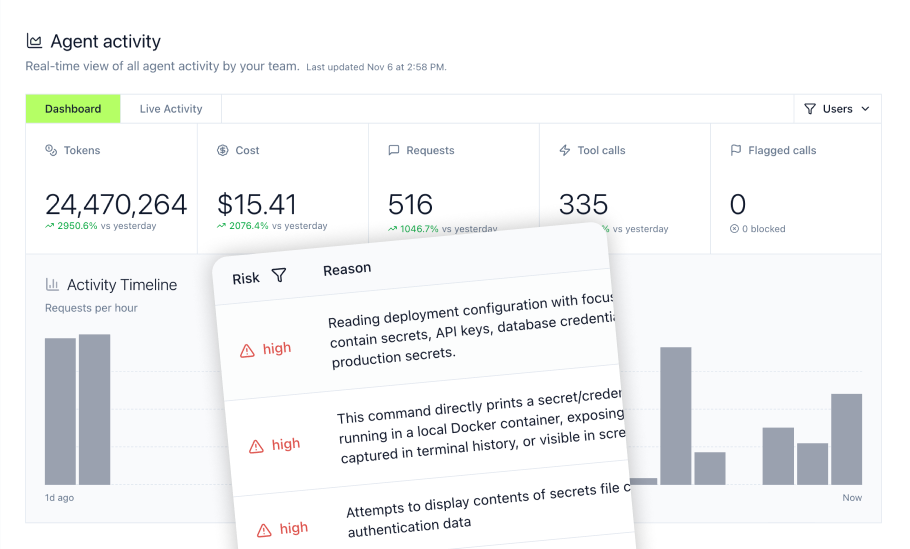
Without a runtime monitoring layer such as MintMCP's LLM Proxy, organizations have limited visibility into:
- Which MCP tools teams are using
- What files agents access
- Which bash commands execute
- What data leaves the organization
The LLM Proxy provides visibility by sitting between LLM clients and models, monitoring every tool invocation, bash command, and file operation from coding agents.
Establishing a Robust Enterprise Risk Management Framework for Claude
A structured approach to Claude Cowork security requires multi-layered controls across policy, technology, and operations.
Proactive Risk Assessment Strategies
Before deployment, organizations should:
- Audit current Claude usage: Identify shadow AI across the organization
- Document data sensitivity levels: Classify information that agents may access
- Establish risk tolerance: Choose between Lockdown, Controlled, or Open postures
- Map to compliance requirements: Determine which regulations apply (SOC 2, HIPAA, GDPR, PCI-DSS)
The NIST AI Risk Management Framework provides structure for this assessment, covering governance, risk identification, measurement, and management.
Developing AI Governance Policies
Effective policies should address:
- Acceptable use: Define permitted use cases and prohibited activities
- Scheduled task governance: Restrict unattended execution to read-only operations
- Regulated workload restrictions: Document "Cowork prohibited for SOX/HIPAA/PCI" until audit coverage confirmed
- MCP server allowlists: Vet and approve all plugins and connectors
- Incident response procedures: Define escalation paths and forensics collection
Implementing Cyber Security Best Practices for Claude-Enabled Teams
Secure Authentication and Authorization
Enterprise deployments require layered authentication controls:
- SAML 2.0/OIDC SSO: Configure with DNS TXT verification (Enterprise only)
- SCIM provisioning: Automate user lifecycle management
- Tenant restrictions: Inject
anthropic-allowed-org-idsheader via proxy to block personal accounts - Managed-settings.json: Deploy deny rules via MDM (Jamf/Intune) for organization-wide policy enforcement
Sample deny rules should block access to:
- .env files containing secrets
- .ssh/ directories with keys
- curl and wget commands for network access
- Password managers and cloud consoles
Comprehensive Monitoring and Audit Trails
Since Cowork is excluded from Anthropic's Audit Logs, Compliance API, and Data Exports, organizations can use OpenTelemetry for operational visibility, but Anthropic explicitly says it does not replace audit logging for compliance purposes:
Data collected via OTel:
- Token consumption (prompt/completion lengths)
- Tool invocations (bash, read_file, write_file)
- MCP server calls with tool names
- Session timestamps and user attribution (when SSO configured)
Data NOT collected by default:
- Prompt content (requires explicit opt-in)
- File contents (never collected)
The MCP Gateway provides real-time monitoring dashboards for server health, usage patterns, and security alerts—essential for organizations needing enterprise AI governance.
Ensuring Compliance: SOC 2, HIPAA, and GDPR with Claude Deployments
Meeting Regulatory Demands
The critical compliance gap for Claude Cowork: activity is explicitly excluded from Audit Logs, Compliance API, and Data Exports. Anthropic currently advises against using Cowork for regulated workloads because these capabilities do not capture Cowork activity.
Compliance readiness by standard:
- SOC 2 Type II: Limited in Cowork's current form—Anthropic states Cowork activity is not captured in Audit Logs, Compliance API, or Data Exports, and OpenTelemetry does not replace audit logging for compliance purposes
- HIPAA: Not ready—prohibit Cowork for PHI workloads until audit coverage confirmed
- GDPR: Evaluate separately and cautiously—Anthropic currently advises against using Cowork for regulated workloads because Cowork activity is not captured in Audit Logs, the Compliance API, or Data Exports
- PCI-DSS: Not ready—prohibit Cowork for cardholder data environments
- FedRAMP: Not ready—Anthropic Claude not FedRAMP authorized
Generating Comprehensive Audit Trails Automatically
Organizations that need centralized governance, authentication, and auditability for MCP interactions can use the MCP Gateway, which provides:
- Centralized audit trails for MCP interactions and access events
- SOC 2 Type II compliant infrastructure
- HIPAA compliance
- GDPR-aligned governance features such as access control, auditability, and data processing safeguards
- OAuth + SSO enforcement for all MCP endpoints
Governing Claude's Access to Internal Data and Tools
Controlling AI Agent Capabilities
Effective governance requires granular control over what Claude can access and execute. Three security posture tiers provide a framework:
Tier 3 (Lockdown):
- Cowork toggle: OFF
- Skills/Plugins: Blocked
- Claude in Chrome: Disabled
- MCP Servers: None
- Best for: Regulated industries, organizations without admin controls
Tier 2 (Controlled):
- Cowork toggle: ON
- Skills/Plugins: Org-vetted only via private marketplace
- Claude in Chrome: Disabled OR strict allowlist (5-10 domains)
- MCP Servers: Org allowlist via managed-mcp.json
- Best for: Most enterprises balancing security and productivity
Tier 1 (Open):
- Cowork toggle: ON
- Skills/Plugins: User-installed with policy
- Claude in Chrome: Enabled with blocklist
- MCP Servers: Allowlist + user requests
- Best for: R&D/innovation teams, low-sensitivity workloads
Protecting Sensitive Enterprise Data
The LLM Proxy enables protection through:
- Sensitive file protection: Prevent access to .env files, SSH keys, credentials
- Security guardrails: Block dangerous commands in real-time
- Command history: Complete audit trail of every bash command and file access
- MCP inventory: Visibility into installed MCPs and their permissions across teams
Anthropic's sandboxing achieves 84% permission prompt reduction through OS-level isolation using bubblewrap (Linux) and seatbelt (macOS), but this requires proper configuration.
MintMCP's Solution: Bridging the Security Gap for Claude Users
The challenges outlined throughout this article—absent audit trails, limited native governance, unmonitored MCP connections, and compliance gaps—represent the reality of deploying agentic AI in enterprise environments. Anthropic's native controls provide a foundation, but organizations need production-grade infrastructure to close the remaining gaps.
MintMCP addresses these challenges through two complementary products. The MCP Gateway transforms local MCP servers into production-ready services with one-click deployment, OAuth protection, and enterprise hardening. Organizations can deploy STDIO-based MCP servers instantly with built-in hosting, add SSO and OAuth automatically, and gain high availability with security and compliance alignment. Real-time dashboards provide visibility into usage patterns and security alerts across all MCP connections.
For organizations deploying Claude Cowork alongside other AI clients like Cursor, ChatGPT, or Microsoft Copilot, MintMCP provides centralized governance through unified authentication (OAuth 2.0, SAML, SSO integration), complete audit trails for every MCP interaction, granular tool access control by role, and cost analytics per team and project. The quickstart guide enables deployment in minutes rather than the weeks required for manual enterprise hardening.
This unified approach ensures that whether teams use Claude Cowork, coding assistants, or other AI tools, security teams maintain consistent visibility, policy enforcement, and audit trails across the entire AI infrastructure—closing the gaps that native vendor controls leave open.
Frequently Asked Questions
How do I prevent Claude Cowork from executing dangerous commands?
Deploy managed-settings.json via MDM (Jamf/Intune) with deny rules blocking curl, wget, .env files, and .ssh/ directories. Configure network egress to "Package Managers Only" plus approved domains. Disable the bash tool entirely if not needed. The MCP Gateway provides additional protection through centralized policy enforcement that users cannot override.
What is the difference between MCP Gateway and LLM Proxy?
The MCP Gateway focuses on securing MCP server connections—adding OAuth, audit logging, and access control to Claude's integrations with databases, APIs, and enterprise tools. The LLM Proxy sits between Claude and the model itself, monitoring tool invocations, bash commands, and file operations. Organizations deploying Claude Cowork typically need both: Gateway for MCP connector governance, Proxy for agent behavior monitoring.
Does MintMCP support both desktop and web versions?
Yes. MintMCP supports Claude Desktop, Claude Web, Claude Code, and other MCP-compatible clients including ChatGPT (via Custom GPTs), Microsoft Copilot, Cursor, Gemini, and Windsurf. The platform provides unified governance across all AI clients through centralized authentication, audit trails, and policy enforcement.
What should I do if I suspect prompt injection?
Stop the task immediately and disconnect Cowork from sensitive folders. Report to your security team and security@anthropic.com. Review OpenTelemetry logs for session activity, checking for unexpected file uploads or network calls. Rotate API keys if compromise is suspected. If your organization uses Enterprise plan, disable Cowork organization-wide via Admin Settings toggle while investigating.
How much does it cost to implement Claude securely?
Cost estimates for deploying agentic AI like Claude vary significantly depending on the required tooling, infrastructure, and organization size. Factors include Claude plan selection (Team vs Enterprise), MDM deployment, monitoring infrastructure, security tooling, and training. Organizations should budget for both initial implementation and ongoing operational costs. ROI depends on use case fit, user adoption, and security posture requirements.
Can I use Claude Cowork for HIPAA-regulated workloads?
Not currently recommended. Cowork activity is excluded from Anthropic's audit logs and Compliance API, creating gaps that cannot satisfy HIPAA audit requirements. Zero-Data-Retention requires a separate addendum. Prohibit Cowork for PHI workloads until Anthropic confirms audit coverage. In the interim, use an architecture that is explicitly scoped for regulated workloads and supported by the necessary contractual and technical safeguards.