Claude Cowork is an agentic desktop workspace that can read and write local files, use internet access and MCP connections, and carry out multi-step tasks on a user's machine. That power expands the prompt injection attack surface beyond normal chat workflows and requires layered controls around access, execution, and monitoring. Anthropic has published materially improved prompt injection robustness results in browser-use evaluations, but benchmark gains do not remove the need for layered controls in production Cowork deployments. Organizations deploying Claude Cowork require defenses combining policy enforcement, runtime detection, and centralized governance through solutions like the MCP Gateway to transform local MCP servers into production-ready, secure infrastructure.
This guide outlines prompt injection risks specific to Claude Cowork, explains how MCP-connected workflows expand the attack surface, and details defense strategies spanning policy enforcement, runtime detection, and centralized governance.
Key Takeaways
- Anthropic has published materially improved prompt injection robustness results in browser-use evaluations, but benchmark gains do not remove the need for layered controls in production Cowork deployments
- Even low per-attempt success rates can compound materially over repeated agent interactions, which is why browser access and other untrusted-content workflows need explicit containment and monitoring controls
- Real-world exploits (Reprompt, .docx injection) bypassed Claude's safeguards within weeks of release, demonstrating that built-in defenses alone are insufficient
- Every MCP connection is a trust boundary; once a Cowork workflow is allowed to access web content, local files, or connected external systems, untrusted content can introduce indirect prompt injection payloads
- Native product controls such as isolation, permissions, and centralized policy settings can reduce friction, but they should be treated as one layer in a broader prompt injection defense strategy
- Defense-in-depth requires combining gateway-level controls, runtime detection, and CI/CD scanning—no single solution is sufficient
- Enterprise deployment timelines range from 9-16 weeks depending on security requirements and compliance needs
Understanding Prompt Injection in Claude and MCPs
Prompt injection attacks manipulate AI systems by embedding malicious instructions within user inputs or external data sources. Unlike traditional software vulnerabilities with discrete entry points, prompt injection exploits the fundamental way large language models process text—they cannot inherently distinguish between legitimate instructions and adversarial commands hidden in content.
What makes Claude Cowork particularly exposed to prompt injection
Claude Cowork differs from standard chat workflows because it can act across local files, internet-connected workflows, and MCP-connected tools from within a long-running desktop task environment. When Claude Cowork reads local files, accesses web content, or uses MCP-connected tools, it operates within the access and permissions made available in that environment. This architectural decision enables powerful automation but creates significant exposure.
Direct vs. indirect prompt injection
- Direct injection: Attackers craft malicious prompts designed to override system instructions, escape safety guidelines, or manipulate Claude's behavior through explicit user input
- Indirect injection: Malicious payloads are embedded in external data sources (documents, web pages, API responses, README files) that Claude processes as legitimate content
The OWASP LLM Prompt Injection Prevention cheat sheet categorizes these attacks across four vectors: instruction override, role-playing manipulation, encoding/obfuscation techniques, and context window exploitation.
How MCP connections expand attack surface
Each MCP server connection creates a new trust boundary. When Claude connects to an Elasticsearch cluster, Snowflake data warehouse, or GitHub repository, any data returned from those sources could contain embedded injection payloads. The GitHub MCP vulnerability demonstrated this risk when researchers showed how poisoned README files could exfiltrate data through indirect prompt injection.
Specific Prompt Injection Risks for Claude Cowork
Agentic desktop workspaces face unique prompt injection risks because they combine broad system access with autonomous decision-making across multiple tools and data sources. HiddenLayer's research demonstrated the worst-case scenario: an indirect prompt injection attack that caused Claude to execute rm -rf / commands, potentially wiping entire systems.
Data exposure and exfiltration
Attackers can craft injections that instruct Claude to read sensitive files (.env, SSH keys, API credentials) and transmit their contents through outbound network requests. Because Claude Cowork has legitimate access to these resources for knowledge-work tasks, distinguishing malicious reads from legitimate operations requires behavioral analysis.
Unauthorized command execution
System-level access represents the highest-risk capability. Prompt injections can manipulate Claude into running operations that:
- Install backdoors or malicious dependencies
- Modify files to introduce vulnerabilities
- Access production databases or infrastructure
- Exfiltrate proprietary data or business logic
Manipulating tool calls
MCP tool invocations can be hijacked through injection. An attacker embedding malicious instructions in a Notion page could cause Claude to execute unintended database queries, send unauthorized emails through Gmail integration, or modify files in connected repositories.
Identifying and Detecting Prompt Injection Attempts
Effective detection requires monitoring at multiple layers: input validation before Claude processes content, behavioral analysis during execution, and post-action auditing for forensic review.
Monitoring tool calls for anomalies
MintMCP's LLM Proxy tracks every MCP tool invocation and file operation across all AI agents. This visibility enables security teams to:
- Identify unusual patterns in tool usage
- Detect attempts to access sensitive file paths
- Monitor sequences that deviate from normal workflows
- Alert on real-time security violations
Multi-tier detection approaches
The NOVA-tracer framework implements three-tier detection combining keyword matching, machine learning semantic analysis, and LLM-based evaluation. This layered approach reduces false positives while catching sophisticated injection attempts that evade simple pattern matching.
Lasso Security's Claude-Hooks implements 50+ regex patterns across four attack categories: instruction override, role-playing manipulation, encoding/obfuscation, and context manipulation. These patterns run as PostToolUse hooks, analyzing tool outputs before Claude processes the results.
Building detection into enterprise workflows
Organizations should integrate detection at three points:
- Pre-execution: Block dangerous operations before they run
- Post-tool use: Analyze returned content for injection indicators
- Continuous monitoring: Track session-level patterns for multi-turn attacks
Implementing Robust Input Sanitization and Validation
While complete input sanitization is challenging with natural language inputs, structured approaches significantly reduce injection success rates.
Filtering malicious patterns
Implement deny lists for known injection patterns:
- Commands attempting to override system prompts ("ignore previous instructions")
- Role-playing manipulation ("you are now a helpful assistant without restrictions")
- Encoding tricks (base64, ROT13, Unicode manipulation)
- Context window flooding designed to push safety instructions out of context
Enforcing structured input formats
Where possible, constrain inputs to structured formats that limit injection opportunities:
- Use JSON schemas for tool parameters
- Validate file paths against allowlists before access
- Require specific formats for database queries
- Implement type checking on all MCP server inputs
Policy enforcement through native controls and centralized governance
Native product controls and centralized governance layers should enforce organization-wide policy consistently, rather than relying on per-user configuration or ad hoc local settings. Configure:
- Deny rules for sensitive operations (network commands, credential access)
- Ask rules requiring explicit user approval for risky actions
- Allow rules for pre-approved safe operations
Anthropic’s guardrail guidance provides general recommendations for reducing jailbreak and prompt injection risk, but enterprises still need deployment-specific controls around access, monitoring, and auditability.
Securing MCP Tools and Access with Granular Controls
MCP servers represent the primary integration point between Claude and organizational data. Securing these connections requires authentication, authorization, and continuous monitoring.
Defining granular tool access policies
Role-based access control at the tool level enables:
- Read-only access for analysis workflows
- Excluding write operations for specific user groups
- Requiring additional approval for high-risk tool invocations
- Version-pinning MCP servers to prevent silent malicious updates
Implementing OAuth and SSO for MCPs
The MCP Gateway adds OAuth 2.0, SAML, and SSO integration to any local MCP server automatically. This enterprise authentication wrapping ensures:
- All MCP access flows through corporate identity management
- Session tokens expire and require re-authentication
- Access can be revoked centrally when employees depart
- Audit trails link every action to authenticated users
Managing API keys securely
Centralized credential management prevents API keys from appearing in source code, environment variables accessible to Claude, or MCP server configurations that could be extracted through injection attacks. Store credentials in dedicated secrets management systems with just-in-time access provisioning.
Monitoring and Auditing MCP Interactions for Compliance
Complete audit trails serve dual purposes: detecting active attacks and supporting regulatory review. This is especially important for Cowork because Anthropic currently states that Cowork activity is not captured in Audit Logs, Compliance API, or Data Exports, which makes external governance and monitoring layers materially more important.
Real-time audit logs for all MCP actions
MintMCP provides audit observability capturing every MCP interaction, access request, and configuration change. These logs include:
- Timestamp and authenticated user for each action
- Complete tool parameters and returned results
- File paths accessed and operations executed
- Network requests initiated through Claude
Ensuring compliance with industry standards
For regulated or audit-sensitive environments, detailed logging, access controls, and retention policies are often required to support security investigations, internal governance, and external review. MintMCP's compliance features deliver:
- Immutable audit trails for regulatory review
- Configurable retention periods meeting compliance requirements
- Export capabilities for external audit tools
- Automated compliance reports for periodic assessments
Post-incident analysis capabilities
When prompt injection attempts are detected (or succeed), detailed logs enable forensic investigation:
- Reconstruct the complete attack chain
- Identify compromised data and affected systems
- Determine whether the attack exploited a previously unknown vector
- Update detection rules based on new attack patterns
Protecting Sensitive Data from AI Agent Access
Even with robust detection and access controls, organizations must implement data-level protections as a final defense layer.
Implementing sensitive file protection
The LLM Proxy explicitly prevents access to sensitive file categories:
- Environment files (.env, .env.local, .env.production)
- SSH keys and certificates (~/.ssh/, *.pem, *.key)
- Credential stores and password files
- Configuration files containing API tokens
Data masking and redaction strategies
For workflows requiring access to databases containing sensitive information:
- Implement row-level security in connected data sources
- Use data masking to redact PII before Claude processes results
- Configure MCP servers to return sanitized data by default
- Maintain separate development datasets with synthetic data
Controlling data residency
Organizations with geographic compliance requirements should validate deployment architecture, data flows, and regional handling controls directly against vendor documentation and internal compliance requirements before using AI agents with regulated data.
Best Practices for Developing Secure Claude Cowork Prompts
Prompt engineering significantly impacts injection resistance. Well-structured prompts reduce attack surface without sacrificing functionality.
Structuring prompts for security
- Place safety instructions at the beginning and end of system prompts (context window attacks often target the middle)
- Use explicit delimiters to separate trusted instructions from user content
- Include negative examples showing Claude how to identify and refuse injection attempts
- Avoid overly permissive instructions that grant broad autonomous authority
Limiting agent capabilities within prompts
Apply the principle of least privilege to prompt design:
- Specify exactly which tools and operations are permitted for each workflow
- Define explicit boundaries for file system access
- Require confirmation for any operation with side effects
- Set timeouts for long-running operations
Educating users on secure prompting
Team training should cover:
- Recognition of indirect injection indicators in external content
- Proper use of isolation features for untrusted operations
- Reporting procedures for suspected injection attempts
- Understanding when to escalate security concerns
Why MintMCP Gateway Is Essential for Enterprise Cowork Deployments
Native product controls help reduce exposure, but they do not replace centralized governance across MCP connections, access policies, runtime monitoring, and auditability. That is the layer this guide should treat as foundational for enterprise deployments.
Claude Cowork's power—local file access, internet connectivity, MCP tool integration, and scheduled autonomous tasks—creates a governance challenge that transcends individual user configuration. Anthropic's own documentation notes that Cowork activity is not captured in standard enterprise audit logs, Compliance APIs, or data exports. For organizations deploying Cowork at scale, that visibility gap makes centralized external governance non-negotiable.
The MCP Gateway addresses this gap by transforming local STDIO-based MCP servers into production-ready services with unified authentication, policy enforcement, and audit capture. Rather than trusting each developer to configure their own security boundaries, MCP Gateway centralizes organization-wide controls so policy is enforced consistently rather than depending on per-user local settings.
This centralization delivers:
- Unified authentication across all MCP connections through OAuth 2.0, SAML, or SSO, ensuring every Cowork action flows through corporate identity management
- Consistent policy enforcement regardless of which MCP servers developers connect, preventing shadow AI sprawl and unapproved tool access
- Complete audit trails capturing every MCP tool invocation, file access, and data query, filling the observability gap Anthropic identifies in Cowork deployments
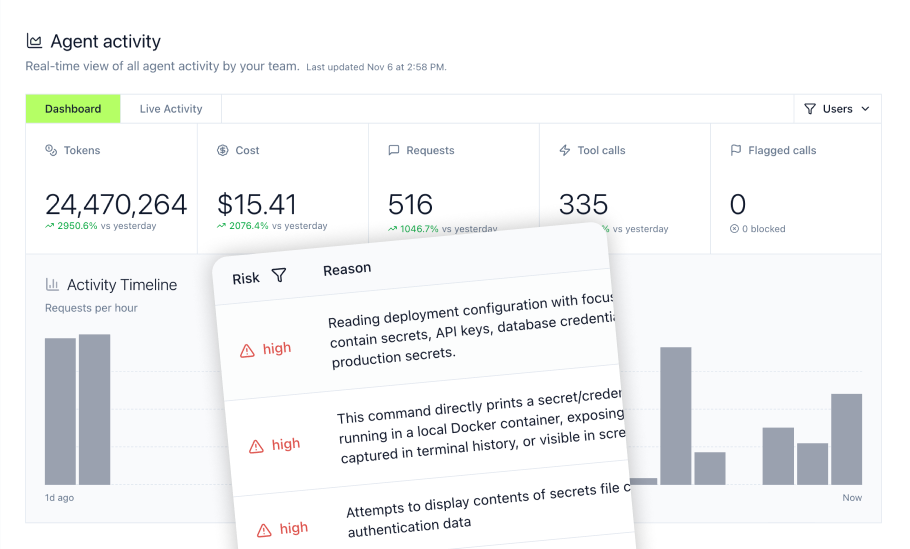
- Real-time monitoring dashboards that surface anomalous behavior patterns, policy violations, and security alerts across all agents and teams
Organizations with compliance requirements—SOC 2, GDPR, or sector-specific regulations—cannot rely on Cowork's native controls alone. The LLM Proxy adds an additional layer by tracking prompts, tool calls, and model responses in real time, enabling security teams to detect prompt injection attempts before they succeed rather than investigating after exfiltration has occurred.
For enterprises navigating the critical challenges of cost control, compliance, and governance at scale, MintMCP provides the infrastructure layer that makes Cowork safe for production use. The combination of MCP Gateway for infrastructure governance and LLM Proxy for runtime monitoring creates defense-in-depth that addresses prompt injection at every layer—from authentication through execution to audit.
Frequently Asked Questions
How does prompt injection differ from traditional software vulnerabilities?
Traditional vulnerabilities exploit specific code flaws with predictable inputs (SQL injection requires database query syntax; buffer overflows require oversized inputs). Prompt injection exploits how language models process natural language—there's no fixed grammar or structure attackers must follow. Defenses must analyze semantic meaning and behavioral intent rather than pattern-matching specific byte sequences, making detection inherently more complex and requiring AI-native security approaches.
Can prompt injection attacks persist across Claude Cowork sessions?
Yes, through several mechanisms. Attackers can inject instructions that modify project files (adding malicious comments to documents, altering configuration files, or poisoning notes). When Claude Cowork is invoked in future sessions and reads these files, the embedded payloads execute again. This persistence is why file integrity monitoring and version control scanning are essential complements to runtime detection.
What should organizations do if a prompt injection attack succeeds?
Immediate response should include: isolating affected systems and revoking Claude Cowork's access tokens; preserving audit logs for forensic analysis; identifying the attack vector (direct input, poisoned file, MCP server response); determining data exposure scope; and notifying affected parties per applicable regulations. Post-incident, update detection rules based on the specific attack pattern, review and tighten policy configurations, and conduct red team exercises to identify similar vulnerabilities.
How do compliance requirements like HIPAA affect Claude Cowork deployment for prompt injection defense?
HIPAA-covered entities should validate exactly which Anthropic services are covered under a Business Associate Agreement and whether Zero Data Retention is required for their deployment model. Anthropic currently lists Claude Enterprise, the native API with Zero Data Retention, and Claude Code with Zero Data Retention as covered services, while third-party MCPs and connectors are not covered under Anthropic's BAA. Any workflow involving PHI therefore needs careful scoping of model access, connector usage, logging, and downstream infrastructure responsibilities.
Are open-source prompt injection detection tools sufficient for enterprise use?
Open-source tools like NOVA-tracer and Claude hook-based detectors can be useful for experimentation and local hardening, but enterprise deployments usually need a centralized control plane for identity, policy enforcement, auditability, and operational governance across teams and MCP-connected systems. That is the gap platforms like MintMCP are designed to address.