As enterprises deploy AI agents, coding assistants, and LLM-powered applications faster than security teams can govern them, organizations face new risks across models, data, identities, tools, and runtime agent activity. This expanding attack surface has increased demand for security controls designed specifically for AI systems and autonomous agents.
AI Security Posture Management (AI-SPM) addresses this gap through discovery, risk assessment, governance, and enforcement across different layers of the AI stack. Some platforms focus on cloud and model posture, while others extend into agent discovery, identity, tool access, runtime behavior, and policy enforcement. MintMCP addresses the agentic layer, governing tool and data access, giving agents first-class identities, monitoring supported agent activity, and enforcing runtime guardrails. Forrester projects spending on off-the-shelf AI governance software will reach $15.8 billion by 2030. This article explains what AI-SPM is, why it matters, and profiles 10 AI-SPM and adjacent AI security platforms across cloud, model, data, application, and agentic runtime layers.
Key takeaways
- AI-SPM now covers multiple layers: cloud and model infrastructure security, plus agent identity, tool access, runtime behavior, and policy enforcement
- MintMCP provides agentic AI security posture and runtime governance through MCP Gateway, Agent Gateway, Agent Monitor, and Guardrails
- Core AI-SPM capabilities include automated AI discovery, AI Bill of Materials generation, risk assessment, runtime enforcement, and compliance mapping to frameworks like NIST AI RMF and EU AI Act
- The EU AI Act became generally applicable August 2, 2026, with phased high-risk requirements beginning December 2, 2027
- Shadow AI can materially increase security exposure and breach costs, reinforcing the need for visibility and governance across both sanctioned and unsanctioned AI use
What is AI Security Posture Management (AI-SPM)?
AI Security Posture Management encompasses security tools designed to discover, assess, govern, and protect AI assets across enterprise environments. Unlike traditional Cloud Security Posture Management (CSPM) focused on infrastructure misconfigurations, AI-SPM addresses risks unique to AI systems:
- AI model security: Detecting vulnerabilities in training data, model weights, and inference pipelines
- Shadow AI discovery: Finding unauthorized AI tools and services employees use without IT approval
- Agent governance: Managing which agents are operating, what identities and credentials they use, and which tools they can access
- Prompt injection protection: Blocking adversarial inputs designed to manipulate AI behavior
- Data flow classification: Understanding what sensitive data AI systems access and process
- Compliance mapping: Aligning AI deployments with NIST AI RMF, EU AI Act, OWASP Top 10 for LLMs, and MITRE ATLAS frameworks
Why AI-SPM matters for enterprises
The urgency for AI-SPM stems from three converging trends:
Rapid AI adoption outpaces security. Organizations deploy AI agents and coding assistants across departments while security teams lack visibility into what these systems access. Traditional API gateways and endpoint protection tools were not designed to understand AI-specific attack vectors.
Regulatory pressure intensifies. The EU AI Act became generally applicable on August 2, 2026, but implementation remains phased. High-risk requirements for Annex III systems apply from December 2, 2027, while requirements for high-risk AI embedded in regulated products under Annex I apply from August 2, 2028. Organizations must map security and governance controls to the provisions and timelines that apply to their systems.
AI-specific attacks proliferate. Prompt injection, model poisoning, and tool poisoning attacks target AI systems through vectors traditional security cannot detect. AI-SPM tools bring specialized detection capabilities for these emerging threats.
How AI-SPM spans cloud, model, and agentic posture
AI-SPM now spans multiple security layers. Cloud- and model-focused platforms such as Wiz, Prisma AIRS, and Orca emphasize capabilities such as agentless cloud discovery, AI asset inventories, model and supply-chain risk, and attack-path analysis. Agentic AI security posture focuses on a different part of the stack: which agents are operating, what identities and credentials they use, which tools and data they can access, what they do at runtime, and whether risky actions should be allowed.
MintMCP addresses the agentic AI security posture and runtime-governance layer through:
- Centralized tool and data access through governed MCP endpoints
- First-class agent identities with scoped permissions and credentials
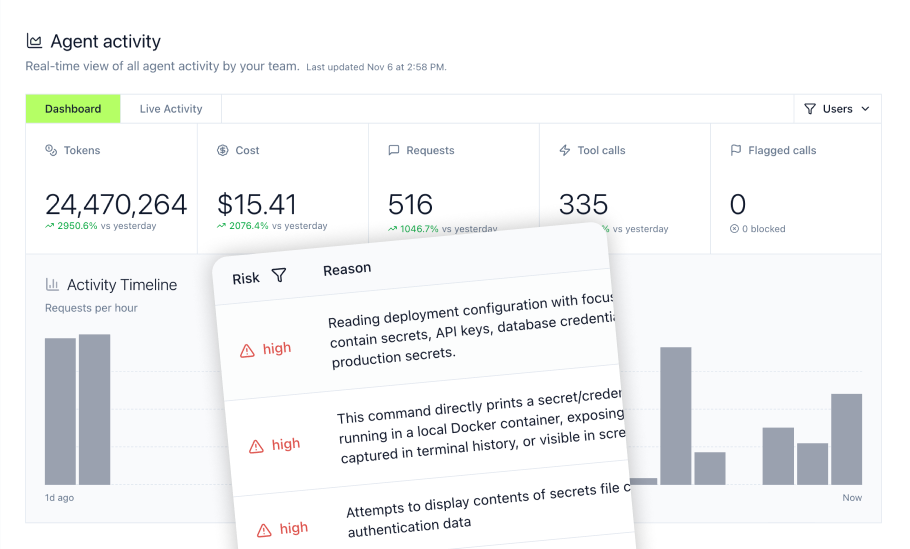
- Agent Monitor visibility into supported prompts, commands, file access, MCP tool calls, usage, and costs
- Runtime controls through Mint Guard, Rules, and Gateway Middleware
This makes MintMCP complementary to deep cloud- and model-scanning platforms when organizations need both infrastructure posture and agent runtime governance.
1. MintMCP
MintMCP provides an enterprise control layer for AI clients and autonomous agents, focusing on governed tool and data access, agent identity, permissions, activity monitoring, runtime controls, and auditability.
Core capabilities
- Governed tool and data access: MCP Gateway centralizes connectors, authentication, credentials, access policies, tool curation, and audit behind governed endpoints
- Agent identity and permissions: Agent Gateway gives autonomous agents first-class non-human identities, scoped MCP and tool access, independent credentials, and attributable audit trails
- Agent activity visibility: Agent Monitor provides visibility into supported prompts, commands, file access, MCP tool calls, usage, and token costs
- Runtime guardrails: Mint Guard, Rules, and Gateway Middleware provide managed detection, declarative enforcement, and customer-authored policy logic for risks such as prompt injection, secrets, PII, and unsafe tool activity
Where MintMCP fits
MintMCP addresses organizations whose AI security posture problem centers on autonomous agents: which agents are acting, what identities and credentials they use, which tools and data they can access, what they are doing, and whether risky actions should be allowed.
Its focus differs from cloud- and model-scanning platforms. Organizations that need agentless cloud discovery, model scanning, AI-BOM generation across ML infrastructure, model supply-chain security, or CNAPP-style attack-path analysis may need those capabilities alongside MintMCP.
Pricing
Contact MintMCP for current pricing.
2. Cycode AI-Enabled ADSP
Cycode's Agentic Development Security Platform combines application security with AI-SPM capabilities, emphasizing automated remediation and AI-powered triage.
Core capabilities
- AI visibility: Automatically discovers AI tools, coding assistants, MCP servers, and models across repositories
- AI Bill of Materials: Generates continuously updated inventory of AI components, dependencies, and data flows
- Maestro orchestration: Multi-agent security workflows for automated remediation
Where Cycode fits
Cycode positions as both "Security for AI" (governing AI tools and models) and "AI for Security" (using AI to accelerate remediation). The platform's AI Exploitability Agent analyzes actual exploitability of findings.
Pricing
Custom enterprise pricing
3. Palo Alto Networks Prisma AIRS
Prisma AIRS is Palo Alto Networks' AI security platform spanning posture management, model scanning, red teaming, runtime security, and agent security, with capabilities expanded through the acquisitions of Protect AI, Koi, and Portkey.
Core capabilities
- Model scanning: Pre-deployment integrity scanning for supply chain risk detection
- Automated red teaming: Continuous adversarial testing for vulnerabilities in AI systems
- AI agent security: Identity verification, real-time governance, and memory manipulation protection
Where Prisma AIRS fits
Organizations with existing Palo Alto infrastructure benefit from unified DevSecOps pipeline integration for model development. The platform provides deep coverage of AWS, Azure, and GCP AI services with extensive third-party integrations.
Pricing
Custom enterprise pricing based on AWS Marketplace listings
4. Wiz AI-SPM
Wiz extends its cloud security platform with AI-specific posture management, emphasizing agentless discovery and attack path analysis.
Core capabilities
- Agentless discovery: Finds AI services, models, and packages across cloud environments without deploying agents
- AI-BOM: Maps dependencies and potential attack paths from exposed endpoints to sensitive datasets
- Security graph: Correlates AI assets with broader cloud infrastructure risks
Where Wiz fits
Wiz serves a significant portion of Fortune 100 companies, making it a natural extension for organizations already standardized on the platform. The agentless deployment model reduces implementation friction. Wiz remains strongest in cloud and AI posture through agentless discovery, dependency mapping, attack-path analysis, and Security Graph context, while its runtime capabilities now extend coverage into live AI workloads and agent behavior across model, workload, and cloud layers.
Pricing
Starting at $38,000 annually on AWS Marketplace for the Advanced bundle
5. Microsoft Defender for Cloud and Purview
Microsoft's AI-SPM capabilities span Defender for Cloud and Purview, providing native governance for Microsoft 365 Copilot and Azure OpenAI deployments.
Core capabilities
- AI-BOM generation: Defender for Cloud discovers generative AI Bill of Materials across supported Azure, AWS, and Google Cloud AI workloads, including Azure OpenAI, Azure AI Foundry, Amazon Bedrock, and Google Vertex AI
- Copilot governance: Native Microsoft Purview controls for protecting and governing Microsoft 365 Copilot data
- Compliance mapping: Aligns with EU AI Act, GDPR, and HIPAA within the Microsoft ecosystem
Where Microsoft fits
Organizations standardized on Microsoft 365 and Azure can extend existing Microsoft security and compliance workflows into AI governance. Microsoft Purview Suite is currently listed at $12.00 per user per month, paid yearly, with qualifying E3 licensing required; Microsoft Defender for Cloud is priced separately on a pay-as-you-go basis.
Defender for Cloud's AI-SPM supports multicloud AI workloads across Azure, AWS, and Google Cloud. As of July 1, 2026, agent-level discovery, posture, and threat protection for Copilot Studio and Microsoft Foundry agents require a Microsoft Agent 365 license.
Pricing
Purview Suite: $12.00 per user per month, paid yearly, with qualifying E3 licensing required; Defender for Cloud is priced separately
6. CrowdStrike Falcon Cloud Security AI-SPM
CrowdStrike extends its Falcon platform with AI-SPM capabilities, emphasizing DNS telemetry for shadow AI discovery.
Core capabilities
- Shadow AI discovery: Uses DNS telemetry to find unauthorized AI tools
- Model scanning: Covers OpenAI, Bedrock, SageMaker, and Vertex AI models
- AIDR (AI detection and response): Prompt interception, policy enforcement, and audit trails
Where CrowdStrike fits
Organizations already standardized on Falcon can extend existing cloud and endpoint security workflows into AI security. The DNS telemetry approach can surface shadow AI usage that cloud-account scanning alone may miss.
CrowdStrike's 250+ third-party integrations through Falcon Marketplace enable comprehensive SOC workflow integration.
Pricing
Custom pricing as part of Falcon platform
7. Varonis Atlas AI security
Varonis launched Atlas in 2026 as an AI security platform spanning discovery, AI-SPM, security testing, runtime guardrails, and compliance, with data context from the broader Varonis Data Security Platform.
Core capabilities
- Red team/penetration testing: Automated adversarial testing of AI systems
- Data flow classification: Scans and classifies data flowing through AI ecosystems
- Automated remediation: Built-in remediation workflows for identified risks
Where Varonis fits
Organizations already using Varonis can extend its data-security workflows into AI discovery, posture management, runtime guardrails, and compliance. The data-centric approach emphasizes both how AI behaves and what sensitive data it can access.
Hundreds of third-party integrations including JFrog, Jira, Okta, and Salesforce support enterprise deployment.
Pricing
Starting at $108,000 annually on AWS Marketplace
8. Cyera AI Guardian
Cyera combines data-centric AI Security Posture Management with runtime protection and agent security, mapping AI assets and agents to identities, sensitive data, access paths, and runtime actions.
Core capabilities
- AI asset discovery: Inventories AI models, applications, agents, knowledge bases, and related AI assets
- Data and identity context: Maps AI assets and agents to identities, sensitive data, permissions, and access paths
- Runtime protection: Applies real-time policy and guardrails to prompts, data access, tool invocations, and agent actions
Where Cyera fits
Cyera's data-centric approach emphasizes understanding what sensitive information AI systems access at granular levels. The specialized Copilot scanning module addresses a common enterprise deployment pattern.
Pricing
Verify current AI Guardian, AI-SPM, and Agent Guardian pricing directly with Cyera
9. SentinelOne Singularity platform
SentinelOne combines endpoint and cloud security with AI-specific governance and runtime controls from Prompt Security, including Prompt AI Agent Security for AI agents, agentic workflows, and MCP environments.
Core capabilities
- Misconfiguration detection: Identifies AI infrastructure misconfigurations through Cloud Native Security tools
- Attack path analysis: Automated inventory and risk mapping for AI assets
- AI PaaS integration: Covers Azure OpenAI, Vertex AI, and AWS AI services
Where SentinelOne fits
Organizations already using SentinelOne can connect AI agent and runtime security with existing endpoint, cloud, identity, and SOC workflows. Some agent-posture and automated-remediation capabilities announced with Prompt AI Agent Security remain in preview.
The Prompt Security acquisition adds AI-specific prompt filtering and input validation.
Pricing
Pricing depends on Singularity and Prompt Security packaging; verify current AI security pricing with SentinelOne
10. Proofpoint AI security
Proofpoint AI Security combines AI discovery, runtime observability, policy enforcement, data protection, and MCP security across workforce and agentic AI.
Core capabilities
- AI discovery and inventory: Discovers sanctioned and unsanctioned AI usage, agents, and MCP connections
- Runtime inspection and enforcement: Observes live AI interactions and applies policies during runtime
- Agent and MCP security: Extends governance and auditability across agents, tool calls, data access, and MCP workflows
Where Proofpoint fits
Proofpoint's approach focuses on protecting users and agents from AI-related threats across the full interaction lifecycle. Organizations with existing Proofpoint security can extend protection to AI interactions.
Major cloud provider integrations support hybrid deployment models.
How to choose an AI-SPM platform
Evaluate your architecture
Organizations should match AI-SPM selection to their deployment model:
- Cloud-native deployments: Wiz, CrowdStrike Falcon provide agentless cloud discovery
- Microsoft-first environments: Microsoft Defender/Purview offers native Copilot governance
- Application development focus: Cycode integrates with DevSecOps pipelines
- Data security priority: Varonis, Cyera emphasize data classification and access monitoring
- Agentic AI focus: MintMCP provides first-class agent identities, tool governance, and runtime controls
Consider architectural strengths
AI-SPM platforms have different architectural strengths. Cloud- and model-focused tools such as Wiz, Prisma AIRS, and Orca are strongest at capabilities such as agentless cloud discovery, model and dependency posture, AI-BOMs, model scanning, and attack-path analysis. Agentic AI security platforms focus more heavily on runtime behavior, agent identities, tool access, permissions, credentials, and enforcement.
For organizations where agent runtime governance is the primary requirement, MintMCP focuses on governed MCP and tool access, first-class agent identities, supported agent activity monitoring, and runtime guardrails.
Map to compliance requirements
The EU AI Act is now in phased application. Evaluate platforms against the obligations and evidence requirements that apply to your AI systems, noting that major high-risk requirements begin on December 2, 2027 for Annex III systems and August 2, 2028 for high-risk AI embedded in regulated products:
- NIST AI RMF mapping
- EU AI Act compliance documentation
- OWASP Top 10 for LLMs coverage
- MITRE ATLAS alignment
- Audit, access-control, and evidence capabilities relevant to SOC 2 and HIPAA obligations, where applicable
Secure your agentic AI with MintMCP
AI-SPM is not a single architectural layer. Cloud- and model-focused platforms secure AI assets, dependencies, models, and infrastructure, while agentic platforms govern identities, tools, runtime activity, and actions. MintMCP addresses the agentic AI security posture and runtime-governance layer.
MintMCP provides an agentic AI security posture and runtime-governance layer that can complement cloud- and model-focused AI-SPM:
- MCP Gateway: Centralizes tool access behind governed endpoints with SSO, SCIM-driven RBAC, and audit logging
- Agent Gateway: Gives autonomous agents first-class identities with scoped permissions, independent credentials, and per-agent audit trails
- Agent Monitor: Provides visibility into supported agent activity including prompts, commands, file access, MCP tool calls, usage, and token costs
- Guardrails: Applies runtime controls through Mint Guard for managed detection, declarative Rules for organization-specific enforcement, and customer-authored Gateway Middleware for custom policy logic and integrations
Cloud- and model-focused AI-SPM asks questions such as "What AI assets do we have, how are they configured, and what model or dependency risks exist?" MintMCP focuses on the agentic runtime questions: "Which agents are acting, what can they access, what are they doing, and which actions should be allowed?"
Together, cloud and model posture plus agentic runtime governance provide defense-in-depth across the AI stack.
Learn more about MintMCP to evaluate agentic AI security posture and runtime governance alongside your broader AI-SPM stack.
Frequently asked questions
What is the difference between AI-SPM and traditional CSPM?
Cloud Security Posture Management (CSPM) focuses on infrastructure misconfigurations, network exposure, and compliance across cloud resources. AI-SPM addresses AI-specific risks including model vulnerabilities, prompt injection attacks, shadow AI discovery, agent governance, and AI-related data flows. While CSPM might detect an exposed S3 bucket, AI-SPM would identify that the bucket contains training data for a production model and assess the downstream risks.
How does agentic AI security posture differ from cloud- and model-focused AI-SPM?
AI-SPM spans multiple layers. Cloud- and model-focused platforms emphasize AI asset discovery, model and dependency scanning, cloud configuration, and attack paths. Agentic AI security posture emphasizes agent identity, permissions, credentials, tool and data access, runtime activity, and policy enforcement. Organizations may need both depending on where their AI risk sits.
Which AI-SPM platform should an organization choose?
Selection depends on existing infrastructure and security priorities. Organizations standardized on Microsoft 365 benefit from Defender/Purview's native Copilot governance. Cloud-native deployments align with Wiz's agentless discovery. Teams with agentic AI priorities should evaluate MintMCP's agent identity, tool governance, and runtime control capabilities. Data-centric organizations may prefer Varonis or Cyera's classification capabilities.
What coverage should be verified in an AI-SPM platform?
AI-SPM products cover different parts of the stack. Verify whether a platform provides the cloud and model capabilities needed, such as agentless discovery, AI-BOMs, model scanning, and attack-path analysis, as well as agentic controls such as runtime tool access, agent identity, scoped credentials, activity monitoring, and policy enforcement. Do not assume every AI-SPM product covers both layers equally.
How quickly can an organization deploy an AI-SPM platform?
Deployment time varies by product, environment, integrations, identity architecture, and policy scope. Agentless discovery can generally be faster to start than deeply integrated runtime, identity, or DevSecOps deployments, so organizations should confirm implementation requirements and timelines with each vendor.