As enterprises deploy AI agents across their organizations, two critical but often conflated concepts have emerged: orchestration and management. While orchestration coordinates how agents work together on complex workflows, management governs agents as infrastructure through identity, security, and compliance controls. Understanding this distinction is fundamental to successful enterprise AI deployment. Organizations need both layers. MintMCP's MCP Gateway governs data and tool connections, while its Agent Gateway builds on that foundation with agent identities, scoped permissions, governed memory, and monitoring.
This article breaks down the core differences between AI agent orchestration and agent management, explains why enterprises need both, and provides practical guidance for building governed, scalable AI agent infrastructure.
Key Takeaways
- Orchestration coordinates how agents collaborate through task routing, workflow execution, and state management, while management governs agents as infrastructure through identity, security, compliance, and lifecycle controls
- Multi-agent orchestration can improve task specialization and parallel execution, while management infrastructure provides the identity, access, and audit controls needed for governed deployment
- Agent sprawl creates four immediate technical debts: ungoverned identity surfaces, embedded credentials, audit gaps, and untracked cost centers. This mirrors the API sprawl problem enterprises faced a decade ago
- Human-centric IAM is often insufficient on its own for AI agents, which require first-class non-human identities, scoped credentials, delegation controls, and per-agent audit attribution
- Demand for agent orchestration and management infrastructure is growing, although market estimates vary substantially depending on how each category is defined
- Enterprises may combine centralized and decentralized orchestration patterns based on workflow risk, resilience, and scalability requirements
Understanding AI Agents: The Foundation of AI-Driven Workflows
AI agents are autonomous software systems that leverage large language models to perceive their environment, make decisions, and take actions to accomplish specific goals. Unlike traditional automation that follows rigid scripts, agents can reason through problems, access external tools, and adapt their approach based on context.
What Defines an AI Agent?
An AI agent combines several capabilities that distinguish it from basic chatbots or rule-based automation:
- Autonomous decision-making: Agents analyze situations and determine appropriate actions without constant human direction
- Tool use and integration: Agents connect to external systems like databases, APIs, CRM platforms, and development tools to retrieve information and execute tasks
- Context awareness: Agents maintain understanding of their current state, past interactions, and relevant environmental factors
- Goal-oriented behavior: Rather than simply responding to prompts, agents work toward defined objectives across multiple steps
In enterprise settings, AI agents operate across diverse use cases including data analysis, customer support, development workflows, and compliance auditing. As more organizations pilot and deploy AI agents, the challenge is shifting from initial experimentation to coordinating and governing them effectively.
What is AI Agent Orchestration? Harmonizing Complex Agent Workflows
AI agent orchestration is the process of coordinating multiple autonomous agents to work together on complex, multi-step workflows. It handles task assignment, shared state management, execution sequencing, and inter-agent communication.
Defining Agent Orchestration: Beyond Individual Task Execution
Orchestration goes beyond running a single agent. It addresses:
- Task decomposition: Breaking complex objectives into subtasks that individual agents can handle
- Workflow sequencing: Determining the order of operations and managing dependencies between agent actions
- State management: Maintaining shared context so agents understand what others have accomplished
- Error handling: Recovering gracefully when individual agents fail or produce unexpected results
Think of orchestration as the conductor of an AI orchestra. Each agent plays its instrument, but the conductor ensures they perform together harmoniously rather than creating cacophony.
The Need for Orchestration in Multi-Agent Systems
When a customer support workflow requires checking order status, reviewing account history, analyzing sentiment, and escalating to appropriate teams, a single generalist agent may become harder to optimize, test, and govern across every step.
Multi-agent architectures address this by assigning specialized agents to each function. Multi-agent orchestration can improve throughput for workflows that benefit from specialization and parallel execution, but results depend on task design, evaluation, and operational controls.
Benefits of Effective AI Workflow Automation
Well-implemented orchestration delivers measurable outcomes:
- Efficiency gains: Parallel execution can reduce workflow time when tasks can run independently
- Cost reduction: Automating repetitive coordination can reduce manual operating work, depending on implementation and workload
- Scalability: Ability to add new agents to workflows without rebuilding entire systems
- Reliability: Fault tolerance through redundancy and graceful degradation
Exploring AI Agent Management: Governance, Security, and Lifecycle Control
While orchestration handles coordination, agent management serves as the control plane governing agent identity, security, permissions, and compliance. Management answers different questions: Who is this agent? What can it access? What did it do? How do we ensure it operates within policy?
The Pillars of AI Agent Management
Effective agent management addresses five core areas:
Identity and Authentication
Each agent needs a verifiable identity separate from the human who created it. This enables credential rotation without disrupting other agents, audit attribution to specific agents rather than shared service accounts, and scope limitation based on agent role rather than creator permissions.
Access Control
Agents require fine-grained permissions at the tool level, not just system level. Enable database reads but block writes, allow GitHub repository access but restrict to specific branches, and permit CRM queries but mask sensitive customer fields.
Observability
Complete visibility into agent actions is non-negotiable for enterprise deployment. This includes conversation-level logging of prompts, tool calls, and responses, per-user and per-agent attribution, and export to SIEM platforms for security analysis.
Policy Enforcement
Governance rules must execute inline with agent operations. Block or flag sensitive data exposure before it leaves the system, enforce approval workflows for high-risk actions, and apply rate limiting to prevent runaway costs.
Lifecycle Management
Agents require the same lifecycle governance as other infrastructure through deployment controls and version management, credential rotation schedules, and decommissioning procedures that revoke access cleanly.
Why Standard IAM Falls Short for AI Agents
Traditional workforce IAM is not sufficient by itself for AI agents because:
- Agents are non-human principals: Workforce roles and groups may need to be extended with workload identities, delegation, and agent-specific scopes
- Long-lived API keys create risk: Service account patterns expose excessive blast radius
- Audit trails lose meaning: When multiple agents share credentials, you cannot attribute actions to specific actors
Agent IAM should use standards appropriate to each flow, such as OAuth 2.0 security best practices, PKCE for authorization-code clients, client credentials or workload identity for machine-to-machine access, and token exchange when delegation is required. Agent identities must be first-class primitives, not afterthoughts.
Key Distinctions: Orchestration Focuses on Flow, Management on Control
The core distinction is straightforward: orchestration solves the "how do agents work together" problem, while management solves the "how do we govern agents as infrastructure" problem.
Orchestration: The "How" of Agent Collaboration
Orchestration platforms provide workflow definition and execution engines, task routing and load balancing, inter-agent communication protocols, state persistence and recovery, and parallel and sequential execution patterns.
Examples include LangGraph and Microsoft Agent Framework as orchestration frameworks, with Salesforce Agentforce as a broader agent platform. AutoGen remains available, but Microsoft recommends Agent Framework for new projects.
Management: The "What" and "Who" of Agent Operations
Management platforms provide centralized authentication and authorization, tool-level access policies, credential vaulting and rotation, audit logging with full attribution, DLP integration and data protection, and shadow AI detection and enforcement.
Complementary, Not Conflicting
These layers address different concerns and work together:
| Aspect | Orchestration | Management |
|---|---|---|
| Primary question | How do agents collaborate? | Who can do what? |
| Core function | Workflow coordination | Governance and security |
| Failure mode | Agents cannot work together | Agents operate without controls |
| Key outputs | Task completion, efficiency | Compliance, auditability |
Enterprises need both. Orchestration without management leads to ungoverned agent sprawl. Management without orchestration limits agents to siloed, non-collaborative deployments.
The Last Mile Problem: Why Enterprises Need Both Layers
The "last mile problem" in enterprise AI refers to the gap between powerful AI capabilities and secure, governed access to internal systems. Many AI projects struggle to move from pilots to reliable production use because organizations must resolve integration, evaluation, security, and governance challenges.
Agent Sprawl Creates Technical Debt
When agents deploy without a management control plane, each creates four immediate technical debts:
- New identity surfaces: Often relying on shared service accounts that hide accountability
- Embedded credentials: API keys and tokens scattered across configurations
- Audit gaps: No centralized record of what agents accessed or changed
- Untracked costs: Token usage and API calls without attribution or limits
This "agent sprawl" mirrors the API sprawl problem enterprises faced in the 2010s. The solution then was API gateways providing centralized visibility and control. The solution now is agent gateways providing the same capabilities for AI agents.
Orchestration Alone Cannot Solve Governance
Orchestration frameworks vary. Some include tracing, guardrails, and platform-specific governance, but they do not automatically provide enterprise-wide identity, credential brokering, cross-framework policy enforcement, or a unified audit layer. Organizations should evaluate those controls separately rather than assuming they are either present or absent.
Ensuring Secure and Compliant AI Agent Deployments
Security teams evaluating AI agent deployments should assess both orchestration and management capabilities. Management platforms address security concerns that orchestration frameworks leave unresolved.
Data Loss Prevention for Agent Interactions
Agents accessing enterprise data create DLP challenges. MintMCP separates these controls:
- Agent Monitor tracks MCP tool calls, bash commands, and file operations, and can block risky activity in supported coding-agent environments
- Custom Gateway Middleware runs inline in a JS sandbox and can integrate with AWS Bedrock Guardrails, Google Cloud DLP, Microsoft Purview, Nightfall, and Skyflow for masking, blocking, and policy enforcement
Managing Credentials at Scale
Enterprise agents require credential management that scales:
- Per-agent credentials: Each agent gets its own rotatable tokens rather than sharing service account keys
- Independent rotation and revocation: Each agent's credentials can be rotated or revoked without affecting other agents or human users
- Scope limitation: Credentials grant minimum necessary access for each agent's function
- Revocation: Compromised or decommissioned agents lose access immediately
Achieving Regulatory Compliance
For regulated industries, agent management must support:
- GDPR: Accountability, documented processing activities where required, appropriate technical and organizational measures, and support for data-subject rights
- HIPAA: Administrative, physical, and technical safeguards for electronic protected health information; encryption is an addressable implementation specification under the current rule
- SOC 2: Controls evaluated against the applicable Trust Services Criteria, based on the scope of the examination
MintMCP is SOC 2 Type II audited, compliant with HIPAA standards, and penetration tested. Enterprise customers can access full security documentation through the Trust Center.
Building Scalable Agent Infrastructure with Bundles
Scaling from pilot projects to enterprise-wide agent deployment requires governance primitives that grow with the organization. The Bundle architecture provides this foundation.
Simplifying Governance with Agent Bundles
A Bundle packages tool access, policy enforcement, and audit logging into a single governance unit. Each Bundle ties SCIM group membership so teams automatically get access based on identity provider groups, curated tool lists where admins control which MCP servers and tools each Bundle exposes, custom policy rules for inline enforcement of organization-specific requirements, and isolated audit trails with complete logging scoped to each Bundle for compliance.
This approach eliminates the manual configuration overhead of managing plugins, access rules, and credentials as separate objects.
Persistent Identities for Non-Human Principals
Agent Bundles extend the model to AI agents themselves. Each deployed agent receives its own credentials through OAuth 2.0 client credentials or bearer tokens specific to that agent, independent rotation where credential changes do not affect other agents, scoped permissions with access limited to what that specific agent needs, and full attribution where every action is traced to the agent that performed it.
Automating Policy Enforcement
Policy-as-code enables consistent governance across all agents:
- Pre-execution checks: Block actions before they occur based on context
- Post-execution filtering: Mask or redact sensitive content in responses
- High-risk action controls: Block, flag, or alert on risky actions; describe human approval routing only when it is separately implemented and documented
- Rate limiting: Prevent cost overruns from runaway agent loops
Detecting and Mitigating Shadow AI Risks
Shadow AI occurs when employees deploy AI agents outside governed channels. This creates blind spots where agents access enterprise data without security oversight.
Why Shadow AI Matters
Developers using tools like Cursor and Claude Code may configure MCP servers directly, bypassing organizational controls. This creates visibility gaps where security teams cannot see what data agents access, policy violations where agents may expose sensitive information without DLP checks, compliance failures where audit trails miss critical agent activities, and cost overruns where untracked token usage accumulates without attribution.
Detecting Off-Gateway Activity
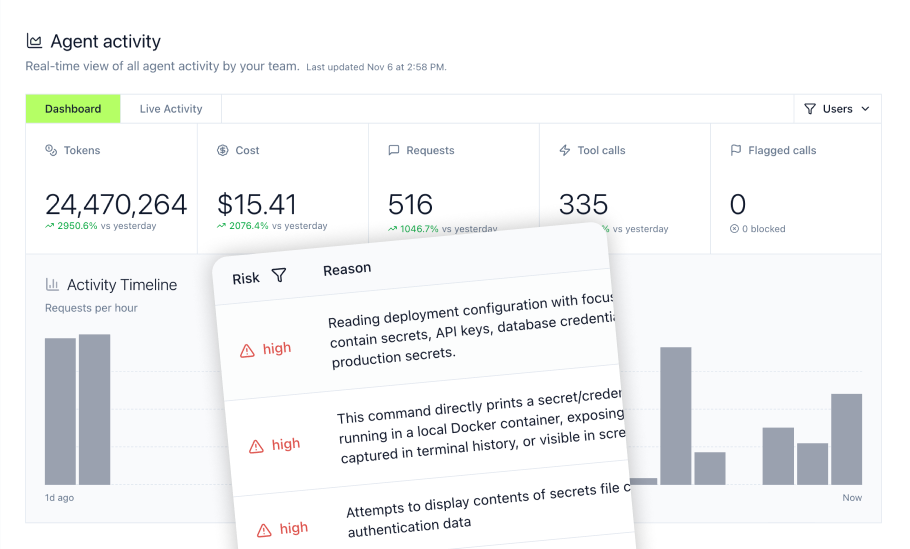
Agent Monitor addresses shadow AI through hooks in development tools. It provides real-time activity tracking to see agent actions across the organization including off-gateway usage, risk detection rules that flag PII exposure, credential leakage, risky commands, and prompt injection attempts, MDM integration to push detection or enforcement configurations to developer machines, and custom guardrails to define organization-specific policies with block, flag, or alert actions.
The Future: Orchestration and Management Converge
The market is separating orchestration and management as distinct categories. Interest in orchestration and management platforms is increasing as enterprises move more agent workflows into production and encounter new governance requirements.
Toward Unified Control Planes
The next evolution combines orchestration flexibility with management governance. Agents coordinate through preferred orchestration frameworks, management layers enforce security regardless of orchestration choice, protocol standardization through MCP and A2A enables interoperability, and unified audit streams capture activity across all agents and frameworks.
Preparing Your Organization
To position for this convergence:
- Evaluate orchestration and management separately: Understand which layer each vendor actually provides
- Adopt protocol-aware governance: Ensure your management layer understands MCP servers and tool calls, not just generic HTTP traffic
- Establish identity foundations: Implement per-agent identities before scaling deployment
- Build audit infrastructure: Create centralized logging that works across orchestration frameworks
MintMCP: Governed Agent Infrastructure for Enterprise Scale
MintMCP's Agent Gateway adds agent identities, scoped permissions, governed memory, and monitoring on top of its MCP Gateway foundation. It can complement orchestration frameworks when their tool access is routed through governed MCP connections.
Organizations using MintMCP's Agent Gateway gain several advantages. First, protocol-aware governance means MintMCP governs MCP traffic at the server and tool level, not just as generic HTTP traffic. This enables fine-grained policies like "allow database reads but block writes" that coarse-grained proxies cannot enforce. Second, Bundle-based deployment packages identity, tools, policies, and audit logging into single governance units that scale with your organization. Third, shadow AI detection through Agent Monitor reveals ungoverned agent activity and enforces guardrails in supported development environments.
The platform's credential architecture provides each agent with its own rotatable, revocable credentials. When an agent is decommissioned or compromised, you revoke its access without affecting other agents or human users. Policy-as-code capabilities enable pre-execution blocking, post-execution filtering, and risk-based flagging for traffic routed through MintMCP and activity captured in supported Agent Monitor environments.
MintMCP is SOC 2 Type II audited, compliant with HIPAA standards, and penetration tested. The architecture separates Agent Monitor for coding-agent activity from Custom Gateway Middleware for inline DLP enforcement, giving security teams visibility and control across the entire agent lifecycle. Enterprise customers can access full security documentation through the Trust Center and integrate MintMCP's audit streams with existing SIEM platforms.
As enterprises move from agent pilots to production deployment, the last-mile problem becomes clear: powerful orchestration is not enough without governed access to internal systems. MintMCP bridges that gap with the management layer that makes agents trustworthy at scale.
Frequently Asked Questions
How do I know if my organization needs an orchestration platform, a management platform, or both?
If your agents work independently on isolated tasks without accessing sensitive enterprise data, orchestration alone may suffice for coordination. However, the moment agents access production databases, customer information, internal systems, or regulated data, you need management capabilities including authentication, access control, and audit logging. Most enterprises deploying agents beyond pilots require both layers.
What happens when agents from different orchestration frameworks need to work together?
This requires distinguishing tool interoperability from agent-to-agent interoperability. MCP standardizes how AI applications connect to tools and context, while A2A is designed for communication between independent agent systems. A management layer can govern framework-neutral tool access only when the participating frameworks route those calls through its governed MCP endpoints.
Can I retrofit management capabilities onto an existing agent deployment?
Yes, though the approach depends on your current architecture. If agents connect to MCP servers, you can route traffic through a management gateway without rebuilding agents. For agents with embedded credentials or direct system access, you will need to migrate them to use the managed credential infrastructure. The Bundle model simplifies this by letting you onboard teams incrementally rather than requiring a big-bang migration.
How do management platforms handle the cost tracking problem for AI agents?
Management platforms can attribute governed tool calls, policy decisions, and resource usage to specific agents and teams. Model-token usage and chargeback usually require telemetry from the model provider or an LLM gateway, so an MCP or agent gateway should not be assumed to provide complete token-cost accounting unless the product explicitly documents it. Rate limits can still control governed tool usage and reduce runaway activity.
What role does the Model Context Protocol play in agent management?
MCP standardizes how AI applications connect to external tools and data sources, giving gateways a consistent place to inspect client-server messages and named tool calls. Read-versus-write enforcement depends on how each MCP server exposes its tools and parameters, so a gateway can enforce policies such as blocking database writes only when those operations are distinguishable and covered by configured rules.