Organizations deploying AI agents face a critical architectural decision that will determine their flexibility for years to come. Teams that hardcode provider APIs into their agent infrastructure can face substantial refactoring when they switch models, while well-abstracted systems can reduce much of the change to configuration, prompt validation, and regression testing. With foundation model capabilities shifting rapidly and pricing varying by orders of magnitude between providers, the ability to swap models without rebuilding agents has become a strategic imperative. An MCP Gateway keeps tool and data access governed across MCP-compatible AI clients, while a separate model abstraction layer handles provider switching. MintMCP's Agent Gateway builds on that foundation with agent identities, permissions, memory, and monitoring.
Key Takeaways
- Proper abstraction layers can turn many model changes into configuration and testing work instead of a full agent rebuild
- Portability makes it easier to compare models against the same evaluation suite, but it does not by itself solve agent quality or reliability
- Snowflake found that adding a plain-text data ontology improved answer accuracy by 20% and reduced average tool calls by about 39% in its tested data-agent setup
- Multi-model routing can reduce LLM costs when lower-cost models meet the required quality threshold for simpler tasks
- Several emerging declarative specifications aim to reduce framework coupling, but portability still depends on runtime and adapter support
- Governance and security must remain consistent during model transitions, requiring centralized policy enforcement independent of the underlying LLM
Understanding AI Agents and the Challenge of Model Interoperability
What Defines an Intelligent Agent in AI?
Modern AI agents combine large language models with tool access, memory, and orchestration logic to perform multi-step tasks autonomously. Unlike simple chatbots that respond to single prompts, agents maintain context across interactions, call external APIs, query databases, and execute workflows that span minutes or hours. This complexity creates deep dependencies on specific model providers, frameworks, and integration patterns.
The agent architecture typically includes four layers: the LLM that provides reasoning capabilities, the tool layer that connects to external systems, the memory layer that maintains context, and the orchestration layer that coordinates multi-step workflows. Each layer can create vendor lock-in if not designed for portability.
Why Model Lock-in Creates Enterprise Risk
When organizations build agents directly on provider SDKs, they create tighter coupling that can require substantial provider-specific refactoring when business needs change. An organization with significant monthly model spend cannot easily test whether another model would deliver comparable quality at lower cost. Teams discover too late that their "AI investment" was actually a framework-specific investment that limits future options.
The risk compounds as organizations scale. An enterprise with many agents built on a single framework can face substantial engineering work when that framework deprecates core features or when a better alternative emerges. Without portability, every model improvement in the market becomes a rebuild decision rather than a configuration change.
The Model Context Protocol (MCP): A Foundation for Tool Portability
How MCP Standardizes Agent-Tool Communication
The Model Context Protocol establishes a vendor-neutral standard for how AI agents communicate with tools and data sources. Rather than building custom integrations for each combination of LLM provider and external system, teams build MCP servers once and connect them to any MCP-compatible client. The protocol uses JSON-RPC 2.0 message encoding over UTF-8, supporting stdio for client-launched local servers and Streamable HTTP for remote servers. The older standalone HTTP+SSE transport was deprecated in the 2025 specification.
This standardization addresses what was previously the most brittle part of agent infrastructure: tool definitions. Before MCP, switching from one agent framework to another often required adapting or rewriting tool integrations. With MCP, a compatible tool server can be reused across Claude, ChatGPT, Gemini, Cursor, and custom agent builds, subject to each client's supported transport, authentication, and MCP feature set.
Evolution and Adoption of the MCP Standard
MCP adoption accelerated through 2025 and 2026, with support available across major AI assistants, coding tools, APIs, and agent platforms. The specification moved under the Agentic AI Foundation in December 2025, placing MCP under neutral Linux Foundation governance. OAuth support added to the MCP specification in March 2025 addressed earlier authentication limitations that had slowed enterprise adoption.
The ecosystem includes a growing number of MCP servers for common enterprise systems such as Salesforce, GitHub, Slack, HubSpot, Notion, Linear, and Snowflake. Teams leveraging Virtual MCPs can bundle multiple servers with role-based tool access, reducing configuration complexity for non-technical users while maintaining security boundaries.
Strategies for Decoupling Agents from Specific LLM Models
Using Abstraction Layers for Model Independence
The most reliable path to portability is building abstraction layers that separate agent logic from provider-specific implementations. Instead of calling the OpenAI SDK directly, portable agents call wrapper functions that route to whatever model the configuration specifies:
Hardcoded approach (creates lock-in):
- Direct provider SDK calls embedded throughout codebase
- Provider-specific prompt formatting
- Framework-native memory stores
Portable approach (enables flexibility):
- Model provider swappable via environment variable or config file
- Prompts written for conservative context windows (8K-16K)
- Memory stored externally in databases, not framework-proprietary stores
Teams that design for portability from day one avoid the technical debt that makes later migration painful. The upfront investment is minimal compared to the cost of a single forced migration.
Declarative Agent Specifications
Three emerging declarative specifications aim to improve agent portability:
Agent Spec (Oracle-backed) uses JSON Schema to define agent behavior, tools, constraints, and execution policies. Adapters exist for LangGraph, AutoGen, CrewAI, and other frameworks, supporting portability where the target framework and agent pattern are covered by an available adapter.
Agent Flavored Markdown (AFM) from WSO2 prioritizes human-readable, markdown-based agent definitions. Product teams can understand and modify agent instructions without deep engineering involvement, making agents versionable in Git alongside documentation.
Agent Format from Snap defines agent identity, capabilities, constraints, and execution policies using a POMDP-inspired schema. It supports patterns including parallel execution, conditional branching, and iterative refinement, but governance enforcement and audit behavior depend on the runtime implementing the specification.
Dynamic Model Routing for Cost Optimization
Organizations running high-volume agent workloads benefit from routing different query types to different models based on complexity, cost, and quality requirements. Simple queries route to faster, cheaper models like Gemini Flash, while nuanced reasoning tasks route to Claude Opus or GPT-4o.
This approach requires:
- Evaluation infrastructure with 20-50 test cases per agent type
- Classification logic to route queries appropriately
- Monitoring to track quality and cost across model variants
Multi-model routing can reduce cost, but savings and quality tradeoffs must be measured on the organization's own workloads.
Ensuring Security and Governance During Model Transitions
Maintaining Audit Trails Across Diverse Models
Model portability creates governance complexity when different agents use different providers. Security teams need unified visibility regardless of which LLM powers each agent. This requires centralized logging that captures prompts, tool calls, responses, and context with per-user attribution, independent of the underlying model.
MintMCP's security governance capabilities centralize audit logging for traffic that passes through MCP Gateway and supported Agent Monitor integrations. Configurable retention and export to SIEM platforms like Sentinel and Splunk ensure compliance teams have the audit trails they need regardless of which models the organization deploys.
Credential Management for Model-Independent Security
When each agent has its own credentials and scope, organizations stop worrying about what could go wrong and start focusing on what they can build. Per-agent identity with scoped credentials that rotate independently becomes critical as organizations run agents across multiple model providers.
Key credential management requirements:
- OAuth 2.0 client credentials or scoped bearer keys for autonomous agents, with SAML SSO used for human users and administrative access
- Short-lived M2M access tokens plus independently rotatable client secrets, with overlapping secrets for no-downtime cutovers
- Tool-level access control (e.g., enable database reads but block writes)
- Audit attribution at the individual agent level
Inline Policy Enforcement and Data Loss Prevention
Security policies must apply consistently regardless of which model processes data. Organizations with existing DLP investments need middleware that integrates inline at the gateway level, not within individual agents that may use different frameworks.
MintMCP supports custom policy code execution on matching Virtual MCP tool calls and supported Agent Monitor hook events, enabling integration with DLP solutions including AWS Bedrock Guardrails, Google Cloud DLP, Microsoft Purview, Nightfall, and Skyflow. Starter middleware templates support OpenAI moderation, jailbreak detection, and integrations with external DLP and guardrail services that can block or mask risky content before it reaches production systems.
Observability and Monitoring for Multi-Model Agent Deployments
Tracking Agent Actions Across Various Models
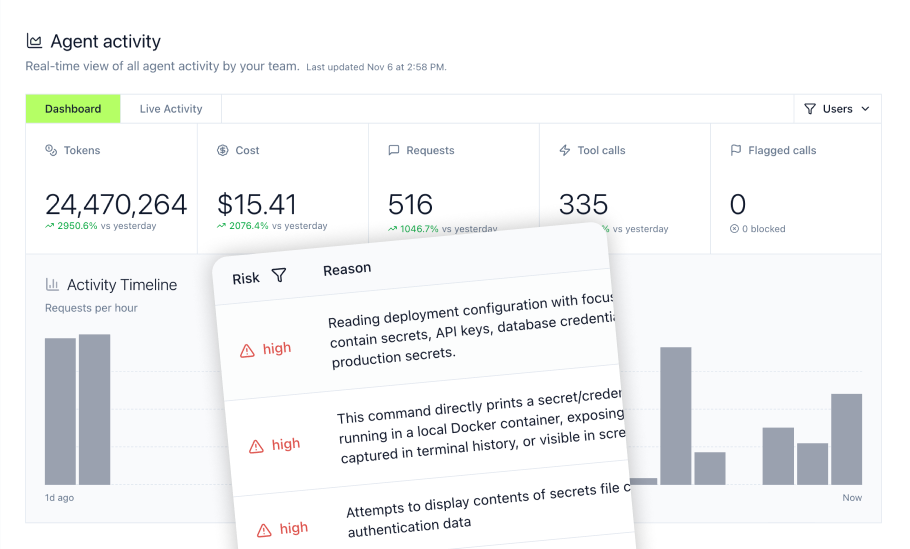
Unified observability becomes essential when agents run on multiple model providers. Agent Monitor provides real-time visibility into supported coding-agent activity, including credential leakage, risky bash commands, and prompt injection attempts. PII and DLP detection are configured through gateway middleware and external guardrail integrations.
Effective multi-model observability includes:
- Org-level analytics on MCP adoption and usage patterns by team
- Latency monitoring across different model providers
- Error tracking with provider-specific diagnostics
- Custom guardrail policies with block, flag, and alert actions
Identifying and Mitigating Shadow AI Risks
As organizations enable model portability, the risk of ungoverned "shadow AI" increases. Developers may test new models through unapproved channels, creating compliance gaps. Agent Monitor addresses this through hooks in Claude Code and Cursor that detect off-gateway MCP usage, providing visibility even into local non-MCP agent activity like bash commands and file reads.
MDM integration enables push of detect-only or enforce-mode configurations to developer machines, ensuring consistent policy application across the organization regardless of which models developers experiment with.
Performance Analytics for Optimized Model Selection
Data-driven model selection requires systematic benchmarking, not anecdotal testing. Organizations should:
- Create evaluation suites with 20-50 test cases per agent type
- Run benchmarks against current models weekly
- Test new models before migrating (monthly or on release)
- Track cost per task alongside quality metrics
Snowflake's controlled test found that context-layer improvements can materially affect results even without changing the model. Its data ontology improved accuracy by 20% and reduced average tool calls by about 39% in the tested setup. Before switching models, teams should ensure their semantic layer is optimized.
Building Your Portability Roadmap
Phase 1: Assessment (Week 1-2)
Audit current agent architecture to identify framework dependencies, tool definitions, and memory storage patterns. Document which agents would require complete rebuilds versus configuration changes to switch models. Prioritize agents by business impact and migration complexity.
Phase 2: Abstraction Layer (Week 3-5)
Implement model abstraction for highest-priority agents. Convert tool definitions to MCP format. Migrate memory storage to external databases if currently using framework-native stores. Build evaluation suites with representative test cases.
Phase 3: Governance Foundation (Week 6-8)
Deploy centralized governance regardless of framework choice. Configure SSO, RBAC, and audit logging. Integrate with existing DLP and SIEM infrastructure. Establish policies for model testing and approval.
Phase 4: Continuous Optimization (Ongoing)
Run weekly evaluations against current models. Benchmark new models monthly. Implement multi-model routing for high-volume workloads. Track cost, quality, and latency metrics to inform model selection decisions.
Organizations that complete this roadmap should be able to reduce framework-specific rework, but migration time will depend on adapter coverage, prompt differences, memory design, and testing requirements.
How MintMCP Enables Production-Ready Agent Portability
Portable agents need more than model abstraction. They also need governance that remains consistent as teams change models, frameworks, and deployment patterns.
MintMCP separates these responsibilities into two connected layers:
- The MCP Gateway governs tool and data connections for Claude, Cursor, ChatGPT, Gemini, and Copilot.
- The Agent Gateway adds agent-specific controls, including:
- Per-agent identities with independently rotatable credentials
- Scoped tool-level permissions
- Centralized memory that follows Git-like principles
- Monitoring across gateway traffic and supported Agent Monitor integrations
This separation allows teams to test new models, switch providers, and adopt emerging frameworks without rebuilding their tool-governance infrastructure.
For traffic that continues through the same configured gateway paths, teams can retain consistent:
- Tool authentication and authorization
- Audit logging and attribution
- DLP and guardrail policies
- Agent-level access controls
Model changes still require validation. Teams may also need to update privacy assessments, vendor reviews, data-flow documentation, and other compliance records based on the new provider.
With model abstraction at the application layer and governance at the gateway layer:
- Security teams maintain centralized visibility
- Engineering teams can evaluate new models with less infrastructure rework
- Finance teams can use multi-model routing without bypassing established controls
MintMCP is SOC 2 Type II audited. Supporting security and compliance documentation is available through its Trust Center.
Frequently Asked Questions
How do I handle agent memory when switching between frameworks?
Agent memory creates the most common portability trap. When memory lives in framework-proprietary stores, migration means losing all accumulated context. Store memory externally in PostgreSQL, Redis, or purpose-built vector databases from the start. MCP memory servers provide framework-agnostic memory access that works across LangGraph, LlamaIndex, and custom implementations. For existing agents with framework-native memory, plan a parallel migration period where the agent writes to both old and new stores before cutover.
What evaluation metrics should I track when comparing models?
Beyond basic accuracy, track task completion rate (did the agent achieve the goal?), tool call efficiency (fewer calls for the same outcome indicates better reasoning), latency percentiles (p50, p95, p99), cost per successful task, and failure mode distribution. Create golden datasets with known-good outputs for regression testing. Weight metrics by business impact: a 10% latency improvement matters more for customer-facing agents than internal tools.
Can I use different models for different agents in the same organization?
Yes, and this approach often optimizes both cost and capability. Route simple classification tasks to faster, cheaper models while reserving expensive frontier models for complex reasoning. The key requirement is unified governance that applies consistent security policies regardless of model. Per-agent identity through solutions like Agent Bundles ensures each agent has appropriate permissions and audit attribution regardless of its underlying model.
How do I manage prompts when models interpret instructions differently?
Write prompts for the lowest common denominator of capability, then add model-specific optimization layers if needed. Avoid provider-specific tags and formatting. Keep instructions explicit rather than relying on model-specific behaviors. Test every prompt against at least two model families before deployment. Maintain prompt variants in version control with clear documentation of which models each variant supports.
What compliance documentation do auditors need for multi-model deployments?
Organizations should document that governance controls operate consistently across model changes. Auditors require evidence that security controls apply consistently regardless of model. Document your governance layer's authentication and authorization flows, show which gateway calls and supported Agent Monitor events are captured, attributed, retained, and exported, and demonstrate that data loss prevention policies apply at the gateway level before reaching any model.