Roo Code was an open-source AI coding assistant that operated as a VS Code extension, offering autonomous coding capabilities with extensive configurability. The extension shut down on May 15, 2026, and its archived repository currently shows about 24,400 GitHub stars. For organizations deploying AI coding tools like Roo Code or its active forks, the core challenge remains unchanged: these agents require broad filesystem access, terminal execution rights, and credentials to function, creating security exposure that individual tools cannot self-manage. Enterprise teams need an MCP gateway to provide centralized authentication, tool-level access control, and audit logging for governed MCP traffic. MintMCP's Agent Gateway builds on that foundation with agent identities, permissions, memory, and monitoring, while Agent Monitor extends visibility and policy enforcement to supported local coding-agent activity.
This article covers what Roo Code is, how to set it up, its key features, and the enterprise controls necessary for secure and governed use of AI coding assistants in production environments.
Key Takeaways
- Roo Code accumulated 3+ million VS Code installations before shutdown, with Zoo Code continuing as a community fork and Kilo Code providing an actively developed migration path for former Roo Code users
- Roo Code accumulated multiple published command-injection and RCE vulnerabilities, including CVE-2026-30307, a critical command-injection flaw in its auto-approval module
- API costs could vary substantially with model choice, task complexity, and retry loops, creating a need for usage visibility and cost attribution
- Roo Code's multi-mode architecture (Architect, Code, Debug, Ask, Orchestrator) enabled task delegation across specialized agents with different models and permissions per mode
- The shutdown and migration ecosystem, including Zoo Code and Kilo Code alongside Cline, the upstream project Roo originally forked from, demonstrates vendor lifecycle risk and reinforces the value of vendor-neutral governance
- Enterprise deployments require integration with AI gateways for centralized policy enforcement, PII detection, credential management, and compliance audit trails
Understanding Roo Code: AI Coding Assistants and the Model Context Protocol
Roo Code represented the "power user" segment of AI coding assistants. Unlike turnkey solutions that prioritize ease of use, Roo Code offered maximum configurability: custom agent modes, support for many AI model providers through native integrations and OpenAI-compatible endpoints, and local model deployment via Ollama.
What Made Roo Code Different
The tool distinguished itself through its model-agnostic architecture. Developers could bring their own API keys (BYOK model) and connect to Anthropic, OpenAI, Google, AWS Bedrock, Azure, or local models without vendor lock-in. This flexibility came with tradeoffs: configuration power was both its draw and its barrier.
Roo Code's open-source nature allowed security teams to audit the codebase before deployment. Using Roo Code with local models could keep model inference on local infrastructure, but data locality still depended on the full configuration, including any remote model providers, MCP servers, and external services.
The MCP Connection
AI coding assistants like Roo Code can use the Model Context Protocol (MCP) to connect to external tools and services. Roo Code's built-in file, terminal, and editor capabilities did not depend on MCP. MCP provides a standardized way for AI systems to connect to external data sources and tools. However, MCP connections create security surface area: every tool an agent can call represents a potential data exposure or unauthorized action.
For enterprises, this means AI coding tools cannot operate safely in isolation. They need governance infrastructure that provides authentication, access control, and audit logging at the protocol level.
Setting Up Roo Code: From Local Installation to Enterprise Deployment
Quick Start: VS Code Extension Installation
The basic Roo Code setup involved installing the VS Code extension, configuring an API key, and selecting an AI provider. For individual developers testing the tool, this process took minutes.
Configuration files controlled:
- Model selection: Which AI provider and model to use for each task type
- Temperature and token limits: Fine-tuning response behavior
- Context management: How much codebase context to include in prompts
- Permission settings: Which file operations require approval
Local Model Configuration
For teams requiring data residency or cost control, Roo Code supported local models through Ollama integration. Roo Code supported local models through Ollama, including Qwen2.5-Coder variants. Performance depended heavily on model size, quantization, hardware, and context length.
Local inference can eliminate paid model API charges, but it still carries hardware, electricity, and operational costs.
Enterprise Deployment Requirements
Moving from individual developer use to team-wide deployment introduces governance requirements that the tool itself cannot address:
- Centralized authentication: SSO integration replacing per-user API key management
- Access control: Defining which teams can access which AI capabilities
- Credential management: Secure storage and rotation of API keys and OAuth tokens
- Audit logging: Complete records of what agents accessed and modified
- Cost attribution: Tracking spend by team, project, or individual
MintMCP's security governance capabilities address these gaps by providing a control layer between AI coding tools and the resources they access.
Essential Features of Roo Code for Developer Productivity
Multi-Mode Architecture
Roo Code's defining feature was its multi-mode system:
- Architect Mode: Planning and design with read and MCP access, plus restricted editing limited to Markdown files
- Code Mode: Implementation with full file system and terminal access
- Debug Mode: Diagnostic focus with logging and error analysis
- Ask Mode: Questions and explanations without file modification
- Orchestrator Mode: Task delegation across other modes
Each mode could be assigned to different AI models. A typical configuration might use a reasoning model (like o3) for architecture decisions while using a faster model (like Claude Sonnet) for implementation.
Boomerang Task Coordination
The Orchestrator mode enabled multi-agent workflows where complex tasks were automatically broken down and delegated to specialized modes. Architecture work could be delegated to Code mode for implementation and, if configured, to a custom security-review mode.
This coordination pattern reduced context-switching overhead but introduced complexity for governance: tracking which mode made which decision and what data each accessed.
Memory and Context Management
Roo Code supported persistent project context through user-managed files, rules, and custom instructions, but it did not ship a built-in cross-session Memory Bank as a standard feature. Teams that wanted durable project memory had to implement their own file-based conventions or external memory workflows.
When teams add persistent agent memory, it becomes a governance concern. Who owns agent memory? How is it audited? Can it be exported if you change tools? MintMCP's Agent Gateway treats memory as company-owned infrastructure with scoped access, version history, reviewability, auditability, portability, and Git-like principles.
Enterprise Controls for Secure AI Coding
The Security Gap in AI Coding Tools
Roo Code implemented file exclusion patterns (.rooignore, .gitignore), permission-based approval gates, and open-source auditability. Despite these measures, multiple security advisories and CVEs were published, including:
- CVE-2025-58370: High-severity command injection risk in auto-approved command parsing through Bash parameter expansion and indirect references
- CVE-2026-30307: Critical command injection flaw affecting Roo Code's auto-approval module
The vulnerability pattern shows why enterprises may need controls beyond the coding tool itself. MCP gateways can govern MCP-routed tool calls, while local agent actions such as file reads and shell commands require agent-level monitoring and policy controls.
Permission Models and Their Limits
Roo Code's permission system used approval prompts for file writes, deletions, and terminal commands by default, while configurable auto-approval settings allowed selected actions to proceed without manual confirmation. This approval-based model has fundamental limitations:
- Approval fatigue: Developers approve requests reflexively after the tenth prompt
- Context blindness: Approvers cannot evaluate whether a request is appropriate without full context
- Automation incompatibility: Human-in-the-loop approval breaks autonomous workflows
Enterprise governance requires policy-based controls that apply consistently without human intervention. MintMCP's Bundle architecture addresses this by packaging tool access, policy enforcement, and audit logging into governance units that apply automatically based on role and use case.
Credential Management Challenges
The BYOK model created credential sprawl. Each developer managed their own API keys, with no centralized visibility into:
- Which keys were active
- What permissions each key carried
- When keys were last rotated
- Who had access to which credentials
Gateway-level credential management provides centralized storage, automatic rotation, and per-agent scoping so credentials can be revoked without disrupting other users.
Integrating Roo Code with Development Tools
IDE and Editor Support
Roo Code operated as a VS Code extension with support for the broader VS Code ecosystem. Integration with development tools followed standard patterns:
- Git integration: Version control operations through terminal commands
- Debugging: Debug Mode for systematic troubleshooting, log analysis, and error diagnosis
- Terminal access: Full shell command execution capability
CI/CD Pipeline Connections
Development workflow automation required connecting Roo Code to external systems: GitHub for version control, Jira for issue tracking, and CI/CD pipelines for deployment. Each connection introduced additional credentials and access surfaces.
For organizations running multiple AI tools (Cursor, GitHub Copilot, Claude Code alongside Roo Code or its forks), MintMCP provides unified governance across tools rather than per-tool configuration.
API and SDK Integration
Programmatic management of Roo Code configurations enabled infrastructure-as-code workflows. Teams could version control their AI tool configurations alongside application code, enabling reproducible environments and change tracking.
Securing Roo Code: Preventing Shadow AI and Data Leakage
The Shadow AI Problem
AI coding tools operate on developer machines with access to codebases, credentials, and internal systems. When developers install and configure these tools independently, organizations lose visibility into:
- Which AI tools are in use
- What data they access
- What actions they perform
- Whether they comply with security policies
This shadow AI phenomenon mirrors the shadow IT problem of the previous decade but with higher stakes: AI agents can access, transform, and transmit data autonomously.
Detection and Monitoring
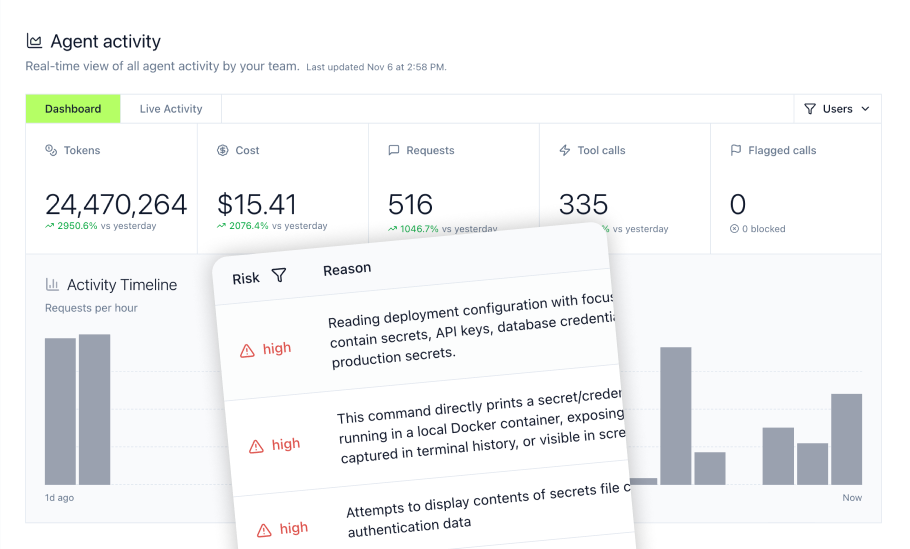
MintMCP's Agent Monitor tracks agent activity in real-time across the organization, including MCP calls made outside the gateway through hooks in Cursor and Claude Code. The monitoring layer detects:
- PII exposure in agent context
- Credential leakage (API keys, tokens in prompts)
- Risky bash commands
- Prompt injection attempts
MDM integration enables pushing detect-only or enforce-mode configurations to developer machines for consistent policy application across the organization.
Data Loss Prevention Integration
Enterprise deployments require connecting AI governance to existing DLP infrastructure. Policy enforcement needs to intercept agent requests, apply DLP rules, mask or block sensitive data, and log the action for audit.
MintMCP's middleware layer integrates with AWS Bedrock Guardrails, GCP DLP, Microsoft Purview, Nightfall, and Skyflow for inline content inspection and remediation.
Roo Code for Enterprise: Compliance, Auditing, and Governance at Scale
Compliance Requirements for AI Tools
Regulated industries face specific requirements for AI coding tool deployments:
SOC 2: A SOC 2 Type II report evaluates controls at a service organization over a defined period. Using a SOC 2-audited gateway can support an organization's control environment, but it does not by itself satisfy the customer's SOC 2 audit requirements.
HIPAA: Healthcare deployments handling PHI must meet applicable HIPAA Privacy and Security Rule obligations, including appropriate safeguards and BAAs where required. HHS guidance permits covered entities and business associates to use cloud services to process or store ePHI when applicable HIPAA requirements are met.
GDPR: European deployments must address lawful processing, data-subject rights, privacy by design, retention, and applicable international-transfer requirements. GDPR does not impose a blanket requirement that personal data be processed only in EU regions.
MintMCP is SOC 2 Type II audited with continuous compliance monitoring. Customers handling protected health information can request HIPAA documentation, and MintMCP signs BAAs.
Audit Trail Architecture
Compliance investigations require complete records showing who invoked which agent, what files were accessed or modified, which AI model processed the request, cost attribution, and security policy violations.
MintMCP's conversation-level logging captures prompts, tool calls, responses, and context with per-user attribution, configurable retention, and export to SIEM platforms including Sentinel and Splunk.
Zero-Trust Architecture for AI
Traditional security models assume trust within the network perimeter. AI agents require zero-trust architecture with no default access assumptions and mandatory authentication and authorization per request.
MintMCP's Bundle model implements this by requiring explicit permission grants for every tool and resource an agent can access, with policy evaluation on every call.
Optimizing Workflows: Use Cases and Time Savings
Development Workflow Automation
Roo Code could improve developer throughput on suitable tasks by automating repetitive coding work. Common productivity gains came from:
- Boilerplate reduction: Generating repetitive code structures automatically
- Code review assistance: Pre-screening code for common issues
- Documentation generation: Creating docs from code comments and structure
- Refactoring support: Suggesting and implementing code improvements
Cost-Benefit Analysis
API costs varied with model choice, task complexity, and retry behavior. Complex refactoring and repeated retries could make costs less predictable.
This cost volatility creates a need for usage monitoring and cost attribution. MintMCP Agent Monitor can estimate costs from supported agent telemetry, while hard budget limits should be enforced through the relevant model provider or billing controls.
Multi-Agent Workflow Efficiency
The Orchestrator mode supported coordination across specialized modes. Teams could configure separate modes for architecture, implementation, security review, and documentation, assigning different models and permissions to each. Roo Code's built-in Orchestrator delegated subtasks, while any security-review stage or workflow-specific outcome depended on how the team configured its custom modes.
The Post-Roo Code Landscape
Shutdown and Fork Ecosystem
Roo Code announced its shutdown on April 21, 2026, and the extension and repository were shut down and archived on May 15, 2026. The team stated "we don't believe IDEs are the future of coding" and pivoted to a cloud-based agent.
The community responded immediately:
- Zoo Code is a community fork of Roo Code and is listed by the archived Roo repository as an alternative
- Kilo Code provides a migration path for Roo Code users and continues active development
- Cline is the upstream project Roo Code originally forked from and remains an alternative
Vendor Lifecycle Risk
The Roo Code shutdown demonstrates a critical enterprise concern: vendor lifecycle risk. Organizations that built workflows around Roo Code faced migration disruption when the tool pivoted away from their use case.
MintMCP's vendor-neutral governance approach provides consistent governance for MCP traffic that continues through its MCP Gateway, while Agent Monitor adds local activity monitoring for supported coding agents. This can preserve gateway-side policies and audit history as teams change AI tools.
What This Means for Enterprise Teams
The post-shutdown landscape of community forks, migration paths, and related alternatives means enterprises may run heterogeneous AI tool environments. Unified governance, monitoring, and policy enforcement across tools becomes essential rather than optional.
MintMCP: Enterprise Governance for AI Coding Assistants
The Roo Code story illustrates why enterprises need governance infrastructure that outlives individual tool choices. When coding assistants shut down, pivot, or fragment into forks, organizations can lose context, audit history, and workflow continuity without a vendor-neutral control layer.
MintMCP separates tool access from agent governance through two connected layers:
- MCP Gateway: Governs data and tool connections for Claude, Cursor, ChatGPT, Gemini, and Copilot with centralized authentication, tool-level access control, and audit logging for MCP-routed traffic.
- Agent Gateway: Extends governance to agent identities, permissions, memory, and monitoring.
For long-running agents that retain context and operate alongside employees, MintMCP treats memory as enterprise infrastructure that is:
- Company-owned
- Scoped by user, team, or organization
- Versioned and reviewable
- Auditable and portable
- Managed using Git-like principles
Agent Monitor extends visibility and policy enforcement to supported local coding-agent activity, including detection of PII exposure, credential leakage, risky commands, and prompt injection attempts.
Together, these layers help decouple governance from individual coding tools. MCP traffic that continues through MintMCP can retain consistent gateway-side access controls and audit policies as teams change tools, while local Agent Monitor coverage depends on support for MintMCP's monitoring hooks.
Frequently Asked Questions
How does Roo Code differ from Cursor and GitHub Copilot?
Roo Code targeted power users who prioritized configurability over ease of use. While Cursor and GitHub Copilot offer polished onboarding experiences and managed infrastructure, Roo Code provided granular control over model selection, mode configuration, and local deployment options. The tradeoff was setup complexity and active security management responsibilities.
Can I still use Roo Code after the shutdown?
The original Roo Code repository is archived and no longer maintained. However, the Zoo Code community fork continues active development, while Kilo Code provides an actively developed migration path for existing Roo Code users. Cline, the upstream project Roo Code forked from, also remains an option. Any fork usage requires careful security evaluation since vulnerability patches may not carry forward.
What local models work best with Roo Code forks?
Roo Code supported local models through Ollama, including Qwen2.5-Coder variants. Performance depended heavily on model size, quantization, hardware, and context length. Local inference can eliminate paid model API charges and support data-locality goals, but whether a deployment satisfies specific data residency requirements depends on the full infrastructure and service configuration.
How do enterprise teams manage API cost variability?
MintMCP Agent Monitor provides usage and cost visibility where supported by client telemetry, including estimated cost by user, model, and session. Teams can use this data for chargeback, anomaly detection, and optimization alongside provider-side budget controls.
What should I evaluate when choosing between AI coding tools?
Key evaluation criteria include security posture (documented vulnerabilities, permission model), governance capabilities (SSO, RBAC, audit logging), cost predictability (pricing model, spend tracking), integration support (IDE compatibility, CI/CD connections), and vendor stability (funding, roadmap clarity). For enterprise deployments, governance infrastructure requirements often matter more than individual tool features since you need controls that work across all tools your developers use.