Data-driven insights revealing why centralized governance, security controls, and audit infrastructure determine AI agent deployment success or failure
AI agents are transforming enterprise operations—but adoption without governance creates substantial risk. The difference between success and failure comes down to risk management infrastructure. MCP Gateway addresses this gap by providing centralized governance, complete audit trails, and OAuth protection that transform experimental AI tools into production-ready systems. This analysis examines market dynamics, security vulnerabilities, governance deficits, ROI potential, and implementation challenges shaping enterprise AI agent risk management.
Key takeaways
- Market growth demands governance infrastructure – The AI agent market is projected to reach $42.7 billion by 2030 at 41.5% CAGR, making risk controls essential at scale
- Security gaps create exposure – 30% of cyberattacks exploited public-facing applications, while credential-based attacks comprised another 30% of incidents
- Governance frameworks lag adoption – Only 16% of organizations have developed a strategy and roadmap for AI agent implementation
- Trust is declining despite investment – Trust in fully autonomous AI agents declined significantly year-over-year
- Infrastructure readiness is low – 82% of organizations lack mature AI infrastructure for secure deployment
Market growth and adoption statistics
1. The AI agent market is projected to reach $42.7 billion by 2030, expanding from $5.32 billion in 2025
Market research confirms explosive growth in AI agent technology, with the market expanding eightfold over five years. This trajectory reflects mainstream enterprise adoption as organizations recognize automation potential across customer service, development workflows, and data analysis. The scale of investment makes risk management infrastructure a strategic priority—deploying agents without governance at this scale creates enterprise-wide exposure that compounds with each new implementation.
2. AI agent market demonstrates 41.50% compound annual growth rate through 2030
The sustained 41.5% CAGR substantially exceeds most enterprise software categories, reflecting urgent demand for AI-powered automation. This growth rate indicates that organizations delaying governance infrastructure will face exponentially larger challenges as agent deployments multiply. Early investment in centralized control planes like MintMCP pays dividends as the agent footprint expands.
3. 79% of organizations report at least some level of AI agent adoption
Survey data reveals near-universal AI agent exploration across enterprises. This widespread adoption creates a critical governance challenge: most organizations operate without unified visibility into which agents are deployed, what data they access, or which actions they perform. The gap between adoption and governance represents significant operational and compliance risk.
4. 88% of organizations regularly use AI in at least one business function
McKinsey research confirms AI has moved from experimental to mainstream business infrastructure. Customer service, development, and data analysis represent the highest-adoption functions due to clear productivity gains. However, regular usage without centralized monitoring creates shadow AI environments where tools operate as black boxes with zero telemetry and uncontrolled access.
5. Only 14% of organizations have implemented AI agents at partial or full scale
Despite widespread interest, Capgemini research shows only 14% achieved scaled deployment—12% at partial scale and 2% at full scale. The gap between experimentation and production reflects infrastructure challenges: lack of authentication frameworks, missing audit capabilities, and inadequate security controls prevent teams from moving beyond pilots. This is precisely why solutions providing one-click deployment accelerate time-to-production.
6. AI agents could generate $450 billion in economic value by 2028
Economic projections quantify the massive upside available to organizations that successfully scale AI agents with proper governance. The value distribution favors early movers who build robust risk management foundations—capturing this potential requires infrastructure that enables scale without proportional risk expansion.
Security and risk statistics
7. 30% of cyberattacks involved exploitation of public-facing applications in 2024
IBM X-Force data reveals public-facing applications as a primary attack vector. AI agents connecting to external data sources and APIs expand this attack surface significantly. Without OAuth protection and access controls, each agent deployment creates new vulnerability points that attackers actively exploit.
8. 30% of incidents involved use of valid account credentials as initial access vector
Credential-based attacks matched application exploitation as the top attack method. AI agents with access to credentials, API keys, and authentication tokens represent high-value targets. MintMCP's LLM Proxy blocks access to .env files, SSH keys, and sensitive configuration to prevent credential harvesting from AI tool environments.
9. 84% increase in infostealers delivered via phishing emails per week in 2024
The surge in credential-stealing malware creates heightened risk for AI agents with system access. Agents executing bash commands, reading files, and accessing production systems without monitoring operate in environments where compromised credentials can enable extensive damage before detection. Real-time tool call tracking becomes essential for identifying anomalous behavior.
10. 51% of organizations using AI have experienced at least one negative consequence
McKinsey data reveals that most organizations already deploying AI have encountered problems—from data leakage to compliance violations to operational disruptions. The majority experiencing negative outcomes validates the need for proactive risk management rather than reactive remediation after incidents occur.
11. Over 3,100 data breach incidents occurred in the u.S. In 2024
Breach volume data demonstrates the scale of security challenges enterprises face. AI agents with data access amplify breach potential by providing attackers additional pathways to sensitive information. Complete audit observability enables organizations to track exactly what data each agent accesses and when.
12. 35% identify cybersecurity risks as the primary barrier to agentic AI adoption
Adoption research confirms security concerns block over one-third of organizations from advancing AI agent deployments. This barrier reflects legitimate risk assessment—but also represents opportunity cost. Organizations with proper security infrastructure like SOC2-certified gateways can advance confidently while competitors remain stalled by unaddressed security gaps.
Governance and compliance statistics
13. Only 16% of organizations have developed a strategy and roadmap for implementing AI agents
Strategic planning data reveals that the vast majority deploy AI agents without formal governance frameworks. Ad-hoc deployment creates inconsistent security postures, scattered credentials, and compliance blind spots. A centralized MCP Gateway architecture enforces consistent policies across all agent deployments.
14. Only 14% of organizations have fully integrated ethical AI principles into decision-making
Ethics integration research shows most organizations lack systematic approaches to AI governance. Without embedded principles, risk decisions happen inconsistently across teams and deployments. Centralized policy enforcement through tool governance ensures consistent application of access controls and usage policies.
15. 60% of organizations do not fully trust AI agents to manage tasks autonomously
Trust survey data reveals majority skepticism about autonomous AI operations. This trust deficit limits deployment scope and ROI potential. Organizations build trust through visibility—complete audit trails showing every tool invocation, command execution, and data access enable confidence that agents operate within acceptable boundaries.
16. Trust in fully autonomous AI agents declined from 43% in 2024 to as low as 27% in 2025
Year-over-year trust data shows confidence eroding despite adoption growth. The decline reflects organizations experiencing negative consequences from ungoverned deployments. Rebuilding trust requires demonstrable control—real-time dashboards, security alerts, and audit logs that prove agents operate safely.
Performance and ROI statistics
17. Companies report average ROI of 171% from agentic AI implementations
ROI research confirms substantial returns for organizations with successful implementations. U.S. enterprises achieve around 192% average ROI. These returns require governance infrastructure that enables scale—organizations achieving high ROI deploy agents broadly rather than limiting scope due to security concerns.
18. 66% of organizations adopting AI agents report increased productivity
Productivity data validates AI agent value proposition across diverse implementations. The productivity gains stem from agents handling routine tasks, freeing human workers for complex problems. Maximizing these gains requires deploying agents across functions—which requires governance infrastructure supporting broad deployment.
19. 57% report cost savings from AI agent implementation
Cost reduction data demonstrates direct financial impact from AI agent deployment. Savings compound as organizations expand agent coverage. Governance infrastructure enables this expansion by reducing the marginal cost of securing each new agent deployment through centralized controls.
20. Autonomous workflow execution can reduce costs up to 70%
Automation research projects significant savings potential for fully autonomous operations. Achieving this reduction requires trust in autonomous execution—which depends on comprehensive monitoring and control capabilities. Organizations cannot realize full automation potential while limiting agent autonomy due to governance gaps.
Infrastructure and readiness statistics
21. Only 18% of organizations report high data-readiness across all dimensions
Data readiness research reveals widespread infrastructure gaps blocking AI agent success. Data quality, integration, and governance deficits prevent agents from accessing information needed for effective operation. Connectors like Snowflake integration bridge data access gaps with proper authentication and access controls.
22. 82% of organizations lack mature AI infrastructure
Infrastructure maturity data indicates most organizations operate with inadequate foundations for scaled AI deployment. The immaturity spans authentication systems, monitoring capabilities, and governance frameworks. Organizations addressing infrastructure gaps early gain sustainable competitive advantages as agent deployments multiply.
23. Only 9% of organizations are fully prepared in data integration and interoperability
Integration readiness research shows data connectivity as a critical bottleneck. AI agents require access to databases, APIs, and enterprise systems to deliver value. Pre-built database connectors with enterprise authentication accelerate integration timelines from months to days.
Future projections
24. 93% of executives believe organizations scaling AI agents in the next 12 months will gain competitive advantage
Executive survey data reflects near-universal recognition that AI agent deployment creates competitive differentiation. The urgency to scale drives demand for infrastructure enabling rapid, secure deployment. Organizations deploying in days rather than months capture first-mover advantages in their markets.
25. 33% of enterprise applications expected to feature agentic AI by 2028
Application integration projections indicate AI agents will become embedded across enterprise software, up from less than 1% in 2024. This trajectory transforms AI agent governance from optional to mandatory—organizations must prepare infrastructure now for the coming explosion in agent touchpoints across their technology stacks.
Strategic implementation insights
Successful AI agent risk management requires infrastructure that scales with deployment expansion. Organizations achieving substantial ROI share common characteristics: centralized authentication, complete audit trails, and real-time monitoring across all agent deployments.
Here's how to build effective risk management infrastructure:
- Deploy a centralized gateway – Route all MCP connections through a unified control plane providing authentication, logging, and policy enforcement
- Implement OAuth protection automatically – Eliminate manual credential management by wrapping MCP servers with SSO integration
- Establish complete audit trails – Track every tool invocation, bash command, and file access for compliance and security review
- Block dangerous operations in real-time – Prevent access to sensitive files, credentials, and risky commands before execution
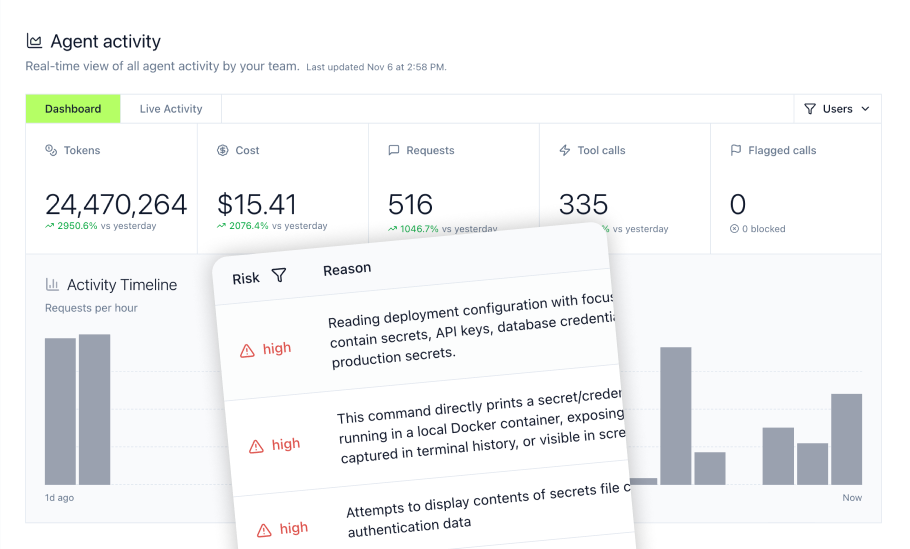
- Monitor continuously – Deploy dashboards showing server health, usage patterns, and security alerts across all agents
The path from experimental AI to production-grade deployment runs through governance infrastructure. Organizations following the MintMCP implementation approach deploy enterprise-ready AI tools in minutes rather than months—turning shadow AI into sanctioned AI without disrupting developer workflows.
Frequently asked questions
How does MintMCP address 'shadow AI risks?
MintMCP provides centralized visibility into all MCP tool usage across Claude Code, Cursor, ChatGPT, and other AI clients. The platform tracks every tool call, monitors file access, and provides complete audit trails. This transforms ungoverned shadow AI into sanctioned deployments with enterprise security controls and compliance documentation.
What key metrics should organizations track for AI agent risk management?
Focus on tool invocation patterns, data access logs, command execution history, and authentication events. Track which MCPs are installed across teams, monitor usage patterns for anomalies, and maintain audit trails for compliance. Real-time dashboards enable continuous monitoring of these metrics across all agent deployments.
Is MintMCP compliant with industry regulations like SOC2 HIPAA and GDPR?
MintMCP Gateway is SOC2 Type II certified with HIPAA compliance options and GDPR-compliant audit trails. The platform provides complete logs satisfying regulatory evidence requirements, data residency controls for regional compliance, and enterprise SSO integration with SAML and OIDC identity providers.
How can HR and finance teams deploy AI agents with proper risk controls?
Both teams benefit from Virtual MCPs that expose only minimum required tools with role-based access controls. Finance teams accessing Snowflake data warehouses through governed connections maintain audit trails for financial reporting compliance. HR teams query knowledge bases through read-only access patterns that prevent unauthorized data modification.
How long does IT take to deploy MintMCP for risk management?
MintMCP provides one-click deployment for STDIO-based MCP servers with automatic OAuth protection. Organizations deploy production-ready infrastructure in minutes rather than months. The platform includes pre-configured policies, centralized credential management, and immediate monitoring capabilities.