Data-driven insights revealing why enterprise AI deployments demand robust security, governance, and centralized control—and the mounting costs of getting it wrong
Enterprise AI adoption has exploded, but security infrastructure has failed to keep pace. Organizations face a stark reality: 97% of organizations that reported an AI-related breach said they lacked proper AI access controls. Shadow AI proliferates unchecked across departments while security teams struggle to gain visibility into what tools employees use and what data those tools access. MintMCP's MCP Gateway addresses this gap by providing centralized governance, OAuth protection, and complete audit trails for all AI tool interactions—transforming ungoverned AI deployments into production-ready infrastructure. This comprehensive analysis examines market growth, breach statistics, governance gaps, and the financial case for enterprise-grade AI security.
Key takeaways
- AI adoption outpaces security – Enterprise AI/ML tool usage surged over 3,000% year-over-year, yet 90% of organizations lack maturity to counter AI-enabled threats
- Governance gaps drive breaches – 63% of organizations lack AI governance policies, and 97% of breached organizations had inadequate access controls
- Shadow AI costs are quantifiable – Shadow AI breaches add $670,000 to average breach costs compared to organizations with proper oversight
- Security automation delivers ROI – Organizations using AI and automation extensively save $1.9 million in average breach costs
- Market validation is clear – The AI cybersecurity market reached $30.92 billion in 2025, growing at 22.8% CAGR through 2030
The landscape of AI adoption: What the numbers say
1. Enterprises blocked 59.9% of all AI/ML transactions due to security concerns
The near-60% block rate demonstrates that current enterprise responses to AI adoption often default to restriction rather than enablement. This approach creates friction that drives employees toward unsanctioned tools and workarounds. Effective AI security requires enabling productive AI usage while maintaining governance—precisely what enterprise MCP deployment infrastructure provides.
2. 89% of IT leaders state AI models in production are critical to their organization's success
Leadership recognition of AI's strategic importance underscores why security cannot simply block AI adoption. The criticality of AI to business outcomes means security solutions must enable safe usage rather than prevent usage entirely. Organizations need infrastructure that transforms AI tools from ungoverned risks into production-ready, compliant systems.
3. 90% of organizations are implementing or planning LLM use cases, while only 5% feel confident in their AI security preparedness
This confidence gap between AI adoption and security readiness represents one of the most significant enterprise risk exposures. Organizations are deploying AI tools at scale while acknowledging they lack the security infrastructure to protect them. Bridging this gap requires purpose-built solutions that deliver governance without slowing deployment velocity.
Bridging the gap: The need for Enterprise-Grade AI security
4. 97% of organizations that experienced ai-related breaches lacked proper AI access controls
IBM's breach analysis reveals that access control failures are the primary driver of AI security incidents. This statistic validates the critical importance of role-based access control, OAuth protection, and granular permissions for AI tool deployments. Without these controls, AI tools operate as ungoverned attack surfaces.
5. 77% of organizations lack foundational data and AI security practices needed to safeguard critical models
Accenture's assessment reveals that the vast majority of organizations have not established basic security practices for AI deployments. This gap encompasses authentication, authorization, monitoring, and audit capabilities—all foundational elements that MCP Gateway architecture provides out of the box.
6. 90% of companies lack the maturity to counter today's ai-enabled threats
Enterprise readiness data shows nearly universal unpreparedness for AI-era security challenges. The maturity gap reflects both technical and organizational deficiencies—missing tooling, undefined policies, and absent governance structures. Closing this gap requires purpose-built infrastructure that delivers security, compliance, and governance without requiring organizations to build capabilities from scratch.
7. 86% of business leaders with cyber responsibilities reported at least one ai-related incident in the past 12 months
Incident prevalence data confirms that AI security incidents are now routine rather than exceptional. The high incidence rate means organizations should assume breach exposure and implement monitoring and audit capabilities accordingly.
8. 13% of organizations reported breaches specifically involving their AI models or applications
Direct AI system breaches represent a distinct attack category from AI-assisted attacks on other systems. These breaches target the AI infrastructure itself—poisoning models, exfiltrating training data, or manipulating outputs. Protecting AI systems requires specialized security controls beyond traditional perimeter defenses.
Shadow AI: The hidden enterprise threat
9. 20% of organizations suffered a breach due to security incidents involving shadow AI
Shadow AI breach statistics quantify the direct security impact of ungoverned AI tool usage. One in five organizations experiencing breaches from unsanctioned AI tools demonstrates that shadow AI is not a theoretical risk but an active threat vector requiring immediate attention.
10. Shadow AI breaches add $670,000 to average breach costs
The financial premium attached to shadow AI incidents reflects the complexity of detecting, investigating, and remediating breaches involving unknown tools. When organizations lack visibility into what AI tools exist in their environment, incident response becomes significantly more difficult and expensive. MintMCP's approach of "turning shadow AI into sanctioned AI" directly addresses this cost exposure.
11. 63% of organizations lack AI governance policies
Policy gaps extend beyond technical controls to include the absence of formal governance frameworks. Without policies defining acceptable AI tool usage, data handling requirements, and access permissions, organizations cannot establish consistent security baselines. AI governance infrastructure provides the technical foundation to implement and enforce such policies.
12. 65% of customer PII was compromised in shadow AI incidents
Data type analysis reveals that shadow AI breaches disproportionately expose customer personal information. This pattern suggests employees use unsanctioned AI tools for customer-facing workflows where convenience outweighs security awareness. The PII exposure creates regulatory compliance violations beyond immediate breach costs.
The attack landscape: AI threats by the numbers
13. Phishing attacks increased by 1,265%, reported since the launch of ChatGPT
Attack volume escalation demonstrates how AI tools amplify adversary capabilities. The dramatic increase reflects AI's ability to generate convincing, personalized phishing content at scale. Organizations face both internal risks from ungoverned AI usage and external risks from AI-powered attacks.
14. 82.6% of phishing emails now use AI in some form
AI-assisted phishing prevalence has reached the point where AI-generated content is the norm rather than the exception. This reality demands both defensive AI capabilities and employee awareness that traditional phishing indicators may no longer apply.
15. 16% of data breaches involved attackers using AI with ai-generated phishing (37%) and deepfake impersonation (35%) as primary methods
Attack methodology data shows AI-powered attacks concentrated in social engineering and identity fraud. These attack types bypass technical controls by targeting human judgment, emphasizing the need for both technical defenses and security awareness.
16. 45% of organizations identified breaches from malware in models pulled from public repositories
Supply chain compromise data reveals that AI model sourcing represents a significant attack vector. Organizations downloading models from public sources without validation expose themselves to embedded malware and backdoors.
The financial impact of AI security failures
17. The global average cost of a data breach reached $4.44 million
Baseline breach costs establish the financial stakes of security failures. This average encompasses detection, containment, notification, legal, and remediation costs across industries and geographies.
18. U.S. Breach costs reached a record $10.22 million, a 9% increase from 2024
Regional cost escalation in the United States reflects higher regulatory penalties, litigation exposure, and remediation costs. U.S.-based organizations face disproportionate financial impact from security failures.
19. Healthcare breaches averaged $7.42 million, the highest among industries for the 14th consecutive year
Industry-specific costs demonstrate how regulated industries face amplified breach impacts. Healthcare organizations deploying AI tools face both general AI security risks and sector-specific compliance requirements that HIPAA-compliant infrastructure addresses.
20. Organizations using extensive AI and automation saved $1.9 million in average breach costs
Security automation ROI demonstrates that AI-powered security tools deliver measurable cost reductions. Organizations that implement comprehensive security automation across detection, response, and remediation see substantially lower breach costs when incidents occur.
21. Organizations using AI and automation shortened breach identification and containment by 80 days
Detection velocity improvements from security automation translate directly to reduced breach scope and cost. Faster detection limits data exposure and accelerates remediation timelines.
22. Mean time to identify and contain a breach fell to 241 days, reaching a nine-year low
Industry-wide detection improvements reflect maturing security operations and increased automation adoption. However, 241 days remains a substantial exposure window that emphasizes the need for continuous monitoring and real-time visibility into AI tool interactions.
The market response: Investment in AI security
23. The AI cybersecurity solutions market reached $30.92 billion in 2025 and is projected to hit $86.34 billion by 2030
Market sizing data validates AI security as a strategic investment priority across industries. The near-tripling of market size over five years reflects urgent enterprise demand for AI security capabilities.
24. The AI cybersecurity market is growing at 22.8% CAGR from 2025 to 2030
Growth rate projections substantially exceed most enterprise software categories, reflecting the urgent need for AI security solutions. Organizations delaying investment risk falling behind as adversary capabilities and regulatory requirements both advance.
Strategic implementation: Building Enterprise-Grade AI security
Effective AI security requires infrastructure designed for governance from the start—not bolted-on controls that create friction and drive shadow AI. The organizations achieving both productivity and security are those deploying centralized MCP gateway infrastructure that provides OAuth protection, audit trails, and access controls without slowing developers.
Key implementation priorities include:
- Centralize authentication – Wrap all AI tool access with OAuth and SSO integration to eliminate credential sprawl and enable consistent identity management
- Enable comprehensive audit trails – Track every tool call, data access, and user interaction to support both security operations and compliance requirements
- Implement role-based access control – Define granular permissions that expose only necessary capabilities to each user or team
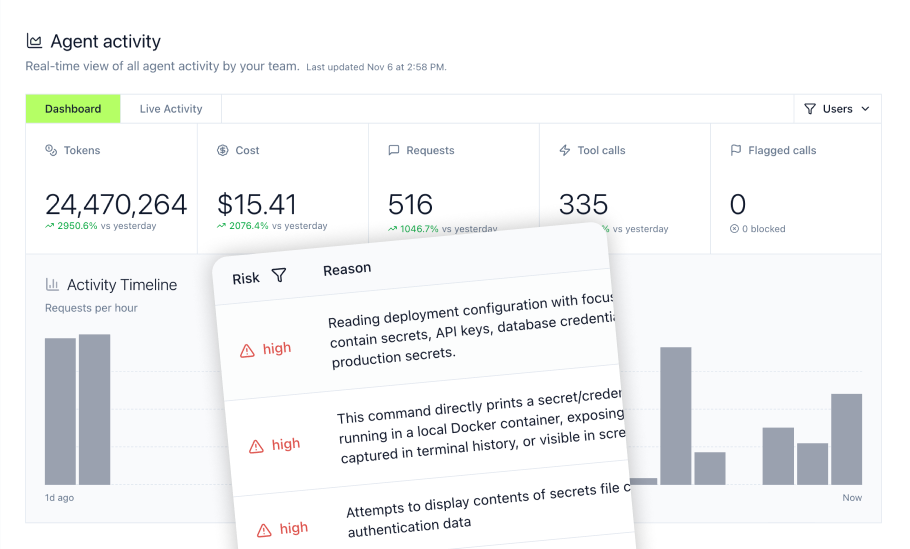
- Deploy real-time monitoring – Block dangerous operations before they execute while maintaining visibility into all AI agent behavior through LLM Proxy capabilities
- Protect sensitive files – Prevent AI agents from accessing credentials, SSH keys, and configuration files containing secrets
Organizations that treat AI security as an enabler rather than a blocker see faster adoption, better compliance posture, and reduced incident exposure. The data demonstrates that the cost of ungoverned AI far exceeds the investment required to deploy proper infrastructure.
Frequently asked questions
What are the primary security risks associated with deploying AI tools in an enterprise?
The primary risks include lack of access controls (97% of breached organizations lacked proper controls), shadow AI usage (adding $670,000 to breach costs), data exposure through unsanctioned tools, and supply chain compromise from public model repositories. Without centralized governance, organizations cannot track what AI tools exist, what data they access, or whether they comply with security policies.
How does MintMCP address compliance requirements like SOC2 HIPAA and GDPR for AI deployments?
MintMCP Gateway is SOC2 Type II certified and offers HIPAA compliance options with complete audit trails for every MCP interaction, access request, and configuration change. The platform provides data residency controls and comprehensive logging that supports regulatory compliance reviews. Role-based access control ensures only authorized users access sensitive capabilities.
What is shadow AI and how can enterprise security solutions help manage IT?
Shadow AI refers to AI tools used without IT or security team knowledge or approval. Shadow AI breaches cost organizations an average of $670,000 more than governed AI incidents. MintMCP transforms shadow AI into sanctioned AI by providing one-click deployment with built-in OAuth protection, monitoring, and audit trails—enabling productivity while maintaining governance.
How does MintMCP's LLM proxy prevent sensitive data exposure by AI agents?
The LLM Proxy monitors every MCP tool invocation, bash command, and file operation from AI coding agents. It blocks dangerous commands in real-time, prevents access to .env files, SSH keys, and credentials, and maintains complete command history for security review. This visibility and control prevents AI agents from accessing or exfiltrating sensitive data.
What kind of audit trails does MintMCP provide for AI tool interactions?
MintMCP provides complete audit trails of every MCP interaction including tool calls, data access, authentication events, and configuration changes. These logs support SOC2, HIPAA, and GDPR compliance requirements with real-time dashboards for monitoring usage patterns and detecting anomalies. Organizations gain full visibility into AI tool behavior across their environment.