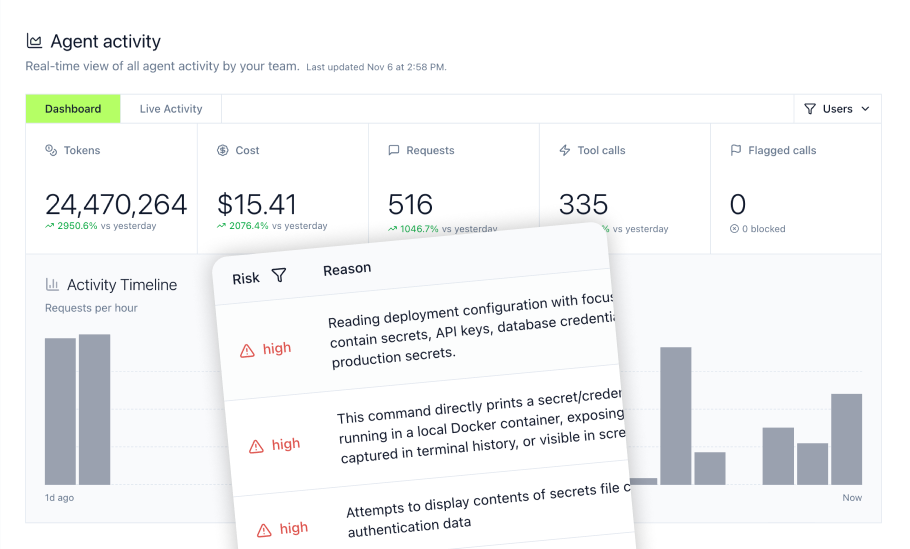
Developer tool companies face a critical infrastructure decision as AI agents become central to engineering workflows. With over 40% of agentic AI projects projected to be canceled by the end of 2027 due to escalating costs, unclear value, or inadequate risk controls, the choice of agent gateway determines whether your AI deployment becomes a governed asset or a security liability.
For companies building developer tools like IDEs, coding assistants, and CI/CD platforms, agent gateways provide the missing governance layer between AI agents and production systems. The Model Context Protocol has reached 97 million monthly SDK downloads, and MCP support is expanding across major AI clients, developer tools, and agent infrastructure. This standardization wave creates both opportunity and risk: teams can deploy powerful agent capabilities faster than ever, but without centralized governance, security gaps multiply with each new integration.
The right gateway transforms N-to-N agent-to-tool complexity into a manageable hub-and-spoke model where authentication, authorization, and observability flow through a single control plane. For developer tool companies, this means shipping AI features without creating compliance headaches or exposing customer code to unmonitored data access.
Key takeaways
- MintMCP Gateway provides a data-permissions-first architecture with SSO, SCIM-driven RBAC, Virtual MCP Bundles, Agent Bundles with M2M auth, hosted MCP connectors, and centralized governance for Claude, Cursor, ChatGPT, Gemini, and Copilot
- TrueFoundry delivers a unified control plane for LLM gateway, MCP gateway, and model deployment, with vendor-reported ~3-4ms gateway latency under load
- Tetrate Agent Router is built on Envoy AI Gateway, a CNCF-backed open-source AI gateway foundation
- Bifrost provides Go-based performance with low gateway overhead at scale
- Lunar.dev MCPX unifies AI Gateway, MCP Gateway, and API Gateway governance in a single control plane
- Portkey focuses on LLMOps breadth with pre-built guardrails, with Palo Alto Networks announcing plans to acquire the company in April 2026
- LiteLLM supports a broad set of model providers as an open-source LLM proxy
- Kong AI Gateway extends mature API gateway infrastructure with MCP protocol support
- Cloudflare AI Gateway provides edge-optimized routing across Cloudflare's global network
- Solo.io Agent Gateway delivers Kubernetes-native, Linux Foundation-governed open-source agent governance
- Helicone emphasizes observability-first design with session replay for agent debugging
- Composio offers a broad pre-built connector library for MCP toolkits and integrations
1. MintMCP Gateway: Enterprise MCP infrastructure for developer tools
MintMCP Gateway provides enterprise-grade governance and infrastructure for AI agents using the Model Context Protocol, enabling developer tool companies to deploy AI agents with centralized security, authentication, and observability. The platform's data-permissions-first architecture starts with SSO, SCIM-driven RBAC, IdP groups, Virtual MCP Bundles, tool-level policy, and audit logs, then enables agents on top.
What makes MintMCP Gateway different
MintMCP solves the fundamental problem that 80% of enterprise effort goes into governance rather than development when deploying AI agents. The platform's architecture wraps stdio, hosted, HTTP-streamable, and SSE MCP servers behind SSO-fronted remote MCP endpoints with OAuth brokering, SCIM-driven membership, and rule-based policy.
MintMCP's approach distinguishes between two connected infrastructure layers: MCP Gateway provides governed data and tool connections for the AI systems users already run, including Claude, Cursor, ChatGPT, Gemini, and Copilot. Agent Gateway extends this foundation with identities, permissions, memory, and monitoring for agents that work alongside users. This two-layer model means developer tool companies can ship AI features with built-in governance rather than requiring months of custom security work per integration.
Core capabilities
- Virtual MCP Bundles create team-specific, per-use-case endpoints that expose only the minimum required tools with SCIM-driven membership, curated tool lists, and fine-grained role-based access
- Agent Bundles give AI agents first-class identities with M2M auth, scoped tools, independent rotation and revocation, and an "act as agent" flow for connectors requiring per-agent OAuth
- Hosted MCP Connectors run connector instances on MintMCP's infrastructure with auto-scaling and sandboxed execution per connector, eliminating the need to manage K8s pods or connector runtimes
- OAuth Brokering adds enterprise authentication to local and hosted MCP servers including OAuth 2.x, bearer tokens, headers, and SSO-fronted access without rebuilding each server
- Custom Gateway Middleware runs customer-authored JavaScript in a sandbox with external DLP integrations for AWS Bedrock Guardrails, Google Cloud DLP, Microsoft Purview, Nightfall, and Skyflow
- Two-layer governance combines Gateway coverage for MCP traffic with Agent Monitor coverage for local non-MCP agent activity in Cursor and Claude Code
Enterprise integrations
MintMCP supports 10,000+ MCP servers in its catalog with managed runtime, including:
- Snowflake data warehouse access with natural language queries
- GitHub integration for code review and repository management
- Slack connectivity for AI-driven team communication
- Elasticsearch knowledge base search for documentation and support content
- Custom MCP server deployment for internal tools and APIs
Security and compliance
MintMCP is SOC 2 Type II audited with continuous compliance monitoring via Drata. Enterprise SSO, complete audit trails, PII detection, and role-based access control are built into every layer of the platform. Customers handling protected health information can request HIPAA documentation. MintMCP signs BAAs and provides penetration-tested infrastructure with data encryption in transit and at rest.
Deployment
Managed SaaS-first delivery with US and EU availability. VPC and self-hosted deployment available on request.
Pricing
Contact for enterprise demonstration and pricing. Free trial available with no sales call required.
2. TrueFoundry
TrueFoundry provides a unified control plane for LLM gateway, MCP gateway, and model deployment, targeting platform engineering and ML teams who need performance at scale alongside governance controls.
TrueFoundry's primary focus
The platform separates control plane from data plane architecture, with vendor-reported ~3-4ms gateway latency under load and 350+ requests per second on a single vCPU. This performance focus appeals to teams where inference latency directly impacts user experience.
Core capabilities
- Centralized MCP Registry and Discovery system for managing MCP servers across the organization
- Token-level usage attribution by user, team, and geography for cost management
- Full-stack AI infrastructure managing ML deployments, LLM gateway, and MCP gateway in one platform
- Self-hosted, cloud, and air-gapped deployment options
Where TrueFoundry fits
Platform engineering teams and ML platform teams who need a unified control plane for both model serving and MCP governance. Organizations where performance benchmarks are a primary selection criterion. Teams already evaluating TrueFoundry for ML infrastructure who want to consolidate tooling.
TrueFoundry reports SOC 2 Type 2 and HIPAA compliance achieved in 2024, with customers including Cargill, Mavenir, Whatfix, and Wadhwani AI.
3. Tetrate Agent Router
Tetrate Agent Router Enterprise brings Envoy-based architecture to AI agent governance, building on Envoy AI Gateway's CNCF-backed open-source foundation.
Tetrate's primary focus
Built on Envoy AI Gateway, the platform emphasizes vendor-neutral, open-source infrastructure that separates control plane from data plane. The architecture places the control plane in Tetrate's managed environment while data planes run in customer VPCs.
Core capabilities
- CNCF-backed Envoy AI Gateway reaching v1beta1 production-stable API in May 2026
- FINOS AI Governance Framework pre-built guardrails for financial services
- Distributed deployment with customer VPC data planes
- Supply chain security emphasis following industry incidents
Where Tetrate fits
Organizations prioritizing open-source foundations and vendor neutrality. Financial services teams requiring FINOS framework alignment. Platform engineering teams already running Envoy or Istio service meshes who want consistency across their infrastructure.
Tetrate offers a self-serve tier with free credit and custom enterprise pricing for larger deployments.
4. Bifrost (Maxim AI)
Bifrost provides an open-source, high-performance AI gateway written in Go, targeting teams who prioritize latency and throughput above all else.
Bifrost's primary focus
The platform achieves low gateway overhead at scale, representing performance advantages over Python-based alternatives. The Go-based architecture unifies LLM, MCP, and agent gateway functionality in a single binary.
Core capabilities
- Ultra-low latency performance documented at scale
- Budget enforcement, failover, and observability integrated at the infrastructure level
- Apache 2.0 open-source license with full transparency
- Integration with Maxim AI evaluation and observability system
Where Bifrost fits
Engineering teams with operational capacity to self-host who need maximum performance. Organizations where gateway overhead directly impacts user experience. Teams building high-throughput AI applications where microsecond-level latency matters.
Bifrost is available as open source under Apache 2.0 with optional enterprise tier for VPC installations.
5. Lunar.dev MCPX
Lunar.dev's MCPX provides a unified control plane spanning AI Gateway, MCP Gateway, and API Gateway, centralizing policy enforcement, access control, and observability.
Lunar.dev's primary focus
The platform unifies governance across model inference, MCP tools, and API traffic through a single control plane. RBAC and ACLs operate at global, service-level, or tool-level granularity with tool customization capabilities for rewriting descriptions or locking parameters.
Core capabilities
- Unified governance across AI, MCP, and API traffic patterns
- Local and remote deployment including managed service, customer cloud, or on-premises
- Prometheus-compatible metrics and immutable audit trails
- STDIO and remote HTTP/SSE MCP server support
Where Lunar.dev fits
Platform and infrastructure teams deploying MCP to production who want centralized access control and observability. Organizations seeking unified governance across multiple traffic types rather than separate tools for each. Security teams requiring comprehensive audit trails with Prometheus integration.
Lunar.dev offers free and commercial tiers with enterprise features for larger deployments.
6. Portkey
Portkey provides an LLMOps platform with AI gateway capabilities, offering prompt management, guardrails, and observability. Palo Alto Networks announced its intent to acquire Portkey in April 2026.
Portkey's primary focus
The platform emphasizes LLMOps breadth beyond basic gateway functionality, including prompt versioning, collaborative templates, and pre-built guardrails for PII detection and content filtering. The acquisition positions Portkey to serve as the AI Gateway for Palo Alto's Prisma AIRS security platform.
Core capabilities
- Pre-built guardrails for security and compliance controls
- Prompt management, versioning, and collaborative templates
- Apache 2.0 open-source core with commercial features
- SaaS, hybrid, and air-gapped deployment options
- Security and compliance documentation for SOC 2, ISO 27001, HIPAA, and GDPR programs
Where Portkey fits
Teams prioritizing guardrails and prompt management alongside gateway functionality. Organizations already in the Palo Alto Networks ecosystem. Teams seeking commercial support with an open-source foundation option.
7. LiteLLM
LiteLLM provides an open-source LLM proxy supporting a broad set of model providers, making it a widely used option in the AI proxy category.
LiteLLM's primary focus
The platform standardizes inputs and outputs in OpenAI format across multiple providers, making it straightforward to switch between models. Python-based architecture with YAML configuration and Docker deployment provides flexibility for customization.
Core capabilities
- Universal API compatibility across multiple model providers
- OpenAI-compatible format for consistent integration patterns
- YAML-based configuration with Docker deployment
- Large community and ecosystem for support
Where LiteLLM fits
Python-heavy engineering teams who value open-source flexibility. Organizations experimenting with multiple model providers who need a unified interface. Teams with operational capacity to manage their own infrastructure and willing to accept Python-based overhead.
LiteLLM is available as open source with optional enterprise tier. Note that the project experienced a PyPI supply chain incident in March 2026 affecting versions 1.82.7 and 1.82.8, which has since been addressed.
8. Kong AI Gateway
Kong AI Gateway extends the mature Kong API gateway with AI-specific capabilities, offering organizations already using Kong a natural extension point for AI traffic.
Kong's primary focus
The platform adds plugin-based AI extensions to established API gateway infrastructure, including semantic caching for LLM responses and MCP Proxy plugin support. Kong provides unified governance for API and AI traffic through a single operational model.
Core capabilities
- Plugin-based AI extensions on mature API gateway foundation
- MCP Proxy plugin shipped in Gateway 3.12
- Semantic caching for LLM response optimization
- Konnect SaaS with self-hosted data plane hybrid deployment
Where Kong fits
Organizations already standardized on Kong for API gateway functionality who want to add AI and MCP support without deploying separate infrastructure. Teams valuing unified operational models across API and AI traffic. Enterprises with existing Kong investments seeking to extend rather than replace.
Kong uses consumption-based pricing with per-service and per-request components.
9. Cloudflare AI Gateway
Cloudflare AI Gateway provides edge-optimized AI traffic management, leveraging Cloudflare's global network for reduced latency and caching benefits.
Cloudflare's primary focus
The platform routes AI traffic through Cloudflare's global network, providing edge caching that can reduce redundant API calls. MCP Server Portals (in open beta) add DLP integration and Cloudflare Access SSO support.
Core capabilities
- Global edge network for low-latency routing
- Edge caching for AI responses
- MCP Server Portals with DLP and SSO integration
- Durable Objects for persistent agent state
Where Cloudflare fits
Organizations already in the Cloudflare ecosystem seeking zero-friction AI gateway adoption. Teams prioritizing global edge presence and caching for AI workloads. Applications where geographic distribution of AI traffic matters for performance.
Cloudflare offers a free tier with enterprise pricing options.
10. Solo.io Agent Gateway
Solo.io Agent Gateway provides Kubernetes-native agent governance as an open-source project donated to the Linux Foundation in August 2025.
Solo.io's primary focus
The platform delivers a service mesh approach for agentic AI, providing a unified data plane for agent-to-agent and agent-to-tool communication. Built on Envoy, it integrates with modern service mesh deployments and Kubernetes-native workflows.
Core capabilities
- Native MCP and A2A (Agent-to-Agent) protocol support
- Built on Envoy with service mesh integration
- Kubernetes-native deployment
- Linux Foundation governance providing vendor neutrality
Where Solo.io fits
Platform engineering teams with Kubernetes expertise who require full infrastructure ownership. Organizations already running Envoy or Istio service meshes. Teams prioritizing open-source, vendor-neutral tooling for long-term infrastructure decisions.
Solo.io Agent Gateway is available as open source with optional commercial support.
11. Helicone
Helicone provides an observability platform with AI gateway capabilities, emphasizing debugging and visibility over governance enforcement.
Helicone's primary focus
The platform offers Session Replay for visualizing agent "thought chains," making it easier to debug complex agent workflows. A Rust-based gateway provides caching, load balancing, and failover alongside observability features.
Core capabilities
- Session Replay for agent workflow visualization and debugging
- Rust-based AI gateway with caching and load balancing
- Request-level cost and latency visibility
- Developer-friendly experimentation tools for iterating on prompts
Where Helicone fits
Development teams building consumer-facing AI applications where debugging agent behavior takes priority over enterprise compliance. Teams in early development phases who need visibility into agent decision-making. Organizations seeking observability-first tooling with basic gateway functionality.
Helicone offers a free tier, with Pro pricing listed at $79 per month under its usage-based pricing model.
12. Composio
Composio provides an MCP integration platform with a broad pre-built connector library, targeting engineering teams who need rapid time-to-value across many integrations.
Composio's primary focus
The platform offers pre-built MCP toolkits and integrations, reducing the time to connect AI agents to business applications. Just-in-time tool selection enables runtime tool loading, and IdP delegation through Okta, Entra, and Google provides centralized authentication.
Core capabilities
- Broad library of pre-built MCP servers and toolkits
- Just-in-time tool selection for runtime tool loading
- IdP delegation through major identity providers
- Managed authentication with centralized OAuth
Where Composio fits
Engineering teams prioritizing time-to-value who need access to many integrations without building custom connectors. Organizations seeking rapid deployment across multiple business applications. Teams where integration breadth matters more than deep governance customization.
Composio offers managed cloud deployment with VPC and on-premises options on the enterprise tier.
Choosing the right agent gateway for your developer tool company
For developer tool companies, the agent gateway decision shapes how AI capabilities integrate with your product and how customers trust your platform with their code and data.
The right gateway architecture distinguishes between two infrastructure layers that work together. MCP Gateway provides governed connections to data sources and tools for the AI systems your users already run, including Claude, Cursor, ChatGPT, Gemini, and Copilot. This layer handles authentication, authorization, and observability for every tool invocation, transforming point-to-point integration complexity into a manageable hub-and-spoke model.
Agent Gateway extends this foundation with infrastructure for agents that work alongside users: agent identities with M2M authentication, scoped permissions that follow least-privilege principles, memory that persists across sessions, and monitoring that captures both MCP traffic and local agent activity. This two-layer approach means your developer tools can ship AI features with enterprise-grade governance built in from day one.
MintMCP Gateway implements both layers. Virtual MCP Bundles let you create per-customer or per-use-case endpoints with SCIM-driven membership and fine-grained access controls. Agent Bundles give each AI agent its own identity with M2M auth, scoped tools, and independent credential rotation. With hosted MCP connectors running on MintMCP's infrastructure, your team ships AI features without managing K8s pods or connector runtimes. OAuth brokering wraps stdio and hosted MCP servers with enterprise authentication. Two-layer governance through Gateway plus Agent Monitor covers both MCP traffic and local agent activity in Cursor and Claude Code.
Start your free trial at mintmcp.com with no sales call required, or contact the enterprise team for a demonstration of how MintMCP supports developer tool deployments at scale.
Frequently asked questions
What is an AI agent gateway and why do developer tool companies need one?
An agent gateway provides centralized authentication, authorization, and observability for AI agents connecting to tools and data sources. For developer tool companies, gateways transform point-to-point agent-to-tool complexity into a manageable hub-and-spoke model. Without a gateway, each new AI integration creates security policy fragmentation, credential sprawl, and visibility gaps. With a gateway, authentication happens once, audit trails flow to a single location, and access controls apply consistently across all agent interactions.
What is shadow AI and how can an agent gateway detect unauthorized agent usage?
Shadow AI refers to AI tools and agents operating outside IT governance, creating security and compliance blind spots. Agent gateways detect shadow AI by requiring all agent connections to route through governed infrastructure. When agents attempt to connect directly to tools without gateway authentication, the activity becomes visible through monitoring hooks in development tools. MintMCP's Agent Monitor extends this detection to local non-MCP agent activity in Cursor and Claude Code, catching bash commands, file operations, and prompt submissions that bypass MCP entirely.
Can agent gateways work with existing developer tools like Cursor and Claude Code?
Yes. Leading agent gateways provide integration with major AI development tools. MintMCP supports governance for Claude, Cursor, ChatGPT, Gemini, and Copilot through centralized gateway coverage for MCP traffic plus Agent Monitor hooks for local activity. This two-layer approach means development teams can use their preferred tools while security teams maintain visibility and control. The gateway handles MCP server connections, while Agent Monitor covers tool-specific behaviors that don't flow through MCP.
What compliance and audit capabilities should developer tool companies expect from agent gateways?
Enterprise agent gateways should provide SOC 2 Type II audited security documentation, comprehensive audit trails, and configurable retention policies. Audit logs should capture every agent action with full context: who initiated it, which tools were called, what data flowed through, and when. SIEM export capabilities let security teams integrate agent activity into existing monitoring workflows. For regulated industries, HIPAA documentation and BAA availability become important selection criteria. Role-based access controls should align with organizational structure through SCIM integration with identity providers like Okta and Azure AD.
How do Virtual MCP Bundles simplify agent management for large organizations?
Virtual MCP Bundles package tool access, policy enforcement, and audit logging into single governance units per team or use case. Instead of managing individual MCP server permissions across dozens of teams, administrators create Bundles that expose only the minimum required tools with SCIM-driven group membership. When a team's identity provider group changes, Bundle access updates automatically. This abstraction reduces configuration complexity while maintaining least-privilege access patterns. Agent Bundles extend the same model to AI agents themselves, giving each agent its own identity, scoped tools, and rotatable credentials independent of human user access.