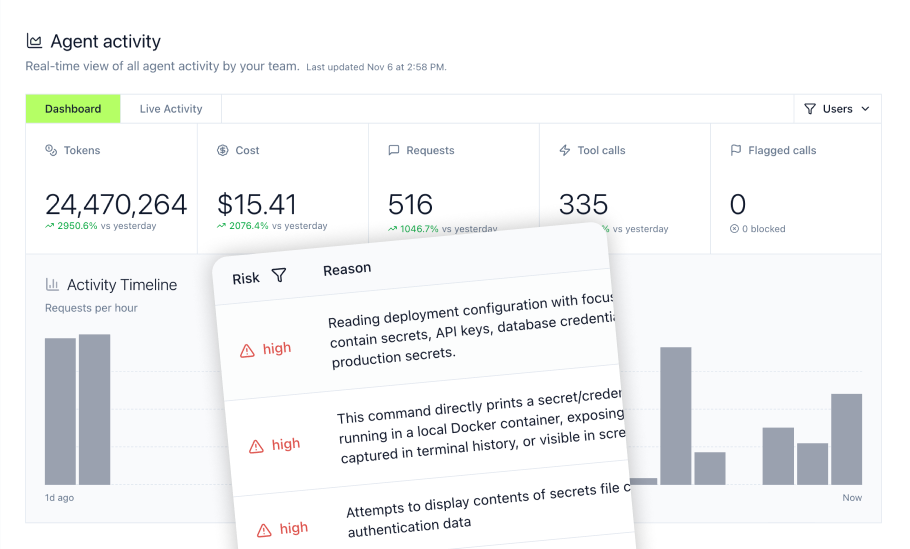
DevOps teams deploying AI agents face a critical infrastructure gap: how do you give agents access to GitHub, Jira, CI/CD pipelines, and production databases without creating a security nightmare? Agent gateways solve this by providing centralized authentication, policy enforcement, and observability for every agent-to-tool connection your organization runs.
The challenge is real. When your incident response agent queries Datadog, your deployment agent pushes to production, or your cost optimization agent terminates idle EC2 instances, you need to know who approved it, what credentials were used, and whether policies were followed. Without an MCP gateway, the answer is often: you cannot prove any of it.
This guide covers the agent gateways purpose-built for DevOps workflows in 2026, with capabilities ranging from MCP server hosting and OAuth brokering to shadow AI detection and audit logging.
Key takeaways
- MintMCP Gateway provides enterprise MCP governance with a data-permissions-first architecture, Virtual MCP Bundles for per-use-case endpoints, Agent Bundles with M2M auth for agent identity management, hosted MCP connectors, JS sandbox middleware, and two-layer coverage via Gateway plus Agent Monitor for both MCP traffic and local agent activity
- Unified control planes reduce infrastructure complexity by combining LLM routing with MCP server management in a single system
- Per-user OAuth flows enable agents to inherit individual user permissions rather than operating with shared service accounts, reducing blast radius for credential compromise
- Open-source gateways provide transparency and avoid vendor lock-in for platform teams with the capacity to operate their own infrastructure
- Container-native approaches integrate MCP server management with existing Docker and Kubernetes workflows
- API gateway extensions allow organizations to add MCP support to existing infrastructure without deploying separate systems
1. MintMCP Gateway: enterprise agent governance in minutes
MintMCP Gateway provides enterprise governance for Model Context Protocol, built around authentication, tool-level access control, credential management, logging, and rule-based policy. The platform takes a data-permissions-first approach: governance is the foundation, and agents are enabled on top.
For DevOps teams, this means turning MCP servers into governed production services with centralized observability, enterprise authentication, and compliance controls, without weeks of infrastructure setup. MintMCP's Agent Gateway builds on that MCP Gateway foundation by adding the control layer for agent identities, permissions, memory, and monitoring.
Why DevOps teams choose MintMCP
MintMCP solves the fundamental problem DevOps teams face when AI agents need access to multiple data sources and tools. The platform's architecture wraps stdio, hosted, HTTP-streamable, and SSE MCP servers behind SSO-fronted remote MCP endpoints with OAuth brokering, SCIM-driven membership, and rule-based policy. This eliminates fragmented security policies and visibility gaps that create operational chaos when managing point-to-point connections between AI agents and tools.
Core capabilities for DevOps
- Hosted MCP Connectors run by MintMCP with auto-scaling and sandboxed execution per connector, reducing the infrastructure overhead that typically delays production deployment
- OAuth Brokering for stdio and hosted MCP servers adds enterprise authentication including OAuth 2.x, bearer tokens, headers, and SSO-fronted access without rebuilding each server
- Virtual MCP Bundles create team-specific, per-use-case endpoints that expose only the minimum required tools with SCIM-driven membership, curated tool lists, and fine-grained role-based access
- Agent Bundles give internal agents first-class identities with M2M auth, scoped tools, independent rotation and revocation, and an "act as agent" flow for connectors that require per-agent OAuth
- Custom Gateway Middleware runs customer-authored code in a JS sandbox with external DLP and guardrails integrations for masking, blocking, and policy enforcement
Two-layer governance model
MintMCP provides two-layer governance that covers both MCP traffic and local non-MCP agent activity. The Gateway handles MCP connections while Agent Monitor covers Bash usage, file reads and writes, and prompt submissions via Claude Code and Cursor hooks. This addresses the shadow AI problem where agents operate outside governed infrastructure.
DevOps-specific integrations
- GitHub integration for code agents with GraphQL API access and quota management
- Datadog and observability tool connections for incident response agents
- Atlassian integration for Jira and project management access in workflow automation
- CI/CD pipeline governance with job-level RBAC for deployment agents
Security and compliance
MintMCP is SOC 2 Type II audited, with continuous compliance monitoring via Drata. Enterprise SSO, complete audit trails, PII detection, and role-based access control are built into every layer of the platform. Customers handling protected health information can request HIPAA documentation, and MintMCP signs BAAs.
Getting started
Visit mintmcp.com/mcp-gateway for deployment guides and free trial access.
2. TrueFoundry
TrueFoundry provides a unified LLM and MCP control plane designed for high-performance deployments at scale. The platform combines model routing with MCP governance in a single infrastructure layer.
Primary focus
TrueFoundry targets platform engineering and ML teams who need to manage both LLM inference and MCP tool access through one system. The unified approach reduces infrastructure complexity for organizations already running multiple AI workloads.
Core capabilities
- Unified control plane for LLM routing and MCP server management
- Low-latency gateway performance, with benchmark claims that should be evaluated against your own workload and deployment environment
- Hybrid deployment options including managed SaaS and self-hosted on customer Kubernetes
- OAuth 2.0 authentication for MCP connections
- SOC 2 Type II attestation and HIPAA support on enterprise tier
Where TrueFoundry fits
Organizations that want a single platform for LLM inference management and MCP governance, particularly those with existing Kubernetes infrastructure and platform engineering teams. The unified approach works well when LLM routing and tool governance need to be managed together.
Deployment model
Hybrid deployment with managed SaaS and self-hosted control plane options. Air-gapped deployment available via forward proxy for regulated environments.
3. Arcade.dev
Arcade.dev focuses specifically on multi-user agent security, providing per-user OAuth and vaulted credentials for agents that operate on production systems.
Primary focus
Arcade.dev addresses scenarios where AI agents need to act on behalf of individual users, inheriting user permissions at runtime rather than operating with shared service accounts.
Core capabilities
- Per-user OAuth with "On-Behalf-Of" flows that inherit user permissions
- Vaulted credential storage that keeps secrets out of LLM context windows
- OpenTelemetry-compatible logging for audit trails
- VPC deployment and tunnel options for sensitive environments
- SOC 2 Type II attestation
Where Arcade.dev fits
Teams building multi-user agents that access sensitive systems like source code repositories, CI/CD pipelines, or production databases. The per-user OAuth model ensures agents operate with the same permissions as the human who invoked them.
Deployment model
Managed SaaS with VPC and tunnel deployment options for enterprise customers.
4. Bifrost by Maxim
Bifrost delivers an open-source agent gateway with low reported gateway overhead for teams that prioritize self-hosted performance.
Primary focus
Bifrost targets platform engineering and AI teams who need gateway infrastructure without vendor lock-in and with minimal performance impact.
Core capabilities
- Apache 2.0 licensed open-source implementation
- Low reported gateway overhead, with benchmark figures framed as gateway overhead rather than end-to-end agent latency
- MCP gateway support for stdio, streamable HTTP, and legacy SSE where applicable
- OAuth and SSO integration
- Self-hosted deployment via Go binary or Docker
Where Bifrost fits
Organizations with platform engineering teams who can operate their own gateway infrastructure and prioritize low latency over managed service convenience. The open-source model provides transparency and avoids vendor dependency.
Deployment model
Self-hosted via Go binary, Docker, or Kubernetes. No managed SaaS option currently available.
5. Docker MCP Gateway
Docker's MCP Gateway brings container orchestration to MCP server management, providing a Docker-native approach to running and managing MCP servers.
Primary focus
Docker MCP Gateway targets development teams already using Docker Desktop and Docker Compose who want to run MCP servers in containerized environments.
Core capabilities
- Container isolation for MCP server deployments
- Docker and Docker Compose integration for orchestration
- Standard container security practices and image management
- Local development workflow support
Where Docker MCP Gateway fits
Developers running MCP servers locally and organizations with existing Docker environments seeking to containerize their MCP infrastructure. The approach integrates naturally with container-based development workflows.
Deployment model
Self-hosted on Docker or Kubernetes infrastructure. Open-source with infrastructure costs varying by deployment scale.
Considerations
A container-native gateway provides infrastructure control, but teams should evaluate whether they need additional governance primitives like SCIM-driven RBAC, tool-level policy, audit logging, OAuth brokering, and agent identity management beyond container lifecycle management.
6. Kong AI Gateway
Kong AI Gateway extends the Kong API gateway platform with support for MCP and Agent-to-Agent (A2A) protocols, enabling organizations to manage AI traffic alongside traditional API traffic.
Primary focus
Kong AI Gateway targets organizations already standardized on Kong for API management who want to add MCP and multi-agent coordination support without deploying separate infrastructure.
Core capabilities
- Integration with existing Kong deployments
- A2A protocol support for multi-agent coordination
- Plugin-based policy enforcement for MCP requests
- Enterprise identity provider integration
- Kubernetes-native deployment
Where Kong AI Gateway fits
Platform engineering teams with existing Kong infrastructure who need to add MCP support and multi-agent coordination. The approach works well when AI traffic and traditional API traffic need unified management.
Deployment model
Hybrid with Konnect SaaS control plane and self-hosted data plane, or fully self-hosted deployment.
Considerations
The API gateway extension approach adds MCP support, but teams should evaluate whether it provides MCP-specific primitives like Virtual MCP Bundles, Agent Bundles, hosted connector runtime, tool-update policy, and OAuth brokering for stdio servers.
7. Portkey
Portkey provides centralized MCP governance with multi-team tool catalogs and OAuth integration, targeting organizations with multiple teams deploying AI agents.
Primary focus
Portkey targets developer and platform engineering teams who need centralized tool governance across multiple teams, with secondary focus on enterprise compliance.
Core capabilities
- Centralized tool catalog with OAuth integration
- Multi-team RBAC and tool access management
- Observability and cost tracking across teams
- SOC 2 Type II attestation
- Managed SaaS and self-hosted deployment options
Where Portkey fits
Organizations with multiple teams deploying AI agents who need centralized governance and cost attribution without building custom infrastructure. The multi-team model works well for platform teams managing developer access.
Deployment model
Hybrid with managed SaaS and self-hosted options on EKS, AKS, GKE, and AWS Marketplace.
Selection criteria for DevOps teams
Authentication architecture
Agent gateways vary significantly in how they handle authentication. Some provide shared service accounts, others offer per-user OAuth flows, and advanced platforms like MintMCP provide per-agent identity with M2M auth. The choice impacts your audit trails, blast radius for credential compromise, and compliance posture.
Consider whether the gateway supports:
- OAuth 2.0 On-Behalf-Of flows for per-user permissions
- Independent agent credentials that rotate separately from user accounts
- Integration with your existing identity provider (Okta, Azure AD)
Organizations requiring strong authentication controls should prioritize solutions that align with NIST framework guidance on identity and access management.
MCP transport support
Not all gateways handle all MCP transports. Many only support remote HTTP and SSE servers, which limits access to the large ecosystem of stdio-based community servers.
Evaluate whether the gateway:
- Supports stdio, HTTP-streamable, and SSE transports
- Can host and run stdio servers, or only proxy remote servers
- Provides OAuth brokering for servers that lack native OAuth support
Observability and audit
Without comprehensive logging, compliance audits fail and incident investigation becomes impossible. Essential metrics include tool call tracking, latency monitoring, error rates, and cost attribution per team and agent.
The gateway should provide:
- Conversation-level logging with per-user attribution
- Log export to your existing SIEM (Splunk, Sentinel, S3)
- Tracking of which tools were called, what data flowed through, and when
CISA security guidance emphasizes continuous monitoring and logging as foundational controls for production systems.
Shadow AI detection
Agents operating outside governed infrastructure create compliance and security blind spots. Advanced platforms detect off-gateway MCP usage in tools like Cursor and Claude Code.
Key capabilities include:
- Detection of agents connecting directly to tools without going through the gateway
- Policy enforcement via MDM for developer machines
- Coverage of non-MCP agent activity like Bash commands and file operations
Operational model
Consider whether you want to operate gateway infrastructure yourself or use a managed service. Self-hosted options require Kubernetes expertise and ongoing maintenance. Managed services reduce operational burden but may have deployment constraints.
Questions to evaluate:
- Do you have platform engineering capacity to operate gateway infrastructure?
- Does the gateway support your deployment requirements (SaaS, VPC, on-prem)?
- What is the expected setup time: days, weeks, or months?
Implementation roadmap for DevOps teams
Phase 1: Pilot deployment (2-4 weeks)
Start with a limited scope deployment covering 10-50 users accessing 3-5 MCP servers. Choose low-risk use cases like internal knowledge base search or development tool integration. This phase validates architecture, identifies integration challenges, and establishes baseline metrics.
Deploy gateway with read-only tools first (logs, metrics, documentation), connect to development and staging environments before production, and establish baseline metrics for latency, error rates, and usage patterns.
Phase 2: Governance framework (4-8 weeks)
Build the policy and access control layer that will scale to production use. Define role-based access controls aligned with team structure, establish server vetting and approval workflows, implement monitoring and alerting for security events, and document operational procedures for ongoing management.
Phase 3: Production rollout (8-12 weeks)
Expand to production data sources and mission-critical workflows. Integrate with enterprise identity providers for SSO enforcement, connect production data sources like data warehouses and enterprise systems, enable self-service access for developers within policy guardrails, and monitor usage patterns to optimize resource allocation.
DevOps use cases for agent gateways
Incident response automation
Deploy agents with access to observability tools (Datadog, Prometheus), restart and scale commands via Kubernetes API (gated by policy), and incident ticketing systems for documentation. The gateway enforces that agents can restart staging services but require approval for production changes.
CI/CD pipeline agents
Automate deployments to staging environments, pull request summarization, and changelog generation. The gateway provides RBAC so agents can deploy to staging autonomously while production deployments require human approval. Track which deployments succeeded, failed, or were blocked.
Cloud cost optimization
Agents scan cloud resources daily, identify idle EC2 instances and unused EBS volumes, propose cost-saving actions via Slack, and auto-terminate non-critical resources after approval. The gateway enforces budget caps so agents cannot exceed specified thresholds in automated changes.
Govern your AI agents with MintMCP
DevOps teams deploying AI agents need more than basic routing. They need governed infrastructure that provides authentication, policy enforcement, audit trails, and visibility across every agent-to-tool connection.
MintMCP delivers this through a two-part architecture. MCP Gateway provides the foundation: governed data and tool connections for the AI systems users already run, including Claude, Cursor, ChatGPT, Gemini, and Copilot. It wraps stdio, hosted, HTTP-streamable, and SSE MCP servers behind SSO-fronted remote endpoints with OAuth brokering, SCIM-driven membership, and rule-based policy.
Agent Gateway builds on that foundation to become the control layer for agents that work alongside users. It provides identities, permissions, memory, and monitoring for internal agents, including long-running coworker agents where that deployment model is relevant. With Agent Bundles, internal agents get first-class identities with M2M auth, scoped tools, and independent rotation and revocation. The two-layer governance model covers both MCP traffic through Gateway and local agent activity through Agent Monitor, eliminating shadow AI blind spots.
For platform engineering teams, this means Virtual MCP Bundles create per-use-case endpoints that expose only the minimum required tools, hosted MCP connectors that run without customer-operated infrastructure, and JS sandbox middleware for custom policy enforcement. DevOps teams get the control plane they need without weeks of infrastructure setup.
Frequently asked questions
What is the difference between an agent gateway and an API gateway?
Agent gateways handle stateful, multi-step agent workflows with session management and tool authorization semantics. Traditional API gateways route stateless HTTP requests. While some API gateway vendors add MCP features, purpose-built agent gateways understand protocol-specific requirements like context state management, tool authorization, and stdio server hosting that traditional gateways do not address.
How do agent gateways prevent shadow AI in DevOps environments?
Agent gateways transform shadow AI into sanctioned AI by requiring agent connections to route through governed infrastructure. The gateway catalogs approved MCP servers, enforces role-based access controls, maintains audit trails of tool invocations, and blocks unauthorized server connections. Advanced platforms like MintMCP also detect off-gateway activity in tools like Cursor and Claude Code via Agent Monitor hooks.
What authentication methods should DevOps teams look for in an agent gateway?
Look for OAuth 2.0 support with On-Behalf-Of flows for per-user permissions, per-agent identity with independent credential rotation, and integration with enterprise identity providers like Okta and Azure AD. Avoid gateways that only support shared service accounts, as these create unbounded blast radius for credential compromise and make audit attribution impossible.
How long does it take to deploy an agent gateway for a DevOps team?
Deployment time varies by approach. Managed services like MintMCP Gateway can accelerate deployment with hosted MCP connectors, SSO-fronted access, and pre-configured governance controls. Self-hosted open-source solutions typically require additional time for infrastructure setup, authentication integration, and security configuration. Plan for a 2-4 week pilot, 4-8 weeks for governance framework, and 8-12 weeks for full production rollout.
Can agent gateways integrate with existing CI/CD pipelines?
Yes. Agent gateways integrate with CI/CD tools through MCP servers for GitHub, GitLab, Jenkins, and other pipeline tools. The gateway provides RBAC to control which agents can trigger deployments, to which environments, and with what approval requirements. REST APIs and SDKs enable programmatic management for infrastructure-as-code workflows.