As autonomous AI agents move from prototype to production, enterprises face a new infrastructure challenge: how do you govern systems that make decisions, access data, and take actions without direct human oversight? 86% of enterprises require tech stack upgrades to properly deploy AI agents, and the infrastructure layer that prevents governance failures is the agent gateway.
Agent gateways solve the "last mile problem" in enterprise AI by providing centralized authentication, real-time monitoring, and governed access to internal systems. Without this control layer, organizations face fragmented security policies, zero visibility into which agents access which tools, and the operational chaos that makes production deployment impossible. Platforms like MintMCP's Agent Gateway address this by giving each agent its own identity, scoped credentials, and complete audit trail.
This guide ranks the top agent gateways for 2026 based on agent-specific capabilities, performance, enterprise readiness, and deployment flexibility.
Key Takeaways
- MintMCP delivers enterprise-grade agent governance with per-agent identities, Virtual MCP Bundles, Agent Bundles with M2M auth, hosted MCP connectors, and JS sandbox middleware
- Bifrost provides open-source architecture written in Go with low-overhead gateway processing and native MCP support
- TrueFoundry offers a unified AI deployment platform combining gateway capabilities with model serving and fine-tuning
- Kong AI Gateway extends traditional API management to AI workloads with A2A protocol support and enterprise-scale infrastructure
- Zuplo delivers edge-native deployment across 300+ global locations with MCP server auto-generation from existing APIs
- LiteLLM supports 100+ LLM providers through a unified OpenAI-compatible proxy with MIT-licensed core
- Portkey brings observability and prompt management, now integrated into Palo Alto Networks' security portfolio
- Cloudflare AI Gateway provides edge-native caching and cost control for teams already using Cloudflare infrastructure
- Apache APISIX offers vendor-neutral governance under Apache Software Foundation stewardship with all AI features open-source
- Envoy AI Gateway extends CNCF's Envoy Proxy for Kubernetes-native AI traffic management
1. MintMCP: Enterprise Agent Governance Without Bottlenecks
MintMCP provides an enterprise gateway for autonomous agents and Model Context Protocol, focused on giving agents first-class identities, scoped permissions, governed tool access, and complete audit trails. The platform helps teams turn AI agents from shadow IT risk into governed production services with centralized observability and enterprise authentication.
What Makes MintMCP Different
MintMCP solves the fundamental problem that 42% of enterprises face when needing access to 8 or more data sources for AI agent deployment. The platform starts with agent identities and permissions, then layers on governed data and tool connections.
MintMCP operates around two connected categories:
- Agent Gateway provides identities, permissions, memory, and monitoring for agents that work alongside users, giving each agent its own credentials, scoped tool access, independent rotation and revocation, and complete audit trails
- MCP Gateway provides governed data and tool connections for the AI systems users already run, including Claude, Cursor, ChatGPT, Gemini, and Copilot, wrapping MCP servers behind SSO-fronted remote endpoints with OAuth brokering and rule-based policy
Core Capabilities
- Agent Bundles give internal agents first-class identities with M2M auth, scoped tools, independent rotation and revocation, and an "act as agent" flow for connectors that require per-agent OAuth
- Virtual MCP Bundles create team-specific, per-use-case endpoints that expose only the minimum required tools with SCIM-driven membership, curated tool lists, and fine-grained role-based access
- Hosted MCP Connectors run connector instances on the customer's behalf with auto-scaling and sandboxed execution per connector, reducing infrastructure overhead
- Custom Gateway Middleware runs customer-authored middleware in a JS sandbox with external DLP and guardrails integrations for masking, blocking, and policy enforcement
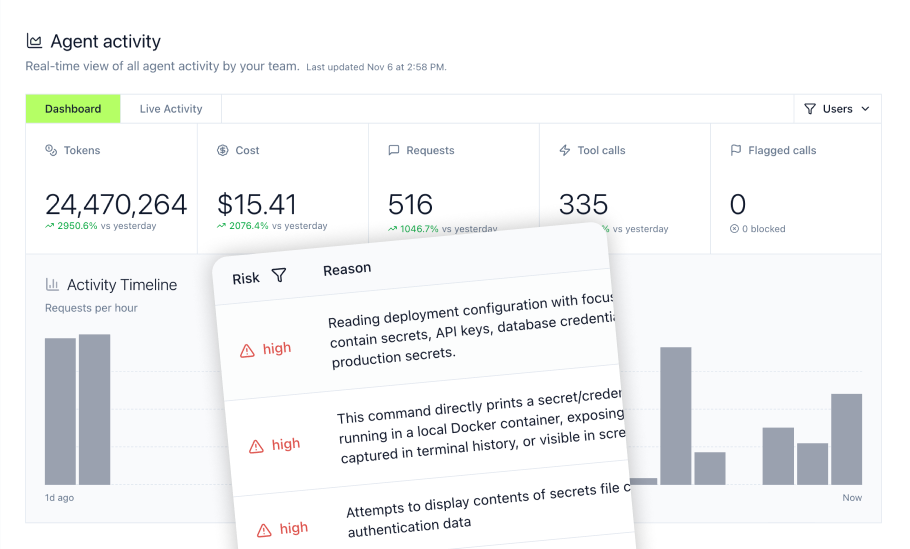
- Two-layer governance covers MCP traffic through the Gateway across Claude, Cursor, ChatGPT, Gemini, and Copilot, while Agent Monitor tracks local coding-agent activity such as MCP calls, Bash commands, and file access
Enterprise Integrations
MintMCP supports governed access to:
- Snowflake data warehouses with natural language queries
- Elasticsearch knowledge bases for HR documentation and log analysis
- Gmail integration for AI-driven customer response automation
- Custom MCP server deployment for internal tools and APIs
Compliance and Security
MintMCP is SOC 2 Type II audited, compliant with HIPAA standards, and penetration tested. Every agent action is audited with full context: who initiated it, which tools were called, what data flowed through, and when.
Deployment: Managed SaaS-first with US and EU availability; VPC and self-hosted deployment available on request
Pricing: Customized pricing based on team size, usage, and deployment requirements; a free trial is available
2. Bifrost (Maxim AI)
Bifrost is an open-source AI gateway written in Go. The platform focuses on low-latency request handling and native MCP gateway capabilities with built-in governance features.
Primary Focus
Bifrost emphasizes performance optimization for AI agent workloads. The Go-based architecture provides lower overhead compared to Python-based gateways. The platform functions as both MCP client and server with autonomous tool execution capabilities.
Key Features
- Open-source core under Apache 2.0 license with enterprise tier available
- Native MCP gateway with built-in governance
- Drop-in replacement for OpenAI, Anthropic, and LiteLLM SDKs
- Self-hosted deployment model
Where Bifrost Fits
Platform engineering teams prioritizing raw performance and infrastructure control. Organizations with Go expertise who want to self-host their gateway infrastructure and customize at the code level.
Deployment: Self-hosted via Docker or binary; enterprise tier available for VPC deployment
3. TrueFoundry
TrueFoundry provides a unified AI deployment platform that combines gateway capabilities with model serving, fine-tuning, and orchestration. The platform was named in Gartner's Market Guide for AI Gateways in 2025 and Gartner Hype Cycle for Platform Engineering 2026.
Primary Focus
TrueFoundry positions itself as a comprehensive AI infrastructure platform rather than a standalone gateway. This includes unified LLM, MCP, and Agent Gateway capabilities alongside model deployment and fine-tuning services.
Key Features
- Unified AI Gateway covering LLM, MCP, and Agent Gateway functionality
- Full AI deployment platform including model serving and fine-tuning
- VPC, on-premises, air-gapped, hybrid, and multi-cloud deployment options
- SOC 2 Type II attestation, HIPAA compliance, and GDPR compliance
Where TrueFoundry Fits
Platform engineering and ML platform teams that need complete AI infrastructure beyond just the gateway layer. Organizations requiring model deployment, fine-tuning, and orchestration capabilities bundled with gateway functionality.
Deployment: Hybrid with managed SaaS plus self-hosted control plane in customer's Kubernetes environment
Pricing: Pro tier starts at $499/month; Enterprise pricing on request
4. Kong AI Gateway
Kong extends its established API management platform with AI-specific capabilities, including Agent Gateway features with A2A (agent-to-agent) protocol support released in version 3.14 in April 2026.
Primary Focus
Kong leverages its existing API gateway infrastructure to provide AI traffic management across LLM, MCP, and A2A traffic.
Key Features
- Agent Gateway with A2A protocol support for agent-to-agent interactions
- Unified LLM, MCP, and Agent-to-Agent traffic governance
- Hybrid deployment with a Konnect-hosted control plane and customer-managed data planes, plus Kong-managed serverless and dedicated cloud options
- Open-source core (Apache 2.0) with enterprise Konnect platform
Where Kong Fits
Large organizations already using Kong for API management who want to extend existing infrastructure to AI workloads. Teams requiring multi-agent orchestration capabilities and A2A communication at scale.
Deployment: Hybrid with Konnect SaaS control plane plus self-hosted data plane, or fully self-hosted
Pricing: 30-day free trial; Plus lists serverless control planes at $25/month, hybrid control planes at $200/month, and $200 per additional 1 million API requests after the included 1 million; Enterprise pricing is custom
5. Zuplo
Zuplo provides an edge-native gateway platform with dedicated project types for API Gateway, AI Gateway, and MCP Gateway functionality. Its MCP Gateway entered public beta in June 2026, and the platform operates across 300+ global edge locations.
Primary Focus
Zuplo emphasizes speed to production with serverless, edge-native architecture. The platform includes MCP server auto-generation from existing APIs, enabling AI agents to safely call existing services.
Key Features
- Three purpose-built project types: API Gateway, AI Gateway, MCP Gateway
- MCP server auto-generation from existing REST APIs
- Edge deployment across 300+ global locations
- Auto-generated developer portals
Where Zuplo Fits
Mid-market and startup teams prioritizing fast deployment and minimal operational overhead. Organizations wanting to expose existing APIs as MCP servers without rebuilding infrastructure.
Deployment: Edge-native serverless; no regional infrastructure to manage
Pricing: Free tier with 100K requests/month; Builder starts at $25/month; Enterprise pricing is custom
6. LiteLLM
LiteLLM is an open-source Python proxy that provides a unified interface to 100+ LLM providers through an OpenAI-compatible API. The platform is backed by Y Combinator and used by Netflix and Lemonade.
Primary Focus
LiteLLM focuses on provider abstraction, allowing teams to switch between LLM providers without code changes. The MIT-licensed core provides broad provider coverage through an OpenAI-compatible interface.
Key Features
- 100+ LLM provider integrations through single API
- OpenAI-compatible proxy for drop-in replacement
- MIT-licensed open-source core, with expanded SSO, audit logs, fine-grained access control, and professional support offered through Enterprise
- Rust migration announced for improved performance
Where LiteLLM Fits
Python-heavy development teams prioritizing ecosystem breadth and provider flexibility. Organizations wanting MIT-licensed infrastructure with community-driven development.
Deployment: Self-hosted; Docker images available
Pricing: Free open-source core; Enterprise tier with SSO and audit logs available
7. Portkey
Portkey provides AI gateway and observability capabilities, now integrated into Palo Alto Networks' Prisma AIRS platform following its acquisition in May 2026.
Primary Focus
Portkey emphasizes observability with detailed visibility into AI interactions. The platform supports MCP Gateway functionality and provides prompt management and evaluation tools.
Key Features
- Observability with analytics metrics for AI interactions
- MCP Gateway support
- Prompt management and evaluation tools
- Integration with Palo Alto Networks' security portfolio
Where Portkey Fits
Organizations with existing Palo Alto Networks security infrastructure. Teams prioritizing observability and prompt management alongside gateway functionality.
Deployment: Portkey is now part of Palo Alto Networks, and Prisma AIRS AI Gateway became generally available in July 2026
Pricing: Post-acquisition pricing and packaging may evolve; contact for current information
8. Cloudflare AI Gateway
Cloudflare AI Gateway is primarily an LLM traffic gateway for analytics, caching, rate limiting, model fallback, and cost controls rather than a full per-agent identity and MCP governance layer.
Primary Focus
Cloudflare AI Gateway focuses on edge-native caching and cost optimization for teams already operating within Cloudflare's ecosystem. The platform integrates with Workers, R2 storage, and D1 database.
Key Features
- Edge-native caching for lowest-latency cached responses
- Integration with Cloudflare Workers ecosystem
- Workers AI integration for edge inference
- Free core AI Gateway features with paid request-based usage
Where Cloudflare Fits
Organizations already using Cloudflare infrastructure who want to add AI gateway capabilities without deploying separate infrastructure. Teams prioritizing minimal operational overhead.
Deployment: Edge-native within Cloudflare platform
Pricing: Free core features; the paid plan includes 10 million requests per month, followed by $0.05 per additional million requests
9. Apache APISIX
Apache APISIX is an API gateway under Apache Software Foundation governance with AI-specific plugins. All AI features are available in the open-source version with no feature gating.
Primary Focus
APISIX provides vendor-neutral, open-source governance under ASF stewardship. The platform is built on Nginx/OpenResty with etcd for dynamic configuration.
Key Features
- All AI plugins open-source with no feature gating
- Multi-LLM routing via ai-proxy-multi plugin
- Apache Software Foundation governance ensures vendor neutrality
- Commercial support available through API7
Where Apache APISIX Fits
Organizations prioritizing vendor neutrality and long-term sustainability. Teams with Apache/Nginx expertise who want fully open-source AI gateway capabilities.
Deployment: Self-hosted
Pricing: Free open-source; commercial support available through API7
10. Envoy AI Gateway
Envoy AI Gateway extends CNCF's Envoy Proxy with AI-specific capabilities, providing Kubernetes-native AI traffic management for service mesh environments.
Primary Focus
Envoy AI Gateway targets organizations already running Kubernetes with Istio or other Envoy-based service meshes. The platform provides OpenAI-compatible API with multi-provider routing.
Key Features
- Built on Envoy Proxy (CNCF graduated project)
- Kubernetes-native via Gateway API
- Token-based rate limiting and cost estimation
- MCP gateway support with OAuth authentication
Where Envoy AI Gateway Fits
Platform engineering teams with existing Kubernetes/Istio infrastructure who want to extend their service mesh to AI traffic. Organizations preferring CNCF-backed projects.
Deployment: Kubernetes-native; self-hosted
Pricing: Open source
Deploy AI Agents with Full Governance
The agent gateway category has matured rapidly in 2026, with agent gateways becoming the control plane for enterprise AI. For organizations deploying autonomous agents that need governed access to internal systems, the infrastructure choice matters.
MintMCP delivers enterprise-grade agent governance through its Agent Gateway and MCP Gateway architecture. Agent Bundles give each agent its own identity with M2M auth, scoped permissions, and independent credential rotation. Virtual MCP Bundles provide team-specific endpoints with SCIM-driven membership and curated tool access. Hosted MCP connectors run with auto-scaling and sandboxed execution, so teams deploy in minutes rather than months.
The two-layer governance model covers MCP traffic through the Gateway across Claude, Cursor, ChatGPT, Gemini, and Copilot, while Agent Monitor tracks local coding-agent activity such as MCP calls, Bash commands, and file access. This provides complete visibility into agent behavior without fragmenting security policies across individual tool connections.
Organizations face an exponential connection problem: N agents accessing M tools creates N×M security relationships to manage. MintMCP transforms this mesh into a hub-and-spoke model with unified governance, where each agent gets scoped credentials, role-based access controls, and audit trails independent of the humans who created them.
Start your free trial at mintmcp.com to deploy governed AI agents this quarter.
Frequently Asked Questions
What is an agent gateway and why do enterprises need one?
An agent gateway provides centralized authentication, authorization, monitoring, and policy enforcement for autonomous AI agents accessing enterprise tools and data. Without a gateway, organizations face fragmented security policies across individual tool connections, zero visibility into agent activity, and the compliance gaps that prevent production deployment. The gateway transforms an exponentially complex mesh of agent-to-tool connections into a manageable hub-and-spoke model with unified governance.
How do agent gateways address security concerns like credential leakage and prompt injection?
Agent gateways can combine several security layers, depending on the product. Identity-aware gateways may enforce SSO or per-agent credentials, while policy controls can restrict tools, parameters, and actions. Guardrail integrations can inspect requests and responses for risks such as PII exposure, credential leakage, and prompt injection. MintMCP supports custom middleware in a JS sandbox for connecting external DLP and guardrails services.
What is "shadow AI" and how can an agent gateway help detect and prevent it?
Shadow AI refers to unauthorized AI tool usage that bypasses organizational governance. When developers connect AI agents directly to tools without going through sanctioned infrastructure, security teams lose visibility into data access patterns and cannot enforce policies. Agent gateways transform shadow AI into sanctioned AI by requiring all connections to route through governed infrastructure. The gateway catalogs approved tools, enforces role-based access, maintains audit trails, and can detect off-gateway activity through monitoring hooks in developer tools.
Can existing local AI agent deployments be integrated into an enterprise gateway without significant code changes?
Yes, when the gateway includes a hosted runtime or bridge that can launch STDIO servers and expose them through an authenticated remote endpoint. STDIO support alone does not guarantee hosted conversion. The current MCP specification defines STDIO and Streamable HTTP as the standard transports, while the older HTTP+SSE transport is retained for backward compatibility.
What compliance standards should enterprises expect from an agent gateway provider?
Enterprise-ready agent gateways should provide SOC 2 Type II attestation demonstrating ongoing security controls, HIPAA documentation for organizations handling protected health information, penetration testing results, data encryption in transit and at rest, and complete audit trails for compliance investigations. Some providers also offer data residency options for multi-region compliance requirements. Request access to the vendor's trust center to review their full security posture before deployment.