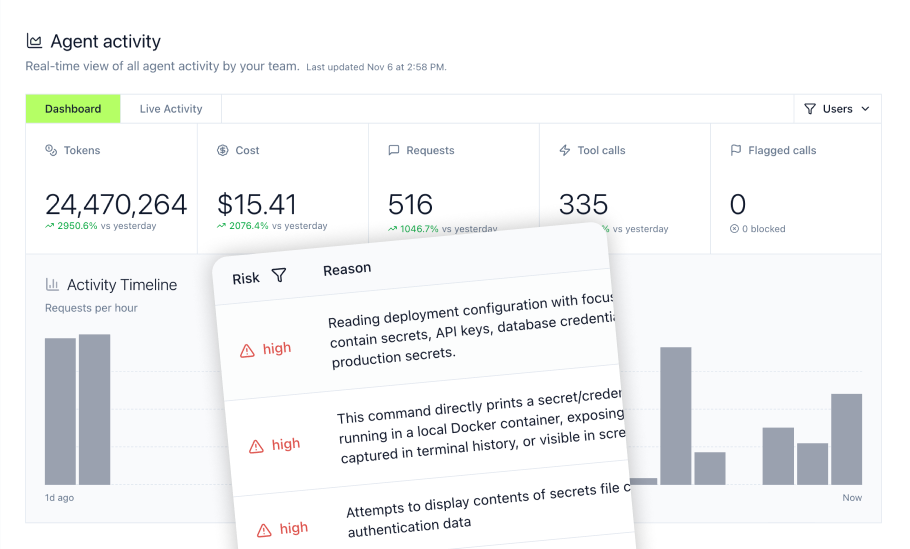
Fintech company Ramp faced a problem familiar to every scaling organization: data questions created bottlenecks through a single on-call analyst, causing hours of turnaround time and suppressing the volume of questions employees felt comfortable asking. Their solution, Ramp Research, is an in-house AI analyst agent deployed in Slack that answered 1,800+ questions in six weeks using an agentic architecture that reasons through problems like a human analyst. This case study offers a blueprint for enterprises building internal AI agents, while exposing the governance gaps that organizations must address before deploying similar systems. For teams evaluating agent infrastructure, understanding how an MCP Gateway centralizes authentication, tool-level access control, credential management, and audit logging, while an Agent Gateway adds agent identities, permissions, memory, and monitoring, becomes essential before replicating Ramp's approach.
Key Takeaways
- Ramp Research handled 1,800+ questions across 1,200 conversations with 300 users within six weeks of launch, representing a 10-20x increase over their traditional help channel
- Ramp launched the agent in early August 2025 and reported the results by mid-September, though its public case study does not disclose the build team's size or total development time
- Metadata alone proved insufficient; domain experts had to write prose documentation covering business areas like pricing, transactions, and accounts before the agent could connect schemas to business meaning
- Ramp chose an agentic architecture with tools, branching, and backtracking over a simple retrieval-augmented generation approach because analytical questions require row-level inspection and multi-step reasoning
- Ramp explicitly excluded PII from agent access by design, a critical compliance decision for finance industry deployments that most case studies gloss over
- Context layer maintenance requires ongoing human curation, representing a hidden operational cost that can degrade agent performance if neglected
Why Ramp Built an Agentic Data Analyst
Before Ramp Research, the company's #help-data Slack channel handled approximately 3-4 questions per day. Employees hesitated to ask questions because turnaround took hours and each request consumed analyst time. The latent demand was significant: questions that could inform pricing decisions, product features, and go-to-market strategy simply died in drafts.
Traditional business intelligence tools created dashboards that served known use cases well. But ad-hoc questions, the kind that arise during cross-functional planning or incident investigation, still required human analysts to manually query databases, interpret results, and format responses.
Ramp formed a team to build the system, but its public write-up does not disclose the team's size or development timeline. Their goal: build a system where anyone in the company could ask data questions in natural language and receive analyst-quality answers in minutes rather than hours.
What Makes Agentic Analytics Different
The distinction between agentic analytics and simple chatbot interfaces matters for implementation decisions. Agentic systems can inspect data, make decisions, branch based on findings, and backtrack when initial approaches fail. This mirrors how human analysts reason through ambiguous problems.
A retrieval-augmented generation (RAG) chatbot retrieves relevant documentation chunks and generates answers in a single pass. This works for straightforward questions with clear documentation. But analytical questions often require:
- Inspecting actual column values to understand data quality
- Constructing SQL queries based on what the inspection reveals
- Branching logic when the first query path leads to dead ends
- Backtracking to try alternative approaches
Ramp's team explicitly rejected the RAG-only approach because their questions required row-level inspection and multi-step reasoning. When someone asks "what's our customer retention rate by cohort?", the agent needs to understand which tables contain cohort data, how retention is defined in Ramp's business context, and whether the available data supports the calculation requested.
The Architecture Behind Ramp Research
Ramp Research connects to three primary metadata sources:
- dbt (data build tool): Model documentation, lineage, and test definitions
- Looker: Dashboard definitions, business metrics, and semantic layer concepts
- Snowflake: Schema information and query execution capability
The agent doesn't just retrieve pre-written documentation. It uses programmatic tools to explore data, inspect column values, construct SQL queries, and provide in-thread CSV previews so users can inspect and validate returned data.
The Context Layer Problem
Early versions of Ramp Research struggled despite having access to structured metadata from all three tools. The agent could see table schemas and column names but couldn't connect them to business meaning. A table called transactions_fact tells you nothing about how Ramp defines a transaction, which edge cases are excluded, or how the table relates to customer-facing reporting.
Ramp's solution: domain experts wrote prose documentation covering their business areas. Pricing analysts documented pricing logic. Transaction processing engineers documented data flows. Account management documented customer lifecycle definitions.
This hybrid approach combining structured metadata with unstructured domain knowledge proved essential. Neither source alone provided sufficient context for the agent to reason correctly about business questions.
Evaluation That Scales
Ramp's team went through three evaluation phases before finding an approach that scaled:
Phase 1: Human-in-the-loop validation. Domain experts reviewed every answer. This caught errors but created a bottleneck.
Phase 2: End-to-end concept tests. Domain experts wrote test cases with expected answers. Better coverage but brittle when underlying data changed.
Phase 3: Intermediate step validation. A custom Python framework in dbt that asserts on tool calls, table references, and query structure rather than just final answers. This tests reasoning quality, not just output accuracy.
The shift to intermediate step validation meant Ramp could iterate on agent behavior without constantly updating expected outputs as data changed.
Implementation and Launch
Ramp's public Ramp Research write-up does not disclose the development team's size or a week-by-week build schedule. It states that Ramp Research launched in early August 2025. By the September 18, 2025 publication date, the agent had answered 1,800+ questions across 1,200+ conversations from 300 users.
Business Impact and ROI
The quantitative results exceeded expectations:
- Question volume: In one four-week period, Ramp Research answered 1,476 questions compared with 66 in #help-data, while Ramp described overall question volume as a 10-20x increase
- Response time: Answers in minutes versus hours
- User adoption: 300 distinct users engaged within the beta period
Ramp frames the value not as headcount replacement but as decision acceleration. Their leadership uses a "counting cards" analogy: even small improvements across thousands of decisions in pricing, product features, and go-to-market compound into material business value for a company at Ramp's scale.
Separate Analytics Infrastructure
Ramp has separately documented a ClickHouse OLAP platform for customer-facing analytics. However, the published Ramp Research architecture identifies dbt, Looker, and Snowflake as its core data stack. Public sources do not establish ClickHouse as a dependency of Ramp Research.
The Governance Gap in Agentic AI
Ramp's case study celebrates productivity gains but provides limited detail on the security and compliance infrastructure required for enterprise deployment. For organizations in regulated industries or with strict data governance requirements, several questions remain unanswered:
Access control: How does the agent respect existing data permissions? The case study mentions no PII access by design, but the enforcement mechanism is unstated.
Audit logging: What happens when an agent makes a mistake or returns incorrect data? How do teams trace reasoning steps for compliance investigations?
Credential management: The agent connects to dbt, Looker, Snowflake, and Slack. How are those credentials stored, rotated, and scoped?
PII protection: Ramp explicitly excluded PII from agent access. But how? Through database views? Query filters? Policy engine enforcement?
These are implementation questions the public case study does not answer. Organizations building similar systems need security governance infrastructure that addresses these challenges systematically.
Why Agent Governance Matters
Gartner predicts that at least 15% of day-to-day work decisions will be made autonomously through agentic AI by 2028. As organizations deploy internal agents like Ramp Research, the attack surface expands significantly:
- Data exfiltration risk: An agent with broad database access could expose sensitive information through poorly scoped queries
- Prompt injection: Malicious inputs could manipulate agent behavior to access unauthorized data
- Credential sprawl: Each integration requires credentials that must be managed, rotated, and audited
- Shadow AI: Employees may deploy unofficial agents that bypass governance controls
For teams building enterprise AI agents, agent identities with scoped credentials and independent rotation become essential infrastructure rather than nice-to-have features.
Lessons for Enterprise AI Teams
Ramp's experience offers practical guidance for organizations considering similar implementations:
What Worked
- Deploy where users already work. Slack integration reduced adoption friction dramatically. Users didn't need to learn a new tool or change workflows.
- Data previews support validation. In-thread CSV previews let users inspect returned data before acting on the result.
- Invest in context, not just retrieval. Structured metadata from tools like dbt provides a foundation, but domain documentation fills critical gaps.
- Test reasoning, not just outputs. Intermediate step validation scales better than end-to-end answer matching.
What to Watch
- Context layer maintenance is ongoing. Ramp has said it wants to automate more of this maintenance, but it has not published a staffing estimate.
- Evaluation shortcuts erode trust. Wrong answers destroy confidence faster than correct answers build it. Invest in evaluation infrastructure early.
- Autonomy has limits. Even sophisticated agents need human oversight for high-stakes decisions. The CSV preview feature explicitly supports human validation.
Prerequisites for Success
Organizations attempting similar builds should have:
- Mature data infrastructure (dbt models, documented schemas, semantic layer)
- Data engineering resources to maintain metadata, domain documentation, evaluations, and the Slack integration
- Clear separation of PII from analytics data
- Performance infrastructure for interactive query speeds
- Agent monitoring capabilities to track behavior and enforce policies
Governed AI Agent Infrastructure With MintMCP
Ramp's case study demonstrates the productivity potential of agentic analytics, but the undocumented governance layer represents significant engineering work that most organizations will need to solve. For enterprises building internal AI agents like Ramp Research, the question becomes whether to custom-build access control, audit logging, credential management, and policy enforcement, or deploy on governed infrastructure from day one.
MintMCP addresses this challenge through two connected layers:
- MCP Gateway: MintMCP's MCP Gateway provides governed data and tool connections for AI systems, centralizing authentication, tool-level access control, credential management, and audit logging. This foundation supports the AI systems users already run, including Claude, Cursor, ChatGPT, Gemini, and Copilot.
- Agent Gateway: Building on that foundation, MintMCP's Agent Gateway adds the governance layer specifically designed for agents that work alongside users. Its capabilities include:
- Agent identities: Scoped credentials that can be rotated or revoked independently
- Permissions: Access controls that respect existing data permissions
- Governed memory: Memory managed as auditable enterprise infrastructure rather than an ungoverned agent resource
- Monitoring and auditability: Centralized records for governed agent activity, including agent-attributed tool calls and authentication events
For organizations deploying Slack-based agents like Ramp Research, this infrastructure means teams can focus on domain documentation and evaluation frameworks rather than building credential rotation systems and audit logs from scratch.
The governance infrastructure becomes particularly critical as enterprises move beyond single-agent experiments to production deployments at scale. MintMCP's approach ensures that governed agent behavior remains auditable, credentials stay isolated and rotatable, and data access policies are enforced consistently across governed agent interactions.
Frequently Asked Questions
How does Ramp Research handle questions it cannot answer?
Ramp documents stateful Slack threads that let users clarify intent and refine questions. It does not publicly describe a formal escalation workflow or the exact response behavior when a question requires data the agent cannot access, including PII.
What happens when the agent returns an incorrect answer?
Ramp added in-thread CSV previews so users can inspect and validate returned data. Its public write-up also describes an evaluation framework that tests tool calls, table references, and query shape. However, it does not document a user flagging process, a formal analyst escalation workflow, or the display of complete reasoning steps to users.
Can Ramp Research be purchased or is this internal only?
Ramp Research is described as an in-house system, not a standalone commercial product. Ramp has not published its build cost or annual maintenance cost. Managed governance infrastructure can reduce custom work for access control, audit logging, and credential management, but the savings depend on the deployment.
How does Ramp maintain the context layer as the business evolves?
Ramp's public write-up says domain owners authored technical documentation and that the team wants to automate more context-layer maintenance. Documentation and metadata must still be kept aligned with changing business logic, but Ramp does not quantify the current staffing requirement.
What data infrastructure is required before building an agentic analyst?
Ramp's published implementation used dbt, Looker, Snowflake, domain-authored documentation, and Slack. The case study does not set a universal sub-second query threshold or explain the technical mechanism used to exclude PII. Teams should evaluate their own data quality, metadata, permissions, and query performance before adopting the pattern.