OpenClaw went from zero to 180,000 GitHub stars in three weeks, making it one of the fastest-growing autonomous AI agent frameworks in recent memory. Within days of its viral spread, researchers identified tens of thousands of exposed instances, with some reports putting the count above 40,000, and 341+ malicious skills distributed through its marketplace. Unlike traditional chatbots that only respond to queries, OpenClaw executes real-world actions—running shell commands, managing emails, controlling browsers, and accessing enterprise systems—all while operating outside conventional security controls. Organizations now face a practical challenge: establish governance frameworks that turn shadow AI into sanctioned AI, with platforms like MintMCP Gateway providing one path to centralized control and visibility.
Key Takeaways
- OpenClaw represents a paradigm shift from passive AI assistants to autonomous agents that take real-world actions with user-level permissions, creating security risks traditional tools cannot address
- Shadow AI is already inside your organization: some security vendors reported OpenClaw activity on employee corporate devices and estimated that roughly 22% of their monitored customer environments had unauthorized usage by early 2026
- Supply chain attacks are rampant: 36% of ClawHub skills contain security flaws, and 341+ skills have delivered malware
- Breach costs can dwarf prevention investments: IBM's 2025 report put the global average cost of a data breach at about $4.44 million, while governance implementation costs vary significantly depending on the organization's infrastructure, compliance requirements, and deployment model
- Default configurations are dangerously insecure: Tens of thousands of instances found publicly exposed with no authentication
- Agents must be treated as non-human identities: CyberArk highlights the "lethal trifecta" of private data access, exposure to untrusted content, and authority to act on a user's behalf—conditions that demand IAM-level governance
- Compliance frameworks exist but require implementation: meeting enterprise security and audit requirements typically requires substantial hardening, additional controls, and formal review, while open-source defaults generally do not provide that out of the box
Understanding the Urgency: Why AI Agent Security is Paramount Now
The security model that protected enterprises for decades assumed humans controlled system access. OpenClaw breaks that assumption entirely. These agents operate with user-level permissions but exhibit non-deterministic behavior—the same input can produce different outputs across executions. Traditional endpoint detection tools designed for human-initiated threats cannot adequately monitor or control autonomous agents that chain multiple benign-looking actions into sophisticated attacks.
The Rapid Growth of Shadow AI
Shadow AI adoption has outpaced every security response. Some security vendors reported OpenClaw activity on employee corporate devices and estimated that roughly 22% of their monitored customer environments had unauthorized usage by early 2026. This adoption happened in weeks, not months—far faster than security teams could establish policies or detection capabilities.
The scale of exposure is staggering:
- Tens of thousands of instances found running publicly without authentication
- 1.5 million API keys leaked through the Moltbook database exposure
- 341+ malicious skills distributed through ClawHub marketplace
- CVE-2026-25253 enabled one-click remote code execution on all versions prior to 2026.1.29
The Compliance Imperative for Enterprise AI
Organizations operating in regulated industries face immediate compliance exposure. OpenClaw's default configuration stores credentials in plaintext, provides no audit logging, and binds to all network interfaces by default. This configuration raises serious issues for regulated environments and would typically require additional controls, auditability, and review before it could be used in production enterprise settings.
Security teams managing AI governance now face the same questions regulators ask: What data can agents access? What actions can they take? Who approved those permissions? Without answers, compliance audits become liability events.
Transforming Shadow AI into Sanctioned AI: The OpenClaw Approach
The path forward isn't banning autonomous agents—it's governing them. Organizations that establish AI agent governance frameworks now will capture productivity benefits while competitors deal with breaches and compliance failures.
Bridging the Gap Between Innovation and Control
CyberArk highlights the "lethal trifecta" of private data access, exposure to untrusted content, and authority to act on a user's behalf—conditions that demand IAM-level governance. Managing these risks requires treating agents as non-human identities with the same IAM rigor applied to human employees.
Effective governance includes:
- Dedicated identity for each agent with a sponsored human owner
- Zero standing privileges with just-in-time access per task
- Complete audit trails of every action taken
- Human-in-the-loop approvals for destructive operations
- Credential rotation on 30-90 day schedules
CloudBees describes this as "bounded autonomy architecture"—defining exactly where agents act independently versus where human oversight is required. Policy becomes enforced code, not documentation.
From Local to Enterprise: Fast-Track Deployment
MintMCP Gateway enables organizations to transform local MCP servers into production-ready services with one-click deployment. Teams can deploy STDIO-based MCP servers quickly with built-in OAuth/SSO protection, audit logging, and centralized governance. This approach turns the shadow AI problem into a managed AI solution—maintaining developer productivity while establishing the controls security teams require.
Comprehensive Compliance: Meeting SOC 2 and GDPR Standards
OpenClaw's open-source version has no certifications—it's community-supported software with no SLA guarantees. Achieving enterprise compliance requires either significant hardening investment or partnering with governance platforms that provide compliance infrastructure.
Built-in Regulatory Readiness
Compliance-ready deployments require:
- Encryption: TLS for all network traffic; encrypted volumes for credential storage
- Access controls: Gateway token authentication; SAML/SSO integration; role-based permissions
- Audit logging: Complete action trails for every tool execution, credential access, and configuration change
- Data handling controls: Clear access boundaries, logging, and deployment configuration reviews for regulated environments
MintMCP Gateway is SOC 2 Type II compliant and provides centralized authentication, audit logging, and governance controls for enterprise deployments The platform maintains detailed audit logs that support security reviews and compliance workflows, reducing the amount of custom infrastructure teams need to build themselves.
Granular Data Access and Control
Organizations that skip governance investments can face material regulatory and operational consequences when data handling and access controls are inadequate.
For teams connecting AI agents to internal knowledge bases, MintMCP's Elasticsearch connector enables secure search across internal documentation while maintaining audit trails and access controls that support enterprise governance and security reviews.
Real-Time Observability and Control for Enterprise AI Agents
Visibility into agent behavior separates managed deployments from security incidents waiting to happen. Traditional logging captures HTTP requests; agent governance requires understanding multi-step action sequences where each individual action appears benign but chains into data exfiltration.
Live Dashboards for Server Health and Usage
Effective monitoring tracks:
- Tool executions: Every MCP tool invocation with input parameters and outputs
- Credential access: When agents retrieve API keys, tokens, or passwords
- Network connections: External services contacted and data transferred
- Action sequences: Multi-step patterns that indicate potential prompt injection attacks
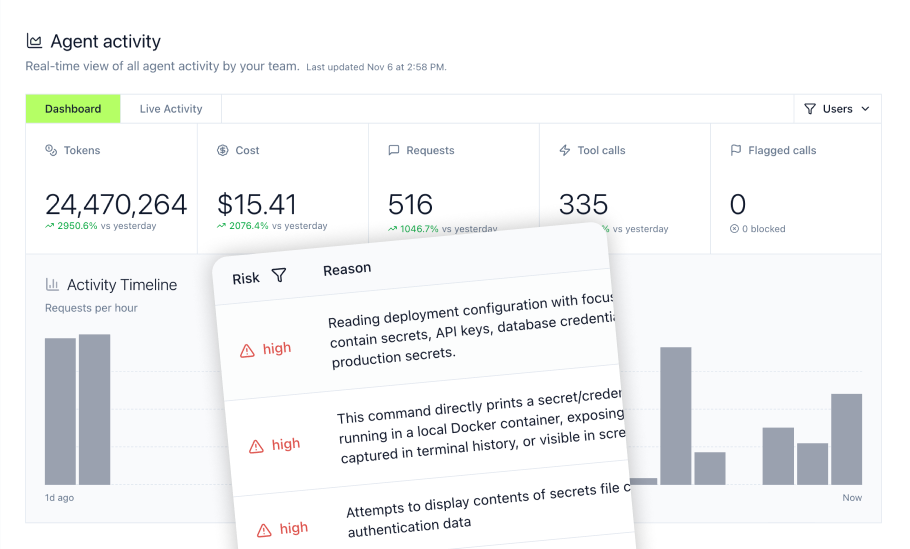
MintMCP's Agent Monitor provides real-time visibility into tool calls, commands, and file access from coding agents like Cursor and Claude Code. Security teams see which MCPs are installed, track usage patterns, and block dangerous commands in real-time.
Proactive Detection of Anomalies and Threats
Zenity's security checklist rates visibility into agent actions as "Critical" severity—without it, organizations cannot detect when agents access sensitive data or execute unauthorized operations. Their eight-point CISO framework prioritizes runtime visibility alongside network isolation and skill verification.
Integration with existing security operations workflows can improve alerting on suspicious patterns. Routing agent activity into existing security operations workflows can materially improve detection and investigation speed.
Safeguarding Sensitive Data: Preventing Risky AI Agent Actions
Coding agents operate with extensive system access—reading files, executing commands, accessing production systems through MCP tools. Without monitoring, organizations cannot see what agents access or control their actions.
Blocking Malicious or Accidental Commands
Repello AI's analysis found that prompt injection attacks often work by hiding malicious instructions in documents, emails, or web pages that agents process. The attack doesn't target the agent directly—it exploits the agent's trust in content it's asked to analyze.
Critical protections include:
- Dangerous command blocking: Prevent execution of
rm -rf, credential harvesting, or network scanning - Sensitive file protection: Block access to .env files, SSH keys, and credential stores
- Allowlist-based tool access: Enable only specific MCP tools required for the agent's function
- Human approval gates: Require confirmation before destructive operations execute
MintMCP's Agent Monitor implements these controls at the gateway level, blocking risky tool calls like reading environment secrets or executing dangerous commands before they reach the underlying system.
Granular Control Over File Operations
The DataCamp security guide recommends a tiered approach: Personal deployments can accept more risk; Enterprise deployments require isolated containers, gateway authentication, disabled shell execution, allowlist-based tool access, and firewall rules blocking unnecessary network egress.
For teams connecting AI agents to data warehouses, MintMCP's Snowflake connector provides granular tool access control—enabling read operations while excluding write tools based on role.
Seamless Integration and Deployment: Accelerating Enterprise AI Adoption
The speed difference between secure and insecure deployment determines whether governance enables or blocks AI adoption. Organizations that make secure deployment frictionless see higher compliance rates than those that create barriers.
Deploying AI Agents in Minutes, Not Days
Entity establishment for AI agent governance traditionally requires:
- Identity provider integration (SAML, OAuth, SSO)
- Secrets management migration (HashiCorp Vault, AWS Secrets Manager)
- Container orchestration setup (Docker, Kubernetes)
- SIEM integration for logging
- Policy engine configuration
For many teams, this process can become slow and operationally heavy when done manually. MintMCP Gateway simplifies this process through one-click deployment that adds hosting, authentication, audit logging, and governance controls around existing MCP servers.
Enterprise-Grade Authentication for All AI Interactions
OAuth 2.0 and SAML integration ensures agents authenticate through existing identity providers. MintMCP supports shared and per-user authentication—flexibility to configure service accounts at the admin level or enable individual OAuth flows based on use case requirements.
For organizations evaluating MCP gateways, the decision criteria center on deployment speed, compliance coverage, and integration with existing security infrastructure.
Beyond Security: Driving Productivity with Governed AI Agents
Security controls that block productivity fail. The goal isn't preventing AI agent use—it's enabling safe use that amplifies employee capabilities while maintaining organizational control.
Unlocking Business Value with Secure AI
Governed AI agents deliver measurable productivity gains:
- Data analysis: AI agents query databases, generate reports, and answer business questions using real-time data
- Customer support: Agents access CRM data and support ticket history to provide faster, more accurate responses
- Development workflows: Coding assistants connect to repositories and CI/CD systems securely
Identity Automation's framework treats AI agents like new employees—each requires identity provisioning, role assignment, access reviews, and offboarding procedures. Organizations that implement this framework report that governance enables rather than restricts AI adoption.
Empowering Employees with Safe AI Tools
MintMCP's mission reflects this balance: "AI tools should be accessible to everyone in an organization, not just engineers." The MCP Gateway handles authentication, permissions, and audit trails so business users can leverage AI capabilities without becoming security risks.
The Future of Enterprise AI: OpenClaw as a Strategic Turning Point
OpenClaw isn't an isolated incident—it's the first mass-adoption test of autonomous AI agents in enterprise environments. The governance frameworks organizations build now will determine their ability to safely adopt whatever agentic AI systems emerge next.
Setting the Standard for AI Agent Governance
The regulatory environment is responding. CISA, Gartner, and institutional investors have concluded that agentic AI requires the same governance rigor as privileged access management systems. Organizations without formal AI governance frameworks face increasing scrutiny from auditors, regulators, and boards.
Preparing Your Enterprise for the Evolving AI Landscape
For many organizations, economics can still favor proactive governance. Avoiding even a single major security incident can justify meaningful investment in governance and control layers. Organizations that build these capabilities now—with platforms like MintMCP—position themselves to capture AI productivity benefits while reducing operational and security risk.
For teams ready to implement enterprise AI governance, the MintMCP whitepaper provides a three-phase implementation roadmap with metrics for measuring success.
Why MintMCP Gateway Is the Right Choice for Enterprise AI Security
Organizations evaluating AI agent governance platforms need a solution that balances security rigor with deployment speed. MintMCP Gateway is designed to help organizations govern MCP-based AI access with centralized authentication, auditability, and operational controls.
What sets MintMCP Gateway apart:
One-click STDIO server deployment means development teams can publish local MCP servers as enterprise-ready services quickly. Built-in OAuth/SSO integration, role-based access controls, and automated audit logging eliminate the custom infrastructure work that traditionally delays secure AI adoption. Security teams get centralized visibility and control; developers get frictionless deployment.
SOC 2 Type II attestation provides a stronger security and auditability baseline for regulated enterprise environments. Rather than spending months hardening open-source frameworks, teams can adopt enterprise-grade security controls without building every layer themselves. Detailed audit logs capture tool invocations, file access, command execution, access requests, and configuration changes
Real-time monitoring and blocking of dangerous operations is handled through MintMCP’s agent monitoring and guardrail layer. The Agent Monitor tracks every MCP tool call, bash command, and file operation, with configurable rules to prevent risky actions like reading environment secrets or executing destructive commands. Security teams see multi-step action sequences that indicate prompt injection attacks, not just individual HTTP requests.
Flexible authentication models support both shared service accounts and per-user OAuth flows, enabling governance frameworks that match organizational structure. Whether you need central admin control or distributed user-level access, MintMCP adapts to your deployment model.
The path from OpenClaw chaos to governed AI adoption doesn't require choosing between security and productivity. MintMCP Gateway delivers both—protecting the enterprise while enabling the AI-powered workflows that support secure AI adoption.
Frequently Asked Questions
What makes OpenClaw different from ChatGPT or other AI assistants?
Traditional AI assistants like ChatGPT respond to queries but don't take actions—they provide information that humans then act upon. OpenClaw and similar autonomous agents execute real-world operations: running shell commands, sending emails, modifying files, and accessing enterprise systems through integrated tools. This fundamental difference means security controls designed for chatbots (content filtering, prompt guardrails) provide insufficient protection. Agents require identity governance, permission management, and action monitoring—capabilities traditionally applied to human employees and privileged accounts.
Can we simply block OpenClaw at the network level?
Network blocking provides temporary relief but doesn't solve the underlying challenge. Employees seeking AI productivity tools will find alternatives—other agent frameworks, different network paths, or personal devices. More importantly, blocking treats the symptom rather than the cause. Organizations need governance frameworks that enable safe AI agent use, not policies that push adoption underground where it becomes truly invisible. The goal is transforming shadow AI into sanctioned AI through proper controls.
How do prompt injection attacks work against AI agents?
Prompt injection exploits the agent's trust in content it processes. Attackers embed hidden instructions in documents, emails, or web pages that the agent reads during normal operation. When the agent processes this content, it may execute the hidden instructions as if they were legitimate user commands. Unlike traditional malware that targets system vulnerabilities, prompt injection targets the AI's decision-making process. Defense requires input sanitization, output filtering, action sequence analysis to detect multi-step attacks, and human-in-the-loop approvals for sensitive operations.
What's the minimum viable security configuration for testing OpenClaw?
For isolated experimentation in non-production environments, DataCamp recommends binding the gateway to localhost only (127.0.0.1:18789), disabling ClawHub skill installation, using environment variables instead of plaintext credentials, and running inside Docker containers with non-root execution. This configuration prevents network exposure while allowing evaluation of agent capabilities. Production deployments require significantly more hardening including OAuth authentication, audit logging, integration with security workflows, and formal governance policies.
How should we handle existing unauthorized OpenClaw installations?
Discovery should trigger incident response procedures, not routine IT cleanup. CrowdStrike's guidance recommends treating discovered instances as potential security incidents requiring investigation: What data did the agent access? What credentials were configured? What skills were installed? Organizations should deploy endpoint scanning, conduct credential rotation for any exposed secrets, and establish clear policies for sanctioned AI tool use going forward.