Every unmonitored Claude Cowork deployment represents a potential compliance gap, security vulnerability, and audit failure waiting to happen. Unlike traditional AI chatbots, Claude Cowork operates as an autonomous agent with local file access, optional browser-based workflows, and the ability to execute scheduled tasks, while MCP expands Claude's access to external tools and systems. For enterprises connecting Claude to internal data sources, the challenge isn't enabling AI productivity—it's establishing governance, security, and compliance controls that match the agent's expanding capabilities. Solutions like MintMCP Gateway provide the centralized governance infrastructure enterprises need to transform local MCP connections into production-ready, compliant deployments.
Key Takeaways
- Claude Cowork can be granted direct read/write access to local files, and Anthropic supports workplace connectors including Google Workspace, Microsoft 365, GitHub, and Slack
- Anthropic says its current Claude-in-Chrome configuration reduces prompt-injection attack success rates to approximately 1% in internal testing, though the risk remains non-zero for enterprise use cases
- Team pricing starts at $25/user/month billed monthly or $20/user/month billed annually for Standard seats; advanced controls such as SSO, SCIM, audit logs, and the Compliance API are available on Enterprise plans
- Critical gap: Cowork activity excluded from Audit Logs and Compliance API even at Enterprise tier—OpenTelemetry provides partial visibility
- Regulated industry deployments often require additional security, compliance, and implementation work beyond base software pricing, especially when external advisors or systems integrators are involved
- Recent vulnerabilities in Anthropic's broader agent tooling—most notably CVE-2025-59536 and CVE-2026-21852 affecting Claude Code—illustrate how agentic products with local execution and project-level trust flows can introduce RCE and credential-exposure risk if not governed carefully
Bridging Claude and Your Enterprise Data with MCP Gateway
What Enterprise MCP Integration Requires
Claude Cowork connects to enterprise systems through the Model Context Protocol—an open standard for AI-to-tool communication supported by Anthropic, OpenAI, Google, and Microsoft. The protocol enables Claude to query databases, read documents, send emails, and execute workflows across connected applications.
The challenge: while many MCP deployments still begin as local developer setups, enterprises increasingly need remote, governed MCP services with centralized authentication, credential management, and access controls.
Core Deployment Requirements
Before enabling Claude Cowork for production data access, enterprises must establish:
- Identity foundation: SAML 2.0 or OIDC SSO with domain verification and SCIM for automated user lifecycle management
- Tenant restrictions: HTTP header injection via network proxy to block personal Claude accounts on corporate networks
- Data protection baseline: Full-disk encryption (FileVault/BitLocker) on all endpoints running Cowork
- Network egress controls: Restrict Cowork’s network egress to approved domains where possible, and account separately for the fact that Anthropic’s web search tool is not governed by those same egress controls
Ensuring Secure and Governed Claude Access
Three security postures define how enterprises should approach Cowork deployment:
Lockdown posture is appropriate for regulated industries awaiting production features. In this mode, Cowork access is disabled entirely, the Chrome extension is blocked, and no user-managed MCP servers are permitted.
Controlled posture fits most enterprises seeking balanced guardrails. Cowork access remains enabled, the Chrome extension is restricted to a strict allowlist of 5–10 approved domains, and MCP servers are managed via organizational allowlist deployed through MDM. In practice, that usually means pairing Cowork with a governance layer such as MintMCP Gateway so MCP access, observability, and policy enforcement are centralized before broader rollout.
Open posture suits innovation teams and low-sensitivity workloads. Cowork access is fully enabled, the Chrome extension uses a blocklist-only approach, and users may add MCP servers to an organizational allowlist following review processes.
Compliance and Auditability Constraints for Claude Workflows
The Audit Trail Gap
Here's the critical compliance challenge: Cowork activity excluded from Anthropic's Audit Logs, Compliance API, and Data Exports even at the Enterprise tier. Local conversation history exists on endpoints, but centralized audit trails required for many regulated or audit-sensitive workflows remain unavailable through native Anthropic features.
This gap creates specific compliance risks:
- No centralized logging of Claude's file access, tool invocations, or data queries
- No request history for demonstrating governance to auditors
- Limited visibility into what data Claude accessed and when
Compensating Controls for Compliance
Organizations requiring audit trails typically need a compensating governance layer around Cowork. MintMCP is one option for centralizing tool-level auditability, access controls, and monitoring where native Cowork logging is incomplete.
Additional compensating controls include:
OpenTelemetry Integration: Enable OpenTelemetry monitoring in Organization Settings to capture tool call data, token usage, and session information. Route telemetry to your SIEM for centralized analysis.
Zero Data Retention Addendum: For Enterprise customers, Anthropic offers ZDR agreements through their Trust Center to minimize data retention for sensitive workloads.
Data Residency and Regional Controls
Organizations with strict data residency requirements should validate Anthropic's current regional and retention controls directly with Anthropic's Trust Center and commercial terms, and evaluate whether an API deployment on infrastructure such as Bedrock, Vertex AI, or Azure best fits their regional control requirements.
For healthcare and other regulated environments, Anthropic offers HIPAA-ready Enterprise options for eligible deployments, but Cowork itself is not recommended for regulated workloads because its activity is not captured in Audit Logs, the Compliance API, or Data Exports.
Monitoring and Securing Claude's AI Agent Tool Calls
Why Agent Monitoring Matters
Claude Cowork's power comes from its ability to execute multi-step workflows across local file systems and connected applications. That same capability creates security risks when agents can read sensitive files, execute bash commands, and access production systems through MCP tools.
Without monitoring, organizations face:
- Zero visibility into what files agents access
- No controls over bash command execution
- Undetected data exfiltration through agent actions
- Persistent attack vectors via compromised scheduled tasks
Implementing Agent Observability
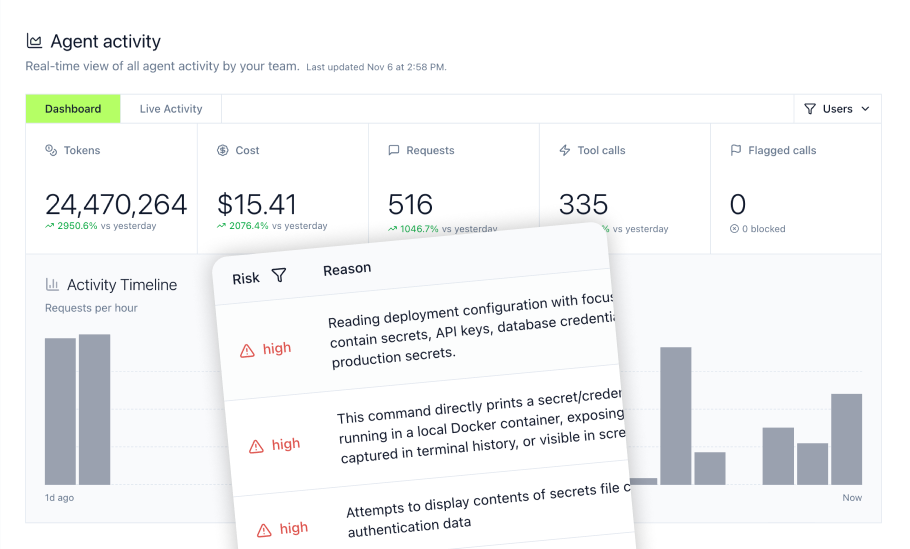
The MintMCP LLM Proxy sits between your LLM client and the model itself, forwarding and monitoring every request. This provides the observability layer that native Cowork deployments lack.
Core monitoring capabilities include:
- Tool call tracking: Monitor every MCP tool invocation, bash command, and file operation from coding agents
- MCP inventory: Complete visibility into installed MCPs, their permissions, and usage patterns across teams
- Command history: Complete audit trail of every bash command and file access for security review
- Security guardrails: Block dangerous commands and restrict file access in real-time
Detecting and Preventing Risky Agent Actions
Configure your monitoring layer to alert on high-risk patterns:
- Off-hours activity: Scheduled tasks running outside business hours
- Unusual token spikes: Anomalous usage indicating potential prompt injection
- Unexpected connector usage: Data access patterns that deviate from approved workflows
- Sensitive file access: Attempts to read .env files, SSH keys, or credential stores
Set the OTEL_LOG_USER_PROMPTS=1 flag to capture prompt content in telemetry—essential for investigating security incidents. Filter the tool_parameters field before SIEM ingestion to avoid exposing secrets embedded in bash commands.
Granular Access Control for Claude Using Enterprise SSO
Identity as the Foundation
Without proper identity controls, users can bypass organizational governance by switching to personal Claude accounts on the same device. Security practitioners report this as the number one evasion technique—making tenant restrictions mandatory for true governance.
Implementing Enterprise Authentication
Enterprise-tier Claude deployments support:
- SAML 2.0 and OIDC SSO: Connect Claude to your existing identity provider (Okta, Azure AD, etc.)
- DNS domain verification: Validate ownership of your email domain for managed workspaces
- Domain capture: Route all corporate email users to the managed organization automatically
- SCIM provisioning: Automate user lifecycle management—onboarding, role changes, and offboarding
Tenant Restrictions Block Shadow AI
Configure your network proxy to inject the anthropic-allowed-org-ids HTTP header, blocking personal Claude accounts from corporate networks entirely. Users attempting to sign in with personal accounts receive a tenant_restriction_violation error.
This control is critical because personal accounts have:
- No admin visibility or controls
- No audit logging
- No compliance features
- Full access to Chrome extension and all capabilities
Enabling Claude for Secure Data Analysis with Snowflake
Connecting Claude to Your Data Warehouse
The Snowflake MCP Server enables Claude to query your data warehouse for analytics, reporting, and business intelligence—with enterprise governance controls.
Available tools include:
- cortex_agent: Combine structured and unstructured data querying with custom tools
- cortex_analyst: Natural language to SQL conversion using semantic models
- run_snowflake_query: Execute SQL queries with support for DML and DDL operations
- query_semantic_view: Query semantic views using dimensions, metrics, and facts
Use Cases by Team
Finance teams: Automate financial reporting, variance analysis, and forecasting with AI agents accessing Snowflake financial data models
Product management: Enable AI-driven product analytics and user behavior analysis directly from data warehouses
Executive teams: Generate real-time business intelligence dashboards and strategic insights without SQL expertise
Controlled SQL Execution
Configure Snowflake access with principle of least privilege:
- Read-only access by default—enable write operations only for approved use cases
- Scope queries to specific schemas and tables containing non-sensitive data
- Implement row-level security policies that apply to AI agent queries
- Monitor query patterns through OpenTelemetry for anomaly detection
Building AI-Powered Knowledge Bases for Claude with Elasticsearch
Enterprise Search Integration
The Elasticsearch MCP Server connects Claude to your enterprise search infrastructure, enabling AI-powered knowledge base queries, support ticket analysis, and log analysis.
Core capabilities include:
- search: Perform Elasticsearch searches using query DSL for flexible document retrieval
- esql: Execute ES|QL queries for advanced data analysis
- list_indices: List all available indices in your cluster
- get_mappings: Retrieve field mappings for specific indices
Practical Applications
HR teams: Build AI-accessible knowledge bases from company documentation, policies, and training materials for instant employee assistance
Support teams: Search historical support tickets and resolution patterns for faster customer issue resolution
Product teams: Enable AI-powered documentation search and contextual help systems using product knowledge bases
Security Considerations for Search Access
Elasticsearch contains aggregated enterprise knowledge—making access controls critical:
- Index-level permissions restrict Claude to approved knowledge bases only
- Field-level security hides sensitive attributes (PII, internal codes) from AI queries
- Query audit logging tracks all search activity for compliance review
- Rate limiting prevents bulk data extraction through repeated queries
Automating Customer Communications with Claude and Gmail
Email Integration for AI Agents
The Gmail MCP Server enables Claude to search, draft, and send emails within approved workflows—with full security oversight.
Available tools:
- search_email: Search Gmail messages using advanced query syntax
- get_email: Retrieve complete email content including metadata
- draft_email: Create Markdown-formatted email drafts
- draft_reply: Generate replies within existing threads
- send_draft: Dispatch prepared drafts through controlled command flow
Customer Support Automation
Claude can handle AI-driven customer response automation:
- Search incoming support emails and categorize by urgency
- Draft templated responses for common inquiries
- Escalate complex issues to human agents with context summaries
- Track response patterns for process improvement
Write-Access Governance
Email write-access represents high-risk capability requiring strict controls:
- Human-in-the-loop approval: Require manual review before sending external communications
- Draft-only mode: Claude creates drafts; humans review and send
- Recipient restrictions: Limit send capability to internal addresses or approved domains
- Content filtering: Block drafts containing sensitive data patterns (SSN, credit cards, medical information)
All MCP connectors use OAuth 2.0 with scoped permissions, but prompt injection attacks can manipulate Claude into exfiltrating data from connected systems. Grant read-only access unless write capability is explicitly required and approved.
Cost Control and Usage Analytics for Claude Deployments
Understanding the True Cost
Claude Cowork's pricing appears straightforward—Team plans start at $25/user/month billed monthly or $20/user/month billed annually for Standard seats—but total cost of ownership includes significant hidden components.
For a 50-user Team deployment on annual billing, expect approximately $12,000–$15,000/year in base subscription costs. Enterprise plans add features such as SSO, SCIM, audit logs, custom retention controls, and broader admin controls. Anthropic currently lists a self-serve Enterprise option at $20 per seat/month billed annually, with usage billed separately, while sales-assisted deployments use tailored commercial terms.
Additional costs include MCP connector subscriptions for specialized data sources, OpenTelemetry SIEM integration for monitoring infrastructure, one-time governance framework development, and ongoing security operations.
For regulated industries, implementation partners such as PwC can provide structured rollout and Responsible AI support, but total services cost depends on scope, controls, and integration complexity.
Measuring ROI
Enterprises report meaningful productivity gains from agentic AI deployments, but the size of the impact varies by workflow, controls, and rollout maturity. A conservative 5–10% productivity gain across 50 knowledge workers delivers $375,000–$750,000 in annual value—achieving break-even within months even with substantial governance investments.
Usage Tracking Infrastructure
Implement real-time usage tracking to optimize spend:
- Per-user token consumption: Identify heavy users and optimize prompting strategies
- Team-level cost allocation: Charge back AI costs to appropriate departments
- Tool call frequency: Track which MCP connectors deliver value versus sit idle
- Peak usage patterns: Right-size capacity and identify training opportunities
Why MintMCP Delivers Enterprise-Ready Claude Governance
Native Claude Cowork deployments lack the governance infrastructure enterprises require. The audit gap, limited per-user controls, and complexity of managing distributed MCP servers create barriers for production deployment—especially in regulated industries.
MintMCP addresses these gaps with purpose-built enterprise MCP infrastructure that transforms experimental AI capabilities into production-grade systems. Organizations can deploy MintMCP with STDIO servers on the managed service or integrate existing remote servers they've already deployed.
Centralized MCP Management: The MCP Gateway transforms scattered local MCP setups into production-ready services with one-click deployment, OAuth protection, and enterprise monitoring. Teams consuming AI capabilities face no infrastructure overhead while IT maintains complete visibility and control.
Complete Audit Trails: Where native Cowork excludes activity from Compliance APIs, MintMCP provides audit observability required for SOC 2, GDPR, and regulated industry frameworks—tracking every tool call, data access, and agent action with immutable logs.
Real-Time Security Controls: The LLM Proxy monitors every MCP tool invocation and bash command, blocking risky operations before they execute. Protect sensitive files, prevent credential exfiltration, and maintain complete visibility into agent behavior without disrupting developer workflows.
Pre-Built Enterprise Connectors: Deploy governed connections to Snowflake, Elasticsearch, Gmail, and other enterprise systems with built-in authentication, access controls, and compliance features—no custom integration development required.
For organizations deploying Claude Cowork at scale, MintMCP provides the missing governance layer that native deployments lack. Deploy in minutes, not months. Book a demo to see MintMCP's Claude governance capabilities in action.
Frequently Asked Questions
How does MintMCP secure Claude's access to sensitive enterprise data?
MintMCP Gateway wraps all MCP connections with OAuth-based authentication and role-based access controls. Rather than granting Claude direct access to data sources, MintMCP enforces authentication through your existing identity provider, applies granular tool-level permissions, and logs every data access for audit review. Virtual MCP servers expose only minimum required tools—not entire MCP servers—implementing the principle of least privilege at the protocol level.
Can MintMCP help my organization meet compliance requirements for Claude usage?
Yes. MintMCP is SOC 2 Type II compliant and provides the audit trail and governance infrastructure that native Cowork deployments lack. Complete logs capture tool calls, data access, and agent actions, helping organizations implement compensating controls and support broader compliance programs. For organizations where Cowork's exclusion from Anthropic's Compliance API creates audit gaps, MintMCP's observability layer provides the compensating controls auditors require.
What kind of monitoring does MintMCP offer for Claude's agent activities?
The LLM Proxy tracks every MCP tool invocation, bash command, and file operation from Claude agents. Real-time dashboards show server health, usage patterns, and security alerts. Organizations can configure blocking rules for dangerous commands, protect sensitive files from access, and receive alerts for anomalous activity patterns—all without requiring changes to developer workflows.
How does MintMCP integrate Claude with existing enterprise authentication systems?
MintMCP supports OAuth 2.0, SAML, and SSO integration with your existing identity provider. When users connect to MCP servers through MintMCP Gateway, authentication flows through your enterprise SSO—eliminating separate credential management. SCIM integration enables automated user provisioning, ensuring access controls stay synchronized with your HR systems.
Can Claude access internal databases like Snowflake or Elasticsearch through MintMCP?
MintMCP provides pre-built connectors for Snowflake, Elasticsearch, and other enterprise systems. These connectors include built-in authentication, access controls, and audit logging—enabling Claude to query your data sources without exposing raw credentials or bypassing governance policies. Configure read-only access by default, scope queries to approved schemas, and monitor all data access through centralized dashboards.
Does MintMCP provide cost and usage analytics for Claude deployments?
MintMCP tracks real-time usage across all AI tool interactions, including Claude. Cost analytics break down spending by team, project, and tool—enabling accurate chargeback and optimization. Performance metrics capture response times, error rates, and usage patterns to identify training opportunities and right-size capacity. Organizations gain the visibility needed to demonstrate AI ROI and control costs as usage scales.