OpenClaw has emerged as one of the most talked-about open-source AI agent frameworks of 2026. This autonomous agent harness runs on your own infrastructure, connecting to messaging platforms like WhatsApp, Telegram, and Slack while executing real business tasks. Yet this rapid adoption has exposed a critical gap: OpenClaw's capability far outpaces its built-in governance controls. For enterprises that need audit trails, credential isolation, and policy enforcement alongside agent autonomy, pairing OpenClaw with an MCP Gateway provides the governed data access layer that open-source frameworks lack.
This guide covers what OpenClaw is, how it works, where it excels, and how to address the security and compliance gaps that prevent most enterprises from running it in production without additional governance infrastructure.
Key Takeaways
- OpenClaw is a free, open-source AI agent framework that runs autonomously on your infrastructure, supporting 20+ messaging channels and multiple AI providers including Claude, GPT-5, and local models via Ollama
- The broader agent-skills ecosystem has significant security challenges: Snyk research found that 1,467 of 3,984 scanned skills had at least one security issue, including 76 confirmed malicious payloads
- OpenClaw's SECURITY.md treats prompt-injection-only reports as out of scope unless they demonstrate an authentication, approval, policy, allowlist, sandbox, or other trust-boundary bypass
- Skills and plugins can inherit broad agent permissions, so production deployments should use SecretRefs, sandboxing, restrictive tool policies, and additional governance where required
- MCP Gateway provides centralized authentication, tool-level access control, credential management with automatic rotation, and comprehensive logging for every agent action in enterprise environments
Understanding OpenClaw: An Overview of Open-Source AI Agents
OpenClaw transforms large language models into autonomous personal assistants that operate continuously on your hardware. Unlike traditional chatbots that wait for prompts, OpenClaw runs proactively through scheduled tasks, persistent memory, and deep integrations with existing tools.
Core Architecture Components
- Multi-channel gateway supporting WhatsApp, Telegram, Slack, Discord, Microsoft Teams, Signal, iMessage, Matrix, and additional platforms
- Heartbeat daemon that wakes on schedule to monitor dashboards, triage alerts, and execute cron jobs without human prompts
- Persistent memory system using local storage with context compaction that remembers interactions across weeks or months
- Skills ecosystem with 1,700+ community skills via ClawHub for web search, file management, API integrations, and browser automation
- Model-agnostic runtime supporting Anthropic Claude, OpenAI GPT, Google Gemini, DeepSeek, Llama, and local models
The framework operates as persistent infrastructure rather than a reactive tool. The guided setup requires Node.js 22.22.3+, 24.15+, or 25.9+, with Node 24 recommended, plus credentials for the chosen model provider. OpenClaw is available under the MIT license, while model, hosting, and infrastructure costs vary by provider and workload.
The Challenge with Open-Source AI Agents: Bridging the Enterprise Gap
OpenClaw's rapid adoption reveals why open-source agent frameworks struggle in enterprise environments. The same architectural choices that enable autonomous operation create security and compliance obstacles that enterprises cannot accept.
Security Risks in AI Coding Agents
OpenClaw's CVE-2026-25253 allowed a crafted link to disclose a Gateway token and potentially lead to remote code execution in versions before 2026.1.29. Version 2026.1.29 patched the issue. The framework's SECURITY.md treats prompt-injection-only reports as out of scope unless they demonstrate an authentication, approval, policy, allowlist, sandbox, or other documented trust-boundary bypass.
The skill ecosystem compounds these risks. Snyk found that 1,467 of 3,984 scanned skills had at least one security issue, including 76 confirmed malicious payloads. ClawHub now uses automated security audits, upload gates, user reports, and moderator action, but these controls do not guarantee that every release is safe.
Critical security considerations:
- Sandboxing is available but must be configured appropriately for the deployment
- Skills and plugins can inherit broad agent permissions
- OpenClaw includes local logs and security audits, but these are not equivalent to centralized, immutable, per-user compliance records
- Native enterprise DLP and organization-wide policy enforcement may require additional infrastructure
- ClawHub security audits reduce risk but do not guarantee that every release is safe
Compliance Challenges with Open-Source AI
Out of the box, OpenClaw does not provide a centralized enterprise compliance program. It includes local security controls, logs, audits, and usage visibility, but regulated deployments may still require organization-wide identity, policy enforcement, DLP, audit retention, and compliance validation. Enterprises in healthcare, finance, and defense cannot deploy the framework without substantial hardening investment.
MintMCP's MCP Gateway addresses these gaps through centralized authentication, tool-level access control, credential management with rotation and revocation workflows, and comprehensive logging for every agent action. The Bundle architecture packages tool access, policy enforcement, and audit logging into single governance units per team or role, solving the configuration complexity that plagues manual compliance setups.
How OpenClaw Enhances Governance and Security for AI Agents
While OpenClaw itself provides minimal governance, the framework can integrate with external governance layers to achieve enterprise-grade controls. The key is understanding where OpenClaw's responsibility ends and where additional infrastructure must begin.
The Bundle Approach to Agent Governance
Rather than requiring manual configuration of separate access rules, credential objects, and plugin permissions, modern governance platforms use bundled abstractions. MintMCP's Virtual MCP Bundles tie SCIM group membership to curated MCP server lists, custom policy rules, and isolated audit trails in a single deployable unit.
Bundle governance capabilities:
- SCIM-driven directory group synchronization and group-based access
- Admin approval options for newly added upstream tools
- Separate organization-level administrative roles and Virtual MCP access policies
- Per-agent credentials that can be rotated or revoked independently of human users
DLP Integration for Enterprise Deployments
Custom policy code execution on every tool call enables inline DLP integration. MintMCP supports connections to Bedrock Guardrails, GCP DLP, Microsoft Purview, Nightfall, and Skyflow for pre- and post-processing inspection. This allows enterprises to block, flag, or mask sensitive data before it reaches the LLM or exits to external systems.
The middleware layer runs in a JS sandbox with allowed-domains fetch, secret injection, and built-in templates for OpenAI moderation and jailbreak detection. Organizations with existing security tool investments can integrate their current DLP pipelines without rebuilding from scratch.
Ensuring Observability and Compliance with Open-Source AI Deployments
Governance requires visibility. OpenClaw includes local logs, diagnostics, security audits, and usage visibility, but enterprises may still require centralized cross-user monitoring, long-term retention, and immutable audit exports.
Shadow AI Detection and Agent Monitoring
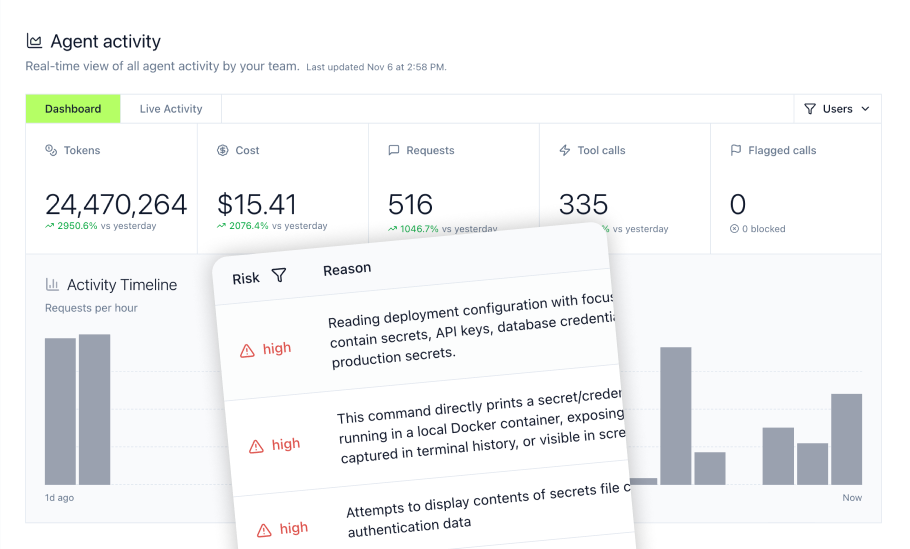
Agent Monitor provides real-time visibility into agent activity across an organization, including MCP calls made outside the gateway through hooks in Cursor and Claude Code. This addresses a fundamental gap: standard MCP specifications provide no visibility into off-gateway usage patterns.
Monitoring capabilities include:
- Detection of PII exposure and credential leakage (API keys, tokens)
- Identification of risky bash commands and prompt injection attempts
- Organization-level analytics on MCP adoption and usage patterns by team
- Latency monitoring and error tracking across all agent activity
- MDM integration for pushing detect-only or enforce-mode configurations
Compliance Documentation and Audit Trails
For enterprises requiring compliance attestation, OpenClaw deployments need external audit infrastructure. Full conversation-level logging that captures prompts, tool calls, responses, and context with per-user attribution becomes essential for SOC 2, HIPAA, and other regulatory frameworks.
MintMCP is SOC 2 Type II audited and compliant with HIPAA standards, with continuous compliance monitoring. Customers handling protected health information can request HIPAA documentation, and MintMCP signs BAAs. This compliance layer, combined with encryption in transit and at rest, centralized access controls, and complete audit trails, can support an audit-ready OpenClaw deployment when configured appropriately.
OpenClaw Use Cases: Empowering Enterprise AI Automation
Despite governance challenges, OpenClaw delivers substantial value for specific automation scenarios. Understanding where the framework excels helps organizations deploy it appropriately.
Email and Communication Management
OpenClaw connects to Gmail, scans incoming messages, categorizes by urgency using LLM analysis, drafts replies for review, and unsubscribes from promotional lists automatically. OpenClaw can help users triage large inboxes, draft replies for review, and automate routine email workflows, although results depend on configuration, permissions, and inbox complexity.
Developer Workflow Automation
The framework enables developers to kick off test runs remotely via SSH, capture Sentry errors via webhook, resolve errors autonomously using code agents, and open PRs on GitHub, all triggered from text messages while away from their desks. Published demonstrations show agents completing multi-step development and deployment workflows, but these examples should not be treated as representative production benchmarks.
Customer Support Automation
Multi-agent Discord setups allow agents to monitor support channels, draft contextual responses from knowledge bases, route complex issues to humans, and update ticket boards automatically. Published case studies describe automating parts of outbound sales and CRM workflows, but they should not be treated as general headcount-replacement benchmarks.
Time Savings and ROI Indicators
Published case studies describe time savings, lower model costs, and faster prototyping, but the available examples are anecdotal rather than independent benchmarks. Organizations should measure outcomes against their own workloads, model choices, review requirements, and infrastructure costs.
For organizations wanting these productivity gains with enterprise governance, MintMCP's Agent Identities provide each deployed agent with its own persistent identity, scoped credentials, and permission boundaries independent of the creator's access level.
Integrating OpenClaw: Architecting a Seamless AI Agent Ecosystem
OpenClaw's integration ecosystem spans 20+ native channels and 1,700+ community skills, but enterprise deployments require careful architecture to maintain security while enabling connectivity.
Native Integration Capabilities
| Platform | Integration Type | Setup Difficulty |
|---|---|---|
| Gmail/Calendar | API (OAuth) | Easy |
| GitHub | API (PAT) | Easy |
| Slack | Bot Token + Socket Mode | Medium |
| Microsoft Teams | Azure Bot Service | Medium |
| Discord | Bot Token | Easy |
| Multi-device pairing | Easy | |
| Telegram | BotFather token | Very Easy |
Governance Layer Integration
When connecting OpenClaw to enterprise systems, the governance layer must sit between the agent and the data sources. MintMCP Gateway provides OAuth brokering for stdio and hosted servers, working around hosted-container redirect-URI limitations that would otherwise block secure authentication flows.
The gateway supports stdio and Streamable HTTP, plus legacy HTTP+SSE for backward compatibility, along with OAuth 2.x, bearer tokens, and headers. Clients connect through one SSO-fronted remote MCP endpoint regardless of upstream variety, simplifying the integration architecture while maintaining security boundaries.
n8n and Workflow Tool Integration
OpenClaw can trigger n8n workflows for deterministic automation pipelines, offloading non-AI tasks to reliable no-code workflows. This hybrid approach keeps the AI agent focused on decision-making while deterministic operations run through battle-tested automation platforms.
Key Technical Differentiators: Why OpenClaw Stands Out
OpenClaw's technical architecture enables capabilities that more restricted frameworks cannot match, though these same capabilities create the governance gaps enterprises must address.
Autonomous Operation Model
Unlike reactive chatbots, OpenClaw operates continuously through its heartbeat daemon. The agent wakes on schedule to monitor dashboards, triage alerts, execute cron jobs, and perform proactive tasks without human prompts. This makes it suitable for always-on automation rather than just interactive assistance.
Model-Agnostic Architecture
The framework supports multiple AI providers without vendor lock-in:
- Supported Anthropic Claude models
- Supported OpenAI GPT models
- Google Gemini
- DeepSeek
- Meta Llama (via Ollama for local deployment)
- Custom local models through Ollama integration
This flexibility allows organizations to optimize for cost, capability, or data sovereignty by selecting different models for different tasks.
Persistent Memory System
OpenClaw maintains context across sessions through Markdown-based memory files with context compaction. This enables multi-week projects where the agent remembers past decisions, user preferences, and project states, something session-based assistants cannot achieve.
However, this memory system lacks enterprise governance features teams need: scoped memory (private, team, org levels), version history, reviewability, and portability. For governed enterprise memory, platforms like MintMCP provide Git-like memory principles where memory is company-owned, versioned, and auditable rather than an opaque vendor blob.
Deploying OpenClaw with Production-Grade Governance
OpenClaw's extensibility and autonomous capabilities make it compelling for enterprise automation, but production deployment requires addressing the framework's governance gaps from day one. Organizations that attempt to retrofit security and compliance controls after agents are already accessing production data face significantly higher costs and operational risks.
The path forward involves layered architecture: OpenClaw handles extensibility, channel integration, and agent autonomy, while a governance platform provides authentication, authorization, audit trails, and policy enforcement. MintMCP's approach packages these governance primitives into deployable bundles that map to organizational structures, eliminating the manual configuration complexity that typically prevents teams from implementing proper controls.
For enterprises evaluating OpenClaw, the total cost of ownership includes not just the free framework and API costs, but the governance infrastructure required to make it enterprise-ready. This includes credential isolation to prevent agents from accessing resources beyond their intended scope, comprehensive audit logging for compliance investigations and security incident response, real-time monitoring for shadow AI detection and anomaly identification, and DLP integration to prevent sensitive data exposure through agent interactions.
MintMCP provides this governance layer as a unified platform, enabling organizations to gain OpenClaw's productivity benefits while maintaining the security posture and compliance documentation required for regulated industries. Teams can deploy agents with confidence, knowing every action is logged, every credential is scoped, and every policy is enforced consistently across the organization.
Frequently Asked Questions
Can OpenClaw run completely offline without any cloud dependencies?
Partly. OpenClaw can run model inference locally through Ollama and keep core processing on your own hardware. However, cloud messaging channels and external integrations still require network services. A truly air-gapped deployment would require locally hosted models, interfaces, and tools with no dependencies on services such as WhatsApp, Slack, Telegram, Gmail, or cloud APIs.
How does OpenClaw handle multi-agent coordination for complex workflows?
OpenClaw supports multi-agent routing with separate agent workspaces, channel bindings, isolated sessions, sub-agents, and configurable nesting for orchestrator patterns. Complex conflict resolution, shared-resource allocation, and organization-specific approval policies may still require additional configuration or custom development.
What happens to OpenClaw memory when the system restarts or crashes?
OpenClaw stores durable memory in local workspace files and indexes it per agent, so saved memory survives system restarts. An unexpected crash can still interrupt work currently in flight. For mission-critical workflows, organizations should back up the workspace and state directories and consider governance systems that provide version history, reviewability, audit trails, and recovery workflows.
How do I migrate from OpenClaw to an enterprise-governed agent platform?
Migration involves three phases. First, export your SOUL.md (personality/instructions) and MEMORY.md (context history) files as the baseline for the new platform's configuration. Second, audit your installed skills and map each to equivalent capabilities in the target platform, noting that custom skills may require redevelopment. Third, implement the governance layer for your existing integrations before cutting over, ensuring credentials are migrated to the new credential management system rather than remaining in OpenClaw's ungoverned storage. Migration time varies based on the number of agents, integrations, custom skills, credentials, and governance policies that must be transferred or rebuilt.
Does OpenClaw work with MCP-native AI tools like Claude Desktop or Cursor?
Yes. Current OpenClaw releases can expose Gateway-backed conversations through `openclaw mcp serve`, which starts a stdio MCP server for Claude Code and other MCP clients. Windows Hub also provides local MCP server mode for Claude Desktop, Claude Code, and Cursor. This native MCP support does not replace centralized enterprise governance, so organizations may still use platforms like MintMCP to apply consistent identity, permissions, monitoring, and audit controls.